Editorial Team
7 min read
Science Corporation’s Series D follows its European retinal-implant launch. Clinical results support improved central vision, but U.S. approval, eligible patients and commercial terms remain consequential questions for the startup, reportedly valued at $3.5 billion.
Science Corporation, a medical technology company developing retinal and brain interfaces, has raised $400 million to expand its PRIMA vision implant across Europe and prepare for a U.S. launch. The financing backs a product with clinical evidence of improved central vision, alongside a much earlier research program connecting engineered neurons to the brain.
The company said in its November 17 funding announcement that the Series D brings capital raised since its 2021 founding above $900 million. PRIMA launched commercially in Europe a few months earlier. The U.S. opportunity still depends on regulatory authorization through a pathway with specific patient-population, evidence and commercial rules.
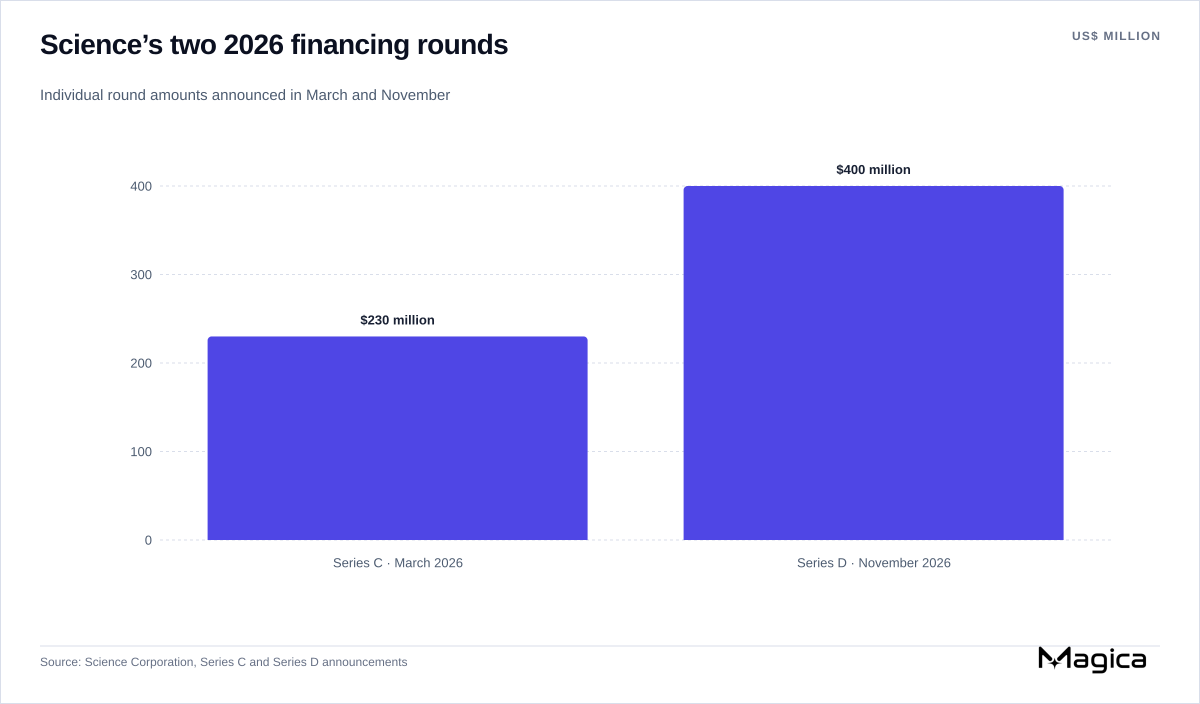
Company-reported financing rounds announced in 2026. Source: Science Corporation; chart: Magica. Source: Science Corporation — Series C.
Investors valued Science at $3.5 billion, according to a person familiar with the transaction cited in the financing report. Science’s announcement does not disclose a valuation, ownership terms or how it will divide the proceeds between commercialization and research.
Participants include Khosla Ventures, the Ackman Oxman Institute, Tenet Healthcare, 885 Capital, Y Combinator and PLC Neurotech. The round follows a $230 million Series C announced on March 5, when Science said total investment had reached approximately $490 million. Both rounds were presented as funding PRIMA commercialization and the wider research portfolio.
Science’s co-founder and chief executive, Max Hodak, co-founded fellow brain-interface company Neuralink in 2016 and served as its president for four years, according to the account of his earlier work. PRIMA’s development history extends beyond Science itself.
The implant was originally developed by Daniel Palanker, a Stanford University professor and ophthalmology researcher, according to Science’s account of the technology. Pixium Vision subsequently developed PRIMA, and Science acquired the implant in 2024. The financing therefore supports the commercialization of an acquired technology as well as Science’s own separate neural-interface research.
PRIMA combines a small photovoltaic chip beneath the retina, camera-equipped glasses and a pocket processor. The glasses project processed near-infrared images onto the chip, which converts light into electrical stimulation of surviving retinal cells. The aim is to replace the signaling function of lost photoreceptors in geographic atrophy, an advanced form of dry age-related macular degeneration that destroys central vision.
Science calls PRIMA the first CE-marked brain-computer interface to restore form vision—the ability to read letters, numbers and words—for patients blinded by certain late-stage macular degeneration. It is available in Germany, according to the financing report, and Science says the new money will broaden European access.
The relevant alternatives are not simply other brain-interface startups. The 2025 PRIMAvera clinical paper describes drugs such as pegcetacoplan and avacincaptad pegol as slowing geographic atrophy rather than restoring lost vision. Magnifiers and implantable telescopes help patients use surviving retina outside the damaged area. PRIMA instead stimulates cells within that area while allowing natural peripheral vision to remain available. The trial did not directly compare these options.
The system also requires surgery and rehabilitation in its use. The financing announcement commits money to research, manufacturing and operations but gives no production-capacity target, treatment price, reimbursement terms or commercial patient count. Those omissions leave the cost and pace of wider access unresolved. In September, Science promoted Darius Shahida from chief strategy officer to president to help lead its global commercial phase, according to the account of its commercial preparations.
Published in the New England Journal of Medicine on October 20, 2025, PRIMAvera was an open-label, single-group study at 17 sites in five European countries. It enrolled patients aged at least 60 with geographic atrophy in both eyes and profound vision loss in the study eye. Patients were compared with their own baseline; there was no randomized control group.
Of 38 implanted participants, 32 were assessed at 12 months. Three had died, one had withdrawn and two were unavailable for testing. Among those assessed, 26—81%, with a 95% confidence interval of 64% to 93%—met the primary improvement threshold: at least 10 additional letters on a standard eye chart, equivalent to 0.2 logMAR. A statistical analysis estimating the missing outcomes put the response rate across all 38 at 80%; that figure is an estimate, not 38 observed follow-up results.
With PRIMA glasses, the mean gain at one year was 24.5 letters. Patients could adjust brightness and use digital zoom from 1× to 12× during testing, so the results describe the combined implant-and-glasses system. Without the glasses, mean visual acuity was unchanged from baseline.
Home-use findings add a different measure of usefulness: 27 of 32 participants reported being able to read letters, numbers and words, and 22 reported medium-to-high satisfaction. Yet the Impact of Vision Impairment questionnaire showed no change in behavior. The authors cautioned that the study was not powered to detect that change and that the questionnaire might be insufficiently sensitive in this population.
Surgical risk was substantial enough to matter to patients’ decisions. There were 26 procedure- or device-related serious adverse events in 19 of the 38 participants through one year. Twenty-one occurred within two months of surgery, and 20 of those resolved within two months of onset. Four events were classified as severe. None was attributed to the device alone; all involved the procedure, either alone or with the device.
The authors also reported that mean retinal atrophy expanded by 8.5 square millimeters in implanted eyes versus 2.5 in eyes without an implant over one year, attributing the additional atrophy to surgery. Mean natural peripheral visual acuity remained equivalent to baseline. Science helped fund and design the study, and its staff participated in data analysis and manuscript preparation.
In its October 5, 2026 three-year follow-up announcement, Science reported a mean gain of 29 letters at 36 months and no new safety signal between months 12 and 36. The company also reported three serious adverse events after month 12, none attributed to the device alone. Only 18 patients were evaluable for efficacy and 27 for safety at three years, from the original 38 implanted. The smaller follow-up group limits any inference that the higher average proves improvement across the original cohort. These are company-reported conference results, distinct from the published one-year paper.
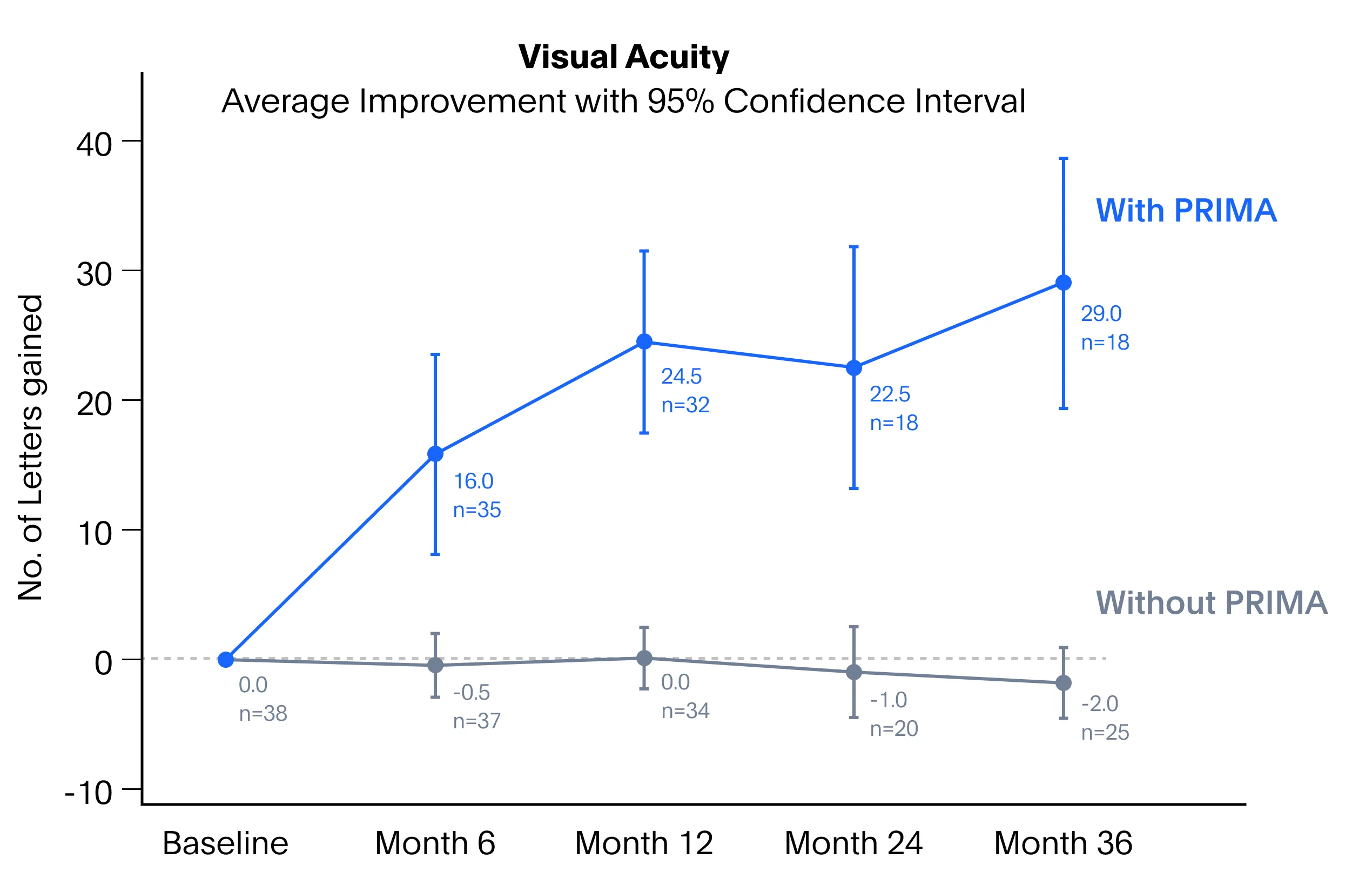
Company-reported PRIMA results through 36 months. Efficacy follow-up fell from 32 patients at one year to 18 at three years, limiting comparisons. “Without PRIMA” means testing without its glasses, not a randomized control group. Source: Science Corporation. Source: Science Corporation — 36-month PRIMA results.
Science says the financing will also fund substantial further investment in its biohybrid program, which integrates engineered neurons with the brain’s own circuits. Unlike PRIMA’s retinal implant, the sensor combines cultured neurons with silicon to connect directly to the brain.
The financing report says Science is designing initial human trials with Murat Günel, a Yale neurosurgery professor. That work remains at a different development stage from PRIMA’s European commercial rollout. Hodak has also announced PRIMA testing for Stargardt disease, another cause of blindness, according to the financing report. Those trials do not establish the same indication or performance as the geographic-atrophy study.
Science says it is pursuing PRIMA authorization through the U.S. Food and Drug Administration’s Humanitarian Device Exemption pathway. The financing report describes its qualifying population as patients with advanced macular degeneration in both eyes. A breakthrough designation previously granted to PRIMA, reported in the device-development account, does not itself authorize U.S. sales.
The FDA’s rules define a humanitarian use device as intended for a condition affecting or manifesting in no more than 8,000 people in the United States annually. An HDE is a marketing application exempt from the usual statutory effectiveness requirements and subject to profit and use restrictions. The agency allows for-profit sales only when specified eligibility conditions are met, and then limits the annual number of devices that may be sold for profit. The pathway is therefore consequential to both patient selection and commercial terms; the general rules do not establish which terms FDA will grant PRIMA.
The next decision is whether FDA authorizes PRIMA and, if so, for which patients and under what conditions. Beyond that, treatment pricing, reimbursement and the capacity to deliver surgery and rehabilitation will determine how widely the European launch and any U.S. approval translate into access. The $400 million finances that effort, but the round itself supplies no answers to those deployment questions.
Microsoft is pitching Copilot Workspaces as a shared environment for people and AI agents. Team collaboration is already in early access, but personal Autopilot integration is still coming soon, with final agent pricing unannounced.
Google is rolling out file references and sharing for Gemini skills as adult personal accounts lose the ability to use Gems. Automatic conversion preserves supported material, but file limits and missing tools can interrupt existing workflows.
Muddy Waters disclosed a short position in Nvidia while questioning a possible connection involving senior adviser Ajay K. Puri. Its own account leaves the key identity question unanswered, separating its new claims from an existing server-diversion prosecution.
Nvidia reported $115.8 billion in quarterly revenue in its first earnings release since co-founder Jensen Huang resigned. Strong demand gives interim CEO Colette Kress a financial cushion, while a campaign for Huang’s return collides with unresolved investigations and the board’s reported opposition.
OpenAI launched GPT-6.2 Astra and Sol for professional work, cutting Astra’s standard input and output token prices by 20%. The models offer cheaper paths through selected tasks, but research evaluations, reporting failures and unfinished independent safeguard testing complicate the case for broader autonomy.
Microsoft’s first live speech-to-speech model offers OpenAI API compatibility and planned enterprise integrations. Its published evaluations show a low-cost option, with several rivals completing more agentic tasks.
Canberra-based Trellis Data is offering its 220-billion-parameter Agentaus 1 model to business and government. Its pitch goes beyond keeping data in Australia, but performance, deployment costs and a planned capital raising remain key tests.
Perplexity is adding direct collaboration between frontier models to Computer, letting a lead agent coordinate up to 16 supporting agents. Company-reported benchmarks suggest mixed teams can outperform repeated copies of one model, but leave customer costs and production reliability unresolved.
Marsh reported 105 client cyber incidents in the last two weeks of October, against 48 in the final two weeks of May. The broker links the increase partly to AI, while warning that insurance panel access may not guarantee an available response team.
Meta’s Muse personal AI agent has launched in Australia, with some local shopping and booking connections to follow. Its browser and payment tools broaden its reach, while the company’s technical disclosures qualify its privacy promises.
Microsoft and Salesforce are extending their sales software alliance with Copilotforce, combining CRM workflows with Microsoft 365 context under existing permissions. The Copilot plugin enters public preview, while Teams remains in pilot; earlier Microsoft tools and a Claude beta raise the bar for proving its value.
Microsoft expands MAI Image 2.7 from an editing preview into image generation and API access, with cheaper Flash pricing and a Canvas workspace. Benchmark claims depend on the workload, while the MAI Labs interface carries restrictions on commercial use.
OpenAI is widening applications for its legal AI configuration after improving research scores and expanding its search index. Access still requires approval, and benchmark results show substantial limits alongside the gains.
Microsoft has made Word, Excel and PowerPoint creation generally available inside Copilot, combining editable files with workplace permissions and collaboration. The broader shift toward autonomous work remains staggered across previews, while its claimed cost advantage rests on company-funded testing.
Knit Health’s NEA-led Series A funds deployment of Med-BEAM for care navigation and hospital operations. Its early company benchmark beats three Claude models at predicting clinical actions, while better patient outcomes remain unproven by that test.
Google will let Gemini users save conversations while opting out of generative AI training on future chats. The global rollout also extends storage of history-off and temporary chats from 72 hours to around two months; human review and longer retention can still apply.
Google is removing the subscription requirement for Gemini’s task mode in six countries, while adding U.S. payment, calling and messaging features. The expansion broadens access to delegated work, but usage limits, permissions and website compatibility still govern what it can finish.
Eligible Pixel owners can join a Play Store beta to generate home-screen widgets from descriptions, but device, language and regional restrictions still apply.
Microsoft’s new in-house coding models compete with outside suppliers inside GitHub Copilot. Company tests show lower task costs at promotional prices, while its continuing financial ties to OpenAI complicate the rivalry.
Valkryn disclosed a $15 million seed round and early military testing contracts. Its evaluator-focused Battle Lab faces existing commercial tools, public testing capabilities and funding constraints that software alone cannot resolve.