Editorial Team
6 min read
Muddy Waters disclosed a short position in Nvidia while questioning a possible connection involving senior adviser Ajay K. Puri. Its own account leaves the key identity question unanswered, separating its new claims from an existing server-diversion prosecution.
Muddy Waters Research, a securities research publisher that finances investigations through investment positions, disclosed a short position in Nvidia on Tuesday, November 17. It paired the bet against the AI computing supplier with an unresolved question about a possible connection between a former senior Nvidia executive and a former Super Micro Computer executive.
Muddy Waters, which is under common control with investment adviser Muddy Waters Capital, announced the position in its research notice. A separate news dispatch records that announcement but adds no evidence resolving the executive connection.
A short position gives the firm a financial interest in a decline in Nvidia’s securities. Its published terms also say it intends to begin covering a substantial majority of its shorts upon publication and may subsequently be short, long or hold no position. The announcement therefore does not establish how large a position remains outstanding after publication.
The commercial stakes extend beyond the short seller’s trade. Nvidia supplies computing technology used in AI infrastructure, while server makers and other intermediaries sit between its chips and their ultimate users. That distribution chain is the focus of the export-control material Muddy Waters cites.
Muddy Waters focuses on Ajay K. Puri, also known as Jay Puri, whom it describes as Nvidia’s senior adviser and former executive vice president of worldwide field operations, having left that executive role in late June 2026. Puri joined Nvidia in 2005 after 22 years at Sun Microsystems in senior sales, marketing and general management positions. His Nvidia responsibilities encompassed worldwide sales, business development, partner alliances, solution architecture and engineering, programme management and support services, according to a profile citing Nvidia’s executive biography. That commercial remit explains why the question could matter to scrutiny of the company’s distribution relationships.
The short seller says a woman identified as Cenly Chen, and in some photograph tags as Cenly Puri, appeared publicly with Puri between 2024 and 2026. It asks whether she is the same Cenly Chen formerly employed by Super Micro Computer, the server manufacturer. Its notice does not resolve that identity question.
The former Supermicro executive has since moved to another infrastructure business. Cenly Chen was appointed chief executive and a director of ChronoScale, a public provider of GPU computing infrastructure for AI workloads, on May 6. In its appointment announcement, ChronoScale said she had held executive roles at Supermicro since 2015, most recently as chief growth officer, senior vice president and managing director, leading global growth initiatives in AI and enterprise infrastructure.
ChronoScale said it chose Chen for her experience scaling infrastructure platforms through rapid growth. The company was formed by combining Applied Digital’s cloud business with EKSO Bionics and provides infrastructure for AI training, inference and high-performance computing. Muddy Waters says Chen left Supermicro in late April or early May 2026.
Those corporate credentials do not establish the photographic identification or wrongdoing. Muddy Waters explicitly says no government has indicted or otherwise accused anyone named Cenly Chen of criminal conduct, and that allegations in the class action it references are unproven. Photographs and names alone cannot resolve questions about knowledge of, or participation in, unlawful transactions.
The Justice Department’s March 19, 2026 announcement names the defendants in the case cited by Muddy Waters as Yih-Shyan “Wally” Liaw, Ruei-Tsang “Steven” Chang and Ting-Wei “Willy” Sun. It describes Liaw as a server manufacturer’s co-founder and business-development executive, Chang as its Taiwan general manager, and Sun as a third-party broker.
The department alleges that they routed servers through a Southeast Asian purchaser, using false end-user records and repackaging to conceal shipments to China. It says advanced AI accelerator chips and servers incorporating them require export licences for transfers to China and Hong Kong. These case descriptions remain allegations, separate from the short seller’s photographic identification question.
In its report, Muddy Waters reproduces federal allegations concerning a scheme involving a Supermicro co-founder, a Taiwan-based manager and a third-party broker. The quoted allegations describe approximately $2.5 billion in server purchases during 2024–2025, with many servers assembled in the United States, and at least approximately $510 million in servers allegedly diverted to China between late April and mid-May 2025. These are server transaction values, not a measure of Nvidia’s chip revenue or losses.
The quoted passages also describe dummy servers allegedly staged to mislead inspectors. That is a specific alleged concealment mechanism; it supplies no evidence identifying the woman photographed with Puri.
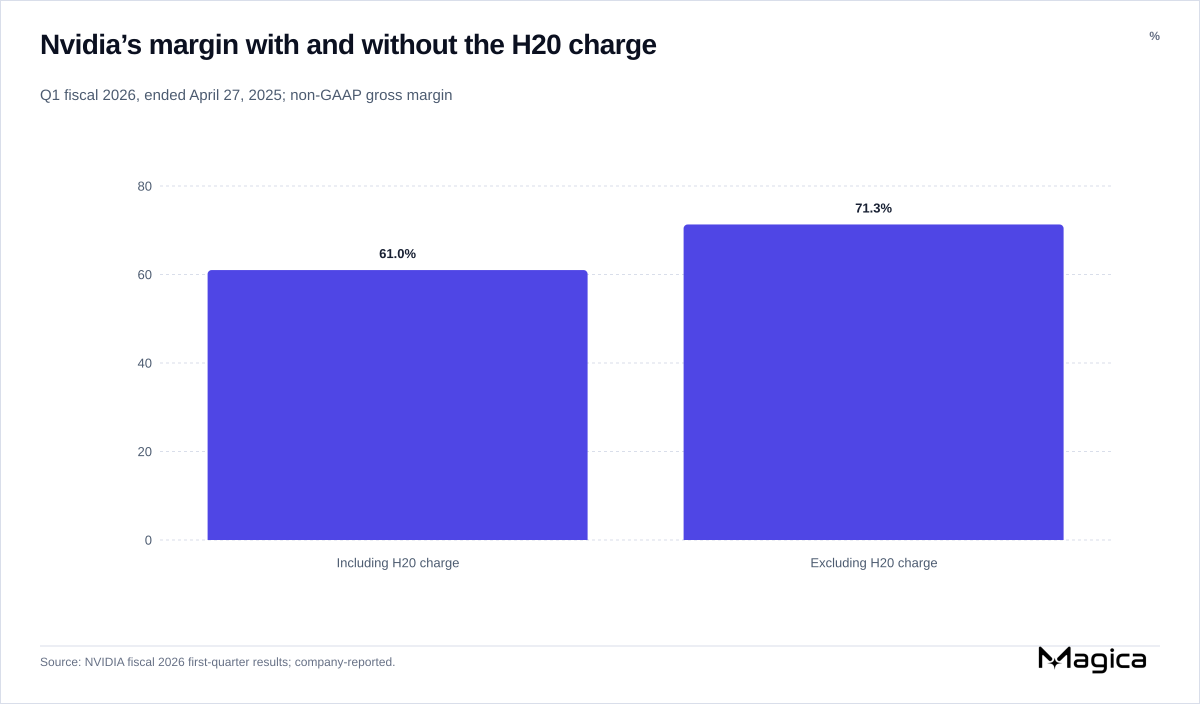
Nvidia’s company-reported non-GAAP gross margin for Q1 fiscal 2026, including and excluding the H20 inventory and purchase-obligation charge. Source: Nvidia fiscal 2026 first-quarter results.
There is a separate, documented financial precedent for export restrictions affecting Nvidia. In its May 2025 results announcement, Nvidia said it was told on April 9 that exports of H20 products to China required a licence. The products were designed primarily for that market. Nvidia reported a $4.5 billion charge for excess inventory and purchase obligations as demand diminished in its fiscal first quarter ended April 27, 2025. It reported $4.6 billion of H20 sales before the new requirements and said it could not ship an additional $2.5 billion of H20 revenue that quarter.
The earnings effect was material even alongside total quarterly revenue of $44.1 billion, up 69% from a year earlier. Nvidia reported a non-GAAP gross margin of 61.0%; it said the same quarter’s margin would have been 71.3% excluding the H20 charge, a difference of 10.3 percentage points. That company-provided adjustment isolates the charge’s effect within the quarter rather than attributing the entire change from earlier periods to export controls.
The charge, unshipped revenue and alleged diverted-server values have different definitions and cannot be added together as losses. The H20 figures concern a different period and mechanism from Muddy Waters’ new questions and provide no corroboration of the proposed executive connection.
The first unresolved step is identifying the woman in the photographs. Any verified relationship would then need evidence tying it to specific transactions, knowledge or compliance decisions before it could support conclusions about the alleged diversion scheme. Neither the research notice nor the contemporaneous news dispatch includes a response from Nvidia or Puri to the short seller’s questions.
A response and transaction-level evidence would help establish whether Muddy Waters has identified an export-compliance issue at Nvidia or a personal connection without demonstrated commercial consequences.
Microsoft is pitching Copilot Workspaces as a shared environment for people and AI agents. Team collaboration is already in early access, but personal Autopilot integration is still coming soon, with final agent pricing unannounced.
Google is rolling out file references and sharing for Gemini skills as adult personal accounts lose the ability to use Gems. Automatic conversion preserves supported material, but file limits and missing tools can interrupt existing workflows.
Nvidia reported $115.8 billion in quarterly revenue in its first earnings release since co-founder Jensen Huang resigned. Strong demand gives interim CEO Colette Kress a financial cushion, while a campaign for Huang’s return collides with unresolved investigations and the board’s reported opposition.
OpenAI launched GPT-6.2 Astra and Sol for professional work, cutting Astra’s standard input and output token prices by 20%. The models offer cheaper paths through selected tasks, but research evaluations, reporting failures and unfinished independent safeguard testing complicate the case for broader autonomy.
Microsoft’s first live speech-to-speech model offers OpenAI API compatibility and planned enterprise integrations. Its published evaluations show a low-cost option, with several rivals completing more agentic tasks.
Canberra-based Trellis Data is offering its 220-billion-parameter Agentaus 1 model to business and government. Its pitch goes beyond keeping data in Australia, but performance, deployment costs and a planned capital raising remain key tests.
Perplexity is adding direct collaboration between frontier models to Computer, letting a lead agent coordinate up to 16 supporting agents. Company-reported benchmarks suggest mixed teams can outperform repeated copies of one model, but leave customer costs and production reliability unresolved.
Marsh reported 105 client cyber incidents in the last two weeks of October, against 48 in the final two weeks of May. The broker links the increase partly to AI, while warning that insurance panel access may not guarantee an available response team.
Meta’s Muse personal AI agent has launched in Australia, with some local shopping and booking connections to follow. Its browser and payment tools broaden its reach, while the company’s technical disclosures qualify its privacy promises.
Microsoft and Salesforce are extending their sales software alliance with Copilotforce, combining CRM workflows with Microsoft 365 context under existing permissions. The Copilot plugin enters public preview, while Teams remains in pilot; earlier Microsoft tools and a Claude beta raise the bar for proving its value.
Microsoft expands MAI Image 2.7 from an editing preview into image generation and API access, with cheaper Flash pricing and a Canvas workspace. Benchmark claims depend on the workload, while the MAI Labs interface carries restrictions on commercial use.
OpenAI is widening applications for its legal AI configuration after improving research scores and expanding its search index. Access still requires approval, and benchmark results show substantial limits alongside the gains.
Microsoft has made Word, Excel and PowerPoint creation generally available inside Copilot, combining editable files with workplace permissions and collaboration. The broader shift toward autonomous work remains staggered across previews, while its claimed cost advantage rests on company-funded testing.
Knit Health’s NEA-led Series A funds deployment of Med-BEAM for care navigation and hospital operations. Its early company benchmark beats three Claude models at predicting clinical actions, while better patient outcomes remain unproven by that test.
Science Corporation’s Series D follows its European retinal-implant launch. Clinical results support improved central vision, but U.S. approval, eligible patients and commercial terms remain consequential questions for the startup, reportedly valued at $3.5 billion.
Google will let Gemini users save conversations while opting out of generative AI training on future chats. The global rollout also extends storage of history-off and temporary chats from 72 hours to around two months; human review and longer retention can still apply.
Google is removing the subscription requirement for Gemini’s task mode in six countries, while adding U.S. payment, calling and messaging features. The expansion broadens access to delegated work, but usage limits, permissions and website compatibility still govern what it can finish.
Eligible Pixel owners can join a Play Store beta to generate home-screen widgets from descriptions, but device, language and regional restrictions still apply.
Microsoft’s new in-house coding models compete with outside suppliers inside GitHub Copilot. Company tests show lower task costs at promotional prices, while its continuing financial ties to OpenAI complicate the rivalry.
Valkryn disclosed a $15 million seed round and early military testing contracts. Its evaluator-focused Battle Lab faces existing commercial tools, public testing capabilities and funding constraints that software alone cannot resolve.