Editorial Team
9 min read
OpenAI is widening applications for its legal AI configuration after improving research scores and expanding its search index. Access still requires approval, and benchmark results show substantial limits alongside the gains.
OpenAI, the developer of ChatGPT, has updated Astra for Law, its AI configuration for professional legal work, and opened applications to all ChatGPT Enterprise customers. The November 17 release replaces the GPT-6 Astra foundation used at its September launch with GPT-6.2 Astra, paired with legal research instructions and an expanded search index, according to the company's announcement.
The expansion takes a product initially offered to selected law firms toward a broader business audience. Its measured gains give legal teams a reason to test it, but the results distinguish stronger research assistance from reliable completion of an entire assignment. Access, confidentiality controls and the cost of professional review remain part of the deployment decision.
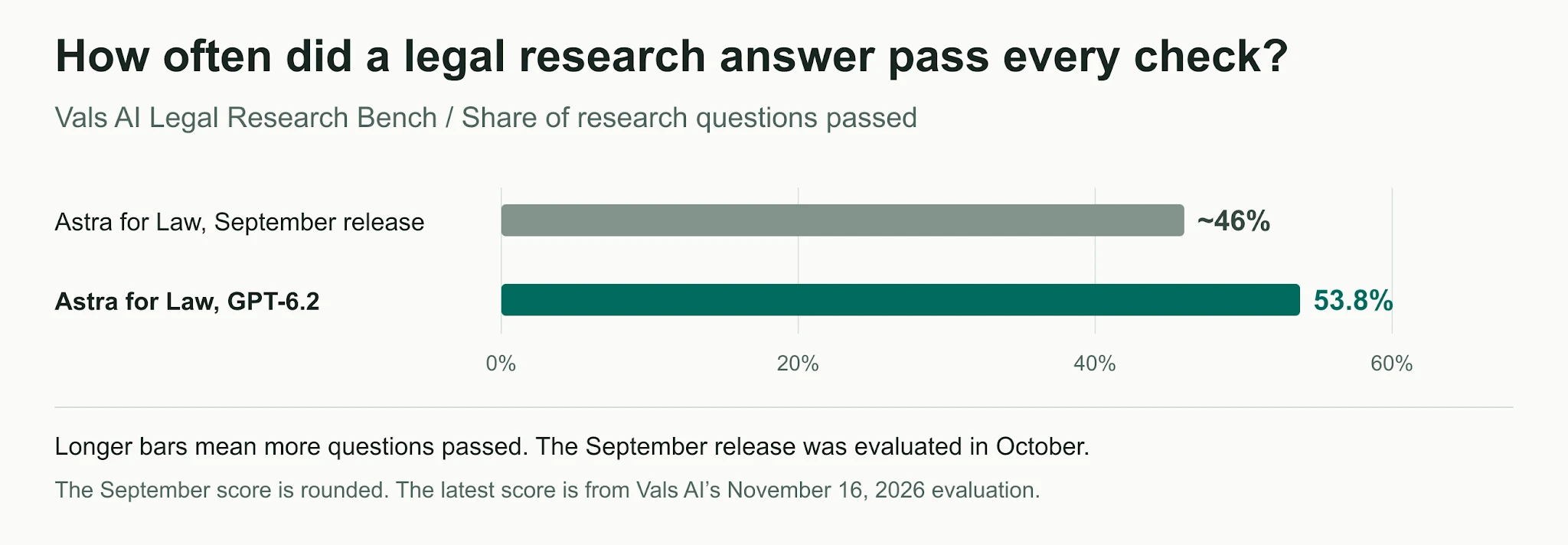
OpenAI’s company-reported Vals AI results: approximately 46% for the September release, evaluated in October, and 53.8% on November 16. The earlier score is rounded. Source: OpenAI.
Astra for Law combines a general-purpose model with tools and instructions for finding legal authorities, weighing their relevance and writing an answer. It is an updated configuration, rather than a newly announced standalone foundation model. OpenAI named the law firms Cooley, Ropes & Gray and Sullivan & Cromwell as initial users in coverage of the release.
OpenAI's access requirements qualify the broad invitation: in eligible geographies, a workspace owner or administrator must verify the business, submit an application and sign a Legal Technology and Trust Addendum. The workspace needs Trusted Access authorization before anyone can use the model. Only lawyers and people working under their supervision may use it.
After approval, administrators activate the configuration and assign authorized users through role-based controls. Existing users can select gpt-6.2-astra-law in ChatGPT, the announcement says. API applicants go through their OpenAI account team or legal sales. The help page still describes the older GPT-6 Astra foundation; the release announcement explicitly identifies GPT-6.2 Astra as the updated version. The help instructions also tell users to review answers and cited sources before relying on them.
This builds on an existing distribution strategy. At the September 17 launch, OpenAI said legal technology companies Harvey and Legora would be able to build on Astra for Law through the API. Wider ChatGPT access adds a direct route alongside that proposed distribution through specialist software.
The launch also described work already under way with selected firms: OpenAI engineers helped adapt ChatGPT Enterprise for Sullivan & Cromwell's agreement analysis, Ropes & Gray's deal diligence and Cooley's IPO preparation. Those examples concern customized workflows and integrations, rather than evidence that the newly released configuration independently completes those jobs.
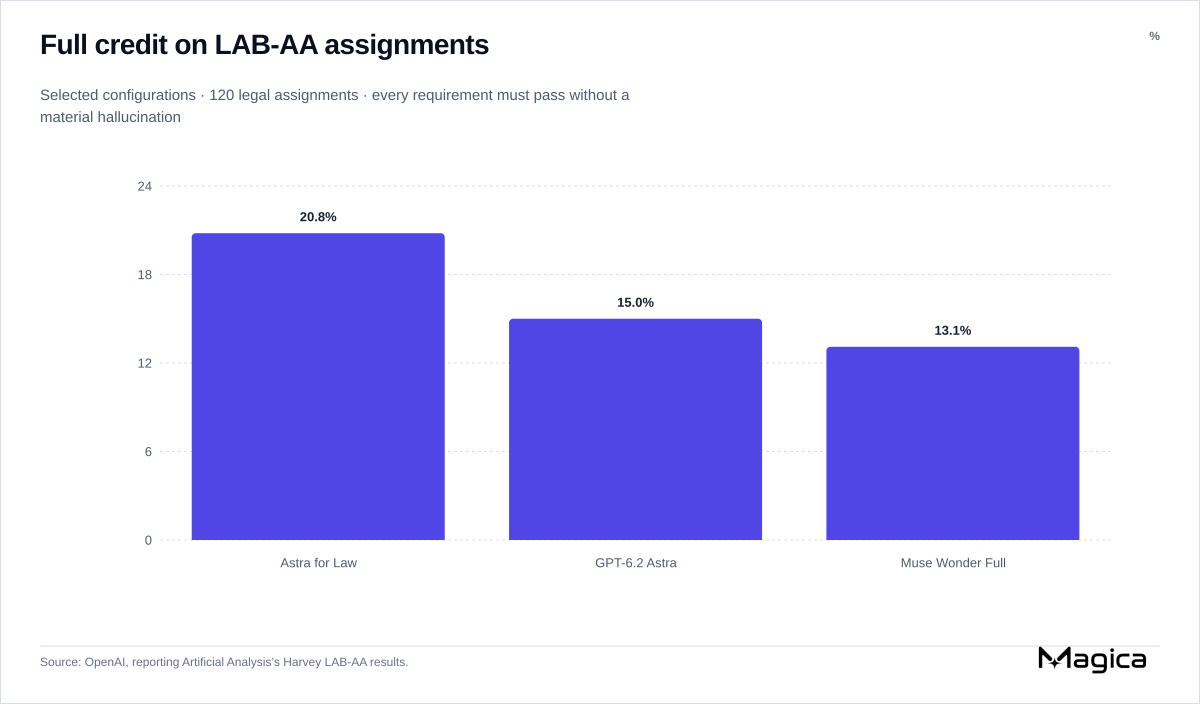
Company-reported LAB-AA full-credit rates for three configurations. Every assignment requirement must pass without a material hallucination; this is a separate test from Vals AI’s research benchmark. Source: OpenAI.
OpenAI says Astra for Law ranked first on LAB-AA, Artificial Analysis's version of the Legal Agent Benchmark developed by Harvey. The evaluation covers 120 assignments across 24 areas of law, including deposition outlines, lease review and acquisition strategy. An answer earns full credit only if it meets every assignment requirement without a material claim unsupported by the source documents.
In OpenAI's account of the results, full-credit rates were 20.8% for Astra for Law, 15.0% for its underlying GPT-6.2 Astra model and 13.1% for Muse Wonder Full, the highest-scoring non-OpenAI configuration. The legal configuration's advantage over its base model was 5.8 percentage points. Its roughly one-in-five full-credit rate means most assignments missed that stringent standard; it does not establish that every remaining answer was wholly wrong.
The company reports 0.03 material hallucinations per assignment, tied with GPT-6 for the lowest rate in the comparison, against 0.06 for GPT-6.2 Astra and 0.59 for Claude Opus 5.5. These are averages on the evaluated assignments, rather than a guarantee against errors in client work.
OpenAI also reports about 64,000 output tokens per LAB-AA assignment, compared with 139,000 for Muse Wonder Full, or 54% less output. That measure includes text generated during reasoning and writing. It can affect usage charges, but it does not establish a customer bill without prices and the rest of the work required.
On Harvey's own LAB, which is separate from LAB-AA, OpenAI reports full-credit rates of 4.6% for GPT-6 Astra, 14.6% for GPT-6.2 Astra and 16.2% with the legal configuration. Most of that measured improvement came from the newer base model; the configuration added 1.6 percentage points in this comparison.
On LAB: USCL, a brief-writing benchmark, AI graders compare briefs using criteria reviewed and calibrated by lawyers. OpenAI reports research-and-draft ratings of 1,844 for Astra for Law and 1,817 for Claude Opus 5.5. When supplied the precedents, the models were effectively even at 1,883 and 1,882. These ratings are not percentages or interchangeable with the other tests' full-credit rates.
Harvey's involvement matters when weighing the evidence: it developed LAB, co-developed the brief-writing test and is also an API customer that OpenAI said would be able to build on Astra for Law. That commercial connection is relevant context for the evaluations and endorsements, without itself resolving whether the measured results transfer to a firm's work.
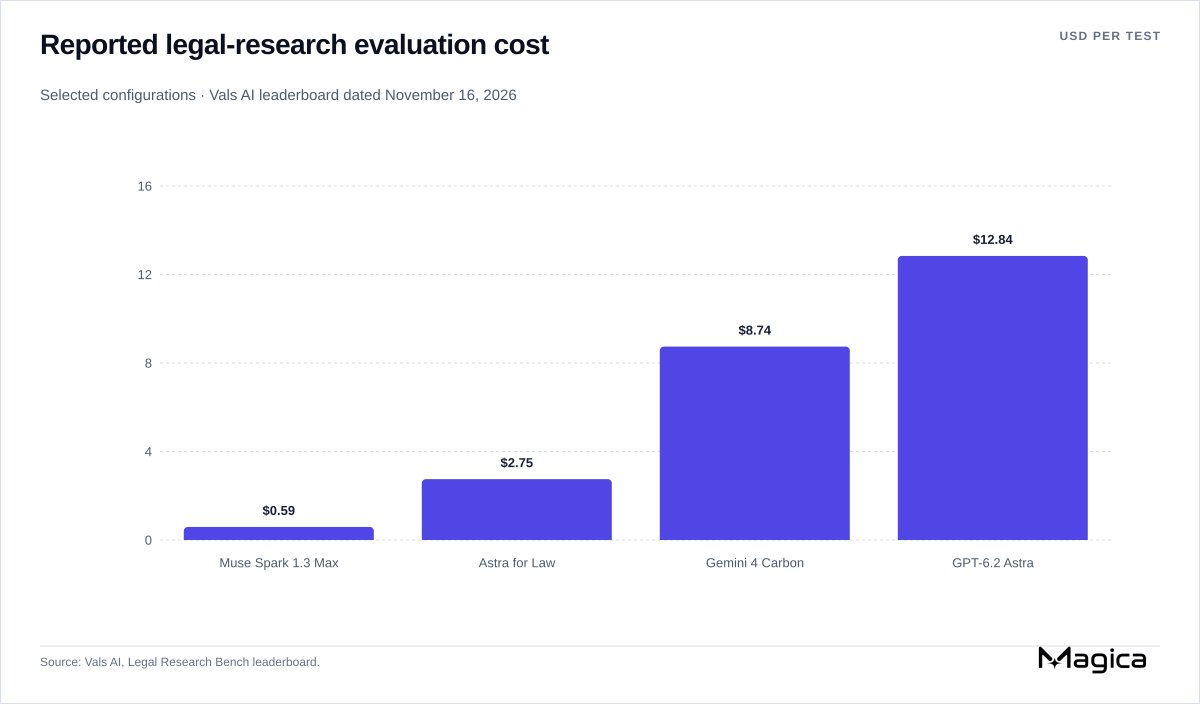
Reported cost per test on Vals AI’s November 16 leaderboard. These are evaluation costs, not customer contract prices or law-firm savings; the article table supplies accuracy and duration. Source: Vals AI.
OpenAI says Astra for Law earned full credit on 112 of 208 questions in Vals AI's November 16 Legal Research Bench evaluation, or 53.8%, up from about 46% in September. It earned 90.9% of available points with partial credit included. Vals, the benchmark provider, explains that its all-pass measure requires every rubric item because a mostly correct answer can still omit a necessary legal point.
The November 16 leaderboard places Astra for Law sixth, behind five configurations and level on all-pass rate with Gemini 4 Hydrogen. Selected comparisons show both the gain over its base model and the alternatives:
| Configuration | All-pass rate | Reported cost per test | Duration per test |
|---|---|---|---|
| Gemini 4 Carbon | 55.77% | $8.74 | 51m53s |
| Muse Spark 1.3 Max | 55.29% | $0.59 | 5m17s |
| Astra for Law | 53.85% | $2.75 | 16m45s |
| GPT-6.2 Astra | 42.79% | $12.84 | 1h19m |
Astra for Law scores higher at lower reported cost than its base model on this evaluation. Muse Spark 1.3 Max, however, has a higher all-pass rate, lower reported cost and shorter duration than the legal configuration. The table describes evaluation costs and timings, rather than customer contract prices or measured savings for a law firm. The leaderboard alone does not establish that small score gaps represent a reliable advantage on other legal questions.
Vals tests research across eight areas of U.S. federal and state law. Practicing lawyers author and peer-review the questions, reference answers and rubrics; GPT 5.4 grades the responses. Vals reports that its judge agreed with a majority of three human expert reviewers 87.4% of the time in judge validation, compared with an average individual human agreement of 83.4%. That measures agreement with the selected reviewers, rather than establishing error-free grading.
The methodology describes a shared tool harness and a three-hour task limit. All public leaderboard results use a private 208-question test set. This distinction matters historically: OpenAI's original launch reported a 54.0% correctness result at its highest reasoning effort on a separate, 200-question private validation set. That figure should not be treated as the baseline for the current 53.8% test-set score.
Aggregate scores also conceal differences relevant to buyers. Vals says no model leads in every practice area and every evaluated model performs worse on questions requiring reconciliation of authorities than on its other questions. A firm's practice mix and the need to resolve conflicting law therefore matter alongside the overall ranking.
OpenAI says in the update that its legal search index grew 34% since September, adding more than 80 million URLs to exceed 310 million, including material from the UK, Australia and Canada. At launch, it identified Free Law Project, the nonprofit behind CourtListener, as the source of a case-law collection covering more than 99.9% of published U.S. precedential case law. That is a claim about coverage of a defined body of cases, rather than all legal information or the correctness of model answers. The current research benchmark covers U.S. law; it does not establish performance in those added international jurisdictions.
OpenAI also positioned the index as complementary to licensed content and specialist products, including those from Thomson Reuters. Its original launch described Thomson Reuters bringing HighQ matter context into ChatGPT and previewing a forthcoming CoCounsel Legal connector. The current help page describes partner plugins such as iManage for saving a negotiation brief to a matter file and DeepJudge for comparing prior deals. The product's usefulness thus also depends on how it works with a firm's existing information and tools.
Confidentiality is another deployment condition. In September, OpenAI said eligible firms' offering included Zero Data Retention on the API and exclusion of ChatGPT Enterprise usage from human review by default. It also described work with the law firm Latham & Watkins on information permissions, ethical walls, client instructions and oversight. These are specific controls and governance work, rather than evidence that every client's confidentiality requirements are automatically satisfied.
For newly eligible teams, the immediate next step is an application and authorization. After that, the unresolved question is whether answers survive professional checking on their actual matters at an acceptable total cost. The announcement and help documentation supply neither a customer price schedule nor a measured reduction in lawyer review time. Those are the missing comparisons needed to turn stronger benchmark results into a purchasing decision.
Microsoft is pitching Copilot Workspaces as a shared environment for people and AI agents. Team collaboration is already in early access, but personal Autopilot integration is still coming soon, with final agent pricing unannounced.
Google is rolling out file references and sharing for Gemini skills as adult personal accounts lose the ability to use Gems. Automatic conversion preserves supported material, but file limits and missing tools can interrupt existing workflows.
Muddy Waters disclosed a short position in Nvidia while questioning a possible connection involving senior adviser Ajay K. Puri. Its own account leaves the key identity question unanswered, separating its new claims from an existing server-diversion prosecution.
Nvidia reported $115.8 billion in quarterly revenue in its first earnings release since co-founder Jensen Huang resigned. Strong demand gives interim CEO Colette Kress a financial cushion, while a campaign for Huang’s return collides with unresolved investigations and the board’s reported opposition.
OpenAI launched GPT-6.2 Astra and Sol for professional work, cutting Astra’s standard input and output token prices by 20%. The models offer cheaper paths through selected tasks, but research evaluations, reporting failures and unfinished independent safeguard testing complicate the case for broader autonomy.
Microsoft’s first live speech-to-speech model offers OpenAI API compatibility and planned enterprise integrations. Its published evaluations show a low-cost option, with several rivals completing more agentic tasks.
Canberra-based Trellis Data is offering its 220-billion-parameter Agentaus 1 model to business and government. Its pitch goes beyond keeping data in Australia, but performance, deployment costs and a planned capital raising remain key tests.
Perplexity is adding direct collaboration between frontier models to Computer, letting a lead agent coordinate up to 16 supporting agents. Company-reported benchmarks suggest mixed teams can outperform repeated copies of one model, but leave customer costs and production reliability unresolved.
Marsh reported 105 client cyber incidents in the last two weeks of October, against 48 in the final two weeks of May. The broker links the increase partly to AI, while warning that insurance panel access may not guarantee an available response team.
Meta’s Muse personal AI agent has launched in Australia, with some local shopping and booking connections to follow. Its browser and payment tools broaden its reach, while the company’s technical disclosures qualify its privacy promises.
Microsoft and Salesforce are extending their sales software alliance with Copilotforce, combining CRM workflows with Microsoft 365 context under existing permissions. The Copilot plugin enters public preview, while Teams remains in pilot; earlier Microsoft tools and a Claude beta raise the bar for proving its value.
Microsoft expands MAI Image 2.7 from an editing preview into image generation and API access, with cheaper Flash pricing and a Canvas workspace. Benchmark claims depend on the workload, while the MAI Labs interface carries restrictions on commercial use.
Microsoft has made Word, Excel and PowerPoint creation generally available inside Copilot, combining editable files with workplace permissions and collaboration. The broader shift toward autonomous work remains staggered across previews, while its claimed cost advantage rests on company-funded testing.
Knit Health’s NEA-led Series A funds deployment of Med-BEAM for care navigation and hospital operations. Its early company benchmark beats three Claude models at predicting clinical actions, while better patient outcomes remain unproven by that test.
Science Corporation’s Series D follows its European retinal-implant launch. Clinical results support improved central vision, but U.S. approval, eligible patients and commercial terms remain consequential questions for the startup, reportedly valued at $3.5 billion.
Google will let Gemini users save conversations while opting out of generative AI training on future chats. The global rollout also extends storage of history-off and temporary chats from 72 hours to around two months; human review and longer retention can still apply.
Google is removing the subscription requirement for Gemini’s task mode in six countries, while adding U.S. payment, calling and messaging features. The expansion broadens access to delegated work, but usage limits, permissions and website compatibility still govern what it can finish.
Eligible Pixel owners can join a Play Store beta to generate home-screen widgets from descriptions, but device, language and regional restrictions still apply.
Microsoft’s new in-house coding models compete with outside suppliers inside GitHub Copilot. Company tests show lower task costs at promotional prices, while its continuing financial ties to OpenAI complicate the rivalry.
Valkryn disclosed a $15 million seed round and early military testing contracts. Its evaluator-focused Battle Lab faces existing commercial tools, public testing capabilities and funding constraints that software alone cannot resolve.