Editorial Team
6 min read
Nvidia released GeForce Hotfix 621.35 to stop excessive background log writes, but a user’s overnight measurements suggest the problem can return. The evidence supports concern about unnecessary SSD writes, while leaving the prevalence and endurance impact unresolved.
Nvidia, the maker of GeForce graphics processors and their PC drivers, released Hotfix 621.35 on November 20 to address excessive background writes to storage. A subsequent overnight user test reported that the activity returned after an initially quiet hour, challenging whether a short check after installation is enough to judge the repair.
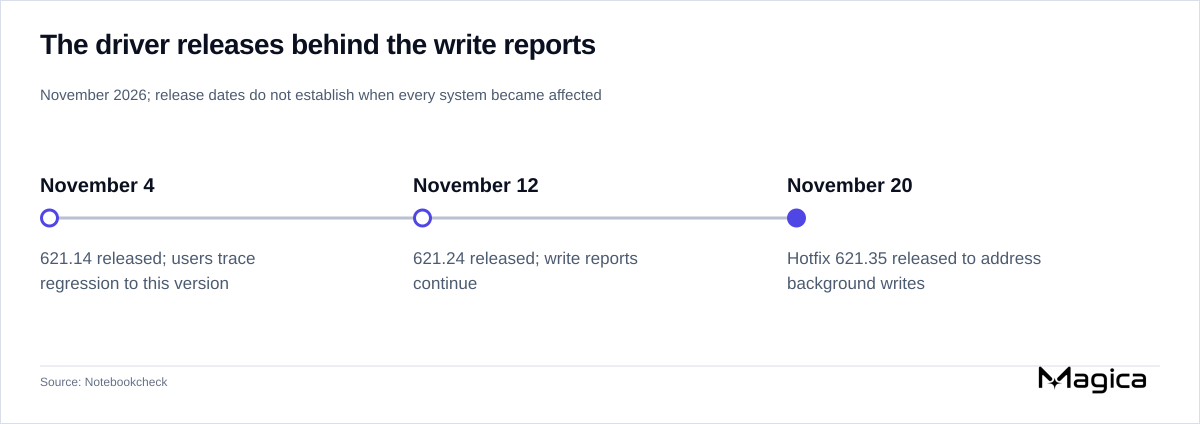
Users traced the regression to 621.14; reports continued on 621.24 before NVIDIA released its targeted hotfix. Source: Notebookcheck.
The problem concerns a background service in Nvidia’s graphics software, generating storage activity even when a PC is idle. The company’s release announcement lists one targeted issue, bug 7116722: excessive background writes to nvlog.nvlgstg. The hotfix is based on Game Ready Driver 621.24.
Users traced the regression to version 621.14, released November 4, with reports continuing on 621.24, released November 12. A report collecting the measurements draws on TroubleGrid and users on Reddit and Nvidia’s forums to identify NVDisplay.Container.exe, running as NVIDIA Display Container LS, as repeatedly rewriting the binary log on the Windows system drive.
The newer drivers also carry game optimizations and support for updated graphics features. Version choice therefore involves more than the log bug.
The reported write volumes differ sharply between machines and test windows. One user measured 515 MB of process writes in five idle minutes on 621.14; another measured more than 3 GB in ten minutes. A separate estimate reached roughly 30 GB an hour on 621.24. These are individual observations, not a measured average across GeForce users.
The five-minute test illustrates the measurement problem. Although the process counter rose by 515 MB, total writes to the C: drive were 270 MB. The same idle comparison on older driver 621.01 produced less than 2 MB of process writes, giving rise to the widely repeated roughly 250-fold increase.
That ratio describes process activity. It does not establish that SSD flash is wearing out 250 times faster. As the measurement caveat explains, Windows process counters do not necessarily equal writes physically reaching the NAND flash. Nor can all system-drive writes automatically be assigned to this one service.
Solid-state drives, or SSDs, have rated write endurance. The report puts typical endurance for a 1 TB SSD at about 600 terabytes written. That reference gives scale to the concern, but these measurements do not establish endurance consumed on each affected drive, annual wear or a failure deadline.
The report also notes that process counters are cumulative since the process started and cover all its I/O. Changes between readings provide a more useful view of activity over a specified interval.
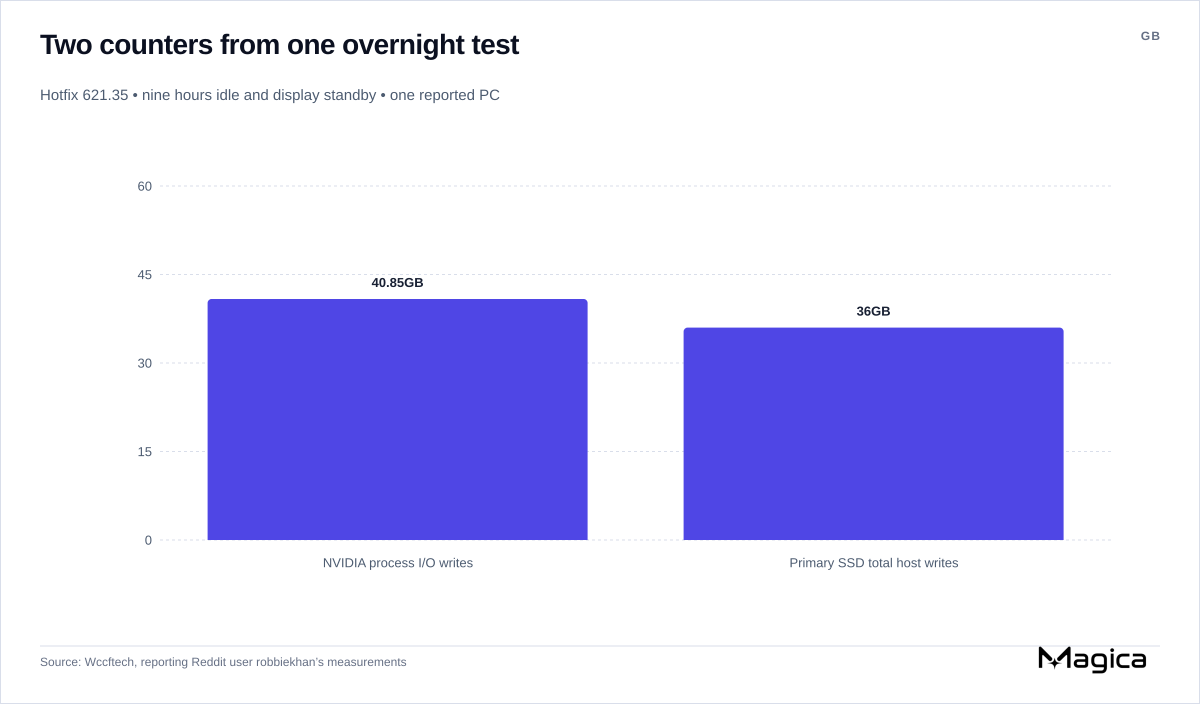
One user’s overnight test on 621.35 recorded these different counters. Drive-wide host writes cannot all be attributed to NVIDIA’s process; neither counter directly measures physical flash wear. Source: Wccftech.
A November 22 report of a user’s comparative test challenges the assumption that installing 621.35 settles the issue. Reddit user “robbiekhan” compared process I/O with HWiNFO64 S.M.A.R.T. host-write measurements on a Windows 11 26H2 PC with an Nvidia RTX 4090 graphics card and a 2 TB Samsung 990 PRO SSD.
The process recorded just 90.8 KB of writes in the first post-install hour. During a subsequent nine-hour overnight idle and display-standby window, however, it accumulated 40.85 GB of I/O writes, while the primary SSD recorded 36 GB of total host writes. The distinction remains important: the latter is a drive-wide counter whose entire total cannot automatically be assigned to this service, nor does it directly measure physical flash wear.
The user’s comparison installation, Studio Driver 621.24, had accumulated 1.18 TB of process I/O writes over five days of uptime. Those unequal windows cannot establish a controlled percentage improvement, although the account describes less frequent recurrence on the hotfix. Separate tests of Game Ready Driver 621.01 recorded much lower process totals: 12.55 MB over 55 minutes and 9.47 MB over 93 minutes.
This remains one reported configuration, not proof that the hotfix fails everywhere. Nvidia’s announcement thread also contains complaints of continuing writes, including one user reporting 6 GB over five hours. It includes a user reporting no unusual behavior on 621.14 and another reporting similar log activity on 621.01. These are forum observations, not a representative sample or controlled validation of any version.
Rolling back to 621.01 can restore video-playback freezes and black screens on some RTX 50-series graphics cards, according to the earlier reporting. Stopping the Display Container service and deleting its log offers temporary relief; disabling the service prevents Nvidia Control Panel and the Nvidia app from opening.
Rollback does not necessarily sacrifice every recent feature. The overnight-test report says DLSS Frame Generation Preset C remains available through the Nvidia app with drivers as old as 617.42, a version the report’s author says they are using. That narrows the feature tradeoff without resolving compatibility for every system.
There is precedent beyond this release. The earlier measurement report records Display Container log-rewriting complaints dating to at least 2021. It also describes rival GPU supplier AMD fixing a similar idle-write problem in its Radeon software, first for RX 7000-series cards and newer on November 12, then extending the fix to older cards on Windows 10 on November 18. Similar symptoms do not establish a shared cause or a like-for-like comparison of severity.
Nvidia explains that its normal driver schedule follows significant game or product releases. Hotfixes move selected repairs out sooner, partly in response to user feedback, through an abbreviated quality-assurance process. The company calls them optional betas provided as-is and says waiting for the next WHQL-certified driver is the safest option. A release report notes that the hotfix is offered through Nvidia Customer Care.
Nvidia says hotfix changes will enter the next official driver release. The unresolved test is whether excessive writes remain suppressed across extended uptime and standby, with process and drive counters recorded separately across multiple configurations. The overnight account makes that duration central: a clean reading immediately after reboot is useful evidence, but insufficient to establish a lasting repair.
Google’s $899 standard flagship brings more storage, a larger main camera sensor and useful software tools. Reviews make a strong case for buying it instead of a Pro, but a weaker one for replacing last year’s Pixel 10.
Dell’s Alienware AW2725DF is reported at $379 on Amazon for Black Friday. The discount brings a once-$899.99 gaming monitor below $400, but its full 360Hz requires DisplayPort and cheaper OLED alternatives temper the bargain.
Amazon’s new flagship tablet earns praise for its optional matte display and Google Play access. The reviews make a stronger case for reading and entertainment than for Alexa-led computing or replacing a laptop.
The FCC has overridden California approval requirements that stood in the way of AT&T ending legacy phone service in parts of the state. AT&T retains a duty to offer basic service, but California must accept the replacement the federal regulator approved.

Sony’s WH-1000XM6 headphones were reported at $348 on Amazon, about 24% below the deal listings’ reference price but about 23% below Sony’s original US launch price. Earlier cheaper offers and a stated November 20 deadline qualify the buying case.
Amazon's Black Friday prices start at $1,049 for the 13-inch M5 MacBook Air and $1,249 for the 15-inch. That is $250 below current list prices, but only $50 below their March launch prices. The 13-inch Starlight model costs 99 cents more.
State prisons and local jails can seek FCC permission to jam contraband cellphones, but deployments must pass interference tests amid industry-reported pilot failures and questions over who pays.
A reported agreement in principle would pay thousands of US school districts around $3 billion over addiction claims and add teen protections. District participation, individual payouts and the substance of the product changes remain unresolved.
Teenage Engineering’s first CD player combines an exposed disc, variable-speed playback and wireless streaming. Its case for a premium rests on hands-on controls and integration with the company’s other audio gear, in a market with cheaper connected players.
Apple is reportedly reviewing an OLED iMac with Samsung Display over panel costs while seeking LCD panels for a launch around 2029. Talks are said to focus on delay, leaving both cancellation and the eventual display choice unresolved.
Purported iPhone Air 2 mockups show two rear cameras, lending support to a longstanding upgrade rumor. An Ultra Wide lens could narrow a gap with the cheaper iPhone 17, but the replicas cannot confirm specifications.
Motorola says nine existing phones are receiving Android 17 and 20 more are due in coming months. The Brazilian list restores previously omitted models, but does not establish worldwide availability.

Amazon’s entry Alexa Tablet 8 is advertised at $149.99 for Black Friday. Google Play expands app choice beyond older Fire tablets, but removing lock-screen ads costs $20, and the base hardware suits modest tasks.
Uber Kids is piloting parent-booked rides in Austin, Nashville and Madison, extending Uber’s teen service to younger children. Drivers get $7 more per completed trip than on UberX and take on pickup, recording and drop-off duties; passenger pricing and pilot safety results remain unresolved.
Microsoft is expanding automatic Windows 11 26H2 delivery to eligible unmanaged PCs running 24H2 and 25H2. The small upgrade resets edition-specific support periods, while performance claims require care about workloads, app updates and comparison builds.
WhatsApp is reportedly lifting its group limit from 1,024 to 1,500 people in a gradual rollout on Android and iPhone, giving community administrators more room without splitting conversations. Official confirmation and a universal availability date remain outstanding.
Google will begin expanding Android developer verification worldwide in January, with other app stores covered by March. Sideloading survives, but ordinary installation on certified devices will depend on a Google-managed identity and app registry.
SK hynix plans to take full ownership of a vehicle holding about 14.1% of Kioxia. Conversion would let it exercise shareholder votes through the vehicle, while the company says existing limits on management participation remain.
Elon Musk pledged further Tesla production growth in China without a target or timetable, then visited its Shanghai factory. The plant’s shipments are rising as exports more than offset declining domestic retail sales.
Samsung appointed memory development chief Hwang Sang-joon and mobile COO Choi Won-joon to run its memory and smartphone businesses. Its co-CEOs retain their division posts as record chip earnings contrast with losses in consumer electronics.