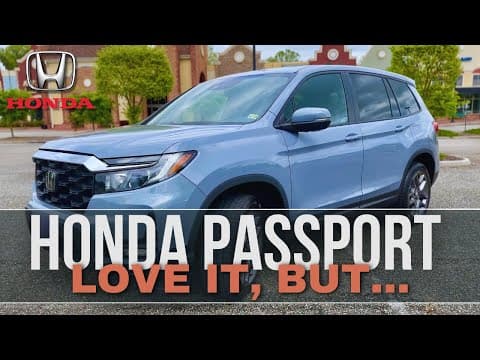
The Honda Passport is a practical two-row SUV that excels in acceleration and comfort but has notable flaws in interior design, features, and off-road capability. This review highlights its strengths and weaknesses, providing insights for potential buyers.
With the next-generation Honda Passport set to arrive soon, now’s the perfect time to step back and evaluate what could be improved in this popular SUV. After three years with my 2022 Passport EX-L, I have a clear picture of its strengths and weaknesses, and I will also incorporate common feedback from previous reviews. Let’s dive into the details.
The Honda Passport is a two-row SUV designed for practicality. It offers a spacious interior, straightforward design, and a long list of standard features, making it suitable for various activities, from ski trips to grocery runs. While it performs well in many areas, it does not particularly excel in any one aspect, except for its impressive acceleration, reaching 60 mph in just 5.9 seconds.
In terms of performance, the Passport delivers quick acceleration and smooth on-road handling. However, it falls short when compared to competitors like the Ford Bronco, which offers superior off-road capabilities, the Mazda CX-70 with its premium aesthetics, and the Hyundai Santa Fe, known for its refined interior.
The interior of the Passport features attractive materials and well-organized controls, but the overall design is beginning to show its age. The instrument cluster display feels outdated, and while the climate control buttons are practical, they lack the modern touch found in the same-year Civic and CR-V.
A significant drawback is the absence of rear climate controls. Passengers in the back must rely on the front controls for temperature and fan speed adjustments, which can be inconvenient, especially for picky passengers.
After 15,000 miles, the driver’s seat showed visible wrinkles. Initially, I attributed this to my weight (190 lbs / 86 kg), but I later discovered that other Passport owners, regardless of weight, experienced similar issues. This suggests a potential quality problem with the leather used in the seats.
My EX-L trim is well-equipped with features like heated leather seats, a power tailgate, parking sensors, and a sunroof. However, I wish Honda offered a more basic version with cloth seats for buyers who do not need leather or a sunroof, which would lower the entry price. In 2022, my two-wheel-drive EX-L had a sticker price of $39,500, but the base all-wheel-drive model now starts at $44,000, positioning it above some three-row competitors.
The 2024 Passport received a slight redesign, but it did not include significant upgrades like a new screen or wireless smartphone connectivity, which were features added to the Ridgeline. However, it did improve the center console with deeper storage and a better wireless charging pad, addressing a previous complaint about the charging pad's design.
At the top of the lineup, the new Black Edition offers many features for its $50,000 price tag. However, it lacks some key features such as a panoramic sunroof, a premium audio system, a 360-degree camera, and wireless smartphone connectivity, which are available in similarly priced models like the Honda Pilot Touring.
One common criticism from previous reviews is the old-school brake pedal instead of an electric parking brake. While I personally don’t mind it, I believe a brake hold feature would enhance the driving experience in stop-and-go traffic. Additionally, the Black Edition lacks a height-memory tailgate, which would be beneficial for shorter drivers or those with low garage ceilings.
The design of the Passport’s taillights is another point of contention. They resemble the Pilot’s design but do not match it completely, leaving an unsatisfactory impression. Furthermore, since the redesign in 2022, Honda removed LED high beams from the Passport, opting for a simpler design that feels like a cost-cutting measure.
On the road, the Passport is easy to drive and surprisingly agile for its size. It prioritizes comfort with good body control and balanced steering. However, the suspension can feel too stiff over bumps, detracting from the overall ride quality. Despite this, it remains smooth and comfortable for highway cruising, instilling confidence in the driver.
While the current Honda Passport may not be the most exciting SUV on the market, it is one of the most dependable. It blends practicality, reliability, and solid performance, making it suitable for daily errands and long road trips. As the next generation approaches, I will miss the current model's well-rounded nature. Although there are more off-road-capable, luxurious, or fun-to-drive options available, few vehicles combine these qualities as seamlessly as the Passport.
If you own a Honda Passport, I encourage you to share your experiences in the comments. For those interested in a more detailed review, please follow the link provided.