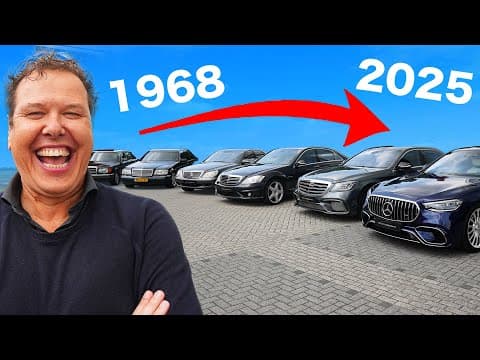
This blog post explores the evolution of the Mercedes S-Class through its eight generations, highlighting the performance, luxury, and technological advancements of each model, culminating in the latest E-Performance variant.
The Mercedes S-Class has long been synonymous with luxury, performance, and innovation. In this post, we will take a closer look at the evolution of the S-Class through its eight generations, focusing on the top models from each era and their impressive performance metrics.
The journey begins with the W109, produced from 1968 to 1972. This model, known as the 300 S, was the first super sedan from Mercedes. It featured a powerful 6.3L V8 engine that produced 250 horsepower, allowing it to reach 0 to 100 km/h in just 6.5 seconds. At the time, this performance was remarkable, even outpacing a Ferrari Daytona.
The W109 laid the groundwork for future AMG models, with over 6,500 units sold, making it a global success.
Next, we have the W116, which introduced the S-Class nomenclature. The top model, the 450 S, debuted at the Geneva Motor Show in 1974. It was known for its comfort and performance, featuring a 6.9L V8 engine that could accelerate from 0 to 100 km/h in 6.9 seconds.
With 73,180 units produced, the W116 became a symbol of success for many celebrities and politicians.
The W126 is often regarded as one of the best S-Class models ever made. Produced from 1979 to 1991, the 560 S was particularly notable, with over 75,000 units sold. It was a staple for state officials and featured luxurious amenities and a powerful engine.
This model was not only luxurious but also a cultural icon, appearing in numerous films from the 1980s.
The W140 marked the introduction of the V12 engine in the S-Class. The S600 was equipped with a 6.0L V12 engine, emphasizing luxury and technological advancements, including double-glazed windows for enhanced cabin quietness.
Despite initial criticism for its size, the W140 was a commercial success, selling well in the luxury market.
The W220 was a significant redesign that focused on reducing weight and improving performance. The S600 featured a 5.5L V12 engine with a twin-turbo setup, achieving 0 to 100 km/h in just 4.6 seconds.
This generation was well-received, although it depreciated significantly in the used car market.
The W221 introduced the AMG variants, with the S65 AMG featuring a 6.0L V12 engine that produced an astonishing 1,000 Nm of torque. This model combined luxury with performance, achieving 0 to 100 km/h in 4.4 seconds.
With fewer than 2,500 units produced, the S65 AMG is a rare find today.
The W222 continued the legacy of luxury and performance, with the S65 AMG offering a refined driving experience. It maintained the powerful V12 engine while introducing advanced technology and comfort features.
This generation was known for its exceptional build quality and performance.
The latest W223 generation marks a shift towards hybrid technology with the S63 E-Performance. This model combines a V8 engine with electric motors, producing a combined output of 802 hp and achieving 0 to 100 km/h in just 3.3 seconds.
This generation represents the future of the S-Class, blending performance with sustainability.
The Mercedes S-Class has evolved significantly over the decades, from the powerful W109 to the technologically advanced W223. Each generation has built upon the last, setting new standards in luxury and performance. As we look to the future, the S-Class continues to innovate, ensuring its place at the forefront of the automotive industry.