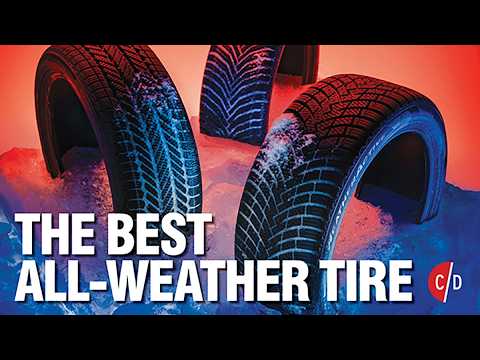
All-weather tires offer a year-round solution with winter capabilities marked by the three-peak mountain snowflake badge. This comprehensive test compared five all-weather tires on dry, wet, and snowy surfaces, alongside winter and summer tires. The Pirelli Cinturato Winter led overall for dry and wet performance, while the Michelin Cross Climate 2 balanced wet and snow grip. Dedicated winter tires still outperform all-weathers in snow, but top all-weather tires provide a solid compromise for a
If you live in a snowy climate, you might have heard about all-weather tires, which have gained popularity in recent years. Unlike all-season tires, all-weather tires are designed with enhanced winter capabilities and carry the three-peak mountain snowflake badge required in Quebec and parts of Europe during winter months. These tires are intended for year-round use, theoretically eliminating the need for separate summer and winter tires.
However, tires are all about compromises. Achieving excellent snow grip often means sacrificing wet weather performance, and vice versa. This article explores how well all-weather tires perform across dry, wet, and snowy conditions based on rigorous testing.
Five all-weather tire models were tested and evaluated on dry, wet, and snow-covered surfaces. The testing was conducted with the help of experts from TyRack, including their testing manager TJ Campbell, at their facility in Southbend, Indiana, for dry and wet conditions. Winter testing took place at the Kiwan Research Center in Michigan's Upper Peninsula, where snow conditions are meticulously maintained by a dedicated crew.
Winter and summer reference tires were also included to highlight performance differences compared to all-weather tires.
The Nokian Remedy WRG5 struggled primarily due to its wet stopping distance, which was nearly 25 feet longer than the best performer at 60 mph. It also exhibited more oversteer during wet autocross and slalom tests. On the positive side, it offered the best warranty with 60,000 miles and no age limit.
In snow, it performed strongly, fighting understeer effectively and providing secure, easy control. Its snow braking distance was only about 4 feet behind the best performers, and it achieved the highest top speed on the frozen track.
The Goodyear Assurance Weather Ready, soon to be replaced by the Weather Ready 2, performed well on dry autocross and braking and was above average in wet conditions. However, its snow performance was disappointing. The tire required constant, quick counter-steering to avoid uncontrollable slides, making it exhausting to drive in snow.
It finished last in snow braking, a critical safety metric. Overall, it was above average on dry and wet roads but offered snow braking performance barely better than an all-season control tire.
The Weather Peak led the pack in cold weather testing with the quickest acceleration, fastest snow autocross time, and shortest stop from 30 mph on snow. However, it fell short in warmer conditions, with a dry braking distance exceeding the best performer by more than a car length and tied for the slowest dry autocross time.
Its squishy tread provided a comfortable ride but caused the car to wander and tramline on the freeway. On the upside, it was the quietest tire tested, measuring 65 decibels inside the cabin at 70 mph.
While the Weather Peak approaches the performance of dedicated winter tires, it needs improvement in other seasons to fully meet the all-weather tire criteria.
Though five years old, the Michelin Cross Climate 2 remains a strong contender, offering a great balance of dry, wet, and snow performance. It topped the wet tests with responsive steering, braking, and acceleration, resulting in less steering effort.
On dry roads, it tended to understeer and felt jumpy over larger surface imperfections, similar to an all-season control tire. It was also relatively loud on smooth surfaces.
In snow, it was arguably the most enjoyable to drive, excelling in braking with strong longitudinal grip that inspires confidence at higher speeds. Its only snow test win was on the 300-foot skid pad.
The Pirelli Cinturato Winter emerged as the overall winner due to its outstanding dry pavement performance. It offered superior grip, the most responsive and direct steering feel, and precise reactions to driver inputs.
Though it stopped slightly longer than the Michelin Cross Climate 2, it was a close second in wet performance and only trailed the best snow acceleration by 0.6 seconds. It also provided a comfortable ride, absorbing road imperfections without loud noises.
The Pirelli's strength lies in delivering excellent performance during the most common driving conditions, including dry roads prevalent even in winter months.
If you can easily store and swap tires seasonally, dedicated summer and winter tires remain the best choice. They outperform all-weather tires in their respective seasons and allow you to split annual mileage between two sets, potentially extending tire life.
However, if changing tires seasonally is inconvenient or impossible, the top all-weather tires like the Pirelli Cinturato Winter and Michelin Cross Climate 2 offer a solid compromise, providing reliable performance across dry, wet, and snowy conditions.
All-weather tires are a versatile option for drivers facing varied weather conditions year-round. While they cannot fully replace the specialized performance of dedicated summer and winter tires, the best all-weather tires deliver commendable performance in snow, wet, and dry conditions.
The Pirelli Cinturato Winter stands out as the best all-weather tire tested, balancing grip, handling, and comfort. The Michelin Cross Climate 2 also remains a strong choice, especially for wet and snowy conditions.
For those prioritizing maximum safety and performance in winter, dedicated winter tires are still recommended. But for convenience and solid all-season capability, top all-weather tires are a worthy consideration.