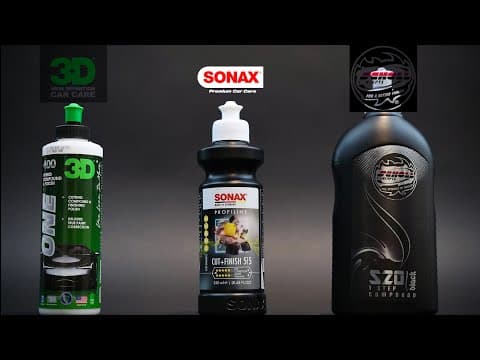
This blog post provides a detailed comparison of three one-step car compounds: 3D One, Sonax Cut & Finish, and Scholl Concepts S20 Black, evaluating their user experience, defect removal ability, and finishing capabilities. Each compound has its strengths and weaknesses, making the choice dependent on individual preferences and specific paint types.
In the world of automotive detailing, one-step compounds are essential for achieving a balance between cutting and finishing in a single stage of paint correction. This blog post reviews and compares three popular one-step compounds: 3D One, Sonax Cut & Finish, and Scholl Concepts S20 Black. We will evaluate them based on user experience, defect removal ability, and finishing capabilities.
A one-step compound is a medium traditional compound designed to provide a good balance of cut and finish across various paint types. It is important to distinguish one-step compounds from all-in-one polishes, which may contain cleaners, fillers, sealants, and primers. One-step compounds aim to simplify the paint correction process by combining cutting and finishing into a single application.
The compounds will be assessed in three key areas:
Dusting can significantly affect the detailing experience. In this comparison, 3D One emerged as the best performer in terms of dusting. It remained relatively dust-free unless used in extreme conditions. Sonax Cut & Finish was also commendable but showed some dusting when pushed too hard. Scholl Concepts S20 Black dusted slightly more than the others but was not excessively problematic.
The ease of wipe-off is crucial for a pleasant user experience. S20 Black was the easiest to wipe off when used correctly. 3D One was forgiving in terms of wipe-off, while Sonax Cut & Finish consistently proved to be the most challenging to wipe off, regardless of the technique used.
Product sling refers to the tendency of compounds to splatter during application. S20 Black, with its thicker consistency, was the least prone to sling. 3D One was more susceptible to sling, requiring careful speed management, while Sonax Cut & Finish struggled with sling, particularly during rotary use.
Good lubrication enhances pad rotation and overall performance. 3D One maintained consistent lubrication throughout the polishing process. S20 Black started well but lost lubrication if overworked. Sonax Cut & Finish had inconsistent lubrication, making it harder to read during application.
When tested outdoors, S20 Black performed quickly, making it suitable for hot environments, although it dusted faster. 3D One resisted dusting well outdoors, while Sonax Cut & Finish was less effective in such conditions due to its difficult wipe-off.
S20 Black excelled in pad residue control, making it easier to clean pads during use. Sonax Cut & Finish followed, while 3D One tended to clog pads more quickly.
In terms of cutting performance, all three compounds showed closely matched results. S20 Black produced the most cut during restrained polishing cycles. However, as the polishing pressure and duration increased, 3D One and Sonax Cut & Finish began to outperform S20 Black.
When it comes to finishing, S20 Black consistently outperformed the other two compounds. It achieved near-perfect finishes on medium to hard paints. 3D One followed closely but struggled on softer paints, leaving some micro-marring. Sonax Cut & Finish was only effective on hard paints, making it less versatile.
In summary, each of the one-step compounds has its strengths and weaknesses:
Ultimately, the choice of compound depends on individual preferences, the type of paint being worked on, and the specific characteristics desired in a compound. Understanding how each compound performs can help detailers make informed decisions and achieve the best results in their work.