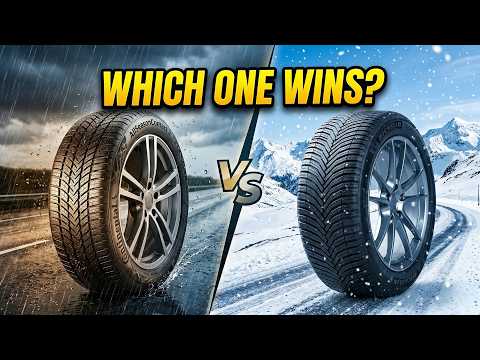
This article compares the Continental AllSeasonContact 2 and Michelin CrossClimate 3 all-season tires, analyzing their wet and snow performance, longevity, rolling resistance, noise, and price. Continental excels in wet conditions and offers better value, while Michelin provides superior snow performance, longer tread life, and better fuel efficiency. Choose based on your climate and driving needs.
Choosing the right all-season tire can be a daunting task, especially when faced with premium options like the Continental AllSeasonContact 2 and the Michelin CrossClimate 3. Both tires promise year-round performance, carry the snowflake certification, and come with a hefty price tag. However, they address different driving needs and conditions, and selecting the wrong one could mean compromising on performance in ways you might not expect.
In this article, we dive deep into independent test data, expert reviews, and real-world feedback to help you understand where each tire excels and where it falls short, enabling you to make an informed decision based on your driving habits and environment.
The Continental AllSeasonContact 2 was launched in fall 2023 as the successor to the original AllSeasonContact. It quickly established itself as the go-to tire for drivers who frequently encounter wet conditions.
In AutoBuild's 2024 test of 15 all-season tires, the AllSeasonContact 2 achieved an exceptional grade of 1.2 for wet properties, making it the winner in wet handling performance. It stops approximately 4.65% shorter from 100 km/h compared to the Michelin CrossClimate 2, and maintains a similar advantage over the newer CrossClimate 3. This difference translates to multiple car lengths in emergency braking scenarios.
This superior wet performance is attributed to Continental's innovative design, which includes a new V-shaped tread pattern combined with CBLock technology. The interlocking tread blocks create a stiffer contact patch, providing precise feedback even when driving through standing water at highway speeds. Additionally, open shoulder grooves efficiently channel water away, reducing the risk of aquaplaning.
In Alvalante's 2024 test, the tire scored 92 out of 100 points for wet handling.
The AllSeasonContact 2 also performs well in snow, earning the three-peak mountain snowflake rating, which signifies compliance with severe snow service requirements. Autobuild's testing gave it a grade of two plus for snow traction, placing it among the top three for snow braking and handling. It maintains stability during sudden steering maneuvers on snow-covered roads, an important feature for winter commutes.
Dry braking distances from 100 km/h are around 40.4 meters, which is good but not class-leading. The tire is slightly noisier than the Michelin CrossClimate 3, measuring 72 dB compared to 71.4 dB.
Continental claims a 15% increase in mileage over the original AllSeasonContact. However, in head-to-head wear testing against the CrossClimate 3, Michelin outlasts Continental by about 15,400 km, or 32% more life. Rolling resistance is competitive but not best in class, with the AllSeasonContact 2 measuring around 8.35 newtons per kilonewton compared to 7.39 for the CrossClimate 3.
The AllSeasonContact 2 is positioned as the value option, typically priced around €118 for a 225/40 R18 size, about 23% less expensive than the CrossClimate 3. It is ideal for drivers in rain-heavy climates such as the Pacific Northwest or the UK, or for electric vehicle owners seeking all-season versatility without excessive road noise.
Launched in Europe in July 2025, the CrossClimate 3 addresses criticisms of its predecessor, particularly in wet grip and treadwear.
The CrossClimate 3 improves wet braking by 4% over the CrossClimate 2, stopping approximately 3 meters shorter from highway speeds. Wet handling also improved by 10% compared to its predecessor. However, the Continental AllSeasonContact 2 still outperforms it in wet braking and handling, stopping 2.4 meters shorter and being 3.3 km/h faster in wet handling tests.
Where the CrossClimate 3 truly shines is in snow. It rivals dedicated winter tires, stopping 1.3 meters shorter than the AllSeasonContact 2 in snow braking tests. It generates 2,992 newtons of pulling force in snow traction compared to Continental's 2,951 newtons and is 1.4 km/h faster through slalom snow handling tests. This makes a significant difference in icy or snowy conditions.
Michelin engineered the CrossClimate 3 with max touch construction, distributing contact forces evenly across the tread. This results in 15% more mileage than the CrossClimate 2 and significantly more than the Continental. Autobuild's wear testing recorded 48,650 km of life for the CrossClimate 3, with 318 grams less tread material lost than the AllSeasonContact 2.
Rolling resistance is one of the CrossClimate 3's strengths, measuring 7.2 newtons per kilonewton, making it highly efficient and beneficial for electric vehicle range and fuel economy.
The CrossClimate 3 features piano acoustic tuning technology, reducing road noise even as the tire wears. It is consistently rated among the quietest all-season tires.
However, aquaplaning resistance is mid-pack, and it does not inspire the same confidence as the Continental in deep standing water at high speeds.
Dry braking from 100 km/h measures around 38.8 meters, which is competitive but not exceptional. Dry handling is composed and predictable but lacks the sharpness of dedicated summer tires.
Priced around €133 for a 225/40 R18 size, it is more expensive upfront than the Continental. However, its longer tread life and better fuel efficiency can make it more cost-effective over time.
The CrossClimate 3 is best suited for drivers in regions with real winters, snowy mountain passes, or unpredictable weather. It is also a smart choice for those seeking maximum mileage and low rolling resistance, including electric vehicle owners.
| Feature | Continental AllSeasonContact 2 | Michelin CrossClimate 3 |
|---|---|---|
| Wet Performance | Class-leading wet braking and handling | Good wet performance but behind Continental |
| Snow Performance | Strong snow capability | Superior snow grip rivaling winter tires |
| Dry Performance | Good but not class-leading | Competitive but not exceptional |
| Noise Level | Slightly noisier (72 dB) | Quieter (71.4 dB) |
| Longevity | Good, but less than Michelin | Best-in-class longevity |
| Rolling Resistance | Competitive but higher | Lower, better for fuel economy and EV range |
| Price | Approximately 23% less expensive | Higher upfront cost but better long-term value |
Choose Continental AllSeasonContact 2 if:
Choose Michelin CrossClimate 3 if:
Both tires are excellent all-season options, but your choice should depend on your specific climate, driving conditions, and whether you prioritize upfront savings or long-term value.
If you have experience with either tire, sharing your real-world feedback can help others make informed decisions.
Thank you for reading, and safe driving!