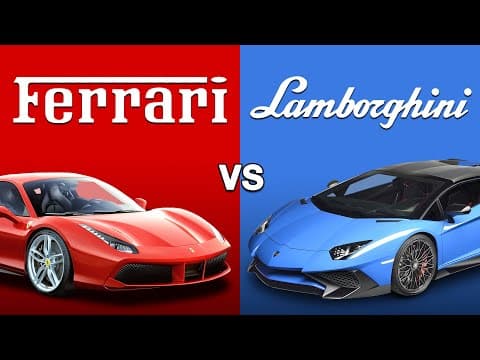
Ferrari and Lamborghini, two iconic Italian luxury sports car brands, have a deep-rooted rivalry marked by exclusivity, founder stories, company struggles, racing heritage, and signature features. Ferrari leads in sales, brand value, and racing success, while Lamborghini is famed for its bold designs and scissor doors. Both brands symbolize high performance and exclusivity, captivating car enthusiasts worldwide.
The rivalry between Ferrari and Lamborghini is one of the most famous in the automotive world, running deeper than many realize. Both brands are iconic Italian manufacturers of luxury sports cars, often labeled as supercars, and are headquartered within an hour's drive of each other. They produce high-quality, high-performance vehicles, mostly assembled by hand, and are synonymous with exclusivity and prestige.
When most people hear the names Ferrari or Lamborghini, they picture outrageously expensive, flashy cars that are more likely to be seen on television shows like "Cribs" than on everyday roads. Starting prices for these cars typically exceed $200,000, with many customers paying significantly more. Classic Ferraris rank among the most expensive cars ever sold.
These brands thrive on exclusivity. Enzo Ferrari, the founder of Ferrari, famously said the company's goal was to produce one less car than the market demanded. This exclusivity is maintained through long waiting lists, invitation-only purchasing opportunities, and a system designed to make ownership difficult. Despite this, both companies reported record sales in 2023: Ferrari sold 13,600 vehicles, and Lamborghini sold 10,100. To put this in perspective, Toyota sold 11.2 million vehicles that year.
Ferrari is the larger company, employing about 5,000 people compared to Lamborghini's 2,000. Ferrari went public in 2015 with a valuation of around $10 billion, which has since grown to over $80 billion. It is recognized as one of the strongest and most valuable brands globally. Lamborghini, privately owned and part of the Volkswagen Group through Audi, had revenues in 2023 roughly half that of Ferrari's, suggesting Ferrari's overall company value is higher, though past reports have placed them at similar valuations.
Enzo Ferrari produced the first Ferrari vehicle in 1947 after years in racing and the automotive industry. By the 1960s, Ferrari had become a highly respected ultra-luxury brand, exclusive to wealthy individuals and producing only a few hundred cars annually.
Ferruccio Lamborghini had a different path. Initially involved in farming and repurposing old war vehicles into tractors after World War II, he built a successful business in agricultural machinery. By the 1960s, Lamborghini was a wealthy individual who owned a Ferrari. However, dissatisfaction with the Ferrari clutch and a confrontation with Enzo Ferrari motivated him to start his own sports car company. Lamborghini wanted to prove he could build better cars, and within a few years, his company gained critical acclaim and celebrity attention, pulling customers away from Ferrari.
Both companies faced significant challenges:
Ferrari: By the late 1960s, Ferrari was struggling with increased competition and declining sales. A potential acquisition by Ford fell through due to disagreements over racing control. Eventually, Ferrari was sold to Fiat, which acquired 90% ownership after Enzo Ferrari's death.
Lamborghini: The 1970s oil crisis and recession hit Lamborghini hard, leading to financial difficulties and bankruptcy. The company changed hands multiple times before being acquired by Volkswagen in 1998, becoming part of Audi and stabilizing financially.
Neither brand has survived independently; both found success under larger corporate ownership.
Racing is a defining aspect of Ferrari's identity. The company has won numerous prestigious races over decades and is arguably the biggest name in auto racing. Enzo Ferrari himself was passionate about racing from a young age, and the company's stock market symbol, RACE, reflects this heritage.
In contrast, Lamborghini has had minimal involvement in racing. Ferruccio Lamborghini was not interested in racing, considering it a waste of resources. The company briefly participated in Formula 1 in the early 1990s under Chrysler ownership but without notable success. Since becoming part of Audi, Lamborghini has increased its racing activities but remains far behind Ferrari's legacy.
Ferrari is heavily associated with the color red, specifically "Rosso Corsa" or racing red. This tradition dates back to when Italian race cars were required to be red by the FIA. Ferrari has maintained this color long after the rule was lifted. Enzo Ferrari famously said that if you ask a child to draw a car, they will draw it red. While Ferrari cars can be ordered in various colors, red remains the most popular, with over 80% of customers choosing it in the 1990s.
Lamborghini is known for its distinctive scissor doors, often called "Lambo doors." First featured on a concept car in 1968 and then on a production model in 1974, these doors open upwards rather than outwards. This design is not only flashy but practical, allowing easier exit in tight parking spaces due to the car's wide and low profile.
The rivalry between Ferrari and Lamborghini is rich with history, passion, and innovation. Ferrari leads in sales, brand value, and racing success, while Lamborghini is celebrated for its bold designs and unique features. Both brands represent the pinnacle of Italian automotive craftsmanship and exclusivity.
While most people will never own one of these supercars, their impact on car culture and the luxury market is undeniable. Whether it's Ferrari's racing heritage and iconic red or Lamborghini's dramatic scissor doors, these cars continue to captivate enthusiasts worldwide.
If you have experience owning or driving a Ferrari or Lamborghini, your insights on their performance, attention, and value would be fascinating to hear. These brands are more than just cars; they are symbols of passion, innovation, and the pursuit of automotive excellence.