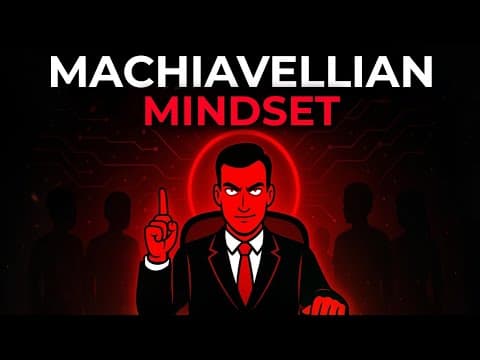
This article explores the Machiavellian mindset, a psychological approach to power and influence based on understanding human nature and perception management. It delves into the origins of power, the importance of strategic charm, and how true power lies in subtle influence rather than direct control. Embracing this mindset requires emotional distance and self-awareness, transforming power from illusion to reality.
What if I told you that power is not a weapon but a mindset? A way of thinking that, when understood correctly, allows you to influence people without touching or speaking to them. This is the beginning of the Machiavellian mindset — a mindset that places a person not just one step but ten steps ahead of others. It is not merely cunning; it is a game of perception where the winner is not the one who is most right but the one who is most wise.
Throughout every society and civilization, a question has always persisted: Where does power come from? Some say from God, others from the people, and some from morality. However, Machiavelli offered a different perspective. He said power does not come from morality; it comes from understanding human nature.
Niccolò Machiavelli, an Italian political thinker from the 1500s, wrote The Prince, a manual of power. He argued that humans are not honest but selfish. If you understand this truth, you can become a king in any crowd. According to him, the world is not divided into good and evil but into the strong and the weak.
Is this perspective bad? No. It is a harsh truth. Every relationship, job, and society is a subtle power game. Those who do not understand it fall into others' traps, while those who do become the creators of the game. This is where the Machiavellian mindset begins.
Consider when a person enters a room. Does their power show through their words first? No. It is their presence — their eyes, silence, and timing. A Machiavellian person knows that power is not about showing but about making others feel it. They control people not by speaking but by forcing them to think.
Power is an illusion that convinces others their choices are their own, while in reality, they are designed by you. A Machiavellian person does not control but influences. They understand others' weaknesses and recognize their needs, then subtly own those needs — never directly but always indirectly. Direct power creates fear, but indirect power becomes a habit.
If you learn this mindset, you can unknowingly become a king in any social structure. People will admire you but will not understand why every step you take seems calculated. This is Machiavellian brilliance.
This mindset is not for everyone. It requires emotional distance, the strength to observe your ego, and the courage to dissect your humanity. You must see yourself as a scientist and others as experiments. This may seem harsh, but it is where true power is born — from awareness.
Ask yourself: Can you feel that cold, deep part inside you that is made only to observe, not to feel? If yes, you are on the first step. The remaining steps will lead you to where power is not an illusion but reality.
Have you ever noticed some people attract attention effortlessly? They say little, yet there is a strange pull around them. This pull is not genuine but created. This is strategic charm — a game of perception where the winner is the most wise, not the most right.
Strategic charm is not mere cunning but a subtle tactic. Every smile, word, and glance is carefully chosen. The first rule of strategic charm is to appear genuine, even if you are not. Humans are driven by emotions, so whoever touches their emotions can change their decisions.
The Machiavellian mindset teaches us that power is a psychological game rooted in understanding human nature and perception. It is about influencing rather than controlling, about subtlety rather than force. Embracing this mindset requires self-awareness and emotional detachment but offers the ability to navigate social structures with calculated brilliance.
If you have found this glimpse into the Machiavellian mindset intriguing, stay tuned for further chapters where we will explore a world where good and evil fade, and only power remains.
This article has unpacked the essence of the Machiavellian mindset, revealing how power is less about morality and more about strategic influence and perception management. Understanding and applying these principles can transform your approach to human behavior and social dynamics.