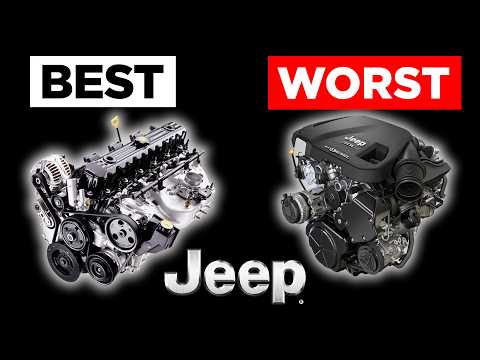
Jeep engines have powered some of the most iconic vehicles in automotive history, from World War II battlefields to rugged off-road trails. This comprehensive ranking explores every Jeep motor ever made, evaluating them based on durability, performance, and legacy. Prepare to discover which engines stand tall and which ones fell short.
Number 10: AMC 4.0L Inline 6 - The King of Jeep Engines
Topping the list is the AMC 4.0L inline 6, an engine that has become synonymous with Jeep reliability and ruggedness. Introduced in 1987 inside the XJ Cherokee, this engine survived nearly 20 years, three corporate owners, and millions of miles of abuse.
- Design: Cast iron block and head, pushrod valve train, no variable valve timing, no turbo, no overhead cams.
- Performance: 190 horsepower and up to 235 lb-ft of torque.
- Strengths: Smooth, usable torque at low RPMs ideal for trail driving, crawling over boulders, deep mud, and steep inclines.
- Durability: Known for its simplicity and fewer moving parts, it is famously difficult to destroy. Some owners have reported over 500,000 miles without a rebuild.
- Weaknesses: Cylinder head cracking issues in 2000-2001 models.
Motor Trend praised the 1997 Cherokee's 4.0L for its longevity and capability in harsh conditions. When Chrysler discontinued it in 2006, many Jeep enthusiasts mourned the loss of this legendary powerplant.
Number 9: Willys Go Devil L134 Flathead - The Engine That Built the Jeep Kingdom
The Go Devil engine is the foundation of Jeep's legacy. Designed in the late 1930s by Delmare Barney Roose, this 134 cubic inch flathead inline 4 produced 60 horsepower and 105 lb-ft of torque.
- Historical Significance: It powered over 600,000 military Jeeps during World War II, contributing significantly to Allied victories.
- Design: Low compression ratio (6.48:1) allowed it to run on low-quality fuel; lightweight at 365 lbs.
- Post-War Use: Powered the first civilian CJ2A Jeeps, widely used by farmers and ranchers.
- Longevity: Produced until 1965, serving for 25 years.
This engine didn't just power vehicles; it helped change the outcome of a global conflict and established the Jeep brand.
Number 8: AMC 258 Inline 6 - The Tough Older Relative of the 4.0
Before the 4.0L, the AMC 258 was the workhorse that made it possible.
- Specs: 4.2L displacement, cast iron block, seven main bearings.
- Performance: Approximately 120 horsepower and 200 lb-ft of torque.
- Applications: Powered CJ5s, CJ7s, Wagoneers, J series trucks, and early YJ Wranglers.
- Durability: Legendary for toughness; stories include running despite severe block damage.
- Weakness: The Carter BBD carburetor on emissions-era models caused many issues.
Many Jeep builders believe the 258 had better bottom-end torque than the 4.0 due to its longer stroke.
Number 7: 3.6L Pentastar V6 - The Divisive Modern Powerplant
Introduced in the 2012 Wrangler, the 3.6L Pentastar V6 brought significant power improvements but also sparked controversy.
- Performance: 285 horsepower and 260 lb-ft of torque.
- Recognition: Named on Ward's 10 Best Engines for three consecutive years.
- Issues: Early models (2011-2013) suffered from left cylinder head failures and rocker arm problems causing the infamous "Pentastar tick." A class-action lawsuit was filed over these defects.
- Oil Filter Housing: Factory plastic housing prone to warping and leaking, leading to fire risks.
- Reliability: When maintained properly, many owners exceed 200,000 miles without major issues.
- Popularity: Currently the most popular Wrangler engine among automatic transmission buyers.
While not a legend, the Pentastar is a massive improvement over its predecessor and performs well for daily driving and moderate off-roading.
Number 6: Willys Hurricane F134 - The Smarter Successor to the Go Devil
The Hurricane engine improved upon the Go Devil with better breathing and more power.
- Specs: 134 cubic inches, F head valve layout.
- Performance: 72 horsepower.
- Applications: Powered CJ3B, CJ5, CJ6, and military M38A1 vehicles.
- Strengths: Simple, tough, and ideal for slow-speed trail crawling and farm work.
- Weakness: Power was modest as vehicles grew heavier.
The Hurricane bridged the gap between wartime flathead engines and the inline 6 era.
Number 5: 2.0L GME Turbo Inline 4 - The Modern Turbocharged Contender
A surprising entry, the 2.0L turbocharged inline 4 debuted in the 2018 JL Wrangler.
- Performance: 270 horsepower and 295 lb-ft of torque, surpassing the 3.6 Pentastar in torque.
- Technology: Twin-scroll turbo delivering peak torque at 3,000 RPM.
- Engineering: Shared with Alfa Romeo Giulia and Maserati Ghibli Hybrid.
- Reliability: Early models had coolant leaks and carbon buildup issues; long-term durability still unproven.
- Fuel Economy: Owners report 19-22 MPG, significantly better than larger engines.
- Popularity: Currently the best-selling Wrangler engine for automatic transmission buyers.
While promising, this engine has yet to earn legendary status in the Jeep community.
Number 4: Buick Dauntless 225 V6 - The Powerful Oddfire Engine
Adopted by Kaiser Jeep in 1966, the Buick Dauntless 225 V6 was the most powerful engine available in CJ models at the time.
- Specs: 225 cubic inches, 160 horsepower.
- Durability: Some engines ran for over 34 years without major work.
- Characteristics: Oddfire design caused rough idle, disliked by inline 6 enthusiasts.
- Legacy: Retired after AMC bought Jeep in 1970 but continued production by GM for 35 more years.
Its long production run attests to the engine's solid design.
Number 3: AMC 2.5L Inline 4 - The Underpowered Budget Option
Born in 1984, the AMC 2.5L inline 4 was a shortened version of the 4.2L six-cylinder.
- Performance: 117 to 130 horsepower, insufficient for Jeep's weight.
- Reliability: Rugged and reliable, often surpassing 200,000 miles with basic maintenance.
- Driving Experience: Rough and underpowered, especially with larger tires.
- Purpose: Offered as a low-cost entry engine to attract buyers.
Despite sharing DNA with the legendary 4.0L, the 2.5L failed to deliver adequate power, leading to widespread frustration.
Number 2: 3.0L EcoDiesel V6 - The Promising Yet Controversial Diesel
The 3.0L EcoDiesel V6 promised torque and fuel economy but was marred by scandal and mechanical issues.
- Performance: 260 horsepower and 442 lb-ft of torque.
- Fuel Economy: 25-30 MPG highway in the Grand Cherokee.
- Controversy: FCA was accused of using defeat devices to cheat emissions tests, resulting in an $800 million settlement.
- Mechanical Issues: Exhaust gas recirculation clogging, diesel particulate filter problems, and expensive repairs.
- Legacy: Pulled from Wrangler and Gladiator lineups, leaving a legacy of unfulfilled potential.
The EcoDiesel offered what Jeep owners wanted but lost trust due to corporate misconduct and high maintenance costs.
Number 1: 3.8L V6 - The Worst Jeep Engine Ever Made
At the bottom of the list is the 3.8L V6, a minivan engine repurposed for the 2007 JK Wrangler.
- Origin: Designed in 1991 for front-wheel-drive Chrysler minivans like the Dodge Caravan.
- Performance: 202 horsepower and 237 lb-ft of torque, with power arriving at high RPMs.
- Issues: Poor low-end torque, sluggish performance, excessive oil consumption (a quart every 2,000 miles).
- Reliability: Engines failed around 100,000 miles due to piston ring and bearing failures caused by oil starvation.
- Design Flaws: Factory oil pan lacked baffling, causing oil starvation during off-road tilting.
- Aftermarket Fixes: Baffled oil pans were developed to address this critical flaw.
- Community Reaction: Widely regarded as the worst engine Jeep ever used, replaced by the 3.6 Pentastar in 2012.
This engine's unsuitability for off-road use and poor reliability make it a cautionary tale in Jeep history.
Jeep's engine history is a tale of innovation, ruggedness, and occasional missteps. From the war-winning Go Devil to the legendary AMC 4.0L inline 6, these engines have shaped the brand's identity. Meanwhile, modern engines like the Pentastar and 2.0L turbo show promise but face challenges earning legendary status. The 3.8L V6 serves as a reminder that not all engines fit the Jeep ethos.
Which Jeep engine surprised you the most? Share your thoughts and experiences with these powerplants in the comments below. For those looking to maximize their Jeep's longevity, following proven maintenance practices is key to keeping these engines running strong for miles to come.