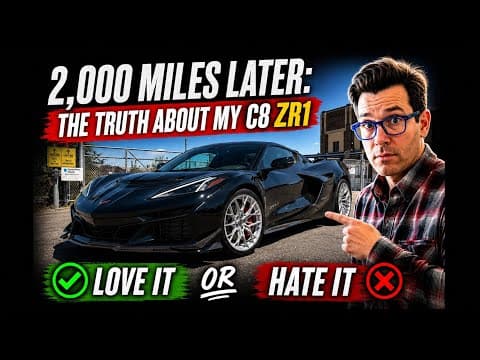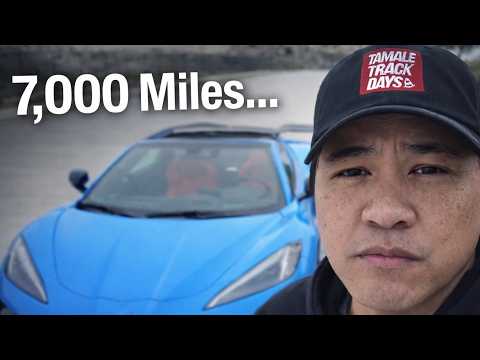
After only 7,000 miles, my C8 Z06 suffered a catastrophic engine failure during a casual drive, not at the track. The diagnosis revealed metal fragments in the oil, leading to a full engine replacement under warranty. Despite this setback, I still love the car for its sound, performance, price, and warranty, and I continue to enjoy driving it on the track.
At about 7,000 miles on the odometer, my C8 Z06 engine blew up. I had put 4,000 miles on it under my ownership. Contrary to popular belief, this failure did not happen at the track. I wasn’t pushing the car hard; I simply took it to Angeles Crest Highway. The drive up was fine, the drive down was fine, and I parked the car at Panera Bread near Target for lunch. When I returned an hour later, the car would not start.
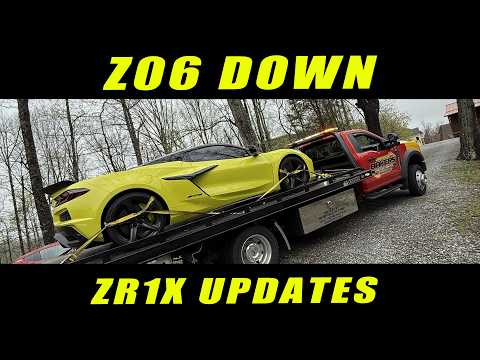
Initially, I thought it was a battery issue, but the battery was completely green and fine. I called OnStar, who arranged a tow truck. However, we encountered another problem: the car could not be put into neutral because the engine needed to be on to shift to neutral. There is no neutral release in this car. The only way to release neutral is to disassemble the trunk, access the transmission, and use a special $200 tool provided by Chevy. Since I didn’t have this tool, the tow truck driver used skates to drag the car onto the truck.
The nearest dealer was Coina Chevrolet. We towed the car there, and I stayed nearby in a hotel to await diagnosis.
The GM technician checked all electrical components and the starter, which were fine. He tried to hand crank the engine, which turned but felt rough with a lot of feedback. Upon checking the oil and oil filter, they found metal fragments inside.
The technician sent photos and videos of the metal fragments to GM corporate, who authorized a new engine replacement. From my last track day to the canyon drive, about two weeks passed. The car started and drove fine that morning, but after shutting it off for an hour, it failed to start again.
Now, with about 8,000 miles on the car, it has a brand new engine and an extended warranty on the replacement. This should allow me to drive stress-free, but the early failure still raises questions about GM’s reliability, especially when driving the car as intended.
I purchased this Z06 with the Z07 package about four months ago. In that time, I took it to two and a half track days: one at Buttonwillow and a double-header hosted with a friend at Tamalei track days. On the second day, I pushed the car hard with new Nankang CRS tires, achieving a lap time of 1:55 flat.
That track day solidified my love for the car.
I bought this car for four main reasons:
Sound: The flat-plane crank V8 sounds incredible. While it doesn’t sound exactly like a Ferrari 458, it’s still to die for.
Performance: The horsepower, torque, and dual-clutch transmission deliver impressive lap times. Despite my sloppy laps, I’m as fast in this car as in my GT3 RS.
Price: I paid $120,000 for this car with the Z07 package. You can find them cheaper now. For the performance and price, it’s unbeatable.
Warranty: My previous GT4 RS and GT3 RS had cracked rear and quarter windows, costing nearly $10,000 to $12,000 to replace. Those cars were out of warranty, so I wanted a car with warranty coverage to avoid expensive repairs. Engine replacement out of warranty can cost $60,000 for a used engine or $100,000 to $120,000 for a new one. With warranty, it’s about $15,000 if you return the core.
The engine failure was a shocking surprise, especially at such low mileage. I had expected the warranty to protect electronics and minor issues, not a catastrophic engine failure. This has left me with a bit of a bad taste regarding GM.
However, I understand that defects happen. My GT4 ordered new a few years ago also had an engine replacement due to a recall affecting many cars. This current failure seems to be a one-off quality control issue rather than a widespread problem, as there is no official bulletin about multiple engine failures.
Despite the failure, I still love the car. The performance is excellent, and I can put down track times comparable to my GT3 RS with minimal modifications—just new tires and a track alignment.
Upcoming track days include Buttonwillow on March 13th and Czechala on April 6th. With new Nankang CRS tires, I expect to improve lap times further.
Many ask how this car compares to Porsches like the GT3 RS and GT4 RS. The C8 Z06 is heavier but hides the weight well due to its power. The driving dynamics—corner entry and exit—feel similar to a GT4 RS. The dual-clutch transmission feels like Porsche’s PDK.
The biggest difference is in the brakes. The C8 Z06 uses brake-by-wire technology, which means the brakes are electronically controlled with a physical brake booster. Initially, there is zero pedal feedback, making it feel like driving a simulator. It took me a few laps to get used to the brakes.
When ABS activates, there is no pulsating feedback as in traditional hydraulic brakes. Instead, a blinking ABS light on the dash indicates activation. This lack of feedback can be unsettling at first.
I tell everyone that you cannot beat the performance of this car for the price. If you already own a Porsche 911 or GT4 RS, I wouldn’t recommend selling it for this car. But if you don’t have a Porsche and are considering a GT4 RS, the C8 Z06 is definitely worth considering.
The only downside is resale value, as many Corvettes are produced, which drives prices down. You can buy a GT4 RS for $170,000 to $220,000, but you’ll likely be more cautious with that car. The C8 Z06 can be enjoyed fully with a full warranty at a much lower price.
My previous video introduced this car before I took it to the track. Now, after experiencing it on track, I’m confident in how great this car is.
I will continue making videos comparing this car to Porsches and sharing my ownership experience. Stay tuned for more updates.
Thanks for reading!