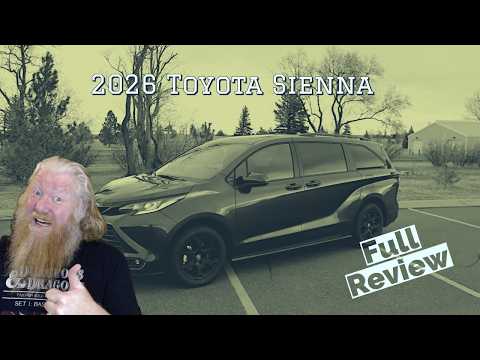
The 2026 Toyota Sienna is a benchmark minivan featuring a hybrid powertrain by default, offering excellent fuel economy of around 35 MPG and versatile seating for seven or eight passengers. While it lacks the ability to remove second-row seats and has some noticeable hybrid braking, it remains competitively priced and comfortable for most, making it a strong choice in the minivan market.
The 2026 Toyota Sienna continues Toyota's legacy in the minivan segment, offering a hybrid powertrain by default and a range of features that make it a strong contender in the market. This review covers the key aspects of the Sienna, including its performance, fuel economy, seating, pricing, and some personal observations.
The Toyota Sienna has been a long-standing minivan in the automotive market. The current generation was introduced around 2021 and has since been recognized as a benchmark minivan that others strive to match. It is notable for being a hybrid by default, which significantly improves fuel economy compared to other minivans.
One of the biggest selling points of the 2026 Sienna is its hybrid powertrain. It delivers a total output of 245 horsepower, which is adequate for a vehicle of its size, especially considering it often carries multiple passengers. While it is not a fast vehicle, it is competent and confident in its performance.
Fuel economy is impressive, with an average of about 35 miles per gallon regardless of whether you choose front-wheel drive or all-wheel drive. This is approximately 5 to 10 miles per gallon better than most other minivans currently on the market. In highway driving, the Sienna can achieve around 38 MPG, and in city driving, it can exceed 40 MPG with careful driving.
The Sienna offers seating configurations for seven or eight passengers, depending on the trim and equipment. However, a notable limitation is that the second-row seats cannot be removed or folded into the floor, unlike competitors such as the Chrysler Pacifica or Kia Carnival. This restricts cargo space somewhat, especially when trying to carry large items like 8-foot sheets of plywood.
Despite this, the minivan remains versatile and spacious, suitable for most family and daily needs.
The reviewer notes some personal discomfort with Toyota's seating, mentioning that the seats have changed over the past decade and are less comfortable for him, though his wife found them very comfortable. Headroom is adequate, and overall, the interior meets expectations for a minivan.
The hybrid braking system in the Sienna is noticeable, with a distinct transition from regenerative braking to physical braking. While not harsh, this sensation is more prominent than in other Toyota hybrids and may take some getting used to.
The base price for the 2026 Toyota Sienna starts around $43,000, including destination fees. Most buyers will likely opt for higher trims such as the XLE or XSE, which bring the price closer to $48,000 to $52,000. These prices are competitive within the minivan segment and generally lower than equivalently sized SUVs.
Compared to other minivans like the Chrysler Pacifica and Kia Carnival, the Sienna stands out primarily due to its standard hybrid powertrain and superior fuel economy. While it lacks some cargo flexibility due to non-removable second-row seats, it offers a smooth and confident driving experience with ample space and amenities.
The 2026 Toyota Sienna is a great minivan choice for those prioritizing fuel efficiency, reliability, and competitive pricing. It serves well as a family vehicle with versatile seating and a comfortable ride. Some personal preferences regarding seating comfort and braking feel may vary among drivers, but overall, the Sienna remains a benchmark in the minivan market.
If you are in the market for a minivan that balances economy, space, and features, the 2026 Toyota Sienna is worth considering.