The Chevy 327 L-79, a compact yet powerful engine, emerged in the 1960s as a performance icon. With 350 horsepower and a lightweight design, it outperformed larger engines in street racing. Despite its understated presence, the L-79 became a favorite among enthusiasts for its agility and effectiveness, leaving a lasting legacy in American muscle car history.
If you've ever seen a small Chevy Nova SS outrun monstrous big blocks on a quarter-mile strip, chances are you've witnessed the true power of a legendary engine that few know by name: the Chevy 327 L-79. In an era obsessed with big numbers—396, 427, even 454 cubic inches—the L-79 humbly arrived with just 327. But don't let the size fool you; this was one of the most powerful and balanced small blocks General Motors ever built.
In the early 1960s, the American car market was in the midst of an unprecedented horsepower race. Automakers were scrambling to release bigger, more powerful engines—Pontiac's 389, Ford's 406, and Chevrolet's own 409. While big blocks dominated magazine covers, General Motors quietly prepared a different strategy. They understood that not everyone needed or could afford to drive gas-guzzling monsters. Thus, Chevrolet focused on the 327 cubic inch small block, a compact engine with serious potential.
Initially, the 327 appeared in Corvettes and Impalas with outputs ranging from 250 to 300 horsepower. However, the real turning point came in 1965 when Chevrolet launched a high-performance variant: the 327 L-79. The mission was clear: create an engine that could elevate small cars like the Nova, Chevelle, or even the Corvette to an entirely new level without relying on sheer engine size.
From this need, a special variant of the 327 was born—one powerful enough to rival big blocks yet compact enough to create a whole new kind of performance. The L-79 was a precision-engineered package tucked inside a compact form, built to extract maximum performance from every cubic inch.
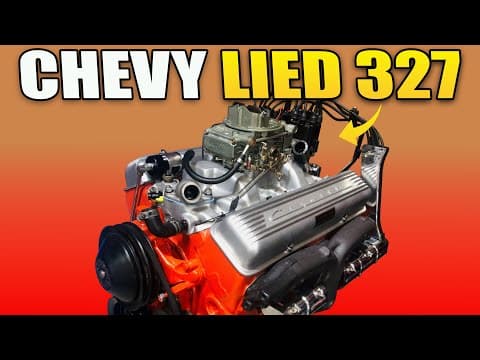
At its core was a high-performance hydraulic camshaft, a rare feature in mass-market performance engines. This cam allowed the L-79 to operate smoothly at over 6,000 RPM, making acceleration feel light and lively. Supporting it was a Holley four-barrel carburetor, a free-breathing intake and exhaust setup, and a compression ratio of 11:1—very high for its time. These elements combined to produce a peak 350 horsepower at 5,800 RPM with around 360 lb-ft of torque, all from just 327 cubic inches.
What truly made the L-79 stand out wasn't just its spec sheet; it was how it delivered that power to the pavement. Lightweight, responsive, and incredibly agile in the mid-range, the L-79 was perfect for drag strips or spirited street driving. Paired with a lightweight chassis like the Nova SS or Chevelle Malibu, the car's power-to-weight ratio became shockingly good.
Chevrolet didn't heavily promote the L-79. Instead, they quietly placed it into select models, creating true sleeper cars—mild in appearance but powered by the heart of a speed demon. The 1966 to 1968 Chevy Nova SS is perhaps the best example. A compact sedan not as flashy as a Chevelle or Camaro, when equipped with the L-79, it could humble just about anything on the drag strip. Weighing around 2,900 lbs, the Nova SS plus L-79 combo delivered an outstanding power-to-weight ratio.
Beyond the Nova, the Chevelle Malibu SS was another model that could be optioned with the L-79, bringing serious performance to a midsized coupe. The Corvette C2 also benefited from the L-79, giving it impressive sports car power while maintaining balanced handling.
Interestingly, many L-79 equipped cars didn't wear special badging. You wouldn't see L-79 proudly displayed anywhere on the exterior, which only added to their mystique and unpredictability. The very definition of a sleeper, the L-79 was a true assassin on the track. On paper, it might seem modest compared to big blocks like the 396 or 427, but on the track, especially inside lightweight cars like the Nova SS or Chevelle, it proved that speed doesn't always come from size.
With 350 horsepower and a light chassis, the L-79 could launch a car from 0 to 60 mph in about 5.8 seconds—an impressive feat then and now. Many Nova L-79s clocked in under 14 seconds on the quarter-mile, beating bigger, louder rivals. More importantly, the L-79 delivered smooth, natural, forceful acceleration. There was no need to rev sky-high or use giant slicks; just a timely press of the throttle, and the car shot forward like an arrow.
In the 1960s street racing scene, the L-79 was a favorite because it was fast and quiet, perfect for ambushing opponents without raising suspicion. No flash, no fame; the L-79 won through real-world effectiveness and shock factor. With such on-track dominance, you'd think the L-79 would be celebrated as a performance icon. Yet surprisingly, very few people, even seasoned car enthusiasts, know much about the L-79.
This lack of recognition isn't due to a lack of power but rather because Chevrolet nearly hid it in plain sight. First, the L-79 wasn't heavily advertised in sales materials; it was listed as just a performance option. There was no big marketing campaign, no magazine covers, and barely a mention in ads. Second, most L-79 equipped cars had no identifying badges or logos, making it easy to mistake for a base engine unless you checked the engine code. Finally, the L-79 showed up in models that didn't stand out visually, like the Nova or Chevelle, so it often flew under the radar.
However, that simplicity became the perfect disguise for the power within. Few knew about it, but those who owned an L-79 understood the true value it delivered. It was those who truly understood—street racers and gearheads alike—who quietly turned the L-79 into a legend.
The L-79 was beloved because it was fast, compact, and easy to modify. Thanks to its standard small block layout, owners could upgrade the cam, carb, and exhaust system without diving too deep into the engine's internals. The Chevy Nova SS was the go-to pairing; it looked like a mild-mannered sedan but underneath sat a finely tuned L-79 ready to launch the moment the light turned green.
The beauty of L-79 cars was that they didn't need to prove anything; they won through effectiveness by catching others off guard. Thanks to the hot-rodding community, engines like the L-79 finally got the chance to be fairly compared with more famous rivals. When judged purely on driving feel and real-world performance, the L-79 was more than capable of taking on big names like the 289 Hypo, Mopar 340, or even the 396 Big Block.
Against the Ford 289 Hypo, the 327 L-79 offered a significant power advantage—350 horsepower versus 271. With its unique hydraulic cam, the L-79 had quicker throttle response and a broader usable rev range. While the 289 was praised for its lightweight and durability, the L-79 stood out for smoother acceleration and stronger mid-range pull.
When compared to the Mopar 340, it was a fair fight; both were high-performance small blocks beloved by modders and easy to upgrade. However, the L-79 held a front-end weight advantage, translating to sharper handling in real-world conditions. When stacked against the Chevy 396 big block, the L-79 may have lacked peak horsepower, but it was also 150 to 200 lbs lighter, giving it a more balanced power-to-weight ratio. In a lightweight chassis like the Nova SS, the L-79 could deliver performance equal to or better than the heavier 396 in the quarter-mile.
Despite its impressive performance and popularity among gearheads, the L-79 couldn't stick around for long. By the late 1960s, the U.S. auto industry began facing major changes in regulations, consumer preferences, and government pressure. Emissions standards tightened, insurance costs for high-performance cars skyrocketed, and buyers began prioritizing comfort and fuel economy over speed. In that climate, high-compression engines like the L-79, with its 11:1 ratio, became increasingly difficult to keep in production.
Chevrolet had to simplify its engine lineup, favoring designs that were easier to regulate, cleaner to run, and better aligned with GM's long-term strategy. 1968 marked the final year the L-79 appeared in the catalog—no press release, no farewell; it quietly faded away just as it had quietly dominated.
However, its legacy didn't disappear. For those who ever drove a Nova or Chevelle with an L-79 under the hood, the memory remains vivid—a compact, quick-revving powerhouse that never needed to show off. For those who felt its power firsthand, the L-79 is more than just an engine; it's a living memory. The distinctive roar and smooth surge of acceleration have kept the L-79 alive in the hearts of enthusiasts.
In a world where performance is increasingly defined by tech and numbers, the L-79 reminds us of a time when power came from pure driving experience—from throttle response and the feeling of the engine waking up with a gentle push. The L-79 never needed to shout; it existed quietly but left a mark that can't be forgotten—not just in the hands of drivers but in the history of American muscle.
If you've ever encountered, owned, or simply admired the L-79, share your story in the comments. It's memories like yours that keep legends alive. If this journey meant something to you, don't forget to like, subscribe, and hit the bell so we can keep exploring the machines that carry America's beating heart.