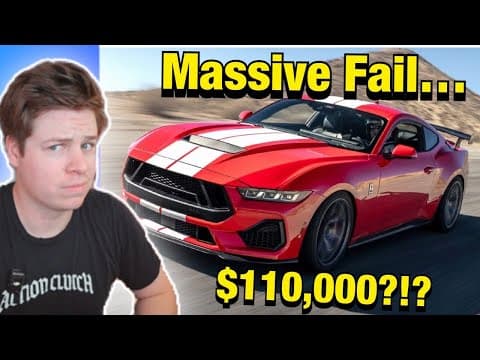
The S650 Mustang has seen disappointing sales due to rising costs, lack of significant innovation, and restrictions on modifications, leading to a decline in its appeal as an everyday sports car.
Sports cars are facing significant challenges in today's market, and the recent performance of the Ford Mustang is a prime example. The S650 Mustang, which was expected to revitalize interest in the iconic vehicle, has instead recorded the lowest sales in Ford Mustang history. In this post, we will explore the reasons behind this decline and what it means for the future of sports cars.
As a long-time Mustang enthusiast, I have a personal stake in this discussion. My girlfriend owns a Mustang GT from 2006, equipped with a built Gen 3 Coyote engine and a Whipple supercharger, producing nearly 1,000 horsepower. My journey into the Mustang world began with a simple desire for an affordable car that offered substantial power. The Mustang was marketed as the everyday man's sports car, but recent trends suggest that Ford has strayed from this original vision.
To understand the current situation, it's essential to look at the sales history of the Mustang:
However, since then, sales have been on a downward trajectory, culminating in the disappointing performance of the S650.
One of the most significant issues facing the S650 Mustang is its increasing price. The base model price has jumped from around $35,000 in 2018 to approximately $45,000 in 2024. This $10,000 increase in just six years is substantial, especially when considering that the Mustang was originally celebrated for its affordability. As prices rise, potential buyers are exploring other options that offer better value.
The S650 Mustang has been criticized for its lack of meaningful updates compared to its predecessor, the S550. While it features a new engine and some aesthetic changes, many enthusiasts feel that the updates are minimal. The performance remains similar, and the introduction of locked ECUs has frustrated car enthusiasts who enjoy modifying their vehicles. This restriction limits the appeal of the S650 to those who want to personalize their cars.
As the price of the Mustang approaches the $50,000 mark, it faces stiff competition from other sports cars that offer better performance, aesthetics, and features. For instance, potential buyers can find used C7 and C8 Corvettes, BMW M4s, and even Dodge Hellcats at similar price points, often with superior specifications. This makes it challenging for the Mustang to justify its price when compared to these alternatives.
The decline of the Mustang is not just a concern for Ford; it signals troubling trends for the sports car market as a whole. With the Mustang, a flagship model, struggling to maintain sales, other automakers may hesitate to invest in new sports car models. The lack of competition and innovation could lead to a stagnation in the market, which is detrimental to car enthusiasts and manufacturers alike.
In conclusion, the S650 Mustang's failure can be attributed to a combination of rising costs, lack of significant innovation, and restrictions on modifications. As a Mustang enthusiast, it is disheartening to see such a storied nameplate struggle in the current automotive landscape. The hope is that once the ECU restrictions are lifted, and Ford re-evaluates its approach to the Mustang, we may see a resurgence in interest and sales. Until then, the future of sports cars remains uncertain, and enthusiasts will continue to seek better value elsewhere.