The Renault Safrane Biturbo, a rare sports sedan, was developed to compete in the executive segment against German rivals. With a unique production process involving external tuning companies, it featured a powerful V6 engine with twin turbos, resulting in impressive performance. Despite its potential, only 806 units were produced due to high pricing and limited demand.
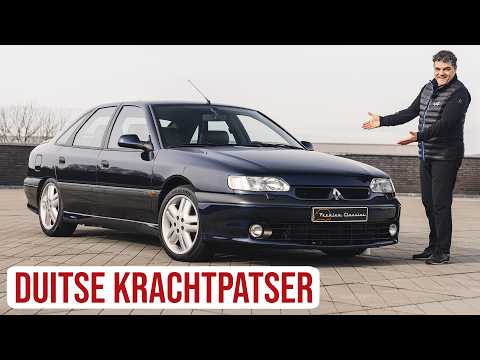
Ladies and gentlemen, we finally have the Renault Safrane Biturbo in front of us. This car has been a long time coming, and it represents an extinct breed of vehicles. Its rarity is not just due to its low production volume but also because of the incredible story behind this sports sedan.
Renault introduced the Safrane as a new name after using the designation 25 twice. The company believed that a new model deserved a new name to signify its freshness, especially in the competitive executive segment dominated by German manufacturers like Audi, BMW, and Mercedes-Benz, as well as Swedish brands like Volvo and Saab, and Italian competitors such as Alfa Romeo and Lancia.
Renault aimed to elevate the quality of their French limousine to compete in this lucrative market. They recognized that the German market had a strong preference for fast variants, which led to the idea of creating a high-performance version of the Safrane.
The development of the Renault Safrane ran parallel to the regular model, which included various engine options, both four-cylinder and six-cylinder, in gasoline and diesel variants. Renault wanted to create a flagship model that would enhance the image of the entire Safrane lineup. To achieve this, they decided to use the largest engine available for the Safrane, which was a well-known PRV engine (Peugeot, Renault, Volvo) that had been upgraded from 2.8 liters to 3.0 liters.
Initially, there was a turbo variant, but it did not meet Renault's standards for a top model. Instead of a single turbo, they opted for two turbos, which required a significant investment. Given the anticipated low production volumes, Renault sought external partners for the engine's development.
Renault approached several tuning companies, including AMG, Oettinger, AC Schnitzer, and Alpina, but ultimately partnered with Irmscher and Hartge. In November 1991, an agreement was signed with Irmscher for the assembly of the Safrane Biturbo.
The production process was unique: the cars were initially built in France as standard RXE models with a regular V6 engine and four-wheel drive. After assembly, they were transported to Germany, where Irmscher modified them. The engine was removed, sent to Hartge for the installation of the twin turbos and intercoolers, and then reinstalled by Irmscher.
The modifications significantly increased the car's performance. The V6 engine's power jumped from 170 to 268 horsepower, and torque increased by 130 Nm. The top speed reached 250 km/h, adhering to the gentleman's agreement among German automakers to include an electronic limiter to avoid exceeding competitive standards.
The acceleration time improved dramatically, with the Biturbo reaching 0 to 100 km/h in just 7.2 seconds, compared to 10.2 seconds for the naturally aspirated version. The Safrane Biturbo was only available with a five-speed manual transmission, emphasizing its sporty character.
One of the standout features of the Safrane Biturbo is its practicality. Under the rear shelf, there is a unique item: a garment bag designed to hold a suit. This feature allows business users to change outfits conveniently, showcasing the car's dual-purpose nature as both a luxury sedan and a performance vehicle.
Despite its impressive specifications and unique production process, the Safrane Biturbo did not achieve commercial success. Renault aimed to sell 500 units per year, but only 806 were produced over three model years from 1993 to 1996. The high price point and limited demand contributed to its rarity.
The Renault Safrane Biturbo is a fascinating example of automotive engineering and marketing. Its development involved collaboration with external tuning companies, resulting in a powerful and unique sports sedan. Although it did not achieve the sales figures Renault hoped for, it remains a rare gem in automotive history, appreciated by enthusiasts for its performance and distinctive character.