Lancia, founded in 1906, was a pioneer in automotive engineering, introducing groundbreaking technologies and winning numerous rally championships. However, after a series of ownership changes and a decline in quality, the brand now struggles with a limited lineup and a tarnished legacy.
Lancia, a name that resonates with automotive enthusiasts, has a storied history that reflects both innovation and decline. Once a leader in engineering and design, the brand now finds itself selling only one car in a single country. This blog post explores the fascinating journey of Lancia, from its groundbreaking beginnings to its current state.
In 1906, in Turin, Italy, two Fiat employees, Vincenzo Lancia and Claudio Fogliano, founded Lancia & C. Fabbrica Automobili. Their first car, the Lancia Alfa, was introduced in 1907, but it was far from remarkable. Lancia envisioned a company that would push the boundaries of automotive engineering, and soon, they began to do just that.
Lancia quickly established itself as a pioneer in automotive technology. In 1913, the Lancia Theta became the first production car to feature a complete electrical system as standard equipment. The 1922 Lancia Lambda followed, introducing the first production car with a monocoque chassis and a narrow-angle V4 engine. Lancia was also among the first to utilize a wind tunnel for car design with the 1937 Aprilia.
Tragedy struck in 1937 when Vincenzo Lancia passed away, leaving his wife Adele and son Gianni to lead the company. They brought in engineer Vittorio Jano from Alfa Romeo, who contributed to Lancia's continued innovation, including the introduction of the first 5-speed transmission in the 1948 Ardea.
Lancia's racing pedigree began to flourish in the 1950s. The 1951 Mille Miglia saw a Lancia Aurelia B20 win its class and finish second overall. Jano's designs led to the creation of the Lancia D24, which won prestigious races like the Carrera Panamericana and the Mille Miglia.
However, financial difficulties forced the Lancia family to sell the core of the company to the Presente family. The Lancia D50, a V8 Formula One car, was later acquired by Ferrari, where it continued to achieve success.
The 1960s and 70s marked a golden era for Lancia, particularly in rally racing. The Lancia Fulvia dominated the Italian Rally Championship, and the introduction of the Stratos in the early 1970s revolutionized rally cars. Designed specifically for rallying, the Stratos was compact, mid-engine, and incredibly agile, winning three consecutive World Rally Championships from 1974 to 1976.
Lancia continued to innovate with the development of the 037, which was built for the Group B rally class. The 037 was a formidable competitor, winning the manufacturers' championship in 1983.
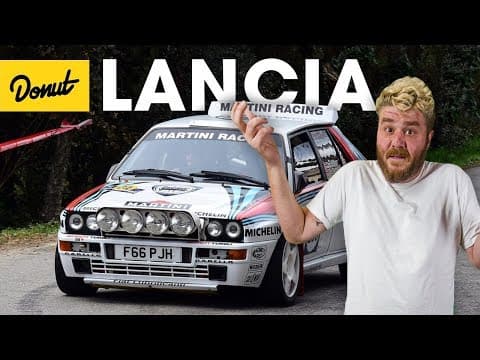
The Lancia Delta, introduced in the early 1980s, became one of the most successful rally cars in history. The Delta S4, with its twin-charged engine, dominated the Group B scene, winning multiple championships until the FIA ended the Group B era due to safety concerns.
Despite the end of Group B, Lancia adapted quickly, transitioning to the Delta HF 4WD in Group A, which continued to win championships throughout the late 1980s and early 1990s. The Delta Integrale, in particular, became legendary, securing six consecutive manufacturers' championships from 1987 to 1992.
Unfortunately, the 1990s marked the beginning of Lancia's decline. The brand struggled to maintain its reputation for quality and innovation, leading to a series of lackluster models. In 1969, Fiat acquired Lancia, and while there were attempts to revitalize the brand, it became known for rebadged Chrysler models and uninspired designs.
Today, Lancia's lineup is limited, and the brand's legacy is overshadowed by its past achievements. Despite this, there are whispers of a revival, with plans for a new Stratos inspired by the original rally legend, though it remains to be seen if Lancia can reclaim its former glory.
Lancia's journey is a testament to the highs and lows of automotive history. From pioneering innovations and racing triumphs to a decline in quality and relevance, Lancia's story is one of both inspiration and caution. As enthusiasts look back on the brand's legacy, the hope remains that Lancia can once again become a name synonymous with automotive excellence.