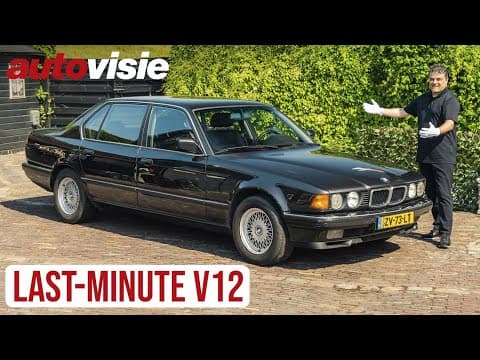
The BMW 7 Series E32, introduced in 1986, was initially not intended to feature a V12 engine. This blog explores the design challenges, strategic decisions, and engineering feats that led to the introduction of the V12 option, transforming BMW's flagship sedan into a formidable competitor against Mercedes-Benz.
My name is Sjoerd van Bilsen, and in this episode of Sjoerds' Weetjes, we delve into the fascinating story behind the BMW 7 Series E32, particularly its unexpected V12 engine option. This model, introduced in 1986, marked a significant shift in BMW's approach to luxury sedans.
The first generation of the BMW 7 Series, known as the E23, did not offer a V12 engine. However, the second generation, the E32, was set to change that. Interestingly, the E32 was not originally planned to include a V12 engine. BMW had a different vision for their flagship model, which was influenced by the work of an engineer who had previously worked at Audi.
The engineer in question was instrumental in developing the Audi 100, a car known for its aerodynamic efficiency. When he transitioned to BMW, he designed a sleek and compact version of the new 7 Series. However, this design lacked the commanding presence expected from a top-tier luxury sedan. Wolfgang Reitzle, the then-CEO of BMW, was not satisfied with the design, believing it would not compete effectively against rivals like Mercedes-Benz.
Reitzle's concerns led him to consult with various BMW employees about the design. While some agreed that the car was too compact, others were harder to convince. Ultimately, Reitzle's vision prevailed, resulting in a delay of about ten months for the design and development team to create a more spacious and imposing vehicle.
With the new design, the BMW 7 Series E32 became broader by four centimeters, providing more interior space. However, to accommodate a V12 engine, the entire engine bay had to be redesigned. Although a V12 engine had been conceptualized for the previous generation, the E32 required a completely new powerplant.
The delay in the development process allowed engineers to refine the V12 engine. One engineer, in particular, dedicated countless hours to perfecting this powerplant, which was completed just in time for Christmas. Reitzle described it as the perfect Christmas gift for BMW.
The V12 engine option was not available immediately upon the E32's launch; it was introduced a year later as the BMW 750i. This engine boasted a 5.0-liter capacity, producing 300 horsepower and driving the rear wheels. BMW aimed to make a significant impact in the automotive world with this announcement, showcasing a car that measured five meters in length, with an extended version offering additional legroom for rear passengers.
The development of the V12 engine was shrouded in secrecy. Even internal security guards were restricted from accessing the locked room where the engine was developed. To further protect their plans, BMW used different material codes for the engine components to prevent leaks about their new project.
Despite these precautions, Mercedes-Benz caught wind of BMW's developments and announced their own V12 engine shortly before the 750i's introduction. BMW's efforts to keep their plans under wraps were ultimately unsuccessful, as competitors often gleaned information through shared suppliers.
When the new BMW 7 Series was finally revealed, it took Mercedes-Benz by surprise. The management at Mercedes had anticipated a smaller vehicle based on the earlier design but were shocked to see the larger, more imposing E32. This revelation forced Mercedes to reconsider their own designs, leading to the reworking of the S-Class W140, which would later be known as "Fat Bertha" due to its poor sales performance.
The introduction of the V12 engine in the BMW 7 Series E32 marked a pivotal moment in the model's history. Although the first generation had considered a V12, it never materialized. However, the subsequent five generations of the 7 Series would feature a V12 option, with the first being the 5.0-liter engine producing 300 horsepower and the last reaching 6.6 liters and 610 horsepower.
The 750i nameplate referenced the engine's capacity, while later models transitioned to the 760i designation. Interestingly, while the 750i was a V12, later generations included a V8 variant under the same name.
The story of the BMW 7 Series E32 and its V12 engine is a testament to the brand's commitment to innovation and competition in the luxury sedan market. What began as a design challenge evolved into a defining feature that set BMW apart from its rivals. Today, while the current generation of the 7 Series does not offer a V12 engine, the legacy of this powerful option continues to resonate within the automotive community. The E32 remains a symbol of BMW's ability to adapt and thrive in a competitive landscape, showcasing the importance of strategic decision-making and engineering excellence in the automotive industry.