The Chevy LT5 DOHC V8, a groundbreaking engine developed through an unlikely collaboration between GM, Lotus, and Mercury Marine, was a technical marvel that elevated the Corvette to supercar status but was discontinued due to internal politics and cost issues, leaving a lasting legacy in automotive history.
Have you ever heard of a Corvette powered by a V8 engine as strong as a Ferrari's, yet not even designed by Chevrolet itself? Enter the Chevy LT5, a rare and mysterious DOHC V8 that stunned the car world in the early 1990s. The LT5 wasn't just an engine; it was GM's technical rebellion, born from an unlikely alliance between three names no one expected to collaborate: GM, Lotus, and Mercury Marine. This bold project aimed to crush every competitor from Europe and Japan and elevate the Corvette to global supercar status. However, just a few years later, it all ended quietly, leaving the LT5 as a forgotten king in Corvette history.
By the late 1980s, the Chevrolet Corvette was gradually losing its edge to European rivals like the Porsche 911 Turbo and Ferrari 328. GM recognized the need for something bolder—an engine powerful and different enough to bring the Corvette back into the global supercar arena. In 1986, General Motors acquired Group Lotus, the legendary British automaker and engineering firm known for its dominance in Formula 1 during the 1960s and 1970s. Their mission was to co-develop an entirely new engine, not just another reworked small block V8, but a revolutionary power plant built from scratch.
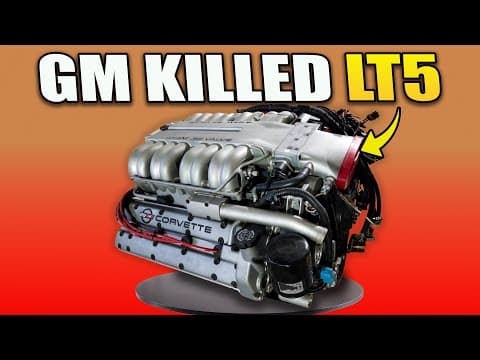
The result was the LT5, a 5.7 L DOHC V8 with 32 valves constructed entirely from aluminum. Lotus assembled a team of its finest engineers for the task, while Mercury Marine, known for building high-performance power boats, was chosen to manufacture the engine in Wisconsin. This collaboration was unusual yet groundbreaking, as GM needed hand-built quality and ultra-precise craftsmanship that traditional assembly lines could not replicate.
Initially, the project considered the innovative 4.0 L V8 engine from the Lotus Etna concept car, rated at 335 horsepower. However, it was deemed slightly underpowered and too bulky for practical use. To address these issues, the team opted for a completely new design, ultimately leading to the heart of the LT5. The engine featured a twin plenum intake manifold, allowing it to maintain strong power delivery across both low and high RPMs. Additionally, Lotus engineers integrated a proprietary active air management system that could temporarily deactivate one bank of injectors and intake valves under light load, improving fuel efficiency without compromising peak power.
When the engine debuted in 1990, it produced 375 horsepower, and by 1993, an upgraded version delivered 405 horsepower, making the Corvette ZR1 one of the fastest American cars of its era. The LT5 had no relation to GM's traditional small block engines; it was a standalone engineering marvel. The LT5-powered Corvette ZR1 set a series of world records for endurance and speed, notably driving over 7,000 miles in 24 hours at an average speed of over 175 mph on GM's test track. In straight-line performance, the ZR1 could accelerate from 0 to 60 mph in just 4.4 seconds, with a top speed exceeding 175 mph—astonishing figures even by European supercar standards of the time.
Despite its clear performance triumph, the LT5 was discontinued just three years after its debut. The reasons were not external but stemmed from within GM itself. The first major issue was cost; the LT5 was hand-assembled at Mercury Marine using premium materials and advanced manufacturing techniques, making the Corvette ZR1 significantly more expensive and pricing it out of reach for most mainstream buyers.
The second, more critical issue was internal politics. Many divisions within GM, especially the small block development team, viewed the LT5 as an outsider. It shared no components with other GM engines, wasn't built by Chevrolet, and was outperforming the very engines GM had long taken pride in developing in-house. Tensions grew as GM underwent a major corporate restructuring focused on cost-cutting and efficiency. In this climate, a foreign-designed, expensive, and non-standard engine like the LT5 had virtually no future. Consequently, in the fall of 1993, GM officially announced the end of LT5 production, a decision that stunned and saddened automotive enthusiasts.
Throughout its entire lifespan, the LT5 engine was used exclusively in the Corvette ZR1 from 1990 to 1995 and never found its way into any other GM vehicle. This uniqueness earned the ZR1 the nickname "King of the Hill" within the Corvette lineage. In total, only 6,939 ZR1s were produced over six years, with the most powerful versions from 1993 to 1995 accounting for only about a third of the total, making them incredibly rare.
Today, original ZR1s that still retain their stock LT5 engines are seeing sharp increases in value, with some selling for two to three times the price of a standard C4 Corvette, and rare examples crossing the $100,000 mark at major auctions. Although the LT5 was cut short prematurely, it left a lasting legacy among performance and engineering enthusiasts. Many experts agree that the LT5 was one of the most advanced engines GM ever produced, symbolizing a rare moment when GM broke all traditions in the pursuit of perfection.
In recent years, the restoration movement for original ZR1s has been steadily growing. Classic Corvette communities actively seek out ZR1s that still retain their original LT5s or invest in full engine rebuilds to preserve the car's authentic identity. Notably, in 2019, GM revived the LT5 name for the supercharged 6.2 L V8 in the C7 generation Corvette ZR1, but it was a completely different beast using a traditional OHV pushrod design.
The Chevy LT5 represents a rare moment when General Motors dared to push beyond its own boundaries. It was not the result of standard procedures but a statement that when an American automaker sets its sights on going toe-to-toe with Europe's finest, it can create something truly magical. Sadly, that magic was tucked away far too soon. However, with every surviving ZR1 and every time an LT5 roars to life, that legacy continues—fierce, proud, and alive.
If GM decided to revive the LT5, staying true to its original DOHC independence, would you want to see it return? Share your thoughts in the comments below.