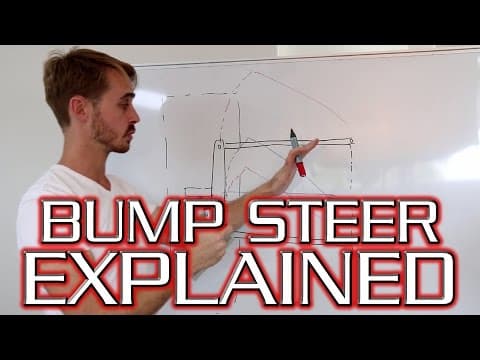
Bump steer is a phenomenon in vehicle suspension systems where tire movement due to bumps affects steering angles, leading to handling issues. This article explores the causes of bump steer, its implications on vehicle handling, and strategies for minimizing its effects, while also discussing scenarios where bump steer can be beneficial.
Bump steer is a critical concept in automotive suspension design that affects vehicle handling. In this article, we will explore what bump steer is, what causes it, how it impacts vehicle dynamics, and strategies for managing it effectively.
Bump steer occurs when the vertical movement of a tire, typically due to hitting a bump, causes the tire to rotate or change its steering angle without any input from the driver. This condition is generally undesirable as it can lead to unpredictable handling characteristics.
To understand bump steer, we can start with a simple example using a double A-arm suspension system. In this setup, when a wheel moves upward due to a bump, it follows an arc. The steering tie rod, which connects the steering rack to the wheel, also moves in an arc but at a different rate due to its length relative to the control arms.
In more complex suspension systems, such as those with kingpin inclination and unequal length A-arms, the principles of bump steer still apply. The angles and lengths of the components must be carefully considered to minimize bump steer.
While it is impossible to completely eliminate bump steer in a rack and pinion system, there are strategies to minimize its effects:
Bump steer can have both negative and positive effects on vehicle handling.
In most cases, bump steer is undesirable as it can lead to:
Interestingly, some drivers and engineers intentionally design for a certain degree of bump steer to enhance vehicle dynamics:
In off-road vehicles, bump steer is particularly problematic. As vehicles traverse uneven terrain, any bump steer can lead to:
For off-road applications, the goal is to achieve zero bump steer, which is challenging due to the significant suspension travel involved.
Bump steer is an essential consideration in vehicle suspension design, affecting handling and stability. While it cannot be entirely eliminated, understanding its mechanics and implementing strategies to minimize its effects can lead to improved vehicle performance. Whether on smooth tracks or rugged terrains, managing bump steer is crucial for ensuring a safe and enjoyable driving experience.