This blog post explores the fundamentals of suspension geometry, focusing on camber, toe, caster, and their impacts on vehicle handling and performance. It discusses how these angles affect tire grip, stability, and steering feedback, providing insights for both racing enthusiasts and everyday drivers.
Suspension geometry plays a crucial role in the handling and performance of a vehicle. In this post, we will delve into the key aspects of suspension geometry, including camber, toe, and caster angles, and how they influence the driving experience. This is part one of a two-part series, with the second part focusing on roll centers, pitch centers, and various suspension types.
A well-designed suspension geometry can significantly enhance a car's grip and handling. In racing, optimizing suspension geometry is essential for extracting maximum performance from tires. Good geometry contributes to stability and improves steering feedback, making the car more responsive. However, incorrect settings can lead to poor handling, making the vehicle difficult to drive, even in a straight line.
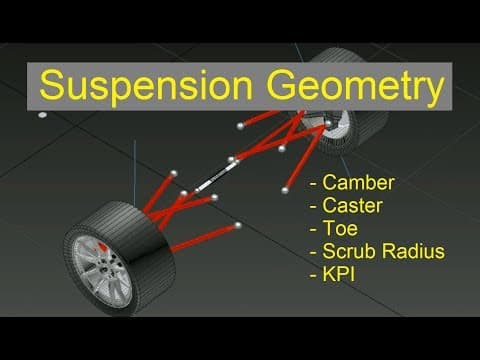
Camber refers to the tilt of the tire when viewed from the front. It can be positive (top of the tire tilts away from the car) or negative (top of the tire tilts towards the car). Camber is measured in degrees from vertical, with zero camber indicating a perfectly vertical tire.
In racing, the goal of adjusting camber is to optimize the tire's contact patch during cornering. A tire with zero camber may have a rectangular contact patch when stationary, but during cornering, the contact patch can deform, leading to uneven tire wear and reduced grip. By introducing negative camber, the contact patch can be optimized to maintain a rectangular shape during cornering, enhancing grip.
While negative camber improves cornering grip, it can compromise straight-line performance. A tire with excessive negative camber may have a reduced contact patch when driving straight, leading to decreased grip during acceleration and braking. Therefore, finding the right balance is crucial, especially in circuit racing where cornering is prioritized.
To determine the optimal camber settings, tire temperature measurements can be taken. If the outer edge of the tire is significantly warmer than the inner edge, it indicates that more negative camber is needed. Conversely, if the inner edge is warmer, it suggests too much negative camber is being used. Racing teams often utilize infrared sensors or pyrometers to monitor tire temperatures during races.
Toe refers to the direction the tires point when viewed from above. If the tires point inward, it is called toe-in (positive toe), and if they point outward, it is called toe-out (negative toe).
A slight toe-in can enhance stability, particularly at high speeds, while excessive toe-out can make a vehicle difficult to control. For instance, toe-out at the rear can lead to instability during cornering, as the rear tires will push the car towards a spin.
Toe angles can also change dynamically due to forces acting on the tires, such as acceleration or deceleration. This can lead to unpredictable handling characteristics, which is why many racing teams aim to minimize these changes by using rigid suspension components.
KPI, or kingpin inclination, is the angle of the steering axis from vertical. A properly set KPI helps reduce scrub radius, which is the distance between the center of the tire's contact patch and the point where the steering axis intersects the ground. A smaller scrub radius can improve steering feel and reduce torque steer in front-wheel-drive vehicles.
Caster is the angle of the steering axis when viewed from the side. Positive caster means the top of the steering axis is tilted towards the rear of the car. This angle is crucial for self-centering the steering wheel and providing feedback during high-speed driving.
In racing, caster can help gain camber in the right direction during cornering, allowing teams to run less static camber while still optimizing tire performance. However, increasing caster can also make steering heavier, requiring a balance between feedback and ease of steering.
Understanding suspension geometry is vital for anyone interested in vehicle performance, especially in racing contexts. Properly adjusting camber, toe, KPI, and caster can lead to significant improvements in handling, grip, and overall driving experience. In the next part of this series, we will explore more advanced concepts such as roll centers and different suspension types used in modern vehicles. Stay tuned for more insights into the fascinating world of suspension geometry.