Editorial Team
8 min read
Google DeepMind’s AlphaGenome 2 improves cell-specific DNA predictions and accepts new single-cell data without fine-tuning. Company benchmarks show gains at high confidence, but limited recall, complementary tools and greater computational demands leave experimental validation essential.
Google DeepMind, Google’s AI research unit, announced AlphaGenome 2 on November 11, extending its DNA prediction system to the specific cell types and states in which genetic changes act. The research tool could help scientists choose which disease-associated variants and target genes to investigate, but its benchmark gains do not establish that it can predict the outcome of laboratory interventions.
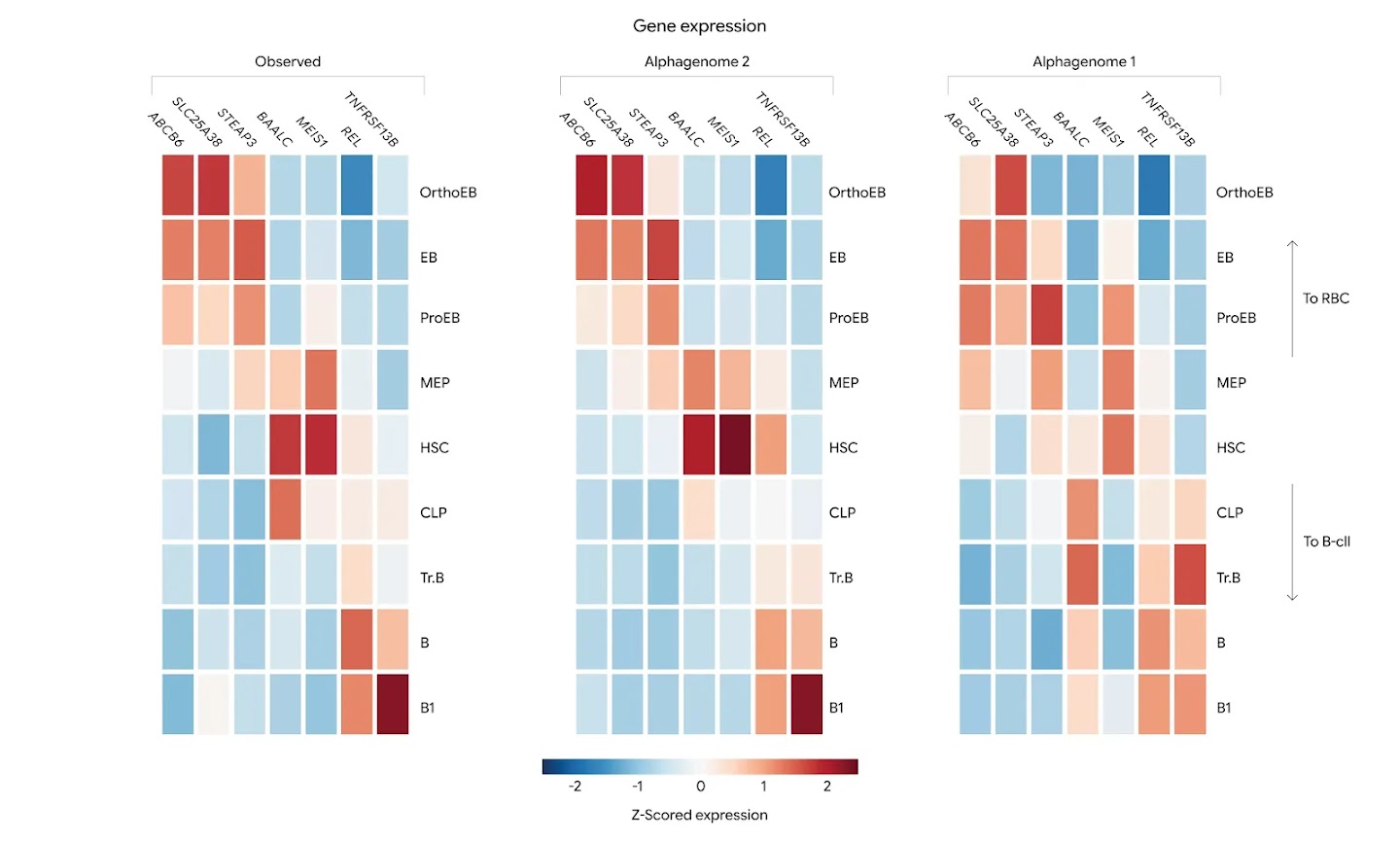
Company-reported gene-expression comparison across blood-cell differentiation: observations (left), AlphaGenome 2 (middle) and AlphaGenome 1 fine-tuned on single-cell data (right). Colors show Z-scored expression. Graphic: Google DeepMind. Source: Google DeepMind.
AlphaGenome 2 is a model for predicting gene regulation: how DNA sequences influence molecular activity, including which genes are switched on and how strongly. DeepMind, formed in 2023 by combining DeepMind and Google Research’s Brain team, launched the original AlphaGenome in 2025. It subsequently released AlphaGenome Atlas, containing predictions for all 9 billion possible single-letter changes in the human genome.
That breadth left an important resolution problem. A tissue sample mixes cells with different jobs, and a genetic variant can act in one population while having little effect in another. Non-coding DNA, which does not encode proteins but can contain switches controlling gene activity, makes up 98% of the human genome, as independent reporting on the launch explains.
James Lee, an immunologist and geneticist at the Francis Crick Institute who led a 2024 study identifying an inflammatory bowel disease mechanism, told that publication that the original model’s limited cell-type specificity had constrained its usefulness to his team. That is the practical problem the update seeks to address.
The new model takes a million-letter DNA sequence together with a specified tissue, cell type or cell state. Rather than generating a fixed collection of tissue outputs in parallel, it uses that biological condition throughout its architecture and predicts one condition at a time, DeepMind said in its announcement.
The sequence model was trained on human and mouse bulk and single-cell datasets. A separate cell-expression encoder was trained on a corpus of 107 million human single-cell gene-activity profiles spanning 68 tissues. A post-training stage aligned those representations with the frozen sequence model. Researchers can then supply their own single-cell RNA-sequencing measurements to describe a new cell population without fine-tuning the model for that dataset.
The system also predicts unmeasured properties, such as chromatin accessibility—how exposed DNA is to regulatory machinery—from available measurements. It adds DNA methylation to the molecular readouts supported by the earlier model. These capabilities could help select the next experiment when profiling every molecular feature of a scarce cell population is impractical.
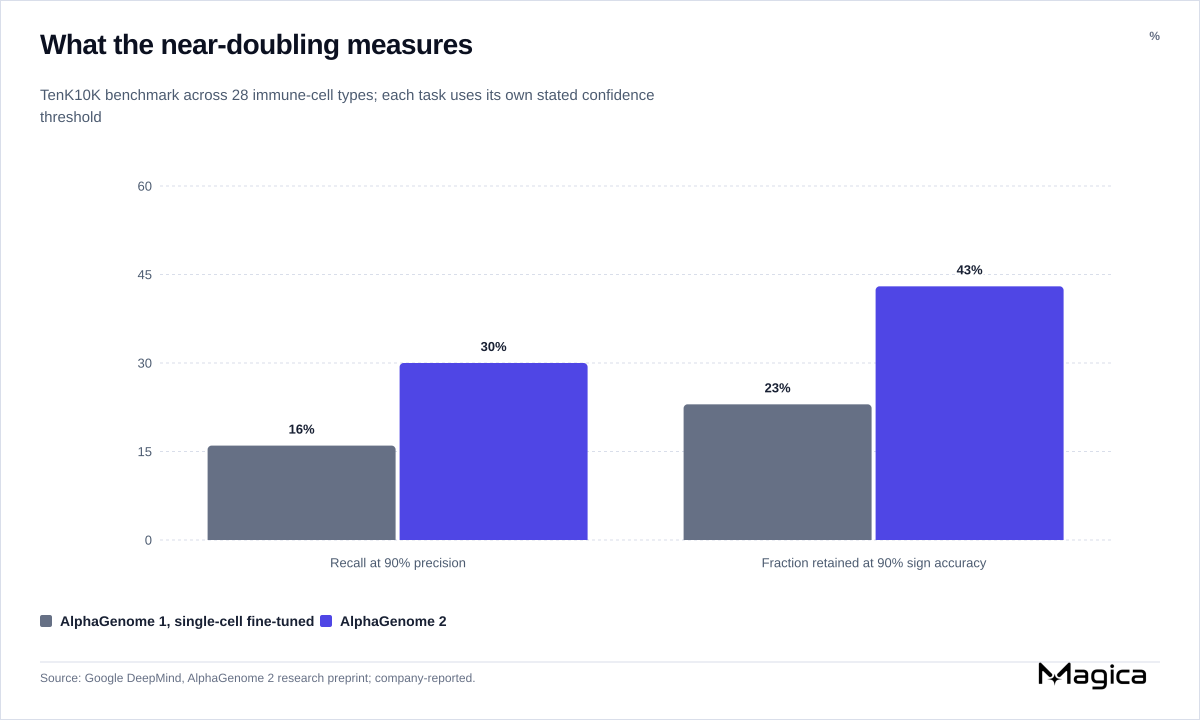
Company-reported TenK10K results across 28 immune-cell types: recall at 90% precision and the fraction retained at 90% sign accuracy. These are separate tasks, not overall accuracy rates. Chart: Magica; data: Google DeepMind. Source: AlphaGenome 2 research paper.
DeepMind’s “nearly twice” claim concerns recall at a demanding confidence threshold, rather than a doubling of accuracy across all tasks. In the company’s research preprint, the TenK10K expression benchmark covered 6,346 fine-mapped variant–gene–cell-type effects across 28 primary blood immune-cell types. These are effects associated with changes in gene expression, designated putatively causal through statistical fine-mapping. The work was funded by Google DeepMind and conducted by its employees.
| TenK10K expression task | AlphaGenome 1 fine-tuned on single-cell data | AlphaGenome 2 | Operating threshold |
|---|---|---|---|
| Recall of putatively causal effects | 16% | 30% | 90% precision |
| Fraction retained when predicting whether expression rises or falls | 23% | 43% | 90% sign accuracy |
The first comparison tested fine-mapped effects against equal numbers of negative controls matched for regulatory-region overlap and distance to the target gene’s transcription start site. Precision measures how many selected predictions were correct within that constructed test; recall measures how many positive examples the model recovered. Thus the 30% result still leaves most benchmark positives unrecovered at that threshold. It should not be read as a 90% success rate for finding disease causes in an unfiltered genome.
For the direction task, the model ranked the fine-mapped effects by predicted magnitude and retained the highest-ranked fraction at the stated sign accuracy. Across the full precision–recall curve for the first task, the improvement was more modest: its area rose from 0.72 to 0.76. The near-doubling describes a particular operating point.
A separate evaluation on held-out genomic regions supports the cell-resolution claim: across human and mouse tissue comparison groups, AlphaGenome 2 explained a median 34% of within-tissue variation in cell-type-specific gene expression, versus 23% for the fine-tuned predecessor.
The predecessor was a strengthened baseline, fine-tuned on single-cell data. The paper also compares AlphaGenome 2 with Scooby, a model of single-cell genomic profiles, and CREsted, a tool for modeling cell-type-specific enhancers. Cell-conditioned models already existed; DeepMind’s claim is better prediction and broader generalization, supported by its comparisons, rather than the invention of cell-specific sequence modeling.
The gains are uneven. On several bulk-tissue benchmarks for splicing, chromatin accessibility, DNase sensitivity and polyadenylation, the paper reports performance comparable to AlphaGenome 1. On an unseen brain dataset from 190 donors with and without Parkinson’s disease, however, the authors report better variant-effect predictions than cohort-trained CREsted and cohort-fine-tuned Scooby. The comparison used chromatin-accessibility effect direction for CREsted and gene-expression effect direction for Scooby. The latter relied on Scooby’s published predictions at its reporting threshold, rather than a full sweep of operating points.
Another comparison narrows any claim of general superiority. On TraitGym, a complex-trait benchmark with 11,400 variants and nine matched controls per positive example, the authors said AlphaGenome 2 matched GPN-Star, a predictor based on evolutionary conservation. Combining the two outperformed either alone, supporting the use of complementary signals when prioritizing variants.
A useful demonstration concerns inflammatory bowel disease. Experiments published in 2024 had established that a regulatory variant increases activity of the ETS2 gene in immune cells, despite lying roughly 290,000 DNA letters away from that gene. AlphaGenome 2 retrospectively selected the implicated variant from seven candidates, linked it to ETS2 and localized the predicted effect to monocytes and macrophages, according to the paper.
That result shows why identifying the nearest gene or averaging across a tissue can be insufficient. It is a computational recovery of an experimentally established mechanism, rather than a newly proven treatment target. The authors state that they conducted no new wet-lab experiments for the study.
The model also used previously unseen data from a COVID-19 vaccination study to distinguish activated immune-cell states. Its predictions nominated CXCR6, a gene encoding a chemokine receptor, as a target of a variant associated with COVID-19 severity, with stronger effects in particular activated T-cell populations. That remains a predicted regulatory mechanism requiring experimental scrutiny.
AlphaGenome 2 is available through the AlphaGenome API for noncommercial research, with commercial research in private preview. The documentation says noncommercial API use is free, query rates vary with demand, and live predictions suit analyses involving thousands of predictions rather than millions. Atlas lookups permit higher rates.
The redesigned architecture has a cost: the paper says a separate prediction is required for each condition, making it more computationally intensive than fixed-output multitask models. Finer biological resolution therefore increases the work required to scan many cell states.
The researchers precomputed scores for about 6.8 million common and trait-associated variants across 510 human conditions, alongside an enhancer–gene linking atlas across 640 primary human conditions. The downloadable release is filtered by predicted effect sizes and enhancer-link thresholds. These selected variant scores serve a different purpose from the earlier Atlas’s exhaustive single-letter coverage; the headline totals describe different resources.
For now, access also depends on the release channel. The paper promises model source code and weights upon final publication. DeepMind says it will additionally bring AlphaGenome 2 Skills to its Antigravity development platform, extending its planned distribution beyond the current API and tutorials. Commercial pricing and a timetable for broader commercial access are not specified in the launch materials.
The authors acknowledge that the model can underestimate effects outside accessible chromatin, at very distant regulatory elements and through mechanisms acting after transcription. Transient, stimulated and disease states remain underrepresented, and closely related neuronal populations can still be difficult to distinguish.
There is a deeper limitation: the cell representations come from observational profiles and encode correlations. The paper says it remains unclear whether AlphaGenome 2 can predict responses to gene knockout, overexpression or dynamic changes in cell state. Generalizing to a new observational dataset does not establish that it can predict what happens when a scientist intervenes.
DeepMind says it is working with collaborators to profile more cell types, developmental lineages and perturbed cell states. The consequential test for researchers is whether model-nominated variants and target genes hold up in prospective experiments, particularly where existing data are sparse. DeepMind says AlphaGenome 2 and its outputs have not been validated or approved for clinical or diagnostic use. As coverage of the launch notes, the company has announced no date for medical use.
Palantir’s co-founder and CEO says he could back a Democrat in 2028, while excluding a Democratic Socialists of America member. His Democratic history complicates talk of a political conversion; the more immediate question is how his government software company will answer congressional scrutiny.
ByteDance’s video model is reaching creators through multiple platforms with 30-second 4K output. Posted prices and draft workflows show why the choice of distributor still matters.
Rox’s $1.3 billion valuation backs AI agents for large enterprise sales teams. Its growth and cost claims face a crowded market, while integration with existing systems leaves the case for replacing Salesforce unresolved.
Google’s Gemini Decision 1 scores predefined choices across text, images, audio, video and PDFs for $0.10 per million input tokens. Its shared-input billing targets recurring workflow costs, but cheaper decision models, rival caching and low-cost generative alternatives complicate the savings claim.
Treasury and other agencies reportedly want Singapore cloud provider Megaspeed on a U.S. trade blacklist. Commerce denies a reported cabinet confrontation over the delay, while Nvidia says it has blocked shipments since June 2025.
United is restricting unauthorized AI agents from searching, booking and managing travel through its platforms and intermediaries. The airline cites security and safety risks as it reserves control over future integrations.
A controlled study found that pharmaceutical ads shifted AI recommendations toward promoted drugs without reducing overall clinical accuracy. The results expose a gap in accuracy tests, but do not establish effects on prescriptions or patient outcomes.
Former AWS computing chief Dave Brown will succeed Santosh Janardhan in early 2027 as Meta weighs its next capacity budget after a quarter of negative free cash flow.
Google is rolling out its Gemini app on Apple CarPlay, bringing voice conversations linked to Gmail and Google Calendar. It joins existing in-car AI options, while some personalized features remain restricted by age and region.
Google Labs’ Tabletop lets groups generate and use shared itineraries, polls and other interactive tools. The US adult-only experiment builds on an idea already offered by shareable AI app builders, leaving its practical advantage to be tested.
Anthropic’s IPO has reportedly attracted orders multiple times the available shares. Its planned $3 billion–$3.5 billion Japanese allocation would exceed Japan’s reported domestic IPO proceeds so far this year, but indications of interest are not completed sales.
Google warned that charging for news links would force it to stop distributing Indonesian news, while Meta and TikTok challenged other parts of the copyright bill. Existing Indonesian payment mechanisms and overseas deals complicate the platforms’ warnings about the cost to publishers.
Utrecht is investigating restrictions on camera glasses in municipal buildings, with findings expected in early 2027. The city must establish whether a ban is lawful, enforceable and compatible with assistive uses.
Research commissioned by cloud-storage supplier Wasabi estimates £3.8 billion in annual UK infrastructure overspend attributable to hard-to-forecast provider charges, including £1.2 billion for AI. Businesses report hiring and investment trade-offs, but recovering that money and turning it into jobs remain conditional.
The USDT issuer’s 800-million-parameter BotPsy beats a larger Qwen model on five of six company-reported agent benchmarks. Its local-AI ambitions still face missing handset measurements and explicit limits on sensitive uses.
Coinbase is rolling out server-enforced trading limits and portfolio-loss triggers for AI agents connected to customer accounts. Product-category permissions remain forthcoming, and pausing new trades does not establish a ceiling on losses.
JetBrains IDEs 2026.3 bundle Air for running coding agents and reviewing their changes, while the standalone Air app is in maintenance mode. Existing provider subscriptions remain usable, but billing, security controls and execution options vary by integration.

Amazon’s shares and convertible notes could be worth $271.8 billion at the top of Anthropic’s proposed IPO range. Existing accounting gains, a 12% ownership cap and Anthropic’s computing commitments shape what that paper value means.
Nvidia chief Jensen Huang argued in May 2025 that US chip restrictions were strengthening Chinese rivals. Filings show a substantial commercial stake, but lost sales and market share alone cannot establish whether the controls failed their security purpose.
Reported demand has Anthropic’s bankers considering a price above its filed $70–$78 range. The combined financing could exceed $100 billion, but existing cash, uneven operating results and long-term computing commitments complicate the valuation test.