Editorial Team
5 min read
Google Labs’ Tabletop lets groups generate and use shared itineraries, polls and other interactive tools. The US adult-only experiment builds on an idea already offered by shareable AI app builders, leaving its practical advantage to be tested.
Google introduced Tabletop on November 11, 2026, an AI experiment from Google Labs, its experimental product arm, for groups organizing trips, potlucks and recreational leagues. Users supply links, files and ideas, then generate interactive tools that invited participants can use together. Google describes the simultaneous collaboration as similar to a Google Doc in its announcement.
The practical proposition is a shared place to act on a plan: voting on dinner, tracking expenses or managing a tournament. But creating and sharing apps through prompts already has precedents, including within Google Labs. Tabletop’s launch makes group participation the focus; it does not yet demonstrate an advantage in cost, reliability or time saved.
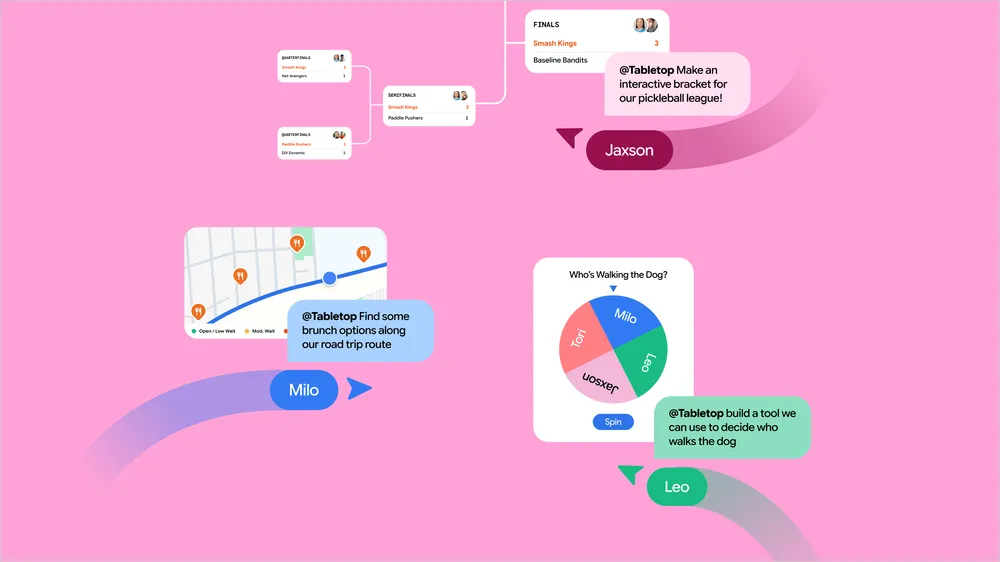
Google’s Tabletop examples include tournament brackets, route planning and a tool for assigning dog-walking duties. Image: Google. Source: Google.
Google says users can prompt @tabletop to create an itinerary, dinner poll, expense splitter or tournament bracket, or begin with a starter template. The organizer then distributes an invitation link through the group chat so others can join the space.
Google’s product examples also show tools being revised through conversation. A report describing those examples says members can ask @tabletop to change a rule or add a feature without rebuilding the space. One demonstration turns Pong into “Pickle Pong,” with a bouncing pickle and a live scoreboard. Other suggested uses include wedding planning, weekly meals and chores with points and a shared reward.
Google’s pitch extends beyond producing a plan for others to read. In launch coverage quoting the company, Google says participants can react, vote and edit together in real time. The same coverage describes potluck trackers, packing lists, roadside-stop voting, study groups and volunteer cleanup planning. These are proposed applications, rather than measured evidence that Tabletop improves coordination.
Palantir’s co-founder and CEO says he could back a Democrat in 2028, while excluding a Democratic Socialists of America member. His Democratic history complicates talk of a political conversion; the more immediate question is how his government software company will answer congressional scrutiny.
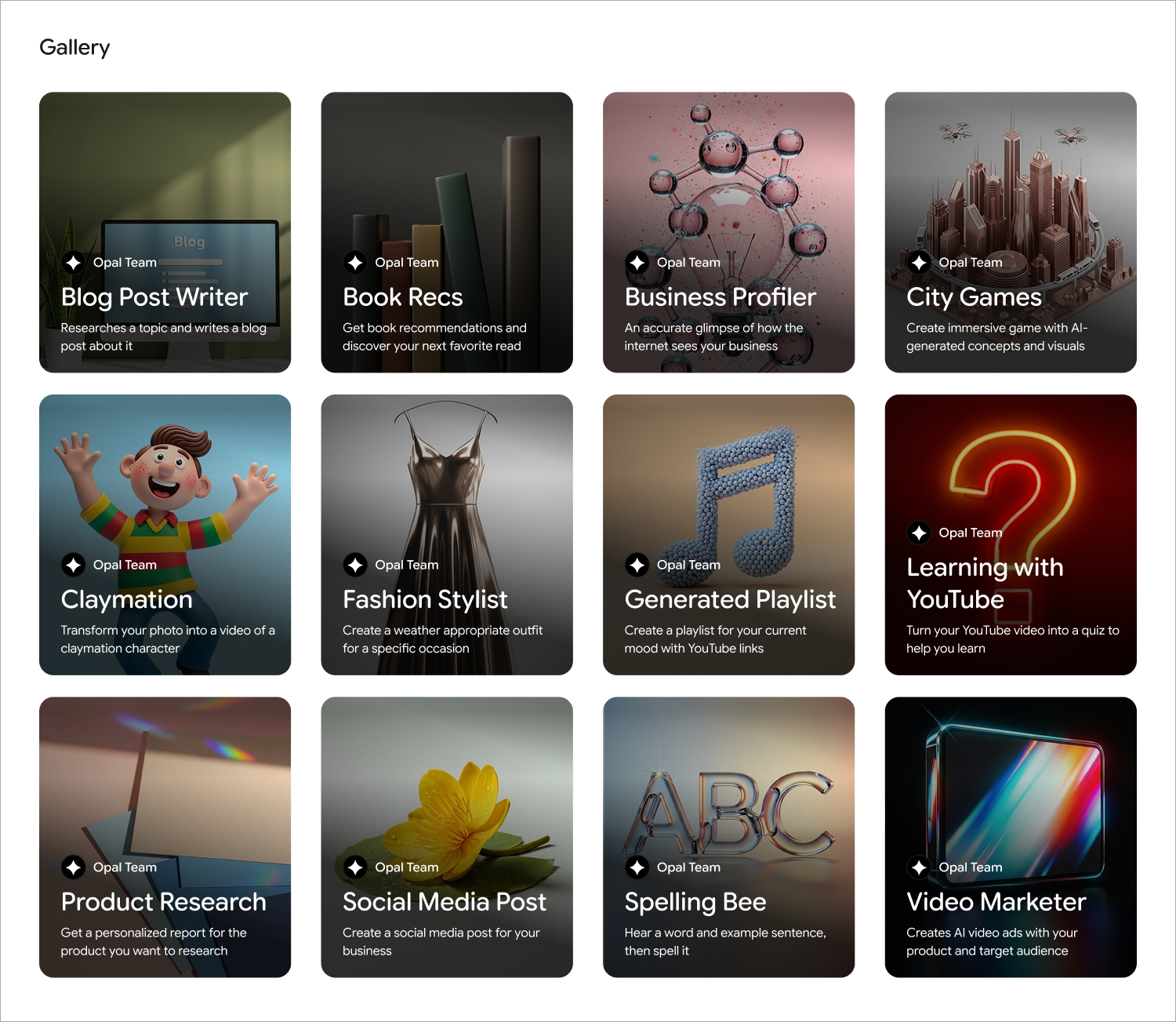
Google’s Opal launch gallery offered starter apps that users could use or remix. Image: Google. Source: Google Developers Blog.
Google Labs introduced Opal on July 24, 2025, an experimental tool for building AI mini apps through natural-language instructions and visual editing. Opal chains prompts, model calls and tools into workflows. Its launch announcement already offered conversational revisions, starter templates and sharing finished apps for others to use with their own Google accounts.
That is a closer precedent than simply asking a chatbot for advice. Tabletop brings a particular use case—people coordinating inside a shared space—to a broader app-building approach Google has already tested. A launch report also notes that Google’s Gemini app already supports trip planning, giving users an alternative when they need an itinerary rather than a collaborative tool.
Outside Google, Anthropic, the company behind the Claude AI assistant, offers artifacts: shareable apps, tools and games created through conversation. Its announcement describes embedding AI capabilities inside those creations, such as a flashcard app that generates cards for topics chosen by its users. It also allows people to customize existing creations; viewers can sign in to a Claude account for the full experience. An update on the page says artifacts support persistent storage.
The comparison is therefore about the experience of coordinating a group, rather than app generation, revision or sharing alone. These sources do not establish that the alternatives lack collaboration.
There are familiar alternatives outside AI app builders, too. Launch coverage noted visual similarities to the workplace-management apps Asana and Monday. Google’s own comparison to a shared document, and its reliance on group chats to distribute invitations, underline the existing habits Tabletop must fit into.
Google says Tabletop is rolling out in the United States for people aged 18 and older through a waitlist. The rollout report says new users will be admitted each week. No timetable for general availability or an international release has been announced in the launch coverage.
The age restriction matters to the family-planning pitch. Some demonstrations involve activities for children, but they do not establish that children can join a space themselves. The announced eligibility remains 18 and older.
The reports also differ on the underlying AI. Neowin identifies Tabletop’s chatbot as powered by Gemini, while The Next Web says Google has not disclosed the model. Google’s own announcement does not identify one, so the model cannot be treated as confirmed by that primary source.
The announcement also leaves pricing and usage limits unspecified and provides no adoption figures or measured time savings. There is consequently no basis here for a like-for-like cost or performance comparison with the alternatives.
The next evidence that matters is what happens after a group joins: whether the generated tools work reliably, remain easy to revise and reduce the organizer’s effort. Wider access and clear pricing would let users assess that trade-off. Until then, the launch establishes an experiment in shared planning, with its practical benefit still to be demonstrated.
ByteDance’s video model is reaching creators through multiple platforms with 30-second 4K output. Posted prices and draft workflows show why the choice of distributor still matters.
Rox’s $1.3 billion valuation backs AI agents for large enterprise sales teams. Its growth and cost claims face a crowded market, while integration with existing systems leaves the case for replacing Salesforce unresolved.
Google’s Gemini Decision 1 scores predefined choices across text, images, audio, video and PDFs for $0.10 per million input tokens. Its shared-input billing targets recurring workflow costs, but cheaper decision models, rival caching and low-cost generative alternatives complicate the savings claim.
Treasury and other agencies reportedly want Singapore cloud provider Megaspeed on a U.S. trade blacklist. Commerce denies a reported cabinet confrontation over the delay, while Nvidia says it has blocked shipments since June 2025.
United is restricting unauthorized AI agents from searching, booking and managing travel through its platforms and intermediaries. The airline cites security and safety risks as it reserves control over future integrations.
A controlled study found that pharmaceutical ads shifted AI recommendations toward promoted drugs without reducing overall clinical accuracy. The results expose a gap in accuracy tests, but do not establish effects on prescriptions or patient outcomes.
Former AWS computing chief Dave Brown will succeed Santosh Janardhan in early 2027 as Meta weighs its next capacity budget after a quarter of negative free cash flow.
Google is rolling out its Gemini app on Apple CarPlay, bringing voice conversations linked to Gmail and Google Calendar. It joins existing in-car AI options, while some personalized features remain restricted by age and region.
Anthropic’s IPO has reportedly attracted orders multiple times the available shares. Its planned $3 billion–$3.5 billion Japanese allocation would exceed Japan’s reported domestic IPO proceeds so far this year, but indications of interest are not completed sales.
Google warned that charging for news links would force it to stop distributing Indonesian news, while Meta and TikTok challenged other parts of the copyright bill. Existing Indonesian payment mechanisms and overseas deals complicate the platforms’ warnings about the cost to publishers.
Utrecht is investigating restrictions on camera glasses in municipal buildings, with findings expected in early 2027. The city must establish whether a ban is lawful, enforceable and compatible with assistive uses.
Research commissioned by cloud-storage supplier Wasabi estimates £3.8 billion in annual UK infrastructure overspend attributable to hard-to-forecast provider charges, including £1.2 billion for AI. Businesses report hiring and investment trade-offs, but recovering that money and turning it into jobs remain conditional.
The USDT issuer’s 800-million-parameter BotPsy beats a larger Qwen model on five of six company-reported agent benchmarks. Its local-AI ambitions still face missing handset measurements and explicit limits on sensitive uses.
Google DeepMind’s AlphaGenome 2 improves cell-specific DNA predictions and accepts new single-cell data without fine-tuning. Company benchmarks show gains at high confidence, but limited recall, complementary tools and greater computational demands leave experimental validation essential.
Coinbase is rolling out server-enforced trading limits and portfolio-loss triggers for AI agents connected to customer accounts. Product-category permissions remain forthcoming, and pausing new trades does not establish a ceiling on losses.
JetBrains IDEs 2026.3 bundle Air for running coding agents and reviewing their changes, while the standalone Air app is in maintenance mode. Existing provider subscriptions remain usable, but billing, security controls and execution options vary by integration.

Amazon’s shares and convertible notes could be worth $271.8 billion at the top of Anthropic’s proposed IPO range. Existing accounting gains, a 12% ownership cap and Anthropic’s computing commitments shape what that paper value means.
Nvidia chief Jensen Huang argued in May 2025 that US chip restrictions were strengthening Chinese rivals. Filings show a substantial commercial stake, but lost sales and market share alone cannot establish whether the controls failed their security purpose.
Reported demand has Anthropic’s bankers considering a price above its filed $70–$78 range. The combined financing could exceed $100 billion, but existing cash, uneven operating results and long-term computing commitments complicate the valuation test.