Editorial Team
5 min read
United is restricting unauthorized AI agents from searching, booking and managing travel through its platforms and intermediaries. The airline cites security and safety risks as it reserves control over future integrations.
United Airlines, the carrier owned by United Airlines Holdings, announced on November 11, 2026 that it is restricting unauthorized third-party AI assistants across its digital platforms and indirect booking channels. Its policy requires the airline’s permission even when a traveler has authorized an assistant to act.
United cites risks to customer information, unintended spending and safety acknowledgments. The commercial stakes are also explicit: its chief executive has objected to creating another intermediary, while the airline already spends billions of dollars a year distributing tickets. The restriction arrives while reported AI booking activity remains small.
United said in its announcement that it is updating booking, ticketing and distribution policies to restrict unauthorized personal AI agents both directly and through travel agencies and aggregators.
Its customer guidance defines the restriction broadly. An agent, bot, browser extension or browser feature is unauthorized if it searches, books, buys, manages or collects information on United’s website or app for a customer without United’s permission. Agencies and booking platforms also need permission to use their own third-party AI tools for United travel.
That scope matters because the policy is not confined to the moment money changes hands. United tells customers they may still use AI for general research and planning, provided the tool does not access its website or app. Assistive technology for customers with disabilities is unaffected.
A secondary account citing earlier reporting says agents can still surface United flights and fares but cannot finalize purchases through its site. United’s own guidance draws a more specific boundary: general research is allowed, but unauthorized tools may not access its website or app even to search.
United says sharing account credentials with personal assistants can expose sensitive information and allow unintended bookings, account changes or spending of MileagePlus loyalty miles. It also warns that automated check-in could skip safety information and potentially violate Federal Aviation Administration and Department of Transportation rules. Its example is the human acknowledgment that bags do not contain banned substances such as explosives.
Palantir’s co-founder and CEO says he could back a Democrat in 2028, while excluding a Democratic Socialists of America member. His Democratic history complicates talk of a political conversion; the more immediate question is how his government software company will answer congressional scrutiny.
Scott Kirby, chief executive of United and its holding company since May 2020 and previously president of both United and American Airlines, brings years of airline commercial leadership to that debate. His roles are documented in the company’s 2025 annual filing. The secondary account, citing earlier reporting of a Chicago event on November 10, quotes him saying: “To be honest, I don't want to create another middleman.”
The holding company reported $2.109 billion in distribution expenses for 2025, down from $2.231 billion in 2024. Those costs include credit-card fees, travel-agency and other commissions, and booking fees paid to global distribution systems. The filing attributes the $122 million, or 5.5%, decline primarily to a change in sales-channel mix and revised assumptions for credit-card fees. These are total distribution costs, not a measure of AI-agent expenses or savings from the new policy.
United already sells through its own website and app, traditional and online travel agencies, and other intermediaries. Its filing describes investment in New Distribution Capability, technology for marketing and selling airline products, alongside its direct channels. United says those channels can improve how it presents offers and reduce distribution costs; some legacy distribution technology can be more expensive and less capable. AI agents would therefore enter an existing contest over sales channels and customer relationships.
The secondary account also says United is seeing little AI-agent booking activity and that its systems can distinguish reservations made by people, conventional agencies and automated assistants. It supplies no booking share or detection-accuracy measure. That leaves the scale of current use and the practical effectiveness of enforcement unquantified.
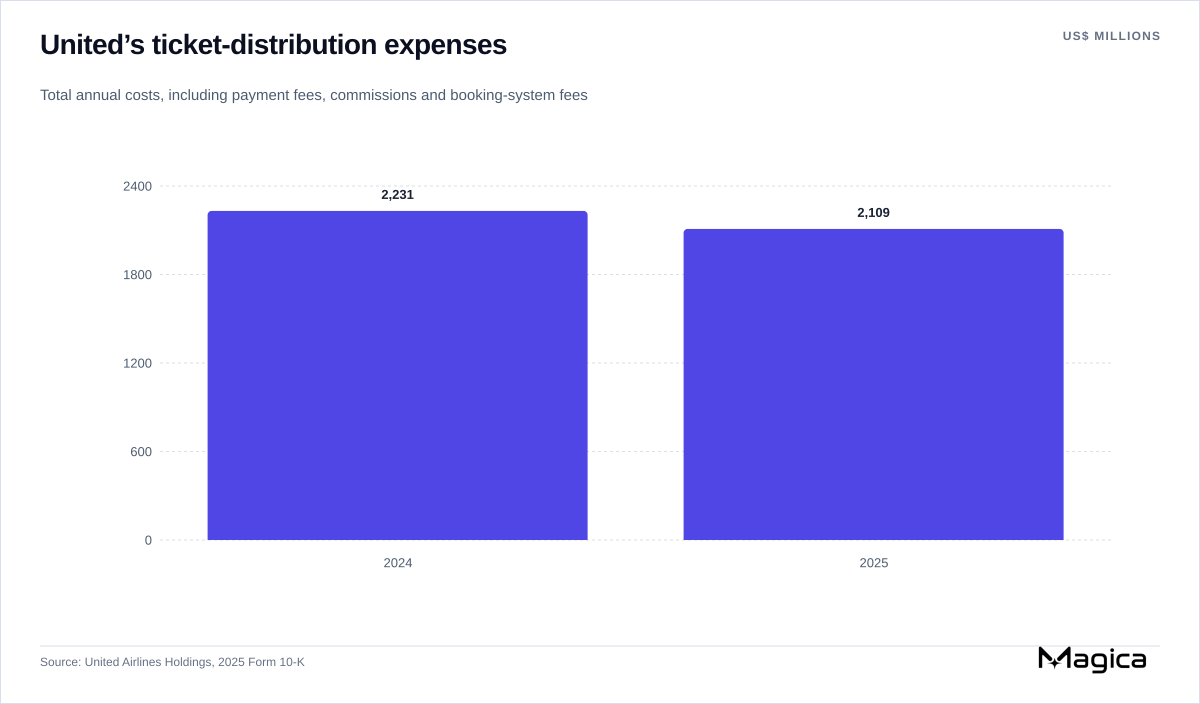
Company-reported distribution expenses for 2024 and 2025. These totals do not measure AI-agent costs or savings from the new restrictions. Chart: Magica; data: United Airlines Holdings. Source: United Airlines Holdings 2025 Form 10-K.
Other airlines illustrate different degrees of access. The secondary account relays Delta Air Lines’ statement that authenticated AI assistants can complete bookings, with additional safeguards for sensitive transactions such as trips by unaccompanied minors. That is Delta’s stated approach as conveyed through the reporting, rather than evidence that any assistant has unrestricted access.
Southwest Airlines announced on October 6, 2026 that it had launched a plug-in in the AI chatbot ChatGPT for discovering and shopping for its flights. Southwest called it the first step in a phased booking approach. Its announcement describes a route from discovery toward booking options, rather than establishing that an autonomous assistant can complete a ticket purchase. An airline-authorized shopping integration and an outside agent operating a customer’s account are different arrangements.
The retailer Amazon has asserted a similar right to decide whether to participate. In a November 4, 2025 statement, it said third-party purchasing applications should respect service providers’ participation decisions and that it had repeatedly asked Perplexity to remove Amazon from Comet, Perplexity’s agentic application. That establishes a precedent for United’s position, not an industry-wide agreement about who should control customer-delegated access.
United says it does not yet work with any third-party AI agents. Its guidance nevertheless leaves room for standardized integrations with protections for privacy, security, authorization and accountability. The announcement and guidance do not set out a launch date or detailed approval criteria for those integrations.
For existing customers, the immediate boundary is clearer. United says agent bookings made before November 11, 2026 will not be canceled, although travelers should check that they were correctly booked and ticketed. It recommends changing passwords immediately if MileagePlus login information has been shared with a third-party agent and securing accounts after suspected unauthorized purchases or mileage use.
The unresolved decision is whether United will turn its proposed protections into an approved integration, and what permissions and responsibility that arrangement will assign. Published technical requirements, approval terms and evidence of how safeguards perform would make that opening concrete. For now, the airline has specified what unauthorized agents may not do while leaving the terms of future access undefined.
ByteDance’s video model is reaching creators through multiple platforms with 30-second 4K output. Posted prices and draft workflows show why the choice of distributor still matters.
Rox’s $1.3 billion valuation backs AI agents for large enterprise sales teams. Its growth and cost claims face a crowded market, while integration with existing systems leaves the case for replacing Salesforce unresolved.
Google’s Gemini Decision 1 scores predefined choices across text, images, audio, video and PDFs for $0.10 per million input tokens. Its shared-input billing targets recurring workflow costs, but cheaper decision models, rival caching and low-cost generative alternatives complicate the savings claim.
Treasury and other agencies reportedly want Singapore cloud provider Megaspeed on a U.S. trade blacklist. Commerce denies a reported cabinet confrontation over the delay, while Nvidia says it has blocked shipments since June 2025.
A controlled study found that pharmaceutical ads shifted AI recommendations toward promoted drugs without reducing overall clinical accuracy. The results expose a gap in accuracy tests, but do not establish effects on prescriptions or patient outcomes.
Former AWS computing chief Dave Brown will succeed Santosh Janardhan in early 2027 as Meta weighs its next capacity budget after a quarter of negative free cash flow.
Google is rolling out its Gemini app on Apple CarPlay, bringing voice conversations linked to Gmail and Google Calendar. It joins existing in-car AI options, while some personalized features remain restricted by age and region.
Google Labs’ Tabletop lets groups generate and use shared itineraries, polls and other interactive tools. The US adult-only experiment builds on an idea already offered by shareable AI app builders, leaving its practical advantage to be tested.
Anthropic’s IPO has reportedly attracted orders multiple times the available shares. Its planned $3 billion–$3.5 billion Japanese allocation would exceed Japan’s reported domestic IPO proceeds so far this year, but indications of interest are not completed sales.
Google warned that charging for news links would force it to stop distributing Indonesian news, while Meta and TikTok challenged other parts of the copyright bill. Existing Indonesian payment mechanisms and overseas deals complicate the platforms’ warnings about the cost to publishers.
Utrecht is investigating restrictions on camera glasses in municipal buildings, with findings expected in early 2027. The city must establish whether a ban is lawful, enforceable and compatible with assistive uses.
Research commissioned by cloud-storage supplier Wasabi estimates £3.8 billion in annual UK infrastructure overspend attributable to hard-to-forecast provider charges, including £1.2 billion for AI. Businesses report hiring and investment trade-offs, but recovering that money and turning it into jobs remain conditional.
The USDT issuer’s 800-million-parameter BotPsy beats a larger Qwen model on five of six company-reported agent benchmarks. Its local-AI ambitions still face missing handset measurements and explicit limits on sensitive uses.
Google DeepMind’s AlphaGenome 2 improves cell-specific DNA predictions and accepts new single-cell data without fine-tuning. Company benchmarks show gains at high confidence, but limited recall, complementary tools and greater computational demands leave experimental validation essential.
Coinbase is rolling out server-enforced trading limits and portfolio-loss triggers for AI agents connected to customer accounts. Product-category permissions remain forthcoming, and pausing new trades does not establish a ceiling on losses.
JetBrains IDEs 2026.3 bundle Air for running coding agents and reviewing their changes, while the standalone Air app is in maintenance mode. Existing provider subscriptions remain usable, but billing, security controls and execution options vary by integration.

Amazon’s shares and convertible notes could be worth $271.8 billion at the top of Anthropic’s proposed IPO range. Existing accounting gains, a 12% ownership cap and Anthropic’s computing commitments shape what that paper value means.
Nvidia chief Jensen Huang argued in May 2025 that US chip restrictions were strengthening Chinese rivals. Filings show a substantial commercial stake, but lost sales and market share alone cannot establish whether the controls failed their security purpose.
Reported demand has Anthropic’s bankers considering a price above its filed $70–$78 range. The combined financing could exceed $100 billion, but existing cash, uneven operating results and long-term computing commitments complicate the valuation test.