Editorial Team
8 min read
Reported demand has Anthropic’s bankers considering a price above its filed $70–$78 range. The combined financing could exceed $100 billion, but existing cash, uneven operating results and long-term computing commitments complicate the valuation test.
Anthropic, the AI research company behind the Claude models and business applications, faces a potential increase in its IPO price after strong reported investor demand. The question for buyers is whether its expanding business can justify that price while supporting computing commitments stretching into the 2040s.
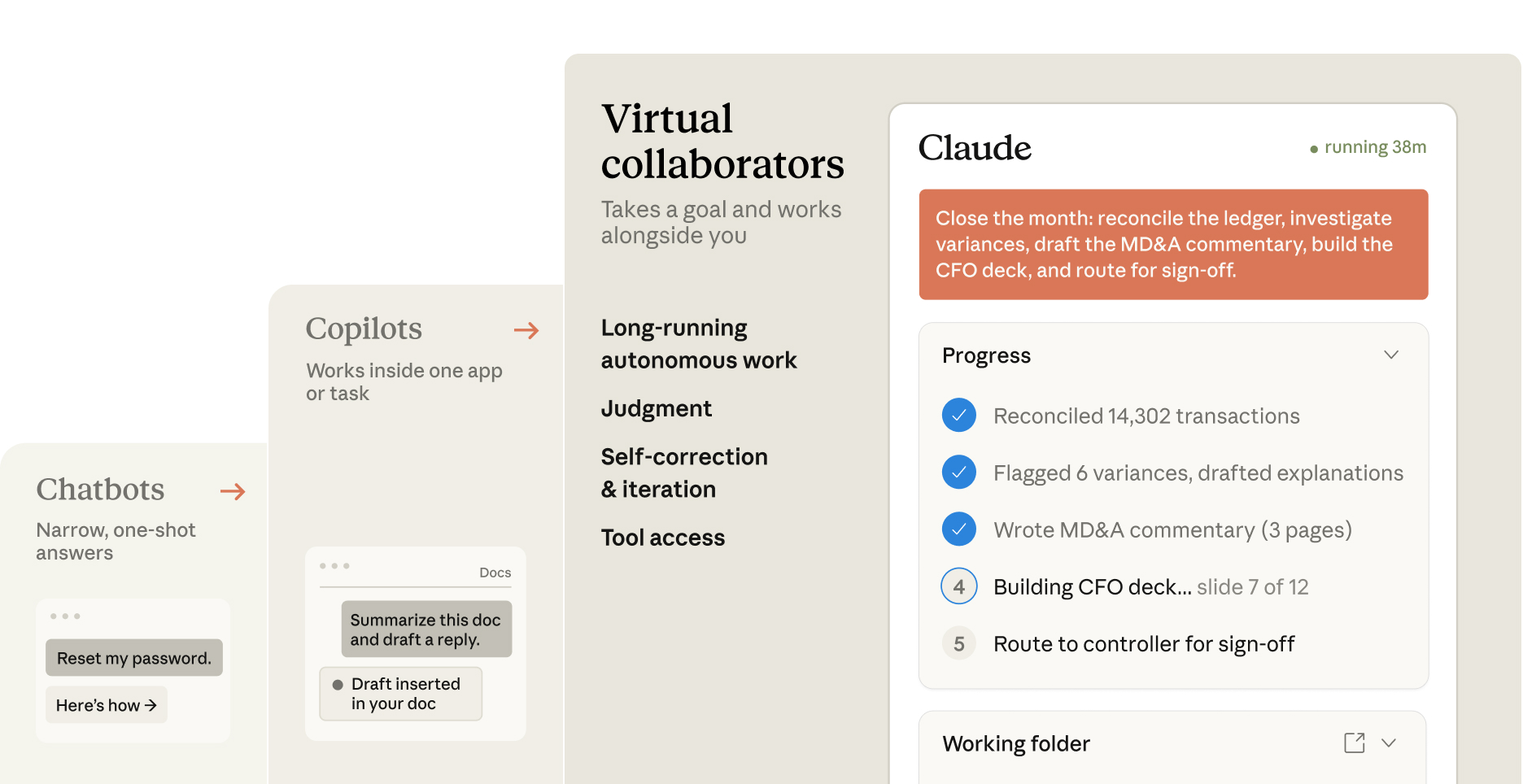
Anthropic’s prospectus illustrates its company-reported approach to multistep work through virtual collaborators. The interface and task counts are illustrative. Source: Anthropic SEC registration statement.
Bankers expect to seek more than $78 a share, potentially lifting the valuation to $1.5 trillion or above, according to an account of Financial Times reporting based on five people familiar with the matter. Discussions began less than a day after Anthropic disclosed a $70–$78 range implying a fully diluted valuation of $1.26 trillion–$1.41 trillion. Investment banks Goldman Sachs and Morgan Stanley are leading the offering, whose roadshow began November 10.
A separate report said prospective orders covered all available shares at launch. Those indications of interest do not establish the price at which the offering will clear.
Founded in 2021, Anthropic publicly launched Claude commercially in the first quarter of 2023, according to its registration statement. Its chief executive and co-founder, Dario Amodei, previously served as vice president of research at rival AI lab OpenAI.
Its enterprise strategy now includes Claude Code, an agent that writes, tests and debugs software, and Claude Cowork, which carries out multistep knowledge-work tasks. Claude is also available through Amazon Web Services, Google Cloud and Microsoft Azure. Usage-based charges, metered in tokens and priced by model, generated 79% of revenue in the first nine months of 2026; subscriptions supplied the rest, the filing says. That makes sustained customer usage central to the revenue story.
The price discussion follows a retreat in expectations. Some investors had previously valued Anthropic closer to $2 trillion, according to the account of the banking negotiations. Technology shares sold off after the US midterm elections, although the market subsequently recovered, the report on investor demand notes. A $1.5 trillion valuation would still fall below those earlier ambitions.
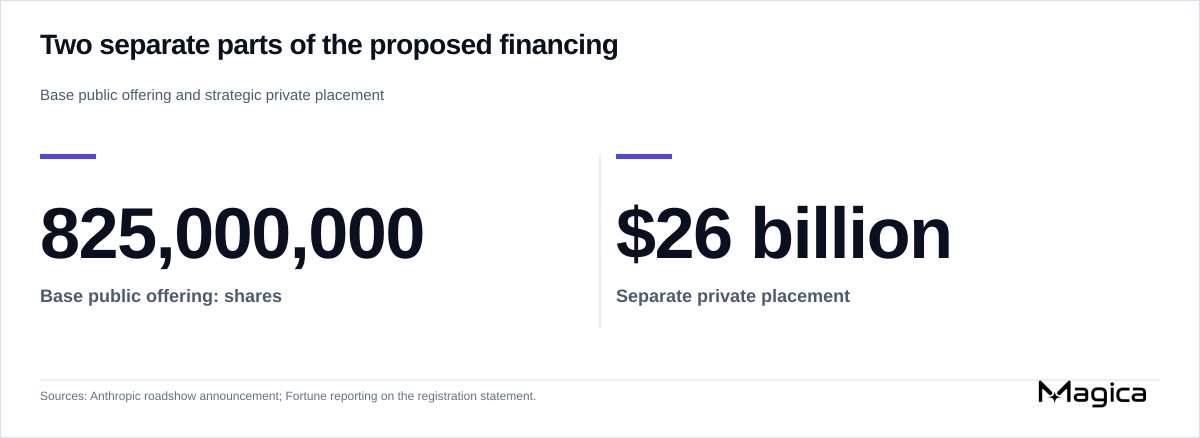
Magica graphic: the proposed base public offering includes company and selling-stockholder shares. The separate private placement adds financing; the optional public allotment is excluded. Source: Anthropic.
Anthropic’s roadshow announcement sets out 825 million shares: approximately 801.35 million offered by the company and 23.65 million by existing shareholders. Anthropic receives none of the latter’s proceeds. Underwriters would have a 30-day option to purchase another 123.75 million shares. The company has applied to trade on Nasdaq as ANT.
At the top of the filed range, multiplying the share counts by $78 gives the following gross transaction amounts, before fees and expenses:
| Component | Amount at $78 per share |
|---|---|
| Company shares in the base IPO | $62.51 billion |
| Existing shareholders’ shares in the base IPO | $1.84 billion |
| Base public offering, combined | $64.35 billion |
| Full optional allotment | $9.65 billion |
| Separate private placement | $26 billion |
| Combined package with full option | About $100 billion |
Google, Nvidia, AMD, Broadcom, Micron, Microsoft and TSMC Partners, an affiliate of Taiwan Semiconductor Manufacturing, have agreed to purchase that $26 billion of nonvoting Class N stock at the IPO price immediately after the offering, according to the account of the filing.
Without the optional allotment, the public sale and placement total $90.35 billion at $78. A higher price would enlarge the public-sale component, but the approximately $100 billion package is already attainable at the filed upper limit if the option is exercised in full. It is neither the base IPO size nor Anthropic’s net cash proceeds.
The valuation figures also use different denominators. The roughly $1.4 trillion upper-end valuation includes options and other equity awards; counting outstanding shares alone gives approximately $1 trillion, the same account explains.
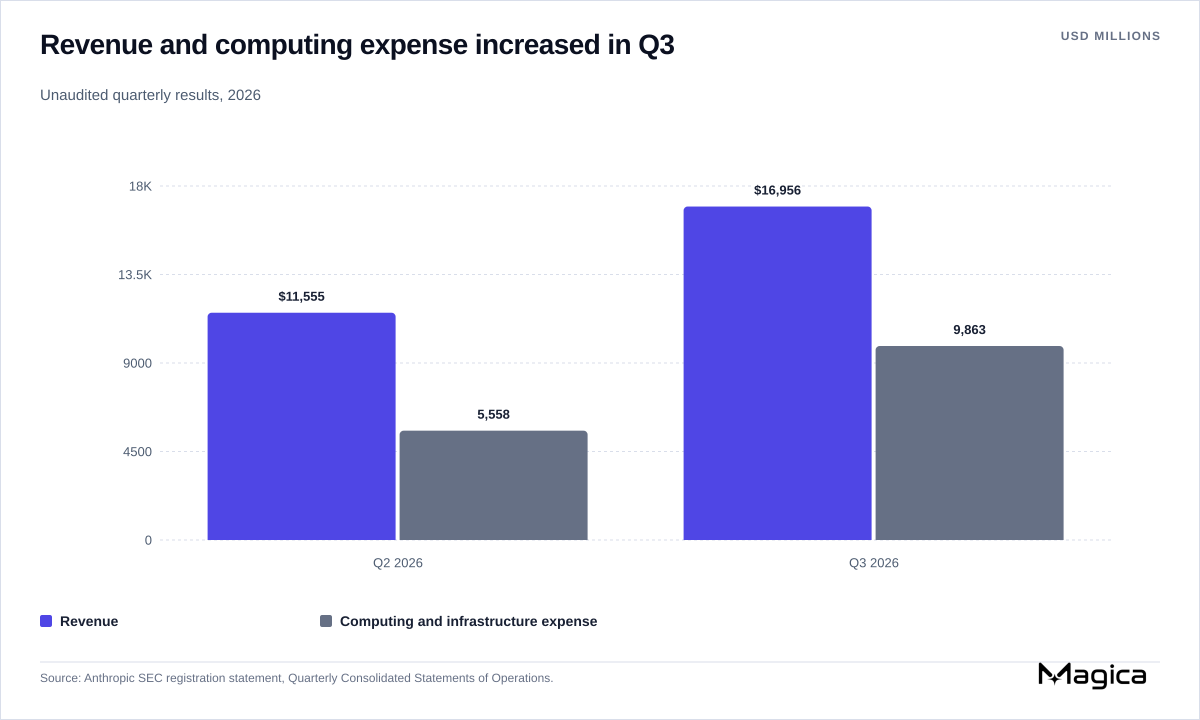
Magica chart of company-reported Q2 and Q3 2026 results. Computing and infrastructure expense includes research and model development; other operating costs are excluded. Source: Anthropic SEC registration statement.
Three backers said Anthropic was prioritizing the amount raised to support computing expenditure over maximizing its valuation, according to the report on the negotiations.
The company is already heavily financed. Its filing records $141.1 billion of capital raised through September 30, with $95.6 billion in cash and cash equivalents and $36.3 billion in short-term investments on that date—a combined $131.9 billion. The new financing would add to an already substantial liquidity reserve.
Against that stands approximately $900.9 billion of purchase and lease commitments entered into as of and subsequent to September 30, substantially all related to computing and infrastructure. About $451.6 billion is expected before the end of 2030, with substantially all the remainder between 2031 and 2045. Approximately $70.7 billion is due in the 12 months following September 30, 2026. These are commitments across different periods, not a single year’s spending.
The financial trajectory is less uniform than the revenue growth alone suggests. The filing’s unaudited quarterly results show:
| Billions of dollars, rounded | Q2 2026 | Q3 2026 |
|---|---|---|
| Revenue | $11.56 | $16.96 |
| Computing and infrastructure expense | $5.56 | $9.86 |
| Operating income or loss | $0.97 | −$0.57 |
Revenue rose about 47% quarter over quarter, while computing and infrastructure expense rose about 77%, calculated from the unrounded filing figures. Those expenses cover more than serving customers, including research and model development. The operating result also reflects personnel, sales and other costs; the table does not attribute the profit reversal to computing alone.
For the first nine months as a whole, Anthropic recorded a $1.3 billion operating loss. Excluding stock-based compensation and noncash charitable contributions produced $4.1 billion of adjusted operating profit, the negotiations report says. Neither that adjusted result nor one profitable quarter establishes sustained operating profitability.
Anthropic told investors its annualized revenue rate reached $81 billion in October, according to the same report. That projects recent activity over a year rather than measuring revenue already earned over a full year. The filing separately records $6.6 billion in operating cash inflow for the first nine months; operating cash flow does not deduct capital expenditure.
The filing also estimates that 5%–7% of revenue in the first nine months came from customers using its services in violation of its usage policy or commercial terms. Anthropic says enhanced detection and enforcement could adversely affect revenue and revenue growth, with the timing and magnitude uncertain.
Goldman Sachs forecasts $65.7 billion of free-cash-flow outflows in 2027 and positive annual free cash flow only in 2030, alongside revenue above $600 billion that year, according to the financing report. These are forecasts from a bank leading the IPO. Investment research firm Morningstar’s analysts put fair equity value at $1.7 trillion but described a possible $500 billion–$3 trillion range depending on adoption, illustrating the sensitivity to future demand.
The private placement brings in companies with existing commercial stakes in Anthropic’s expansion. Its filing describes computing workloads running across AI chips from Amazon, Google, Nvidia and AMD. Cloud partners also distribute Claude. Google is simultaneously a strategic investor, infrastructure partner and named model-development competitor.
Anthropic’s competition disclosures identify OpenAI and Google, models with publicly available weights, and technology suppliers able to bundle AI into existing products or subsidize prices. Those alternatives constrain how much enterprise adoption necessarily translates into pricing power. OpenAI told investors its third-quarter revenue was $10 billion, according to a person with direct knowledge cited in the negotiations report.
Money alone cannot ensure timely capacity. The filing warns that power connections can take years and specialized electrical equipment requires advance orders. Anthropic can face costs even when associated capacity is delayed or never delivered. That creates execution risk alongside the funding requirement.
The offering’s intermediaries and early holders have separate stakes. Banks’ compensation depends on the negotiated fee rate and deal size; Anthropic has not disclosed its overall underwriting fee or its division among banks. Reported secondary offers include up to $500 million of private stock at a 4% premium to the eventual IPO price and $1.25 billion through a special-purpose vehicle at a $1.5 trillion valuation. These are offers, not completed trades. Anthropic has sought to restrict such vehicles and warned that offers from certain secondary brokers would not be recognized.
Public shareholders also inherit limited control. Anthropic is a Delaware public benefit corporation required to balance shareholder financial interests with its public-benefit purpose and the interests of those materially affected by its conduct. Under the structure described in the filing, an entity belonging to its seven co-founders will hold 50.1% of votes on general shareholder matters. The Long-Term Benefit Trust, intended to comprise financially disinterested trustees, generally selects and can remove a majority of directors.
Anthropic must complete its investor meetings and set the offering price. Pricing is expected November 18, according to the account of the filing; a discussion of the reported demand places trading on November 19. Anthropic’s roadshow announcement says the registration statement has not yet become effective, a prerequisite for selling the securities.
The final price, share count, optional allotment and fees will establish the transaction’s usable proceeds. Subsequent results must show whether customer usage can support margins as new computing capacity comes online—and whether that capacity arrives on schedule. Early orders answer the demand question at proposed IPO terms; they leave those operating tests unresolved.
JetBrains IDEs 2026.3 bundle Air for running coding agents and reviewing their changes, while the standalone Air app is in maintenance mode. Existing provider subscriptions remain usable, but billing, security controls and execution options vary by integration.

Amazon’s shares and convertible notes could be worth $271.8 billion at the top of Anthropic’s proposed IPO range. Existing accounting gains, a 12% ownership cap and Anthropic’s computing commitments shape what that paper value means.
Nvidia chief Jensen Huang argued in May 2025 that US chip restrictions were strengthening Chinese rivals. Filings show a substantial commercial stake, but lost sales and market share alone cannot establish whether the controls failed their security purpose.
The British AI chip designer has secured private and UK government backing before its planned 2027 commercial launch, putting a multibillion-dollar valuation on its promise of faster, cheaper inference.
Zhang Yiming reportedly told staff that ByteDance needs years to challenge leading US AI labs, even as the TikTok parent prepares a personal agent for release within weeks. Its consumer reach and video strengths have yet to translate into frontier language models.
Helsing has unveiled a military intelligence platform promising European control over data, models and operations. Germany's evaluation of roughly 30 European systems makes procurement and demonstrated performance the next tests.
Public safety leaders warn that synthetic voices and background sounds make hoax emergency calls harder to assess. A voluntary survey exposes preparedness gaps, but does not establish a national AI-swatting rate or measure growth over time.
Fortinet's November security disclosures include AI-assisted findings, but some affected software branches still await fixes. Earlier testing put token costs at about $540 per true positive, excluding the broader work of reviewing findings and securing customer deployments.
Tamil Nadu told the Madras High Court that accounts containing about 2.22 million rupees had been frozen after its library-procurement order, while a criminal case was still being prepared. The dispute tests safeguards ordered in 2024; AI involvement remains unconfirmed.
Unions withdrew objections to Google’s proposed $10 million purchase of Spirit Airlines data after securing employee-record exclusions and independent privacy review. The agreement follows earlier passenger-data protections; court approval and verification remain ahead.
Baird cut Nvidia to Neutral and its price target to $200 from $500. Its case combines slower forecast AI spending growth with China-linked inventory exposure and uncertainty over founder and CEO Jensen Huang’s tenure.
ByteDance is reportedly accelerating plans to combine its Spell project with Doubao. Existing travel bookings reveal a transaction-fee business, while the phone assistant's history shows how access to other apps can constrain execution.
The Office for Students wants more AI-free assessment and better AI skills teaching, backed by existing quality rules. Its research raises doubts about unsupervised coursework, but universities say assessment reform is already under way.
Finland has recognised Tesla’s provisional Dutch approval after changes to branding and speed controls. Drivers remain responsible, and the national decision does not commit Finland to backing EU-wide authorisation.
Grok Bot can connect to internal MCP servers through Tailscale without exposing them to the public internet. User-based authorization preserves network controls, but administrators must configure how narrowly the assistant can reach into their systems.
Daylight’s Goldman Sachs Alternatives-led Series B backs security agents supported by human engineers. The young company reports rapid growth, but has not disclosed the economics behind its automation promise.
Primordial Labs raised $18 million to widen deployment of Anura, its military command software. Existing contracts and demonstrations give it a foothold, but integration counts do not establish sustained use or lower operating costs.
Northwestern Polytechnical University bought two Nvidia H200 processors for 874,700 yuan and awarded five contracts for rented Nvidia computing, procurement records show. Separate US restrictions on the defense-linked institution remained in place despite January’s conditional opening for H200 exports to China.
The North Dakota Republican says allegations involving a suspected Chinese intelligence operative make Huang vulnerable to coercion. Nvidia’s board is backing its founder while independent directors investigate, with investors facing both security and leadership risks.
Scott Bessent says Washington and Beijing are establishing a channel for serious AI incidents, following their September agreement. Its usefulness depends on unresolved reporting procedures and participation by the companies that detect model failures.