Editorial Team
6 min read
The mathematicians claim finite-time blow-up without external forcing, a significant advance if verified. Their repository omits the numerical certificate and its checking computation, and says the patched Lean package was not rebuilt.
Tristan Buckmaster, a mathematics professor at New York University’s Courant Institute, and Levent Alpöge, an Anthropic number theorist, have posted a 79-page paper claiming finite-time blow-up for the unforced Navier–Stokes equations. The pair previously collaborated on AI-assisted fluid-equation proofs. Their November 20 release targets whether initially smooth motion in a viscous fluid can develop a singularity—a loss of smoothness—in finite time without an outside force. But the repository omits numerical evidence needed to check the claim.
The researchers bring an established mathematical record to an unverified claim. NYU’s account of their September work identifies Buckmaster as a 2019 Clay Research Award recipient and says their earlier proofs were formalized and verified using Lean, a software proof assistant. Alpöge’s research background includes a Princeton doctorate in 2020 and joint work answering a broad version of Hilbert’s tenth problem: there is no general algorithm for deciding whether polynomial equations have solutions in the integers of any number field. His employer, Anthropic, develops the Claude AI models, giving the collaboration a connection to one of the labs competing over AI-assisted mathematics.
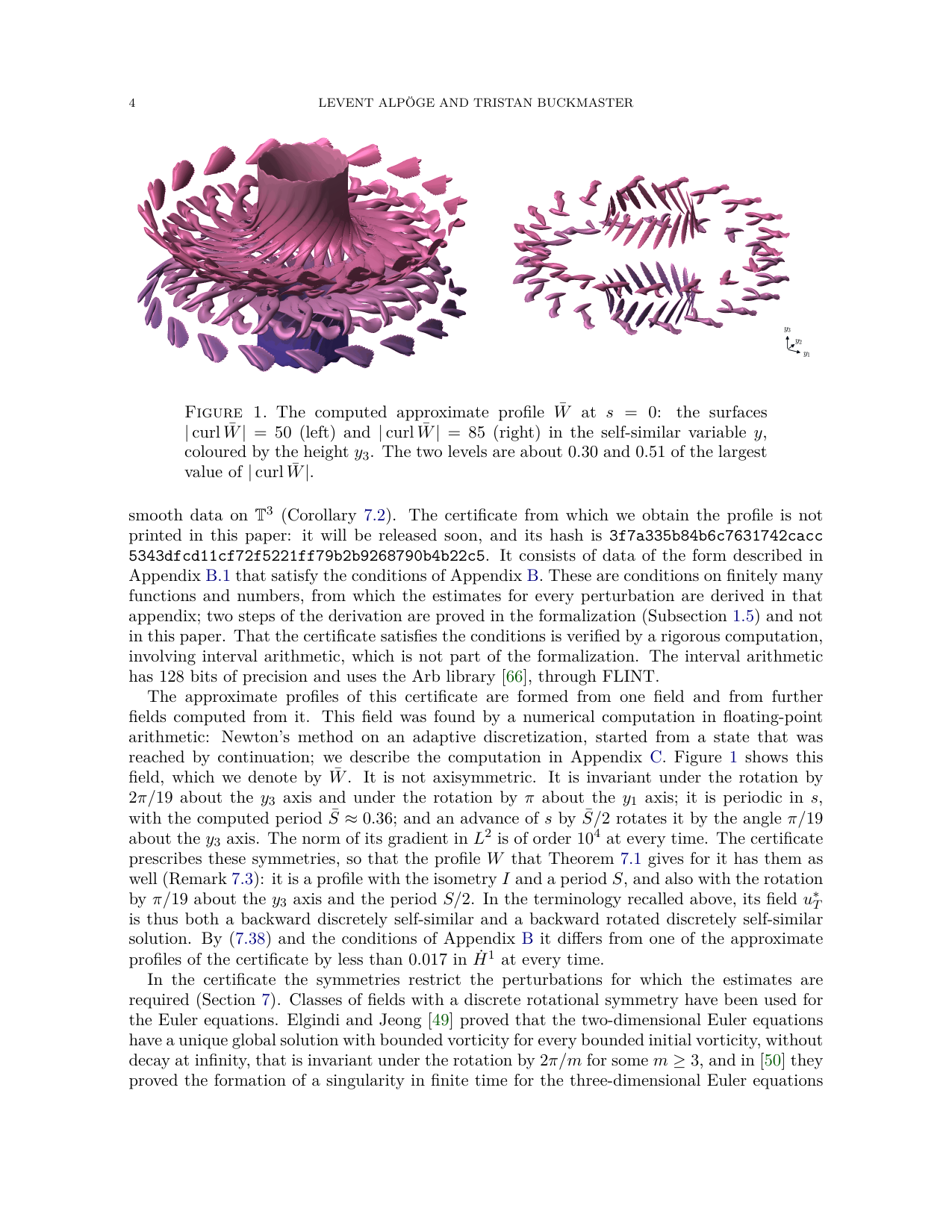
Alpöge and Buckmaster’s Figure 1 shows their computed approximate fluid profile at two vorticity-magnitude levels. The numerical certificate remains unreleased. Source: GitHub.
According to a report describing the paper, the authors claim smooth, compactly supported, divergence-free initial data in ordinary three-dimensional space, and smooth initial data in a periodic box, whose unforced Navier–Stokes solutions blow up in finite time. They say this disproves the two universal existence-and-smoothness alternatives in Charles Fefferman’s official problem formulation.
OpenAI reports sharply lower reasoning-extraction rates in internal GPT-6.2 tests and backs sanctions against illicit foreign distillation. Its own research and rival Anthropic’s experience show why protecting hidden reasoning leaves capability transfer and customer costs unresolved.
The distinction from September’s announcements needs care. On September 7, Buckmaster and Alpöge announced forced Euler blow-up: a related problem involving equations without viscosity. NYU says their work also covered the inviscid Boussinesq and incompressible porous media equations, the latter with Matei Coiculescu, a Courant Instructor. Those results established a record of computer-assisted fluid proofs, rather than a solution of the unforced Navier–Stokes problem.
The AI developer OpenAI separately claimed Navier–Stokes blow-up using a smooth external force. The official problem’s breakdown alternatives permit forcing, as the report notes; the earlier claim cannot simply be dismissed as answering an unrelated question. The new paper’s claimed advance is that no such force is needed. The report also says OpenAI declined to claim the prize for its September result.
The new argument has two interlocking parts. As described in the report, a conditional theorem links blow-up to a smooth, backward discretely self-similar solution: a pattern recurring at progressively smaller scales, potentially with rotation. A stability argument then connects that pattern to nearby smooth initial states. The second part seeks to establish that the required pattern exists near a numerical approximation, using explicit inequalities that a certificate must satisfy.
The report places this numerical-certificate strategy in the tradition of earlier computer-assisted Euler blow-up work by Jiajie Chen and Tom Hou. The use of computation is therefore an established approach; the claimed advance is the result it is being used to establish.
That makes the certificate central to the claim. A formal argument about what follows if those inequalities hold cannot, by itself, establish that the numerical object actually meets them.
The repository lists a Lean 4 package of about 2,270 files and 600,000 lines. Lean is the proof-assistant system used to express and check the formal argument; the package draws on the Mathlib library. The README warns that a full build requires substantial memory and time. Those figures describe the checking infrastructure, not a measurement of how much mathematical work an AI system performed.
The README also distinguishes statement files containing sorry placeholders from Solution.lean, which it says proves the statements using the accompanying library. Comparator files specify which theorem statements must agree and restrict the permitted axioms. The presence of placeholders in the statement files therefore is not, on its own, evidence that the intended solution files leave those theorems unproved.
The more consequential limitations are explicit. The numerical certificate is absent; the paper supplies its hash and says it will be released. A rigorous interval-arithmetic computation checks its conditions using 128-bit precision and Arb through FLINT, but that computation is outside the formalization and is also absent from the repository.
The code has a further qualification. A November 20 patch changed cell-layer statements and dependent proofs, including a bound, permission for one cell constant to be zero, and which harmonics are included. The README says the patched package was not rebuilt when the repository was assembled. A successful build of the released version remains an evidentiary step, alongside checking the numerical component and the correspondence between the formal statements and the mathematical claim.
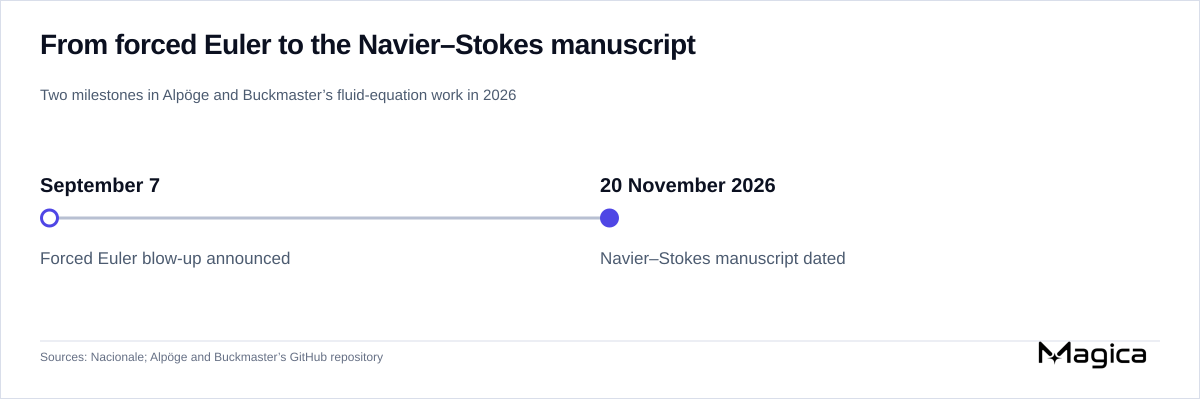
The September forced Euler announcement preceded the November Navier–Stokes manuscript. Graphic: Magica. Source: Nacionale.
Buckmaster described the Navier–Stokes write-up as “unpolished and heavily LLM-assisted,” according to his announcement quoted in the report. He linked the timing to the previous race for an announcement. That disclosure supports a claim about assistance with this paper; it does not quantify the model’s contribution or establish autonomous discovery. The report says the new paper had not undergone peer review.
The September dispute provides relevant context for that urgency. Buckmaster alleged that OpenAI’s effort followed leaked word of the pair’s work. OpenAI disputed the allegations and said its researchers and agents had not seen their work before it became public. The available reporting does not resolve that disagreement.
The companion unforced Euler paper, written with Coiculescu, describes using the Claude and Codex AI systems, according to the same report. Its authors say Anthropic’s models wrote the first force-free proof from their earlier forced-Euler and weakened-viscosity Navier–Stokes drafts, after which the researchers rewrote it with both systems and substituted their own ideas. OpenAI had already claimed unforced Euler blow-up in September, so the companion result is not the first such claim. These disclosures concern the Euler paper; they do not establish which system supplied each step of the new Navier–Stokes argument.
The immediate tension is between establishing priority quickly and making a claim reproducible. The release makes the manuscript and a substantial formal library available while leaving a necessary numerical component under the authors’ control pending release.
The first practical requirement is access to the certificate and the computation that checks it, followed by independent examination of the mathematics and the released Lean package. The missing materials do not demonstrate that the proof is wrong. They limit what can presently be verified from the public release.
The $1 million Millennium Prize has a separate institutional process. The Clay Mathematics Institute’s rules say it does not accept direct submissions. Before it will consider a proposed solution, the work must appear in a qualifying outlet, at least two years must pass after publication, and it must receive general acceptance in the global mathematics community.
A repository announcement cannot satisfy that process by itself. The next decisive evidence is a complete, reproducible argument that independent mathematicians can check—including the numerical component on which this particular claim depends.
Alberta proposes 600-metre setbacks for large data centres and expanded utility oversight, but exemptions and rules still to be written will determine how much protection communities receive.
President Donald Trump backed Commerce Secretary Howard Lutnick as lawmakers scrutinize alleged delays in restricting a suspected route for AI chips to China. A new congressional inquiry also questions Nvidia’s influence on an existing investigation.

Amazon’s month-old Echo Time is $50 off for Black Friday. Its touchscreen, home hub and optional sleep-aware alarm cost $90 more than the reported Echo Spot price, while Alexa+ access and evidence of better waking remain key buying questions.
Merck will pair its experimental data with Isomorphic Labs’ AI to seek small-molecule cancer drug candidates. The deal follows Isomorphic’s $5 billion financing, but its payments, target and development timetable remain undisclosed.
Thinking Machines Lab released a roughly 20GB open-weights model that reuses its middle layers for reasoning. It brings the Inkling family to local hardware, with competitive coding results but workload-dependent costs and preliminary evidence on oversight.
Apple’s first HomePod mini update since 2020 adds Mac audio and four-speaker surround, but Siri AI remains unavailable, core home-hub features carry over, and reviews disagree on playback reliability.
Treasury Secretary Scott Bessent says an unnamed Anthropic founder will announce a large gift to children's investment accounts within weeks, but the amount, recipients and connection to existing philanthropic pledges remain undisclosed.
Google says air cooling will limit water use at its Visakhapatnam AI hub, but environmental proceedings and residents’ accounts raise broader questions about land, electricity, public incentives and the evidence behind promised benefits.
Nvidia slipped behind Alphabet to fourth in U.S. market value during November 20 trading. The reversal follows a steep selloff despite strong reported revenue growth, with a permanent CEO still to be chosen.
Google will close the Nest app on January 25, 2027 and retire Assistant on home speakers and displays in August. Device transfers are automatic, but continued voice access requires accepting Gemini; basic assistance remains free.

Amazon says Cairn agents exploited a MONAI Label zero-day to take over a university server. Other attacks failed, and maintainers list no patched package release.
Federal Reserve Governor Lisa D. Cook sees early AI pressure on coding, translation and young workers, but says a solid overall labor market and persistent inflation still call for tighter monetary policy.
President Donald Trump threatened a tax on U.S. companies building data centers abroad without specifying how it would work. The proposal raises questions for an AI export program that has received 78 applications and for domestic construction constrained by power and community opposition.
Donald Trump said only older chips should be sold to China while discussing a broader deal with Beijing. His remarks leave unresolved which products would qualify as Washington tightens access to American AI hardware and overseas manufacturing.
Treasury Secretary Scott Bessent expects no change to the US policy permitting limited H200 sales to China despite sparse orders. Nvidia’s earlier filing shows Chinese restrictions and tariff costs also obstruct sales, while the company warns that exclusion helps competitors.
AI infrastructure stocks fell on November 20 amid cloud financing concerns and a reported NAND demand warning. Customer contracts support the buildout, but IREN’s filing shows the conditions and cash demands behind its expansion.
Jensen and Lori Huang’s foundation has committed $350 million to CoreWeave computing for research recipients. The purchase links charitable access to Nvidia’s commercial ecosystem, while pricing, allocation and supplier-selection terms remain unclear.
The Pentagon treated Anthropic’s military-use safeguards as a supply chain threat. Later court rulings diverged under different statutes, while the dispute exposed how difficult it was to replace Claude in classified systems.
A new investigation describes decades of alleged humiliation under Nvidia co-founder and former CEO Jensen Huang. He denies a former HR chief’s claims, while employee support and stock rewards complicate the account of his management.