Editorial Team
7 min read

Amazon says Cairn agents exploited a MONAI Label zero-day to take over a university server. Other attacks failed, and maintainers list no patched package release.
Amazon says AI agents discovered and exploited an unpatched vulnerability in MONAI Label, an open-source tool for labeling medical images, during a September campaign against universities in East Asia. The operator supplied targets and an objective; the agents chose and tested attack paths that eventually yielded a root shell, giving them administrative control of one server.
The finding concerns agents discovering a flaw during an actual intrusion, rather than merely replaying a known exploit. But the same investigation records lengthy failures, a human-directed follow-on operation and an inferred second compromise. Those distinctions matter when assessing how much work attackers can delegate—and which protections still stop them.
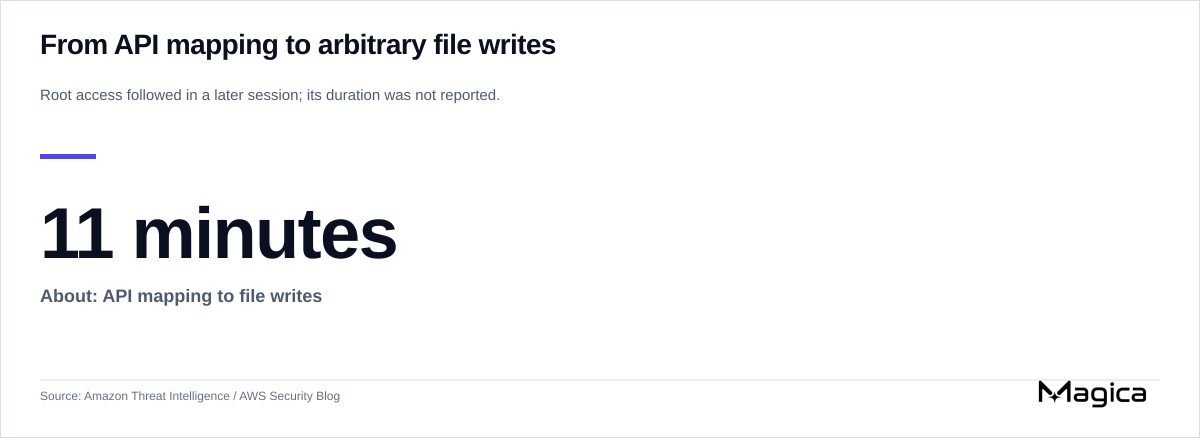
Amazon’s company-reported 11-minute interval covers the initial file-write phase, not the complete server takeover. Source: AWS Security Blog.
Amazon Threat Intelligence, the security research team behind the cloud provider’s investigation, said in its November 20 disclosure that it found a publicly accessible Cairn instance without authentication on September 10. Its project configurations, operator prompts and AI output exposed operations against university-associated IP addresses in East Asia outside mainland China over approximately 48 hours beginning September 8.
Cairn is an open-source framework that coordinates multiple AI agents around a plain-language objective. Built for defensive research and problem solving, it can also let an attacker delegate the sequence of actions needed to reach a target. Amazon said this operator supplied IP addresses and instructions to obtain shell access, leaving the agents to plan, execute and adapt without selecting their every next step.
OpenAI reports sharply lower reasoning-extraction rates in internal GPT-6.2 tests and backs sanctions against illicit foreign distillation. Its own research and rival Anthropic’s experience show why protecting hidden reasoning leaves capability transfer and customer costs unresolved.
MONAI Label uses AI to accelerate medical image annotation. It was developed through research at King’s College London and collaboration with NVIDIA’s healthcare team, and belongs to the broader MONAI medical imaging project pioneered by the university and NVIDIA. Its image-upload functionality became the entry point here. Neither the software’s medical purpose nor the reported server takeover establishes that patient data was accessed.
Amazon has not named the universities. It also declined to identify their country, according to a report on the investigation. AWS said the affected organizations were not its customers and that it worked through a government partner to notify them because it had no direct notification path.
Amazon assigns moderate confidence to a Chinese nexus, citing Simplified Chinese prompts, China Standard Time script timestamps and the selection of universities it considered likely to be of strategic interest to China. That assessment does not identify a particular group or establish state sponsorship.
According to Amazon, the agents identified the application framework, mapped its API and tested a filename parameter in an upload endpoint for path traversal: whether a supplied path could escape its intended directory. In about 11 minutes, they went from API mapping to writing files at arbitrary locations on the server.
Root access came in a later session. The agents placed malicious Python code in a file loaded automatically when an interpreter starts, then invoked a training endpoint that launched another Python process. Amazon said that process established a reverse shell running as root. The 11-minute figure therefore measures the initial mapping-to-file-write phase, not the entire path to administrative control.
The maintainers’ critical-severity advisory corroborates the underlying defect. Both image and label upload operations constructed destination paths from caller-controlled values without checking that they stayed inside the datastore directories. An attacker could write wherever the application process had permission, potentially causing code execution or denial of service.
Authentication is disabled by default, so any network client able to reach a default-configured server could exploit the flaw. With authentication enabled, an account with the annotator role was sufficient. The consequences depend on network exposure, user access and the process’s write permissions and privileges.
Amazon assesses with high confidence that the flaw was a zero-day at discovery, citing the absence of any corresponding fix, issue, advisory or prior vulnerability-database reference. The advisory supports the existence of the bug; it does not independently establish that these agents were its first discoverers.
After discovery, the human operator supplied a proxy into a second university network and directed the agents to attack other machines there. Amazon said the proxy connected to a server running the same vulnerable software. It inferred that the operator had exploited the flaw to establish that foothold; the second compromise was not presented as directly observed.

Amazon’s company-reported counts describe two failed operations. They do not establish a campaign-wide success rate. Source: AWS Security Blog.
The same campaign produced two substantial failures, also described in coverage of Amazon’s findings. Against an unauthenticated Redis database, agents spent roughly 16 hours taking 148 sequential actions. They tried known Redis exploitation techniques and Log4Shell against another service, then used a vulnerability in the co-located Qdrant service to map an internal Docker network and attempted credential sprays. Amazon said none of the attempts to gain access succeeded.
Another operation targeting a university GPU server lasted more than six hours. Agents gathered about 80 real usernames from public university material and tested more than 30,000 credential combinations against SSH and other university services. They found no working login. These are observations of persistence, not a representative benchmark: Amazon provides no complete target denominator, model comparison or operator cost for this campaign.
Cairn’s use in intrusions was already documented. Google’s threat-intelligence team and Mandiant said in an October 30 report on agent frameworks that they had observed multiple attackers abusing Artex, Hexstrike and Cairn in incident-response engagements. Autonomous intrusion work is thus broader than this one tool; Amazon’s specific contribution is its account of previously unknown flaw discovery and subsequent exploitation.
There is also evidence of low operating costs in a separate campaign. Cybersecurity firm Gambit Security’s September 22 retailer investigation described Strix for vulnerability searches, Cairn for end-to-end exploitation and Hermes for orchestration. Gambit reported that the operator’s own cost review averaged $25.46 across 101 completed scans, with individual figures ranging from $3.13 to $79.31. Those are scan costs from that operator’s review, not independently measured costs per successful breach or a price for the university operation.
Gambit reconstructed the retailer activity from recovered attacker infrastructure, verified live compromises and logs containing AI claims. It acknowledged that some claims could not be independently verified and that incomplete data left room for errors. Its findings support prior operational use and possible economic incentives, without establishing that Cairn alone delivered the results.
Google had also reported Cairn use against a U.S. aerospace organization, according to coverage of the earlier findings. Amazon does not identify the underlying models used in the university attacks, so its account cannot attribute the result to a particular model.
AWS said maintainers had released a fix. The more precise record separates fixed source code from a patched package: the pull request merged into the main branch on October 19, while the November 18 advisory lists versions through 0.8.5 as affected, no patched version and inclusion of the fix in the next release.
The changes confine image and label writes to their intended directories and sanitize image identifiers. Until users can upgrade, maintainers recommend enabling authentication, denying annotator access to untrusted users, keeping servers off untrusted networks and running them without administrative privileges, with write access limited to the datastore.
Amazon advocates automated defensive responses with human oversight and promotes its own network protections in the disclosure. It presents no comparative test of defensive products. The failed attacks and the advisory’s permission limits also show why exposure and deployment configuration remain part of the response.
For MONAI Label operators, the immediate decision is whether to deploy the fixed code or restrict access while awaiting a patched package. For the broader claim about autonomous attacks, the missing evidence is different: a fuller accounting of targets, successful compromises, data accessed and operating costs. One observed takeover demonstrates a capability; it does not settle its reliability or scale.
Alberta proposes 600-metre setbacks for large data centres and expanded utility oversight, but exemptions and rules still to be written will determine how much protection communities receive.
President Donald Trump backed Commerce Secretary Howard Lutnick as lawmakers scrutinize alleged delays in restricting a suspected route for AI chips to China. A new congressional inquiry also questions Nvidia’s influence on an existing investigation.

Amazon’s month-old Echo Time is $50 off for Black Friday. Its touchscreen, home hub and optional sleep-aware alarm cost $90 more than the reported Echo Spot price, while Alexa+ access and evidence of better waking remain key buying questions.
Merck will pair its experimental data with Isomorphic Labs’ AI to seek small-molecule cancer drug candidates. The deal follows Isomorphic’s $5 billion financing, but its payments, target and development timetable remain undisclosed.
Thinking Machines Lab released a roughly 20GB open-weights model that reuses its middle layers for reasoning. It brings the Inkling family to local hardware, with competitive coding results but workload-dependent costs and preliminary evidence on oversight.
Apple’s first HomePod mini update since 2020 adds Mac audio and four-speaker surround, but Siri AI remains unavailable, core home-hub features carry over, and reviews disagree on playback reliability.
Treasury Secretary Scott Bessent says an unnamed Anthropic founder will announce a large gift to children's investment accounts within weeks, but the amount, recipients and connection to existing philanthropic pledges remain undisclosed.
Google says air cooling will limit water use at its Visakhapatnam AI hub, but environmental proceedings and residents’ accounts raise broader questions about land, electricity, public incentives and the evidence behind promised benefits.
Nvidia slipped behind Alphabet to fourth in U.S. market value during November 20 trading. The reversal follows a steep selloff despite strong reported revenue growth, with a permanent CEO still to be chosen.
Google will close the Nest app on January 25, 2027 and retire Assistant on home speakers and displays in August. Device transfers are automatic, but continued voice access requires accepting Gemini; basic assistance remains free.
Federal Reserve Governor Lisa D. Cook sees early AI pressure on coding, translation and young workers, but says a solid overall labor market and persistent inflation still call for tighter monetary policy.
President Donald Trump threatened a tax on U.S. companies building data centers abroad without specifying how it would work. The proposal raises questions for an AI export program that has received 78 applications and for domestic construction constrained by power and community opposition.
Donald Trump said only older chips should be sold to China while discussing a broader deal with Beijing. His remarks leave unresolved which products would qualify as Washington tightens access to American AI hardware and overseas manufacturing.
Treasury Secretary Scott Bessent expects no change to the US policy permitting limited H200 sales to China despite sparse orders. Nvidia’s earlier filing shows Chinese restrictions and tariff costs also obstruct sales, while the company warns that exclusion helps competitors.
AI infrastructure stocks fell on November 20 amid cloud financing concerns and a reported NAND demand warning. Customer contracts support the buildout, but IREN’s filing shows the conditions and cash demands behind its expansion.
Jensen and Lori Huang’s foundation has committed $350 million to CoreWeave computing for research recipients. The purchase links charitable access to Nvidia’s commercial ecosystem, while pricing, allocation and supplier-selection terms remain unclear.
The mathematicians claim finite-time blow-up without external forcing, a significant advance if verified. Their repository omits the numerical certificate and its checking computation, and says the patched Lean package was not rebuilt.
The Pentagon treated Anthropic’s military-use safeguards as a supply chain threat. Later court rulings diverged under different statutes, while the dispute exposed how difficult it was to replace Claude in classified systems.
A new investigation describes decades of alleged humiliation under Nvidia co-founder and former CEO Jensen Huang. He denies a former HR chief’s claims, while employee support and stock rewards complicate the account of his management.