Editorial Team
6 min read
Jensen and Lori Huang’s foundation has committed $350 million to CoreWeave computing for research recipients. The purchase links charitable access to Nvidia’s commercial ecosystem, while pricing, allocation and supplier-selection terms remain unclear.
Nvidia co-founder and former chief executive Jensen Huang’s charitable foundation has committed $350 million to renting computing time from CoreWeave, a cloud provider built on Nvidia infrastructure, for research grant recipients, according to a report describing its latest tax filing. The Jen-Hsun & Lori Huang Foundation is overseen by Huang and his wife, Lori Huang, its co-president.
The arrangement addresses researchers’ access to expensive computing infrastructure while directing charitable spending to a cloud provider backed by Nvidia, the AI-chip supplier Huang co-founded in 1993. The central question is how much research capacity the foundation receives and on what terms.
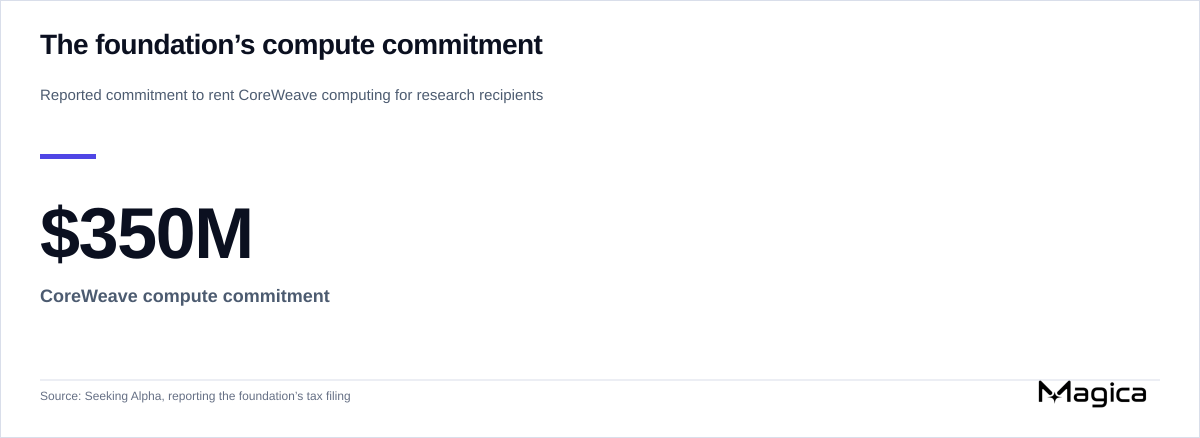
The reported $350 million commitment does not establish how much has been paid or used. Source: Seeking Alpha.
Nvidia’s earlier proxy disclosure says the foundation agreed to buy graphics processing unit, or GPU, compute time from CoreWeave for donation to universities and other nonprofit research institutes developing open science and AI research. It says $108.3 million had been donated to date.
The news report describes that amount as already spent. Nvidia’s wording establishes donated compute, rather than how much researchers have consumed. Neither account establishes that the full $350 million commitment has been paid or used.
A CoreWeave spokesperson said, in the report, that grant recipients use the computing for research and the foundation does not use it itself. The report attributes the program’s name, the Computing Initiative for Open Science, and its aim of overcoming barriers to large-scale GPU access to the foundation’s tax filing.
Nvidia also says it plans to provide free engineering services to certain recipients. It describes this as similar to the assistance it routinely offers developers using Nvidia accelerated computing. The disclosure does not promise technical support to every grantee.
Nvidia disclosed the arrangement in its proxy section on transactions with related persons. The proxy identifies Jensen and Lori Huang as foundation board members since 2007 and lists about 58.7 million Nvidia shares held by the foundation as of March 23, 2026. It explicitly says the couple have no pecuniary interest in those shares: their governance role does not make the charitable assets their personal property.
The foundation nevertheless depends heavily on Nvidia’s stock for its financial capacity. The tax-filing report puts its assets at $12.7 billion on December 31, 2025, up from $9.2 billion a year earlier, with Nvidia shares representing nearly 90% of year-end assets.
That is a historical valuation. The same report says Huang was forced out of Nvidia last week and that the board rejected his reinstatement request this week. It also reports that Nvidia shares fell about 30% after reports about his personal conduct emerged. Those developments do not establish the foundation’s current asset value, but they limit what its earlier balance sheet says about its capacity today.
The supplier relationship extends beyond philanthropy. Nvidia announced in January 2026 that it had invested $2 billion in CoreWeave common stock. The companies also set out plans to accelerate CoreWeave’s buildout of more than 5 gigawatts of AI factories by 2030, including Nvidia support for procuring land, power and buildings. That is a development target, not capacity already delivered.
The foundation is buying services for charitable recipients; Nvidia bought equity. Both benefit the same supplier, but the transactions have different purposes and economic rights. Their overlap alone does not demonstrate artificial demand or establish whether the foundation secured favorable prices.
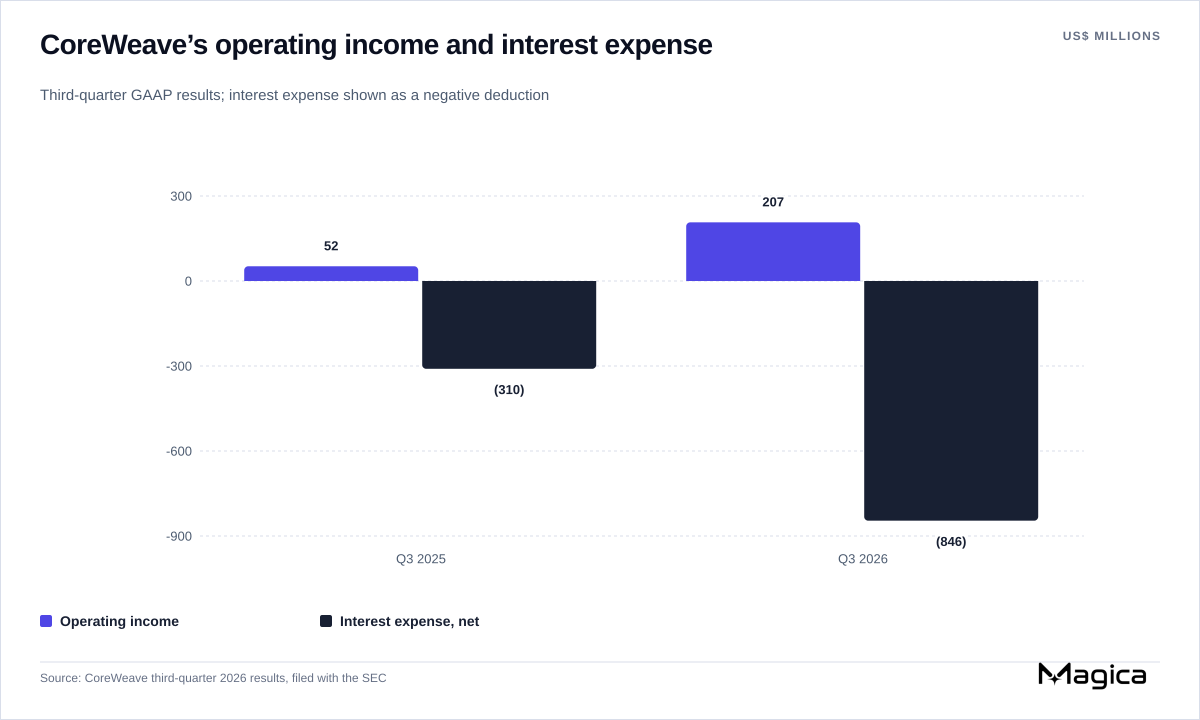
Company-reported GAAP results for the quarters ended September 30, 2025 and 2026. Parentheses show net interest expense as a deduction. Source: SEC — CoreWeave third-quarter 2026 results.
CoreWeave is a specialized cloud provider supplying infrastructure and software for AI workloads. Its 2025 annual report says it was founded in 2017 and launched its cloud platform in 2020. Before 2022, most of its limited revenue came from cryptocurrency mining offerings that it has since discontinued.
The filing also says all GPUs in its infrastructure were Nvidia GPUs and that current customers had contractually specified their use. The relationship therefore involves hardware dependence as well as Nvidia’s equity investment.
The filing says CoreWeave primarily finances infrastructure through asset-level debt supported by customer contracts requiring payment for committed capacity, supplemented by corporate equity and debt. That makes the durability and terms of customer demand consequential to its financing model. The available foundation disclosure does not establish whether this agreement uses the same contract structure.
CoreWeave’s November 10 results show both growth and financing costs. These are reported GAAP figures for the three months ended September 30, in millions of dollars:
| Measure | 2026 | 2025 |
|---|---|---|
| Revenue | $3,661 | $1,365 |
| Operating income | $207 | $52 |
| Interest expense, net | $846 | $310 |
| Net loss | $709 | $110 |
Interest expense exceeded operating income in both quarters. The $350 million foundation commitment cannot be treated as quarterly revenue or as a measure of profit: its payment and delivery schedule is not established in the available evidence.
Nor is CoreWeave the only potential supplier. Its annual report identifies Amazon Web Services, Google Cloud, Microsoft Azure and Oracle as competitors, some of which are also customers. CoreWeave warns that larger rivals may offer lower prices or bundle competing services. That does not prove a cheaper equivalent was available for this program, but it makes comparison of price, hardware and support essential to judging supplier selection.
Infrastructure is another constraint. CoreWeave’s November results reported more than 1.7 gigawatts of active power. Its annual report warns that power availability, equipment supply and construction can constrain expansion. A dollar commitment does not by itself specify which GPUs researchers can access, when they can use them or how much work they can complete.
The tax-filing report calls the $350 million commitment the foundation’s largest gift for 2025. It separately reports about $373 million in total giving that year, roughly three times the 2024 amount. A commitment and annual giving are different measures; the available evidence does not reconcile their accounting or payment periods.
Other reported gifts included $19 million to the California College of the Arts, $1.2 million to the Hong Kong University of Science and Technology and $1.05 million to College Track, which supports first-generation college students. Most 2024 giving went to a donor-advised fund at Schwab Charitable, which was absent from the reported 2025 recipient list. The compute program identifies a commercial supplier and a resource intended for research institutions, while leaving allocation among those institutions unclear.
The foundation and CoreWeave could make the arrangement assessable by disclosing recipient institutions, project-selection criteria, contract duration, GPU types, computing hours delivered and prices paid. Comparable supplier offers would help establish whether the foundation bought competitive capacity; reporting on research outputs would show what recipients accomplished with it.
The filings and reporting establish a charitable purpose and a commercial relationship. They do not explain why CoreWeave was chosen or permit a cost-per-GPU-hour calculation. Delivery and allocation terms are the next evidence needed to judge how much scientific access the commitment purchases.
OpenAI reports sharply lower reasoning-extraction rates in internal GPT-6.2 tests and backs sanctions against illicit foreign distillation. Its own research and rival Anthropic’s experience show why protecting hidden reasoning leaves capability transfer and customer costs unresolved.
Alberta proposes 600-metre setbacks for large data centres and expanded utility oversight, but exemptions and rules still to be written will determine how much protection communities receive.
President Donald Trump backed Commerce Secretary Howard Lutnick as lawmakers scrutinize alleged delays in restricting a suspected route for AI chips to China. A new congressional inquiry also questions Nvidia’s influence on an existing investigation.

Amazon’s month-old Echo Time is $50 off for Black Friday. Its touchscreen, home hub and optional sleep-aware alarm cost $90 more than the reported Echo Spot price, while Alexa+ access and evidence of better waking remain key buying questions.
Merck will pair its experimental data with Isomorphic Labs’ AI to seek small-molecule cancer drug candidates. The deal follows Isomorphic’s $5 billion financing, but its payments, target and development timetable remain undisclosed.
Thinking Machines Lab released a roughly 20GB open-weights model that reuses its middle layers for reasoning. It brings the Inkling family to local hardware, with competitive coding results but workload-dependent costs and preliminary evidence on oversight.
Apple’s first HomePod mini update since 2020 adds Mac audio and four-speaker surround, but Siri AI remains unavailable, core home-hub features carry over, and reviews disagree on playback reliability.
Treasury Secretary Scott Bessent says an unnamed Anthropic founder will announce a large gift to children's investment accounts within weeks, but the amount, recipients and connection to existing philanthropic pledges remain undisclosed.
Google says air cooling will limit water use at its Visakhapatnam AI hub, but environmental proceedings and residents’ accounts raise broader questions about land, electricity, public incentives and the evidence behind promised benefits.
Nvidia slipped behind Alphabet to fourth in U.S. market value during November 20 trading. The reversal follows a steep selloff despite strong reported revenue growth, with a permanent CEO still to be chosen.
Google will close the Nest app on January 25, 2027 and retire Assistant on home speakers and displays in August. Device transfers are automatic, but continued voice access requires accepting Gemini; basic assistance remains free.

Amazon says Cairn agents exploited a MONAI Label zero-day to take over a university server. Other attacks failed, and maintainers list no patched package release.
Federal Reserve Governor Lisa D. Cook sees early AI pressure on coding, translation and young workers, but says a solid overall labor market and persistent inflation still call for tighter monetary policy.
President Donald Trump threatened a tax on U.S. companies building data centers abroad without specifying how it would work. The proposal raises questions for an AI export program that has received 78 applications and for domestic construction constrained by power and community opposition.
Donald Trump said only older chips should be sold to China while discussing a broader deal with Beijing. His remarks leave unresolved which products would qualify as Washington tightens access to American AI hardware and overseas manufacturing.
Treasury Secretary Scott Bessent expects no change to the US policy permitting limited H200 sales to China despite sparse orders. Nvidia’s earlier filing shows Chinese restrictions and tariff costs also obstruct sales, while the company warns that exclusion helps competitors.
AI infrastructure stocks fell on November 20 amid cloud financing concerns and a reported NAND demand warning. Customer contracts support the buildout, but IREN’s filing shows the conditions and cash demands behind its expansion.
The mathematicians claim finite-time blow-up without external forcing, a significant advance if verified. Their repository omits the numerical certificate and its checking computation, and says the patched Lean package was not rebuilt.
The Pentagon treated Anthropic’s military-use safeguards as a supply chain threat. Later court rulings diverged under different statutes, while the dispute exposed how difficult it was to replace Claude in classified systems.
A new investigation describes decades of alleged humiliation under Nvidia co-founder and former CEO Jensen Huang. He denies a former HR chief’s claims, while employee support and stock rewards complicate the account of his management.