Editorial Team
9 min read
OpenAI reports sharply lower reasoning-extraction rates in internal GPT-6.2 tests and backs sanctions against illicit foreign distillation. Its own research and rival Anthropic’s experience show why protecting hidden reasoning leaves capability transfer and customer costs unresolved.
OpenAI, the developer behind ChatGPT and the GPT models, said on November 20 that updated safeguards reduced the average success rate of attacks extracting reasoning from an earlier request from 54.0% on GPT-6 Astra to 0.2% on GPT-6.2 Astra. The result concerns a specific internal evaluation, rather than a demonstrated end to unauthorized model copying. The company is also backing legislation to sanction foreign actors that illicitly extract capabilities from American AI models.
The company's announcement describes a defense of both safety controls and a valuable development resource: the intermediate reasoning that another model can learn from. OpenAI argues that copying capabilities without copying their safeguards could enable harmful cybersecurity or biological assistance that the original model would block.
GPT-6.2 Astra and GPT-6.2 Sol are OpenAI reasoning models, which generate internal intermediate steps before answering. Their November 17 system card describes them as its most capable externally deployed models to date and assesses both as meeting its Critical cybersecurity-capability threshold under the Preparedness Framework, its system for assessing severe frontier-model risks. The new disclosure explains protections already outlined in that card, building on a September campaign investigation.
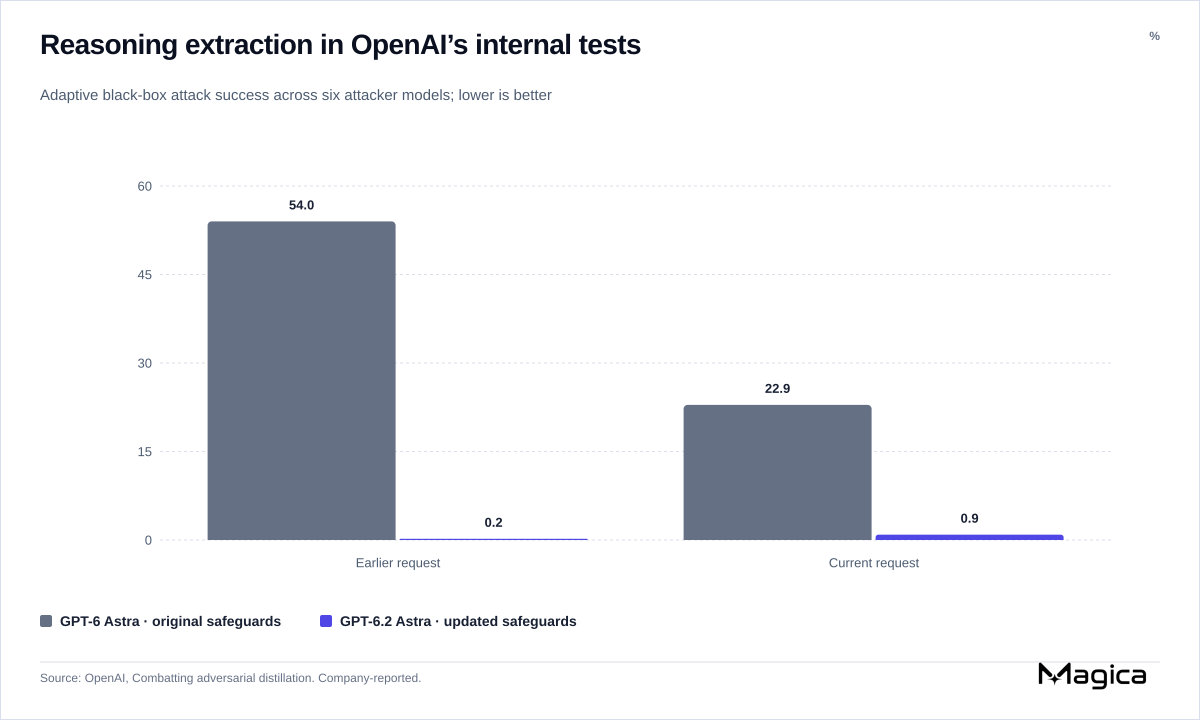
OpenAI’s company-reported extraction-test results. Both model and safeguards differ between configurations; these rates do not measure production leakage or all distillation activity. Source: OpenAI.
OpenAI used automated attackers that adapted their requests to the defender's replies. Its black-box evaluation gave attackers the view available to an external user and aggregated results across six attacker models.
| Protected reasoning targeted | GPT-6 Astra, original safeguards | GPT-6.2 Astra, updated safeguards |
|---|---|---|
| Earlier request | 54.0% | 0.2% |
| Current request | 22.9% | 0.9% |
These are company-reported average attack success rates under the evaluated configurations. The earlier-request decline is about 99.6% relative to the original rate, calculated as (54.0 minus 0.2) divided by 54.0. It does not mean that 99.6% of all distillation activity was eliminated. As a methodological assessment notes, the comparison changes both the model and its safeguards, so it cannot isolate the contribution of any single defense.
The system card reports corresponding rates of 0.5% and 0.8% for GPT-6.2 Sol. Neither document turns these test results into a measured rate of leakage across ordinary production traffic.
The underlying cyber capabilities explain the stakes. In a separate internal evaluation of exploit development from V8 and Chrome vulnerabilities disclosed between June and August 2026, OpenAI reports a mean arbitrary-code-execution rate of 53.5% for GPT-6.2 Astra at maximum reasoning effort, against 31.5% for GPT-6 Astra. The measure weights engine and browser tasks equally and concerns known flaws, rather than discovery of new ones. Those capability tests ran without production safeguards.
There is also a separate warning about broader safety. The system card says the UK AI Security Institute, an external government evaluator given pre-release access, found a substantial cybersecurity jailbreak regression relative to GPT-6 Astra. OpenAI said it mitigated the reported attack and related gaps, but the institute had not independently tested the latest changes when the card was written. Those findings concern eliciting prohibited assistance, a different question from extracting hidden reasoning.
Distillation is a common machine-learning technique in which a student model learns from a teacher model's outputs. OpenAI's internal study started each run from the same pretrained student and used supervised fine-tuning data drawn primarily from coding and defensive cybersecurity tasks performed by Astra-level teachers. It compared exact reasoning traces with a user-visible baseline of final responses, reasoning summaries and tool interactions, then evaluated the students again after lightweight reinforcement learning.
The exact-trace student generally performed better after supervised fine-tuning. After reinforcement learning, it still scored higher at the largest inference budget tested on both benchmarks shown, while the summary-trained student scored higher at lower budgets. Inference budget here concerns resources spent producing answers at evaluation time.
That qualification matters. The study supports protecting exact traces as a way to limit additional capability transfer. It also shows why protecting them cannot, by itself, stop students learning useful skills from permitted outputs. OpenAI says it will investigate different student models and training recipes.
The approach has an industry precedent. Anthropic, the rival developer of Claude models, said in an October 12 report that a pretrained Claude student trained on full transcripts from Claude Opus 4.8 scored 80.4% on SWE-bench Verified, a coding benchmark, against 71.8% with summarized transcripts. This separate experiment also shows that summaries retain teaching value; its scores are not directly comparable with OpenAI’s cybersecurity study.
Anthropic said early evidence suggested its defenses reduced data harvested by distillers by around 90% to 99%. More specifically, it estimated that the number of Claude reasoning tokens extracted on its own platform after introducing its classifier was consistently 10 to 100 times lower than before. That operational estimate measures something different from OpenAI’s laboratory attack success rate, so the percentages cannot rank the providers’ defenses.
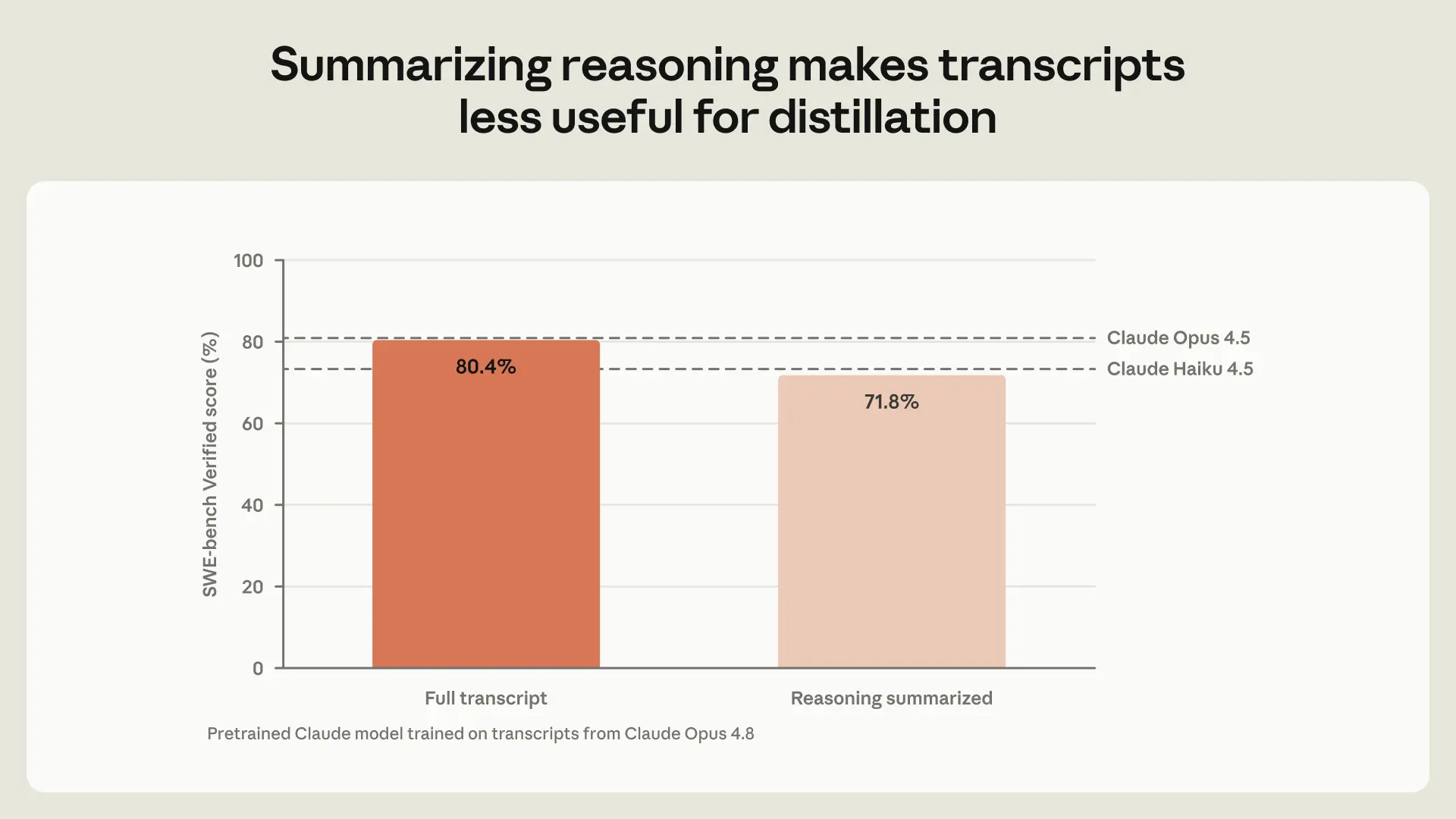
Anthropic’s company-reported experiment: a Claude student scored 80.4% on SWE-bench Verified after training on full transcripts, versus 71.8% with summarized reasoning. Source: Anthropic.
OpenAI describes three defenses at the request level: adversarial training to refuse reasoning-extraction attempts, classifiers examining inputs and outputs, and restrictions on reusing encrypted reasoning through its application programming interface.
The training is intended to preserve legitimate requests for explanations and assistance. The output checks cover tool-call arguments as well as assistant messages, in streaming and non-streaming responses. A model can otherwise leak reasoning through a tool invocation even if its final answer does not reveal it.
For GPT-6.2 Astra and Sol, protected reasoning is tied to the conversation history that produced it. Appending messages allows the model to build on earlier reasoning; rewriting an earlier message causes the API to drop subsequent reasoning. Older model families with weaker safeguards cannot read the two models' protected reasoning, OpenAI says.
OpenAI says it also closed a pathway that could expose another user's encrypted reasoning, alongside stronger boundaries across users, workspaces, organizations and model families.
Similar controls already exist at Anthropic. Its preserved-thinking measure restricts prior-context editing for certain Claude models and API accounts created on or after August 31, 2026. It also limits reasoning reuse across model generations and organizations. These measures make conversation handling part of the defense, alongside screening individual requests.
Anthropic says in its account of the tradeoffs that they include integration changes for some legitimate developers and false positives in fewer than 0.1% of cases. Since September 24 it has resumed charging for requests blocked before a response in areas, including distillation, where it reports that low false-positive rate. It also says it has turned away meaningful revenue and trillions of tokens of paying distillation traffic. Preventing extraction therefore has costs for the provider as well as the requester.
OpenAI’s broader cyber safeguards carry a separate usefulness tradeoff. On its evaluation of answering allowed cyber requests within policy, GPT-6.2 Astra scored 78.1%, against GPT-6 Astra’s 90.7%; GPT-6.2 Sol scored 69.5%. These are evaluation results, not production rejection rates, and they do not isolate the effect of anti-distillation controls. OpenAI’s Daybreak program provides vetted access for authorized cyber work. Its planned Astra launch configuration limits reduced cyber refusals to organizations separately approved for Daybreak Red, the tier requiring stronger verification.
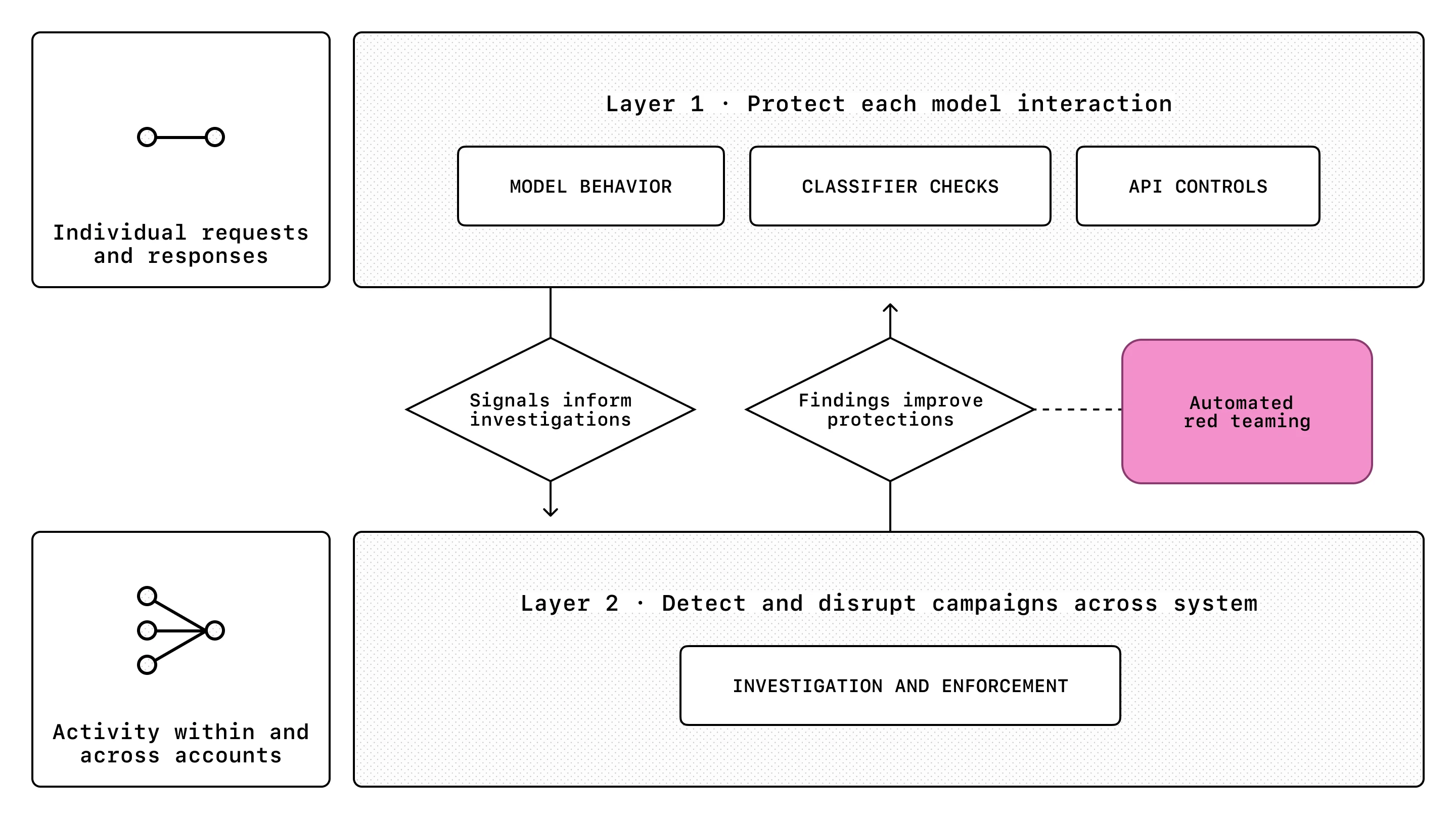
OpenAI’s defense diagram links controls for individual requests with campaign investigation and enforcement. Investigation findings feed back into protections. Source: OpenAI.
Campaign investigations add a second level of control. OpenAI says weekly enforcement against unauthorized distillation campaigns has ranged from thousands to tens of thousands of accounts this year, increasing significantly during the summer. Those are enforcement volumes, not a count of distinct attackers or proof of how much capability transfer was prevented.
The company says attacks uncovered in investigations feed back into safeguard training and testing. It also shares indicators of compromise with other model providers and coordinates safeguards and enforcement with deployment partners.
The September disclosure provides a narrower historical reference. A report recounting OpenAI’s investigation relays the company’s finding of 16,000 extraction-pattern requests from more than 4,000 users on July 24 and 25. In the original September 30 disclosure, OpenAI says its wider investigation identified related activity across more than 15,000 users and that it fully disrupted that cluster by July 28. OpenAI says the operators manipulated model interactions, without breaking its encryption, compromising a database or gaining direct access to stored user conversations.
OpenAI attributed a core cluster to individuals associated with Moonshot AI, the developer of Kimi models, while saying it was unclear whether all operators came from a single actor.
In the new announcement, OpenAI also repeats its February warning to Congress about activity indicating attempts by rival model developer DeepSeek to distill U.S. frontier models. These remain OpenAI's allegations. They do not establish that every account affected by enforcement belonged to either developer.
The company is also asking for government support. It backs legislation giving U.S. authorities more tools to identify and sanction foreign actors that illicitly extract American model capabilities, alongside stronger controls on access to advanced training hardware. OpenAI presents the two as complementary defenses of U.S. AI leadership. That position also aligns with its commercial interest in controlling access to capabilities it develops; the safety and competitive consequences require separate assessment.
OpenAI says its operational goal is to reduce the volume and value of data obtained, increase campaign costs and shorten the interval between detection and enforcement. Its announcement does not quantify the change in those costs or response times. It is applying selected improvements to GPT-6 Astra and plans to disclose more about disrupted campaigns.
Anthropic’s experience supplies a caution about durability: it says it does not know how long its gains will last and had yet to see a highly sophisticated, persistent attempt to circumvent the new defenses. It also warns that attackers can move to other models or inference providers with weaker protections.
The next evidence needed from OpenAI is independent testing of updated extraction defenses and sustained measurements of usable reasoning obtained across evolving campaigns and deployment partners. Reporting those results alongside disruption to legitimate work would show whether the laboratory gains meaningfully constrain capability transfer at an acceptable operating cost.
Alberta proposes 600-metre setbacks for large data centres and expanded utility oversight, but exemptions and rules still to be written will determine how much protection communities receive.
President Donald Trump backed Commerce Secretary Howard Lutnick as lawmakers scrutinize alleged delays in restricting a suspected route for AI chips to China. A new congressional inquiry also questions Nvidia’s influence on an existing investigation.

Amazon’s month-old Echo Time is $50 off for Black Friday. Its touchscreen, home hub and optional sleep-aware alarm cost $90 more than the reported Echo Spot price, while Alexa+ access and evidence of better waking remain key buying questions.
Merck will pair its experimental data with Isomorphic Labs’ AI to seek small-molecule cancer drug candidates. The deal follows Isomorphic’s $5 billion financing, but its payments, target and development timetable remain undisclosed.
Thinking Machines Lab released a roughly 20GB open-weights model that reuses its middle layers for reasoning. It brings the Inkling family to local hardware, with competitive coding results but workload-dependent costs and preliminary evidence on oversight.
Apple’s first HomePod mini update since 2020 adds Mac audio and four-speaker surround, but Siri AI remains unavailable, core home-hub features carry over, and reviews disagree on playback reliability.
Treasury Secretary Scott Bessent says an unnamed Anthropic founder will announce a large gift to children's investment accounts within weeks, but the amount, recipients and connection to existing philanthropic pledges remain undisclosed.
Google says air cooling will limit water use at its Visakhapatnam AI hub, but environmental proceedings and residents’ accounts raise broader questions about land, electricity, public incentives and the evidence behind promised benefits.
Nvidia slipped behind Alphabet to fourth in U.S. market value during November 20 trading. The reversal follows a steep selloff despite strong reported revenue growth, with a permanent CEO still to be chosen.
Google will close the Nest app on January 25, 2027 and retire Assistant on home speakers and displays in August. Device transfers are automatic, but continued voice access requires accepting Gemini; basic assistance remains free.

Amazon says Cairn agents exploited a MONAI Label zero-day to take over a university server. Other attacks failed, and maintainers list no patched package release.
Federal Reserve Governor Lisa D. Cook sees early AI pressure on coding, translation and young workers, but says a solid overall labor market and persistent inflation still call for tighter monetary policy.
President Donald Trump threatened a tax on U.S. companies building data centers abroad without specifying how it would work. The proposal raises questions for an AI export program that has received 78 applications and for domestic construction constrained by power and community opposition.
Donald Trump said only older chips should be sold to China while discussing a broader deal with Beijing. His remarks leave unresolved which products would qualify as Washington tightens access to American AI hardware and overseas manufacturing.
Treasury Secretary Scott Bessent expects no change to the US policy permitting limited H200 sales to China despite sparse orders. Nvidia’s earlier filing shows Chinese restrictions and tariff costs also obstruct sales, while the company warns that exclusion helps competitors.
AI infrastructure stocks fell on November 20 amid cloud financing concerns and a reported NAND demand warning. Customer contracts support the buildout, but IREN’s filing shows the conditions and cash demands behind its expansion.
Jensen and Lori Huang’s foundation has committed $350 million to CoreWeave computing for research recipients. The purchase links charitable access to Nvidia’s commercial ecosystem, while pricing, allocation and supplier-selection terms remain unclear.
The mathematicians claim finite-time blow-up without external forcing, a significant advance if verified. Their repository omits the numerical certificate and its checking computation, and says the patched Lean package was not rebuilt.
The Pentagon treated Anthropic’s military-use safeguards as a supply chain threat. Later court rulings diverged under different statutes, while the dispute exposed how difficult it was to replace Claude in classified systems.
A new investigation describes decades of alleged humiliation under Nvidia co-founder and former CEO Jensen Huang. He denies a former HR chief’s claims, while employee support and stock rewards complicate the account of his management.