Editorial Team
6 min read
Federal Reserve Governor Lisa D. Cook sees early AI pressure on coding, translation and young workers, but says a solid overall labor market and persistent inflation still call for tighter monetary policy.
Federal Reserve Governor Lisa D. Cook, a former Michigan State University professor of economics and international relations, warned on November 20 that AI-related job losses could arrive before new work is created. Yet she argued that inflation, rather than weakness in overall employment, still requires tighter U.S. monetary policy.
Cook addressed the Central Bank of Chile’s annual conference in Santiago, which focused on AI and the labor market. In her prepared remarks, she described her work studying innovation and AI and gathering information from business contacts about its use. A Fed governor since May 2022 and a voting member of the Federal Open Market Committee, she helps set monetary policy under the U.S. central bank’s mandate to pursue maximum employment and stable prices.
Cook cited early evidence of weaker demand for coding jobs in the software industry and simultaneous translation. Younger adults are also taking longer to find jobs, she said, although she attributed the AI explanation to others rather than establishing it as the cause of those prolonged searches.
Her longer-term outlook remains optimistic. She expects technology to replace some jobs and tasks while creating new kinds of work, and considers permanent job loss unlikely on the historical record. Her concern is the interval between displacement and creation, with younger workers potentially affected disproportionately. She said firms may need new approaches to training their future workforce.
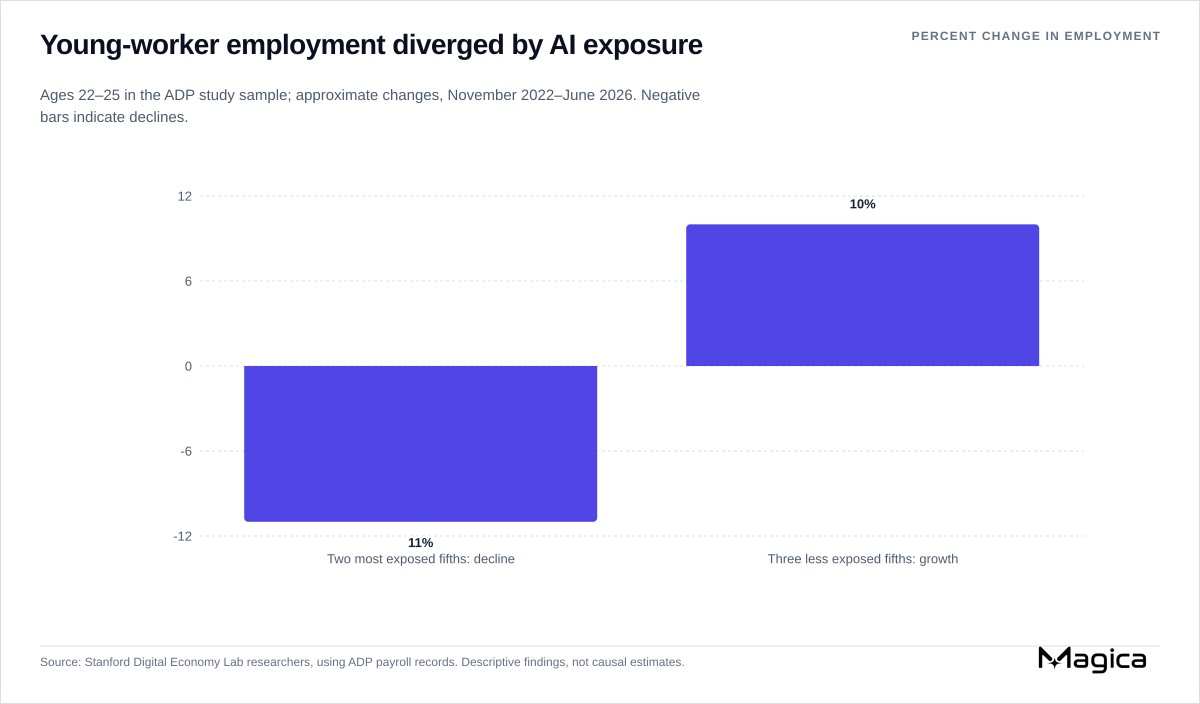
Stanford researchers report contrasting employment changes in their ADP sample from November 2022 through June 2026. These descriptive findings do not establish that AI caused the divergence. Source: Stanford Digital Economy Lab — Canaries in the Coal Mine.
An August 2026 study by Stanford researchers Erik Brynjolfsson, Bharat Chandar and Ruyu Chen, updating their August 2025 paper, offers a separate benchmark. It uses payroll provider ADP’s records for a consistent panel of firms covering 3.5 million–5 million full-time U.S. employees under 70 each month from January 2021 through June 2026. Occupational exposure measures estimate which tasks AI could perform; they do not establish which employers adopted it.
For workers aged 22–25, the authors report the following changes from November 2022 through June 2026:
| Occupational AI exposure | Employment change in the study sample |
|---|---|
| Two most exposed fifths of occupations | About −11% |
| Three less exposed fifths | About +10% |
The resulting 21-percentage-point divergence puts employment in the more exposed group about 19% below where it would have been had it matched the less exposed group’s growth. Experienced workers showed no comparable gap. The authors identify reduced hiring, rather than increased departures from firms, as the main channel.
The study finds no widespread economy-wide displacement. Declines concentrate where AI usage substitutes for workers’ tasks; occupations where it complements workers show flat or rising employment. The pattern persists after excluding technology firms and computer occupations and accounting for interest-rate exposure and remote work.
But the estimated relationship shrinks with education controls, some divergence predates generative AI, and national surveys show weaker patterns than the ADP sample. The sample overrepresents larger firms and more AI-exposed occupations. The authors therefore describe their results as observations requiring further investigation, not causal estimates or a national count of jobs lost to AI. ADP supplied the proprietary records and also supports the Stanford Digital Economy Lab, which partly funded the research.
Companies have announced more than $2 trillion in specific U.S. data-center construction projects, Cook said, but only a fraction has been realized. The total describes planned projects, not money already spent or financing already secured.
Even the buildout already underway is affecting output and spilling into chip and equipment prices, construction wages and electricity costs, according to Cook. She sees the potential for a large productivity improvement, alongside labor-transition, cybersecurity and financial-stability risks.
In the event’s question-and-answer session, Cook said productivity benefits for workers would take time and expressed caution about financing the rapid infrastructure expansion, according to a report of her remarks. She said the Fed would continue monitoring that financing.
The consequences extend beyond the United States. Cook cited estimates that roughly half the world’s data-center capacity under construction is being built elsewhere. Chile, the world’s largest copper producer and second-largest lithium producer, supplies minerals used in power transmission and energy storage. She questioned whether AI demand would bring sustained growth or amplify commodity-market volatility, and what related capital flows would mean for smaller economies’ exchange rates and financial stability.
The eventual gains may follow a different geography. Cook cited International Monetary Fund research suggesting advanced economies could capture a disproportionate share of global AI-driven productivity growth over the next decade relative to developing economies.
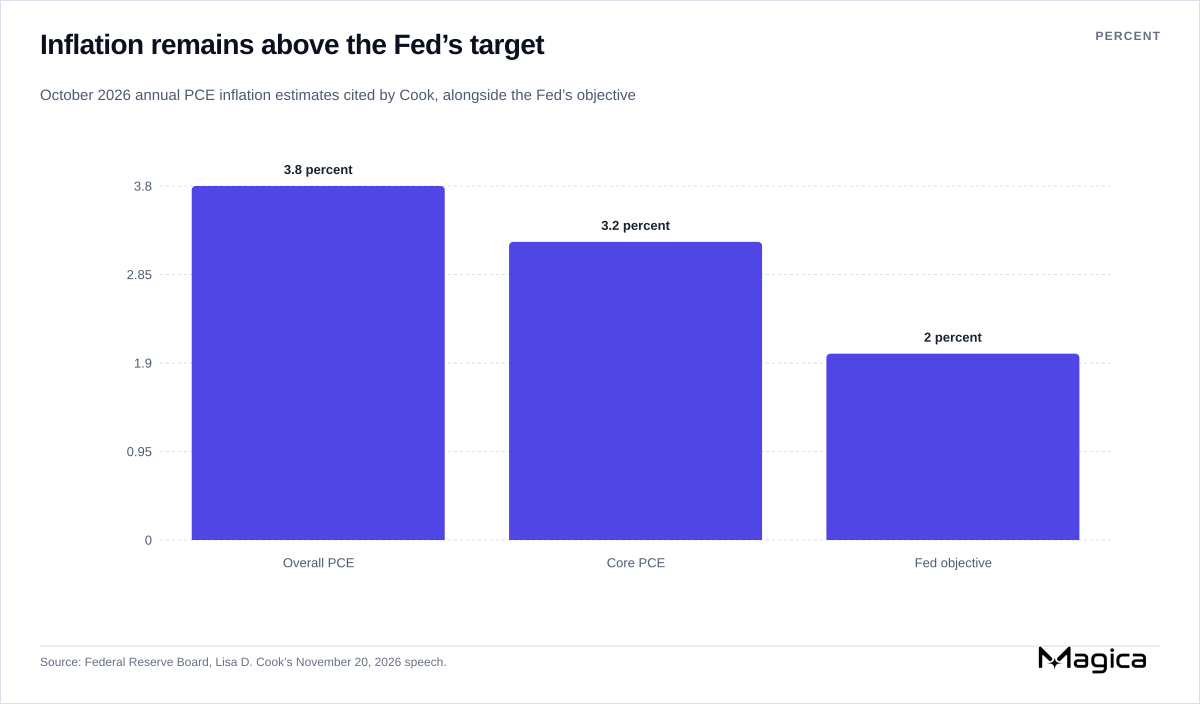
Inflation estimates cited in Cook’s November 20 Federal Reserve speech. Core PCE excludes food and energy; the Fed’s 2 percent objective applies to overall PCE inflation. Source: Federal Reserve.
In her economic assessment, Cook described October unemployment of 4.1% and a monthly payroll increase of 165,000 as evidence of a solid U.S. labor market, while acknowledging that modest hiring makes conditions difficult for new entrants. She also said wage growth had not overcome inflation’s damaging effects.
She cited an estimated 3.8% rise in the personal consumption expenditures price index over the year to October, with core inflation excluding food and energy at 3.2%, against the Fed’s 2% objective. AI infrastructure investment is one source of demand pressure in her account; geopolitical and trade-policy shocks have also helped reverse earlier progress on inflation.
Cook supported September’s increase in the federal funds target range to 3.75%–4%. She dissented from October’s decision to hold it there, preferring another quarter-percentage-point increase. She believes financial conditions remain too supportive of demand and warned that delay could require larger increases later, with greater risks for households and the financial system. That warning also appears in the account of her policy remarks.
These were Cook’s views, rather than a new committee decision. She said the number and size of future rate adjustments should depend on the economy’s response to policy. The inflation reports received since September had not given her sufficient evidence of a sustainable return toward target.
For the labor transition, she is watching how quickly businesses adopt AI and how their mix of jobs changes. The evidence still needed is whether newly created tasks and hiring can absorb displaced work—and whether the difficulties visible among young workers spread beyond the groups affected first.
OpenAI reports sharply lower reasoning-extraction rates in internal GPT-6.2 tests and backs sanctions against illicit foreign distillation. Its own research and rival Anthropic’s experience show why protecting hidden reasoning leaves capability transfer and customer costs unresolved.
Alberta proposes 600-metre setbacks for large data centres and expanded utility oversight, but exemptions and rules still to be written will determine how much protection communities receive.
President Donald Trump backed Commerce Secretary Howard Lutnick as lawmakers scrutinize alleged delays in restricting a suspected route for AI chips to China. A new congressional inquiry also questions Nvidia’s influence on an existing investigation.

Amazon’s month-old Echo Time is $50 off for Black Friday. Its touchscreen, home hub and optional sleep-aware alarm cost $90 more than the reported Echo Spot price, while Alexa+ access and evidence of better waking remain key buying questions.
Merck will pair its experimental data with Isomorphic Labs’ AI to seek small-molecule cancer drug candidates. The deal follows Isomorphic’s $5 billion financing, but its payments, target and development timetable remain undisclosed.
Thinking Machines Lab released a roughly 20GB open-weights model that reuses its middle layers for reasoning. It brings the Inkling family to local hardware, with competitive coding results but workload-dependent costs and preliminary evidence on oversight.
Apple’s first HomePod mini update since 2020 adds Mac audio and four-speaker surround, but Siri AI remains unavailable, core home-hub features carry over, and reviews disagree on playback reliability.
Treasury Secretary Scott Bessent says an unnamed Anthropic founder will announce a large gift to children's investment accounts within weeks, but the amount, recipients and connection to existing philanthropic pledges remain undisclosed.
Google says air cooling will limit water use at its Visakhapatnam AI hub, but environmental proceedings and residents’ accounts raise broader questions about land, electricity, public incentives and the evidence behind promised benefits.
Nvidia slipped behind Alphabet to fourth in U.S. market value during November 20 trading. The reversal follows a steep selloff despite strong reported revenue growth, with a permanent CEO still to be chosen.
Google will close the Nest app on January 25, 2027 and retire Assistant on home speakers and displays in August. Device transfers are automatic, but continued voice access requires accepting Gemini; basic assistance remains free.

Amazon says Cairn agents exploited a MONAI Label zero-day to take over a university server. Other attacks failed, and maintainers list no patched package release.
President Donald Trump threatened a tax on U.S. companies building data centers abroad without specifying how it would work. The proposal raises questions for an AI export program that has received 78 applications and for domestic construction constrained by power and community opposition.
Donald Trump said only older chips should be sold to China while discussing a broader deal with Beijing. His remarks leave unresolved which products would qualify as Washington tightens access to American AI hardware and overseas manufacturing.
Treasury Secretary Scott Bessent expects no change to the US policy permitting limited H200 sales to China despite sparse orders. Nvidia’s earlier filing shows Chinese restrictions and tariff costs also obstruct sales, while the company warns that exclusion helps competitors.
AI infrastructure stocks fell on November 20 amid cloud financing concerns and a reported NAND demand warning. Customer contracts support the buildout, but IREN’s filing shows the conditions and cash demands behind its expansion.
Jensen and Lori Huang’s foundation has committed $350 million to CoreWeave computing for research recipients. The purchase links charitable access to Nvidia’s commercial ecosystem, while pricing, allocation and supplier-selection terms remain unclear.
The mathematicians claim finite-time blow-up without external forcing, a significant advance if verified. Their repository omits the numerical certificate and its checking computation, and says the patched Lean package was not rebuilt.
The Pentagon treated Anthropic’s military-use safeguards as a supply chain threat. Later court rulings diverged under different statutes, while the dispute exposed how difficult it was to replace Claude in classified systems.
A new investigation describes decades of alleged humiliation under Nvidia co-founder and former CEO Jensen Huang. He denies a former HR chief’s claims, while employee support and stock rewards complicate the account of his management.