Editorial Team
6 min read
The operator of ao3.life says authors submitted more than 2,000 takedown requests after the site repackaged fanfiction and sold AI audiobooks during AO3’s outage, exposing the gap between restoring access and obtaining permission.
An unofficial, AI-built copy of Archive of Our Own, the fanfiction repository known as AO3, has shut down after its operator said they handled more than 2,000 author takedown requests. The site, ao3.life, had republished stories without authors’ permission and charged readers for AI-generated audiobook versions.
The service went down on Monday evening, November 2, according to the shutdown report. Its short life exposed a problem that a working search bar and downloadable files could not solve: restoring readers’ access also meant moving authors’ work into a service they had never chosen.
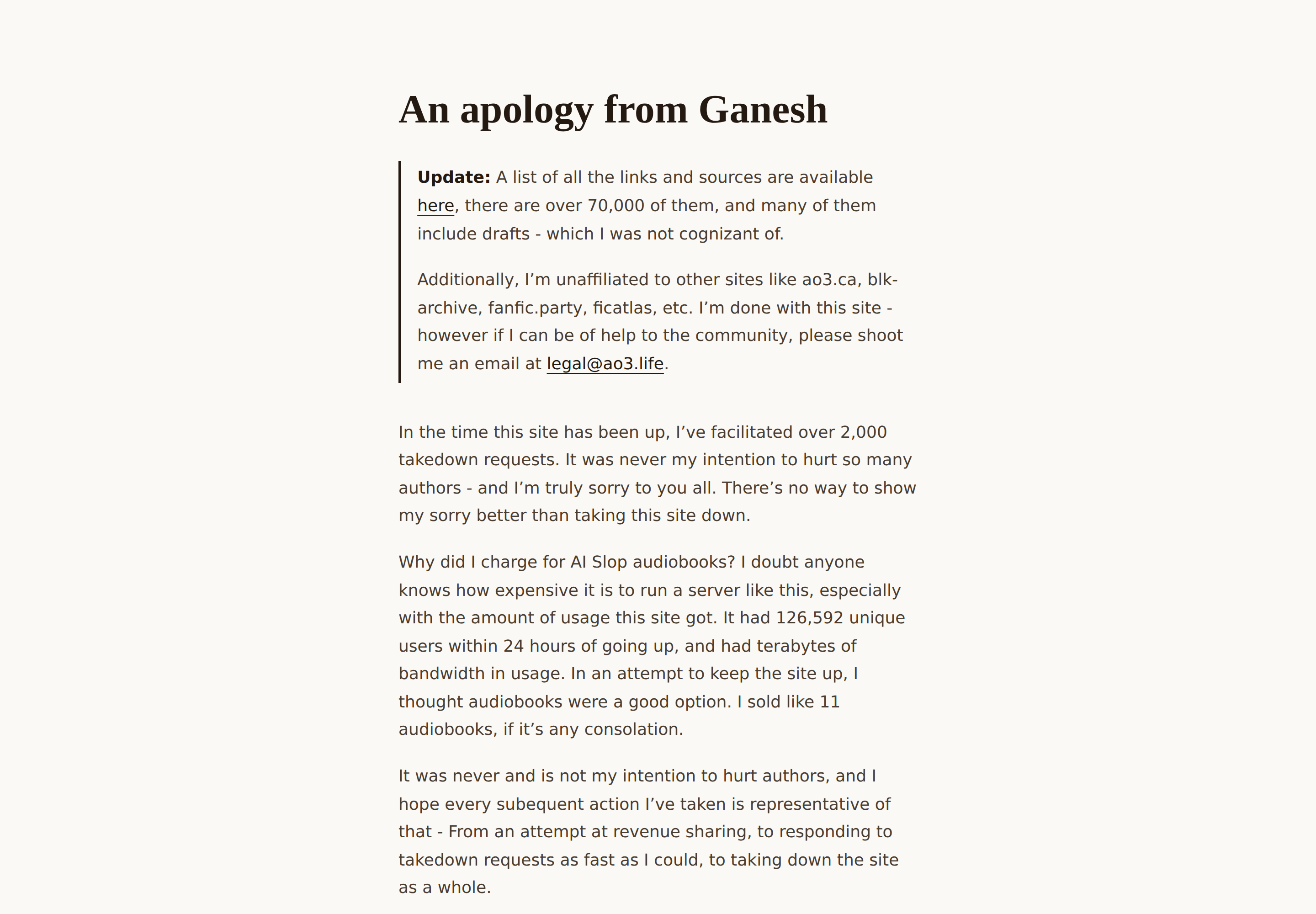
ao3.life operator Ganesh replaced the service with an apology reporting more than 2,000 takedown requests. The operator’s account has not been independently audited. Source: ao3.life.
Archive of Our Own, usually called AO3, is a fanfiction repository owned by the Organization for Transformative Works, or OTW. The fan-run nonprofit describes itself as dedicated to preserving fanworks and sustained entirely by user donations in its budget announcement. AO3 prohibits authors from monetizing works on the platform or linking to payment services, according to the shutdown report.
AO3 went offline on Thursday, October 29, following a security incident, according to the shutdown report. The expected outage could last up to four weeks, and the repository hosts nearly 18.5 million works, the report said. OTW said no data had been lost, according to the report. The interruption left readers unable to reach stories and authors unable to change access settings on the original service.
Into that gap came ao3.life. Its operator, who identifies in the apology replacing the site only as Ganesh, describes themselves as a 17-year-old from India working alone. Ganesh said shared drive links and people reading through the Wayback Machine prompted an attempt to build a better interface and search function.
Ganesh is the only name supplied in the apology; the operator’s identity and account of working alone have not been independently established. The operator denies affiliation with AO3 or OTW and says no company funded the project.
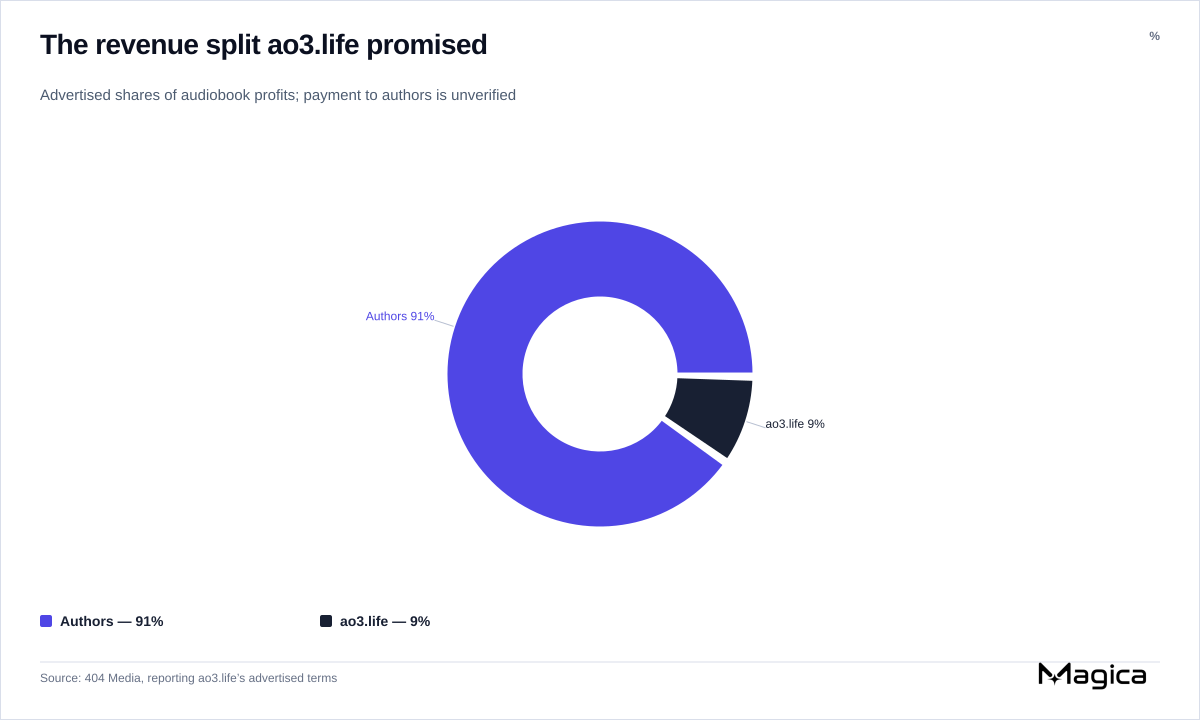
ao3.life advertised 91% of profits for authors and 9% for narration and processing. The available evidence does not establish that authors were paid. Source: 404 Media.
The site offered EPUB downloads and AI audiobooks, charging after the first three minutes of audio. It promised authors 91% of profits, retaining 9% for narration and processing, according to the shutdown report. Authors did not need an account to accrue a purported share; the site said it would hold earnings until they collected them.
That arrangement made payment an after-the-fact proposition. In the apology, Ganesh acknowledged planning to wait for authors to reach out and called the plan insufficiently thought through. Offering a share did not establish that the author had agreed to either republication or audio conversion.
Ganesh said server demand motivated the audiobook charges, claiming 126,592 unique users in the first 24 hours and terabytes of bandwidth usage. The operator said they sold about 11 audiobooks and, in a separate response, put the cost of running the website below $200. These are self-reported figures; the available evidence supplies neither a complete revenue account nor proof that authors received payments. They do not establish how much money the site earned or whether audiobook sales covered its costs.
OTW’s April 2025 budget projected about $625,000 in AO3 expenses for that year, including $430,000 for new servers and $20,000 for server-related equipment to accommodate expected traffic growth. Those were annual budget projections, not final spending or 2026 costs. They show the infrastructure supported by donations, but cannot establish a cost or efficiency comparison with a short-lived copy of the archive.
The takedown process created another obstacle. The shutdown report described instructions asking authors to put a verification note on their AO3 profile, even though AO3 was inaccessible. A separate account of the dispute described verification through email associated with an AO3 profile. Both accounts illustrate the burden placed on authors to establish ownership after their stories had already been copied.
The dispute extended beyond paid audio. The separate report on the replacement archives described fanfic.party as calling itself a temporary, not-for-profit backup. That service said it accepted files sent to it rather than scraping them itself, would never train AI on the works, and opposed selling AI audiobooks for profit. Another service, blk archive, said rights remained with authors and disclaimed affiliation with AO3 or OTW.
Those services presented different models from ao3.life’s paid audio. They still offered authors removal or opt-out requests after publication. Ganesh also disclaimed connections to other replacement sites.
OTW said its legal team was taking legal and technical steps against ao3.life before it closed, according to the same report. The report also relayed OTW’s warning that there were no official AO3 mirrors. These sites were independently assembled collections, rather than restored access to the original service.
Ganesh’s technical account says AI agents controlling 40 virtual machines collected shared drives, existing scrapes, and other sources. Files were normalized into EPUBs, stored on S3, and indexed using Meilisearch. Some older stories came from an old dataset, the operator said.
Authors can restrict AO3 works to logged-in users through an archive lock. That makes the provenance of these copies important: the material was not necessarily a fresh copy of what an author currently allowed the public to read. Authors reported finding locked, deleted, or older versions of works. Ganesh’s apology also acknowledges that a published list of more than 70,000 source links includes drafts, something the operator said they had not realized. That figure counts source links, not stories or affected authors.
The episode also has a precedent. The separate account describes a December 2024 dispute over WordStream, which reposted AO3 fiction with AI-generated audio, covers, and summaries. Audio repackaging was already a source of conflict before this outage created demand for replacement access.
Reports of drafts and deleted works fueled speculation about a connection to AO3’s security incident. The available reporting does not establish one. Ganesh denies involvement in any breach, says the files came from public scrapes, and attributes drafts to shared drives and document links. The separate account said OTW had confirmed a security incident, was still determining its scope, and had not ruled out access to user account data. That is distinct from deletion of works. OTW had not tied ao3.life to the outage. The origin of individual files remains unresolved.
Ganesh says the site is finished and describes using agents to remove requested material from the search index, storage, and website. The apology is an account of those actions, not an independent audit of deletion.
The remaining question is what happened to the underlying copies, especially drafts and works whose authors had restricted or withdrawn them. A closed reading interface does not by itself establish that every stored file has been deleted. Resolving that question would require evidence of removal across the service’s storage and indexes, alongside a clearer account of where the material originated.
FTAI Aviation is financing a planned 100-turbine production run in 2027, while ProEnergy has a 650 MW equipment order from Crusoe. Converted aircraft engines offer another supply route for data-center power, but delivery targets, affiliated financing and unproven operating economics qualify the opportunity.
Meta is marketing dollar bonds in a plan to borrow at least $20 billion, including an expected euro offering. Capital spending exceeded operating cash flow last quarter, but the debt is part of a wider financing strategy that also includes equity offerings and a proposed non-voting share-sale program.
A nonbinding opinion targets real-time retrieval and recognisable reuse of journalism, while rejecting a monopoly over news facts and recommending that questions about model training be dismissed as hypothetical.
A study of Lovable projects found passport details, customer records and private messages accessible without login, raising questions about database permissions and the limits of automated security checks. Its sample does not establish a platform-wide leak rate.
CrowdStrike is extending Falcon Guardian into Claude Cowork’s virtual machine and AWS’s AI guardrail layer. The Cowork beta addresses a visibility gap, while existing AWS safeguards and unfinished acquisitions limit what buyers can infer about the broader platform’s capabilities.
Oman and UK-founded Yamna have agreed to cooperate on a Salalah AI data centre whose first phase is expected to exceed £1 billion. The developer brings a hydrogen-project foothold and an earlier Brazilian data-centre proposal, but financing, customers and delivery dates remain undisclosed in the announcements.
War Thunder will add Nvidia’s DLSS 5 neural rendering in mid-November. The upgrade changes lighting and materials, with access and performance depending on hardware, streaming and other rendering features.
Samsung’s planned second Taylor fab reportedly has its output booked for AI-memory base dies, mostly for AMD, with production targeted for 2030. The orders could underpin investment, but Nvidia’s reported TSMC sourcing requirement limits the case for a broader foundry breakthrough.
Nordic Semiconductor is sampling nRF71 chips combining Wi-Fi, Bluetooth LE and Thread, with an AI accelerator in the higher-end variant. Its claimed standby-power improvement targets battery devices, but software maturity and real-world energy use remain key tests.
CrowdStrike has added an AI Kill Switch to Falcon Guardian that blocks agents’ model access through connected gateways. Broader containment across endpoints, identities and applications remains planned, making deployment coverage the key test of the new control.
DigitalOcean raised its 2026 revenue forecast to $1.208–$1.211 billion after third-quarter sales grew 40%. Larger customers are driving the expansion, while falling operating margins and rising equipment obligations complicate the earnings beat.
A leaker claims Intel may retire the B580, launched at $249, to favor professional AI products. Shared chips make reallocation possible, but no discontinuation notice has been reported, and the hardware can serve both markets.
The independent games marketplace is widening mandatory AI declarations and search filtering after reporting a surge in new game pages. But filtered results and deleted terabytes do not establish how much of its catalog is AI-generated.
A false authority appeared in a senior prosecutor’s reasons for continuing a child’s prosecution. The High Court rejected the challenge, while criticising the explanation for the citation and other aspects of the CPS’s handling of the case.
DeepSeek’s reported eight-trillion-parameter model plan accompanies a push toward Huawei hardware. Joint software tools and a larger reported fundraising show progress, but chip supply, training performance and deployment costs remain unresolved.
China plans broader AI legislation, regulatory sandboxes and employment safeguards. The test is how those pledges extend existing rules for public-facing generative-AI services.
CrowdStrike has agreed to acquire AI observability company Fiddler and security-testing startup Dreadnode, bringing agent evaluation and monitoring into Falcon. The proposed Falcon integrations would connect testing with runtime protection and behavioral monitoring, alongside an overlapping offering from Palo Alto Networks.
SpaceX plans to adapt satellite cooling technology for orbital AI computers. Early chip demonstrations support the concept, but radiator mass, launch cadence and useful hardware lifetime still determine whether it can compete with computing on Earth.
Revolut says serving open-weight GLM models to roughly 2,000 engineers reduced its AI invoice to a tenth of previous spending. The deployment also required extensive GPU tuning, and the disclosed figures leave full operating costs and productivity attribution unresolved.
Drax has agreed to develop an AI data centre with Brookfield and Radiant, backed by the Brookfield–Qai venture. Potential investment could exceed £20 billion including chips, but the first phase, targeting up to 100MW, still needs a tenant, approvals and final investment decisions.