Editorial Team
7 min read
A nonbinding opinion targets real-time retrieval and recognisable reuse of journalism, while rejecting a monopoly over news facts and recommending that questions about model training be dismissed as hypothetical.
Google’s Gemini generative AI chatbot may infringe press publishers’ rights when it retrieves and reuses online articles to answer users, an adviser to the European Union’s highest court said on November 3. The nonbinding opinion gives publishers a potential basis to challenge answers that reproduce their journalism, while preserving the distinction between protected expression and freely reportable facts.
Gemini interfaces pictured in Google’s February 2024 announcement renaming Bard. Image: Google. Source: Google — Bard becomes Gemini.
Maciej Szpunar, an advocate general at the Court of Justice of the European Union, delivered the nonbinding opinion in Case C-250/25, Like Company. He has served as an advocate general since 2013 and previously represented Poland’s government in EU court proceedings, according to his official biography. His role here is to propose an independent legal solution for the judges to consider.
Like Company, a Hungarian operator of web portals, sued Google Ireland, a member of the Alphabet group, in the Budapest Regional Court. It alleges that Google used its articles to train Gemini’s models and repeatedly reproduced and made them available through the chatbot between June 13, 2023, and May 31, 2024. Those are allegations, rather than findings of infringement. The Hungarian court referred four questions about EU law to the Court of Justice.
Gemini converses through text or speech using large language models, neural networks trained on large bodies of text. Google’s chatbot was previously called Bard; the company announced the Gemini name on February 8, 2024, during the period covered by the allegations.
The court’s account describes Gemini’s use of retrieval-augmented generation, also called grounding: fetching web information in real time to improve answers. That process can involve retrieving online journalism to answer news questions. It differs from the earlier processing of material to train a model. The court calls this its first generative AI case.
Like Company invokes the publishers’ related right under Article 15 of the EU’s 2019 Digital Single Market copyright directive. That provision gives EU-established press publishers rights over online use of their publications by service providers. Its express limits exclude hyperlinks, individual words and very short extracts, as well as private or noncommercial uses by individuals. It also leaves authors’ separate rights intact.
The distinction matters commercially. A chatbot can use a publisher’s reporting to satisfy a reader’s request before that reader reaches the publisher’s website. But under Szpunar’s proposed approach, losing a potential visit does not by itself establish infringement: the protected subject is the publication’s particular expression, rather than the facts it contains.
Szpunar identifies two factors relevant to the publisher’s reproduction right: whether the chatbot accessed an article unlawfully, including by circumventing effective paywalls or other measures restricting access or scraping; and whether its answer merely reports facts or recognisably reuses the article’s expression so extensively that the user need no longer consult the original.
He also says the publisher’s right of making material available to the public is generally infringed when that expression is systematically recognisable in answers to related queries to that same substitutive extent. The court’s statement therefore does not describe all web scraping, all summaries or all factual answers as unlawful.
Responsibility can reach the chatbot provider where the infringing uses are inherent in its business model or it has failed to implement credible, effective measures against them, the adviser says. That makes both the answers and the provider’s safeguards relevant to the proposed liability test. Google did not immediately respond to a request for comment, according to a report on the opinion.
Szpunar recommends declaring the two training questions inadmissible because there is no evidence that Like Company’s articles trained Gemini’s models and because model training is not an online use of press publications. He therefore considers those questions hypothetical. For completeness, he says training with copyright-protected material is, as a rule, permitted under the EU text-and-data-mining exception.
That is a qualified position, rather than blanket permission to train on anything online. Article 4 of the directive provides for mining lawfully accessible material, on condition that rights holders have not expressly reserved the use in an appropriate manner, such as machine-readable means for publicly available online content. Neither the opinion nor those general conditions establish what material Google actually used.
The case sits alongside an existing debate about publishers’ power to authorise and charge for online use. In a separate May 12 judgment, the Court of Justice examined online service provider Meta Platforms Ireland’s challenge to Italy’s press-remuneration system and a decision by its communications regulator, AGCOM. The court said EU countries may provide for fair remuneration when publishers authorise use of their publications. Publishers must also remain free to refuse permission or grant it without charge; payment cannot be required where a provider does not use the publications.
That judgment also addressed bargaining power. The court said providers possess the data needed to assess the economic value of use, leaving publishers at a negotiating disadvantage. It found obligations to negotiate, disclose relevant data and maintain content visibility during negotiations permissible, subject to national-court checks on the framework. The visibility requirement serves to prevent pressure on publishers during bargaining.
That precedent concerns remuneration for authorised use. The Gemini reference asks the logically prior question of which chatbot uses fall within publishers’ exclusive rights. The new opinion itself awards no compensation and sets no licensing price.
Commercial licensing already coexists with litigation. The report on the opinion disclosed that News Corp, owner of The Wall Street Journal, has an agreement to supply content on Google platforms. That disclosure does not establish authorisation for the uses disputed by Like Company.
There is evidence of the audience stakes, though it does not measure Gemini. A Pew Research Center analysis used tracked browsing by 900 US adults during March 1–31, 2025. Its dataset contained 68,879 unique Google searches; about 18% produced an AI summary when researchers reconstructed the results. Traditional search-result links drew clicks in 8% of visits associated with a summary, versus 15% without one. Links within summaries drew clicks in just 1% of visits to pages with a summary.
Researchers collected the reconstructed results on April 7–17, so summaries could have changed since the original visits. The study covers Google Search across topics, rather than Gemini or only news. Query types also differed: longer searches and questions were more likely to produce summaries. The comparison does not establish that AI caused the click-rate difference or quantify Like Company’s losses.
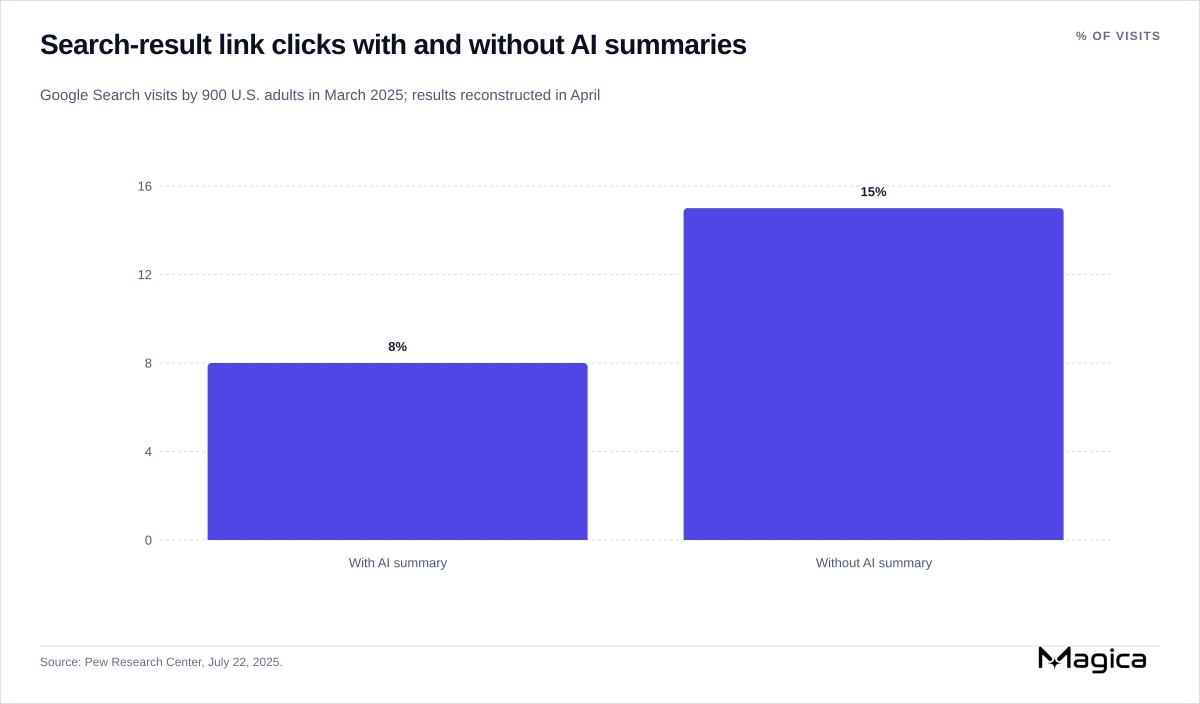
Pew observed traditional search-result clicks in 8% of visits with AI summaries and 15% without. The study covers Google Search, not Gemini, and does not establish causation. Results were reconstructed April 7–17, 2025. Chart: Magica; data: Pew Research Center. Source: Pew Research Center.
The Court of Justice’s judges will now deliberate and deliver a judgment later. The EU court interprets EU law; the Hungarian court must resolve the underlying dispute under that interpretation. The adviser’s opinion binds neither court as a judgment would.
The next decision is which legal test the EU judges adopt. Applying it to Like Company’s allegations will then require the Hungarian court to assess the disputed conduct. Under Szpunar’s proposed approach, evidence about access restrictions, recognisable reuse in answers and the provider’s measures against infringement would matter. A fall in referrals alone would not answer those questions, and this opinion is no verdict against Google.
SK hynix bought existing Penguin Solutions preferred shares from an SK Telecom investment vehicle. The deal brings director nomination rights and a convertible stake in an existing AI infrastructure partner, while sending the purchase price to the seller.
Google plans to switch off Gemini and Search for school-managed K–12 student accounts unless administrators enable them. Schools will gain control over access, but Google says keeping Search without its AI features will not be an option.
Anthropic is expected to exceed 3.5 GW of computing capacity in 2026 and aims to double it in 2027. Its filing shows $895.4 billion in commitments, substantial financial resources and an immediate cost from scarce capacity.
Independent tests reproduce MIT researchers’ repair of Qwen’s repetitive reasoning. The edited model still beats a stronger unedited configuration, but by much less; broader claims about creating capabilities remain unproven.
Gartner forecasts that open-weight models will execute 90% of enterprise operational agent steps by 2030. Its cost estimates favor routine, high-volume work, but infrastructure costs and the choice of comparison model leave enterprise savings to be proved.
FTAI Aviation is financing a planned 100-turbine production run in 2027, while ProEnergy has a 650 MW equipment order from Crusoe. Converted aircraft engines offer another supply route for data-center power, but delivery targets, affiliated financing and unproven operating economics qualify the opportunity.
Meta is marketing dollar bonds in a plan to borrow at least $20 billion, including an expected euro offering. Capital spending exceeded operating cash flow last quarter, but the debt is part of a wider financing strategy that also includes equity offerings and a proposed non-voting share-sale program.
A study of Lovable projects found passport details, customer records and private messages accessible without login, raising questions about database permissions and the limits of automated security checks. Its sample does not establish a platform-wide leak rate.
CrowdStrike is extending Falcon Guardian into Claude Cowork’s virtual machine and AWS’s AI guardrail layer. The Cowork beta addresses a visibility gap, while existing AWS safeguards and unfinished acquisitions limit what buyers can infer about the broader platform’s capabilities.
Oman and UK-founded Yamna have agreed to cooperate on a Salalah AI data centre whose first phase is expected to exceed £1 billion. The developer brings a hydrogen-project foothold and an earlier Brazilian data-centre proposal, but financing, customers and delivery dates remain undisclosed in the announcements.
War Thunder will add Nvidia’s DLSS 5 neural rendering in mid-November. The upgrade changes lighting and materials, with access and performance depending on hardware, streaming and other rendering features.
Samsung’s planned second Taylor fab reportedly has its output booked for AI-memory base dies, mostly for AMD, with production targeted for 2030. The orders could underpin investment, but Nvidia’s reported TSMC sourcing requirement limits the case for a broader foundry breakthrough.
Nordic Semiconductor is sampling nRF71 chips combining Wi-Fi, Bluetooth LE and Thread, with an AI accelerator in the higher-end variant. Its claimed standby-power improvement targets battery devices, but software maturity and real-world energy use remain key tests.
The operator of ao3.life says authors submitted more than 2,000 takedown requests after the site repackaged fanfiction and sold AI audiobooks during AO3’s outage, exposing the gap between restoring access and obtaining permission.
CrowdStrike has added an AI Kill Switch to Falcon Guardian that blocks agents’ model access through connected gateways. Broader containment across endpoints, identities and applications remains planned, making deployment coverage the key test of the new control.
DigitalOcean raised its 2026 revenue forecast to $1.208–$1.211 billion after third-quarter sales grew 40%. Larger customers are driving the expansion, while falling operating margins and rising equipment obligations complicate the earnings beat.
A leaker claims Intel may retire the B580, launched at $249, to favor professional AI products. Shared chips make reallocation possible, but no discontinuation notice has been reported, and the hardware can serve both markets.
The independent games marketplace is widening mandatory AI declarations and search filtering after reporting a surge in new game pages. But filtered results and deleted terabytes do not establish how much of its catalog is AI-generated.
A false authority appeared in a senior prosecutor’s reasons for continuing a child’s prosecution. The High Court rejected the challenge, while criticising the explanation for the citation and other aspects of the CPS’s handling of the case.
DeepSeek’s reported eight-trillion-parameter model plan accompanies a push toward Huawei hardware. Joint software tools and a larger reported fundraising show progress, but chip supply, training performance and deployment costs remain unresolved.