Editorial Team
6 min read
A study of Lovable projects found passport details, customer records and private messages accessible without login, raising questions about database permissions and the limits of automated security checks. Its sample does not establish a platform-wide leak rate.
Researchers at German security firm Crissy Field found sensitive personal and business records accessible without login in applications built with Lovable, a Swedish AI platform that turns plain-language instructions into web applications. Their investigation documents passport details, customer payment information and private messages, while leaving the prevalence of leaks across the platform unresolved.
Lovable launched publicly in November 2024 after evolving from the open-source GPT Engineer project. It markets software creation to people with little or no programming experience. The findings test how far that promise extends when an application starts handling confidential customer data and its builder must decide who can read it.
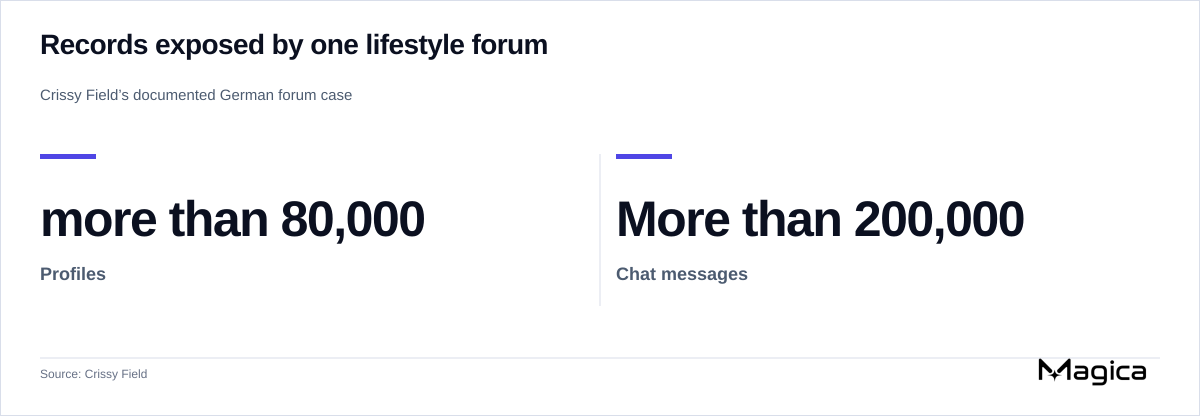
Crissy Field found these records accessible without login in one forum. Counts reflect records retrieved, not unique people affected or the full database. Source: Crissy Field.
Crissy Field, which conducted the investigation in collaboration with Handelsblatt, describes a German lifestyle forum exposing more than 80,000 profiles containing full names, email addresses, dates of birth and gender information, alongside more than 200,000 chat messages. A separate service provider exposed more than 1,000 records containing identity-document details, including passport numbers, expiration dates and nationalities.
Several event organizers and restaurants exposed tens of thousands of records relating to ticket and food sales. Inspected records included email addresses, phone numbers, postal addresses, payment information and ticket codes. A property management company exposed AI-generated summaries of internal emails containing sensitive information about tenants, owners and business partners.
Other accessible material included contracts, invoices, personal photo albums and internal WhatsApp communications. In one case, 280,000 emails sent to a provider’s customers were accessible. These are different types of records across different applications; the report provides no total count of unique people affected.
SK hynix bought existing Penguin Solutions preferred shares from an SK Telecom investment vehicle. The deal brings director nomination rights and a convertible stake in an existing AI infrastructure partner, while sending the purchase price to the seller.
The researchers said the information could facilitate phishing, ticket fraud or identity theft. They could not establish whether anyone had misused it. They retrieved only portions of the datasets, so the reported record counts describe what they downloaded rather than the full extent of the affected databases.
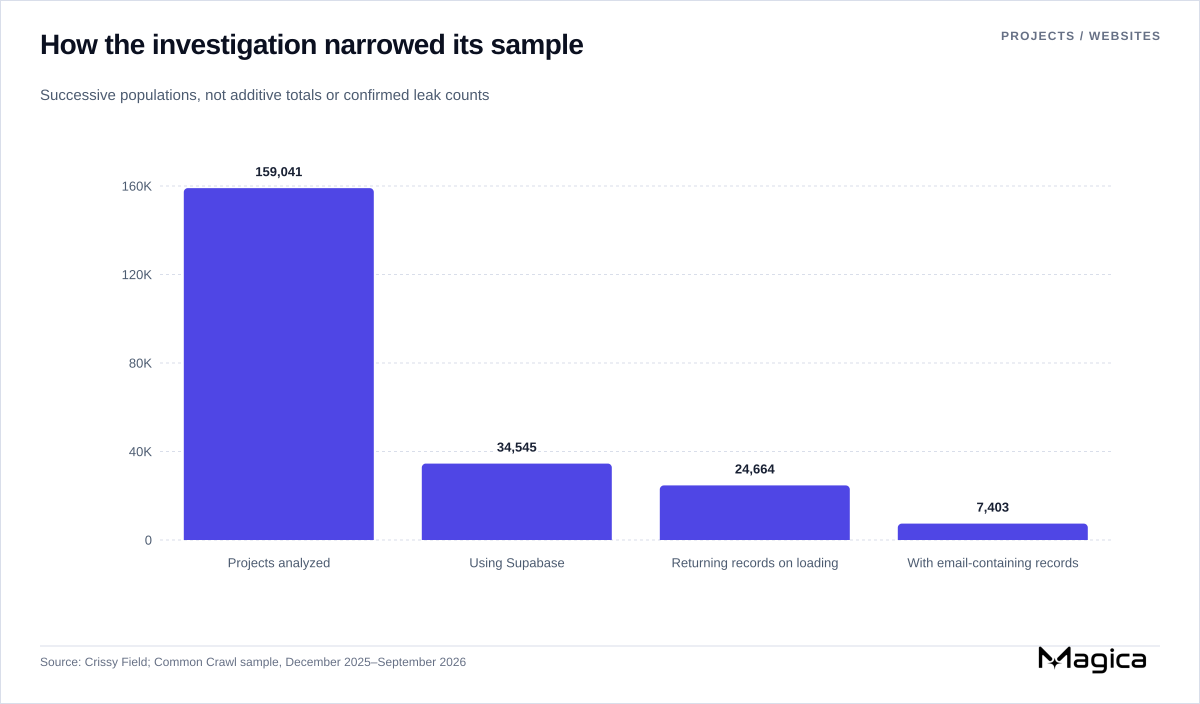
Crissy Field’s successive study populations are not additive. Public or test records may contain email addresses; these counts do not establish a confirmed leak rate. Source: Crissy Field.
Using Common Crawl’s open-web archive, Crissy Field identified and analyzed 159,041 Lovable projects from December 2025 to September 2026. Its investigation focused on Supabase, a database service integrated with Lovable, because that integration was relatively easy to analyze and the researchers believed it was the most widely used database service among Lovable projects.
The study’s successive populations matter:
| Population | Number | What the researchers observed |
|---|---|---|
| Lovable projects analyzed | 159,041 | Projects identified through Common Crawl |
| Projects using Supabase | 34,545 | The database integration selected for investigation |
| Websites returning Supabase records on loading | 24,664 | Records delivered without login or other interaction |
| Websites with email-containing records | 7,403 | Found through additional read-only requests using the same API key |
Those email-containing records appeared in 10,560 tables. The 7,403 websites represented about 30% of the 24,664 examined more closely, but Crissy Field explicitly cautioned against reading that as a confirmed leak rate.
Some records may contain public contact addresses or test data; conversely, sensitive records without email addresses would escape that indicator. Sending database records when a page loads can also be legitimate if the information is intended for public display. The sample was not representative of all Lovable applications.
Lovable’s own database features, introduced in late 2025, were outside the analysis. The report also says its figures update the analysis underlying an earlier article published on November 2. The latest research figures therefore should not be treated as identical to every earlier account.
Lovable’s ambition now extends well beyond prototypes. In an August 12, 2026 funding announcement, Lovable said it had raised $400 million at a $13.3 billion valuation and that users had created more than 60 million projects since launch. The company said Lovable-built apps received over 900 million visits a month. Those company-reported project and visit totals describe activity across the platform, not the population tested by Crissy Field; neither can serve as a denominator for the security findings.
In the same announcement, Lovable listed automatic and scheduled security scanning among features developed since its December 2025 Series B. It said the new funding would support product, infrastructure and team expansion, including further work on security, reliability, permissions and governance. That makes protection of operating businesses part of its stated expansion plan.
Lovable had already addressed the relevant security risk publicly. In a June 9, 2025 security announcement, it said missing or overly broad Supabase Row Level Security policies could expose database contents. These policies govern which records users can access.
The company said it automatically scanned apps before publication, had integrated Supabase’s Security Advisor and offered an AI security reviewer. It also acknowledged that incorrect database configurations could slip through its scan and that it could not guarantee complete security.
The new findings therefore raise a question about protection in practice despite available checks. They do not establish which checks each affected application used or prove that every exposure arose from the same configuration mistake.
Lovable reportedly told Handelsblatt that the problem was widespread across the industry, according to India Today’s account of its response. Crissy Field likewise notes that access-control errors can occur in conventionally written software. This investigation provides no comparable sample of competing platforms from which to rank their safety.
The responsibility question remains consequential for customers drawn to Lovable’s no-technical-knowledge pitch. Crissy Field says Lovable’s terms put responsibility for applications and data handling on customers. It also argues that recurring integration patterns can make similar access mistakes easier to find across many apps.
Crissy Field recommends expert reviews of permissions, interfaces and separation between user accounts before confidential data is introduced, and after significant changes. The firm also offers help securing applications in the report, giving it a commercial interest in demand for such reviews.
The next test is remediation: which exposed datasets have been secured, whether affected users have been notified, and whether access logs show earlier retrieval by outsiders. The published findings do not answer those questions. Evidence that publishing checks prevent similar exposures from recurring would also help customers judge what protection they receive before introducing confidential data.
Google plans to switch off Gemini and Search for school-managed K–12 student accounts unless administrators enable them. Schools will gain control over access, but Google says keeping Search without its AI features will not be an option.
Anthropic is expected to exceed 3.5 GW of computing capacity in 2026 and aims to double it in 2027. Its filing shows $895.4 billion in commitments, substantial financial resources and an immediate cost from scarce capacity.
Independent tests reproduce MIT researchers’ repair of Qwen’s repetitive reasoning. The edited model still beats a stronger unedited configuration, but by much less; broader claims about creating capabilities remain unproven.
Gartner forecasts that open-weight models will execute 90% of enterprise operational agent steps by 2030. Its cost estimates favor routine, high-volume work, but infrastructure costs and the choice of comparison model leave enterprise savings to be proved.
FTAI Aviation is financing a planned 100-turbine production run in 2027, while ProEnergy has a 650 MW equipment order from Crusoe. Converted aircraft engines offer another supply route for data-center power, but delivery targets, affiliated financing and unproven operating economics qualify the opportunity.
Meta is marketing dollar bonds in a plan to borrow at least $20 billion, including an expected euro offering. Capital spending exceeded operating cash flow last quarter, but the debt is part of a wider financing strategy that also includes equity offerings and a proposed non-voting share-sale program.
A nonbinding opinion targets real-time retrieval and recognisable reuse of journalism, while rejecting a monopoly over news facts and recommending that questions about model training be dismissed as hypothetical.
CrowdStrike is extending Falcon Guardian into Claude Cowork’s virtual machine and AWS’s AI guardrail layer. The Cowork beta addresses a visibility gap, while existing AWS safeguards and unfinished acquisitions limit what buyers can infer about the broader platform’s capabilities.
Oman and UK-founded Yamna have agreed to cooperate on a Salalah AI data centre whose first phase is expected to exceed £1 billion. The developer brings a hydrogen-project foothold and an earlier Brazilian data-centre proposal, but financing, customers and delivery dates remain undisclosed in the announcements.
War Thunder will add Nvidia’s DLSS 5 neural rendering in mid-November. The upgrade changes lighting and materials, with access and performance depending on hardware, streaming and other rendering features.
Samsung’s planned second Taylor fab reportedly has its output booked for AI-memory base dies, mostly for AMD, with production targeted for 2030. The orders could underpin investment, but Nvidia’s reported TSMC sourcing requirement limits the case for a broader foundry breakthrough.
Nordic Semiconductor is sampling nRF71 chips combining Wi-Fi, Bluetooth LE and Thread, with an AI accelerator in the higher-end variant. Its claimed standby-power improvement targets battery devices, but software maturity and real-world energy use remain key tests.
The operator of ao3.life says authors submitted more than 2,000 takedown requests after the site repackaged fanfiction and sold AI audiobooks during AO3’s outage, exposing the gap between restoring access and obtaining permission.
CrowdStrike has added an AI Kill Switch to Falcon Guardian that blocks agents’ model access through connected gateways. Broader containment across endpoints, identities and applications remains planned, making deployment coverage the key test of the new control.
DigitalOcean raised its 2026 revenue forecast to $1.208–$1.211 billion after third-quarter sales grew 40%. Larger customers are driving the expansion, while falling operating margins and rising equipment obligations complicate the earnings beat.
A leaker claims Intel may retire the B580, launched at $249, to favor professional AI products. Shared chips make reallocation possible, but no discontinuation notice has been reported, and the hardware can serve both markets.
The independent games marketplace is widening mandatory AI declarations and search filtering after reporting a surge in new game pages. But filtered results and deleted terabytes do not establish how much of its catalog is AI-generated.
A false authority appeared in a senior prosecutor’s reasons for continuing a child’s prosecution. The High Court rejected the challenge, while criticising the explanation for the citation and other aspects of the CPS’s handling of the case.
DeepSeek’s reported eight-trillion-parameter model plan accompanies a push toward Huawei hardware. Joint software tools and a larger reported fundraising show progress, but chip supply, training performance and deployment costs remain unresolved.