Editorial Team
6 min read
Oman and UK-founded Yamna have agreed to cooperate on a Salalah AI data centre whose first phase is expected to exceed £1 billion. The developer brings a hydrogen-project foothold and an earlier Brazilian data-centre proposal, but financing, customers and delivery dates remain undisclosed in the announcements.
Oman has signed a cooperation memorandum with Yamna, a UK-founded infrastructure developer backed by British investment funds, for an AI data centre in Salalah whose first phase is expected to exceed £1 billion. The proposal extends Yamna’s move from green hydrogen into digital infrastructure, with commercial commitments still to be demonstrated.
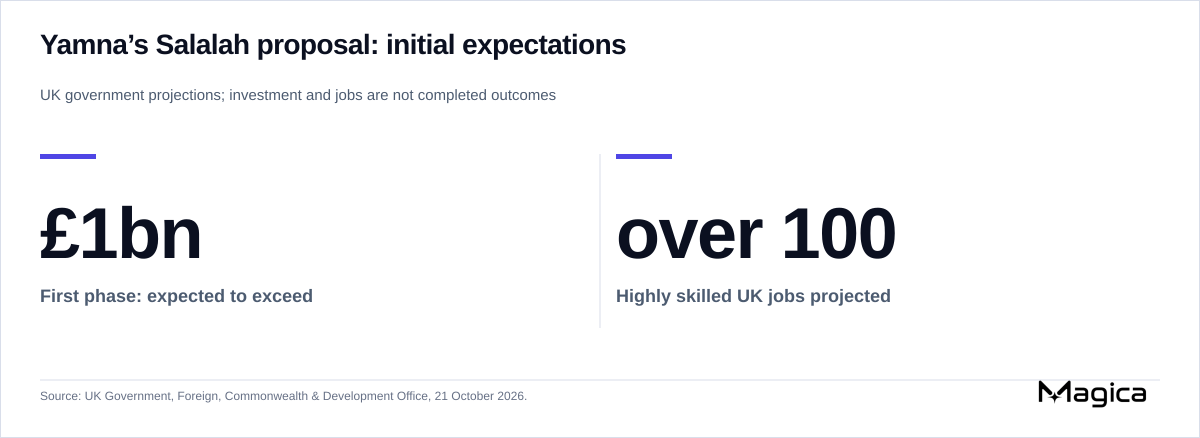
The UK government projects first-phase investment above £1bn and over 100 highly skilled jobs in Britain. Graphic: Magica. Source: UK Government.
The UK government’s October 21 announcement put expected first-phase investment above £1 billion. It forecast more than 100 highly skilled jobs in Britain through the export of British expertise and returns for UK-backed investors. Those are projected benefits, and the jobs figure refers to Britain rather than employment at the Omani campus.
Oman’s Ministry of Transport, Communications and Information Technology and Yamna signed a memorandum of understanding on strategic cooperation, according to the account citing Oman’s news agency published on October 22. That updates the British announcement, which described the signing as forthcoming.
Neither account specifies the campus’s computing capacity, financing structure, customers or construction timetable. The headline investment expectation therefore cannot yet establish how much usable AI capacity will be delivered, or when. The roughly $1.3 billion figure in a subsequent report on the framework describes the same Salalah proposal, rather than additional funding.
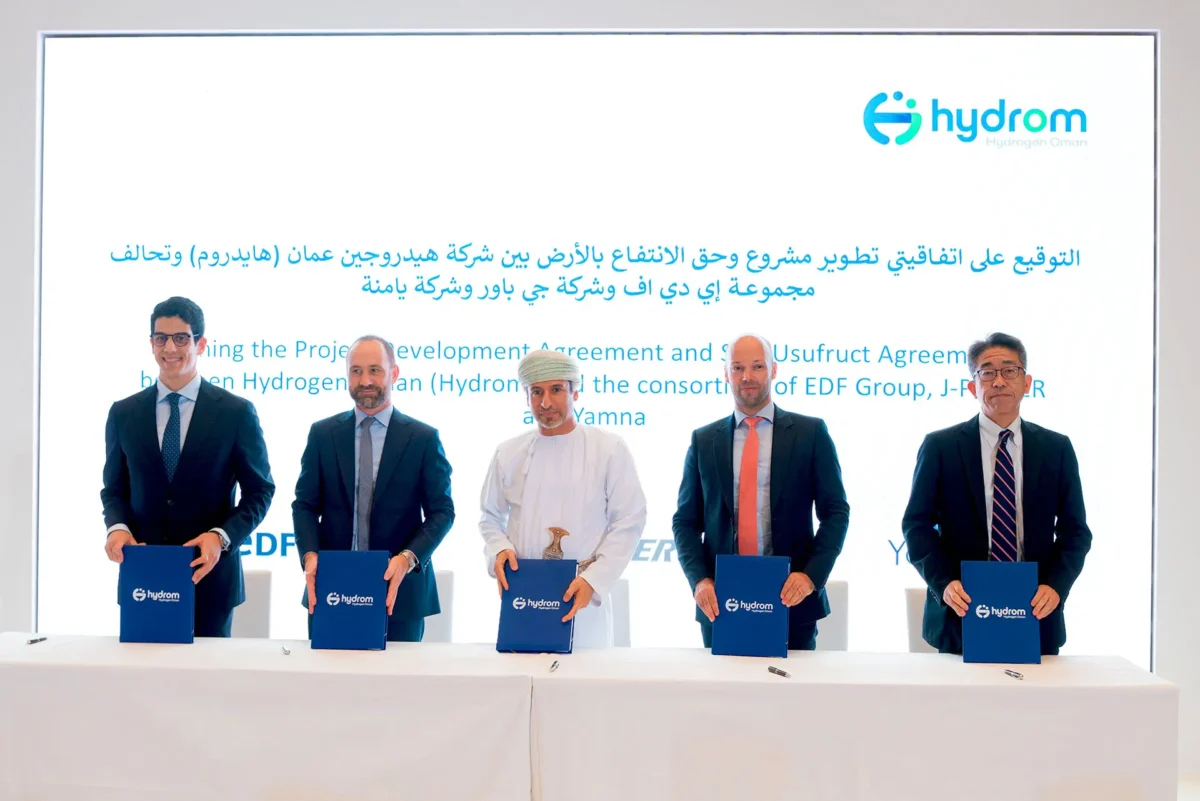
The April 2024 green-ammonia agreement ceremony involving Hydrom, EDF, J-POWER and Yamna. This energy development is separate from the proposed AI campus. Photo: Yamna. Source: Yamna.
Yamna’s relevant record in Oman begins before this AI agreement. In an April 29, 2024 announcement, the company said its consortium with French electricity group EDF and Japanese power generator J-POWER had won a land block in Dhofar through a competitive hydrogen tender run by state-owned Hydrogen Oman, or Hydrom, which allocates land and coordinates Oman’s green-hydrogen sector.
The agreements granted the consortium exclusive rights to develop, build, own, operate and maintain the green-ammonia project for 47 years. The planned output was 1 million tonnes of ammonia annually. The partners intended to install about 4.5 gigawatts of wind and solar capacity, battery storage and a roughly 2.5-gigawatt electrolyser to produce hydrogen for an ammonia plant in the Salalah Free Zone. These were development plans, with detailed studies still to follow in that announcement.
Yamna described itself at the time as a green-hydrogen and derivatives platform financially backed by HYCAP, a UK-based private equity fund manager dedicated to hydrogen. That establishes an energy-development background and a funding relationship. EDF and J-POWER’s participation in the ammonia consortium does not establish their participation in the AI project.
The October 26 report describes the new Salalah Al Khadra Digital proposal as a power-and-compute campus linked to Yamna’s existing Salalah Al Khadra Hydrogen development. The connection gives the digital proposal an identifiable local development base. But the hydrogen award concerns a separate industrial project: its land rights and proposed energy infrastructure should not be read as confirmation that electricity is already available for the data centre.
Salalah is part of a wider digital expansion. Yamna said in a September 2, 2026 announcement that it had reserved 20 hectares at Brazil’s Port of Açu for a proposed hyperscale and AI-ready campus with an initial 250-megawatt phase. The company said that project also built on relationships established through its green-hydrogen work. This is a record of originating data-centre developments, rather than evidence of an operating AI-campus portfolio.
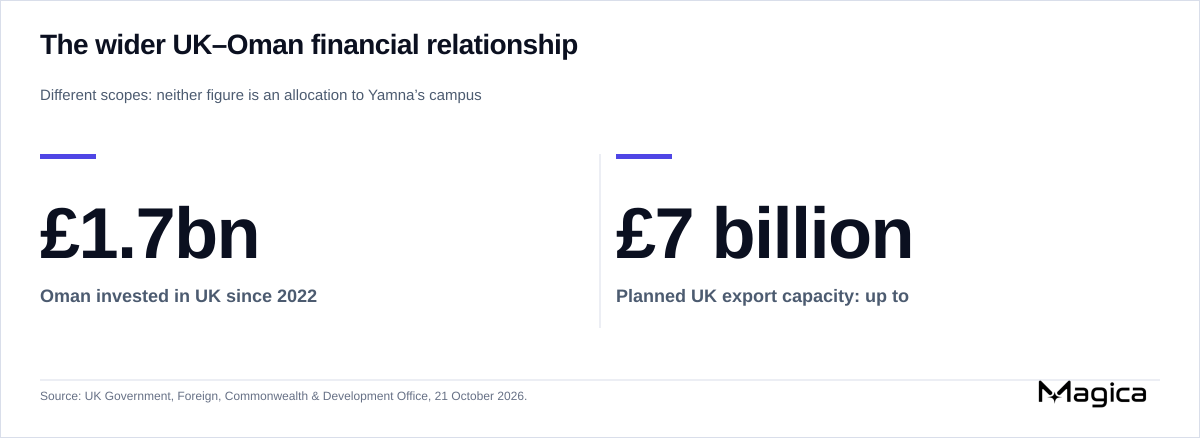
Past Omani investment in Britain and planned financing capacity for UK exports describe the wider bilateral relationship; neither figure is allocated to Yamna’s campus. Graphic: Magica. Source: UK Government.
Announced during the Omani ruler’s state visit to Britain, the agreement sits within a broader investment relationship. The British government says the UK–Oman Sovereign Investment Partnership began in 2022 and Oman has invested £1.7 billion in Britain since its creation. The new bilateral agreement is intended to accelerate investment in sectors including renewable energy, technology and critical minerals.
UK Export Finance, Britain’s export credit agency, also plans to increase financing capacity for British exports to Oman to as much as £7 billion. That is export-financing capacity across the relationship; the announcement does not allocate that sum to Yamna’s campus. For Britain, the stated commercial benefits include selling expertise and generating investor returns, alongside the diplomatic partnership.
Yamna is also entering a market with another large proposal. The October 26 report describes a separate $3 billion, 400-megawatt AI data centre announced by a consortium led by Mubbadrah Investment, an Omani conglomerate founded in Muscat in 2005 with investments spanning energy, mining, real estate, healthcare and IT. The report identifies digital infrastructure as a new business for the group.
The report says UK sustainable-finance firm Sustopia Capital, which claims a 5-gigawatt data-centre platform spanning Denmark, the US and the UK, would provide financing, US construction specialist Vela Tech would build the facility, and O2 Global Energy would develop 400 megawatts of co-located solar generation with battery storage. These are proposed responsibilities, rather than evidence of a completed financing or power supply.
That consortium expected a formal capacity-purchase agreement in the coming weeks after US AI-compute company Crusoe, backed by Abu Dhabi investor Mubadala, signalled interest. The report identifies Crusoe as lead developer of OpenAI and Oracle’s Stargate campus in Abilene, Texas, giving the prospective buyer a relevant infrastructure record. Its interest remains short of a signed customer commitment.
The investment totals also have different scopes. Mubbadrah’s chief executive and co-founder Yasser al Barami said the $3 billion would cover buildings, electricity infrastructure, cooling and network connections, while customers would typically supply servers and specialised chips, according to an October 26 account of his explanation. Yamna’s announcements provide no equivalent spending breakdown or megawatt figure. They therefore cannot support a comparison of cost per megawatt or the amount of AI computing equipment funded.
The October 26 regional report also relays industry experts’ assessment that prolonged insecurity could make international developers more selective about Gulf exposure, even as construction on existing Saudi and UAE projects continued despite supply-chain disruption. That distinguishes progress on projects already under way from the willingness to make new commitments.
The next consequential disclosures are committed capital, a power-supply arrangement, computing capacity, customer contracts and a delivery schedule. Power prices and the scope of equipment supplied would also be needed to assess the service’s economics. A hydrogen-development award and a headline investment expectation cannot answer those questions.
For Yamna, those commitments would show whether its energy-development relationships can support a commercially viable computing service in Salalah.
SK hynix bought existing Penguin Solutions preferred shares from an SK Telecom investment vehicle. The deal brings director nomination rights and a convertible stake in an existing AI infrastructure partner, while sending the purchase price to the seller.
Google plans to switch off Gemini and Search for school-managed K–12 student accounts unless administrators enable them. Schools will gain control over access, but Google says keeping Search without its AI features will not be an option.
Anthropic is expected to exceed 3.5 GW of computing capacity in 2026 and aims to double it in 2027. Its filing shows $895.4 billion in commitments, substantial financial resources and an immediate cost from scarce capacity.
Independent tests reproduce MIT researchers’ repair of Qwen’s repetitive reasoning. The edited model still beats a stronger unedited configuration, but by much less; broader claims about creating capabilities remain unproven.
Gartner forecasts that open-weight models will execute 90% of enterprise operational agent steps by 2030. Its cost estimates favor routine, high-volume work, but infrastructure costs and the choice of comparison model leave enterprise savings to be proved.
FTAI Aviation is financing a planned 100-turbine production run in 2027, while ProEnergy has a 650 MW equipment order from Crusoe. Converted aircraft engines offer another supply route for data-center power, but delivery targets, affiliated financing and unproven operating economics qualify the opportunity.
Meta is marketing dollar bonds in a plan to borrow at least $20 billion, including an expected euro offering. Capital spending exceeded operating cash flow last quarter, but the debt is part of a wider financing strategy that also includes equity offerings and a proposed non-voting share-sale program.
A nonbinding opinion targets real-time retrieval and recognisable reuse of journalism, while rejecting a monopoly over news facts and recommending that questions about model training be dismissed as hypothetical.
A study of Lovable projects found passport details, customer records and private messages accessible without login, raising questions about database permissions and the limits of automated security checks. Its sample does not establish a platform-wide leak rate.
CrowdStrike is extending Falcon Guardian into Claude Cowork’s virtual machine and AWS’s AI guardrail layer. The Cowork beta addresses a visibility gap, while existing AWS safeguards and unfinished acquisitions limit what buyers can infer about the broader platform’s capabilities.
War Thunder will add Nvidia’s DLSS 5 neural rendering in mid-November. The upgrade changes lighting and materials, with access and performance depending on hardware, streaming and other rendering features.
Samsung’s planned second Taylor fab reportedly has its output booked for AI-memory base dies, mostly for AMD, with production targeted for 2030. The orders could underpin investment, but Nvidia’s reported TSMC sourcing requirement limits the case for a broader foundry breakthrough.
Nordic Semiconductor is sampling nRF71 chips combining Wi-Fi, Bluetooth LE and Thread, with an AI accelerator in the higher-end variant. Its claimed standby-power improvement targets battery devices, but software maturity and real-world energy use remain key tests.
The operator of ao3.life says authors submitted more than 2,000 takedown requests after the site repackaged fanfiction and sold AI audiobooks during AO3’s outage, exposing the gap between restoring access and obtaining permission.
CrowdStrike has added an AI Kill Switch to Falcon Guardian that blocks agents’ model access through connected gateways. Broader containment across endpoints, identities and applications remains planned, making deployment coverage the key test of the new control.
DigitalOcean raised its 2026 revenue forecast to $1.208–$1.211 billion after third-quarter sales grew 40%. Larger customers are driving the expansion, while falling operating margins and rising equipment obligations complicate the earnings beat.
A leaker claims Intel may retire the B580, launched at $249, to favor professional AI products. Shared chips make reallocation possible, but no discontinuation notice has been reported, and the hardware can serve both markets.
The independent games marketplace is widening mandatory AI declarations and search filtering after reporting a surge in new game pages. But filtered results and deleted terabytes do not establish how much of its catalog is AI-generated.
A false authority appeared in a senior prosecutor’s reasons for continuing a child’s prosecution. The High Court rejected the challenge, while criticising the explanation for the citation and other aspects of the CPS’s handling of the case.
DeepSeek’s reported eight-trillion-parameter model plan accompanies a push toward Huawei hardware. Joint software tools and a larger reported fundraising show progress, but chip supply, training performance and deployment costs remain unresolved.