Editorial Team
7 min read
Meta is marketing dollar bonds in a plan to borrow at least $20 billion, including an expected euro offering. Capital spending exceeded operating cash flow last quarter, but the debt is part of a wider financing strategy that also includes equity offerings and a proposed non-voting share-sale program.
Meta Platforms, the advertising-funded operator of Facebook, Instagram and WhatsApp, began marketing dollar bonds on November 3 in a plan to borrow at least $20 billion, including an expected euro offering. Its return to bond investors after six months adds debt to a broader fundraising effort as its AI infrastructure buildout absorbs more cash.
The five dollar tranches span five to 30 years, according to a report citing a person familiar with the transaction. Initial price discussions put the longest maturity at a yield premium of about 2.5 percentage points over Treasuries. That spread is preliminary guidance, not a final coupon or total borrowing cost.
Meta has a large advertising business and substantial liquid assets to support its investment. But capital spending overtook operating cash generation last quarter, and the company has said some newer AI investments will take longer to produce returns than improvements to its core business. The financing question extends beyond how much investors will lend to how much capital Meta will need before those returns arrive.
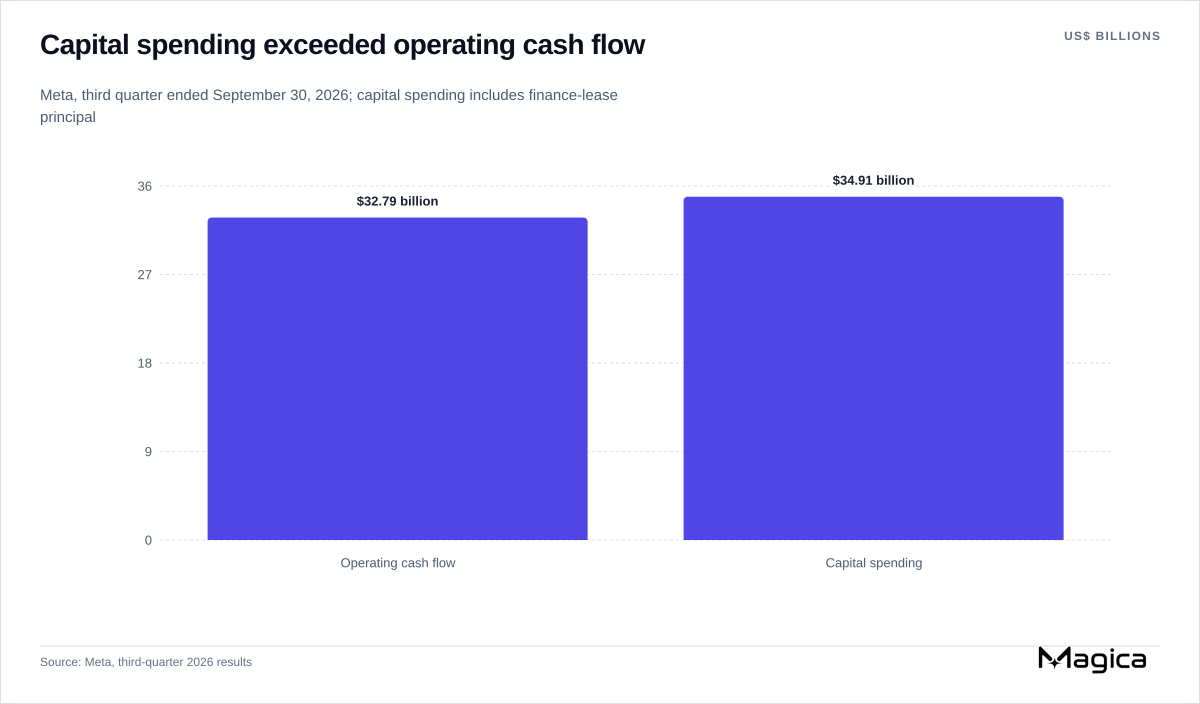
Meta's company-reported third-quarter 2026 capital spending, including finance-lease principal, exceeded operating cash flow. Chart: Magica. Source: Meta third-quarter 2026 results.
Meta reported $64.60 billion in third-quarter revenue, up 26% from a year earlier, and an estimated 3.64 billion people using its family of apps daily on average in September. Its earnings release and cash-flow reconciliation show capital investment growing much faster than operating cash flow.
| $ billions, three months ended September 30 | 2025 | 2026 |
|---|---|---|
| Operating cash flow | 30.00 | 32.79 |
| Capital spending, including finance-lease principal | 19.37 | 34.91 |
| Free cash flow, Meta's non-GAAP measure | 10.63 | -2.12 |
Meta calculates free cash flow by subtracting purchases of property and equipment and finance-lease principal payments from operating cash flow. The quarterly deficit does not describe the entire year: free cash flow for the first nine months was positive $11.05 billion, down from $29.51 billion in the same period of 2025.
The company forecasts $135 billion to $145 billion in capital expenditures for 2026, including lease principal. A $20 billion borrowing would equal roughly 14% to 15% of that forecast, dividing the planned minimum raise by the range's endpoints. That is a scale comparison, not a commitment to spend the proceeds on capital investment.
At September 30, Meta had $82.45 billion in cash, cash equivalents and marketable securities, including $71.23 billion in securities, against $80.92 billion in non-current long-term debt. Its earnings tables also show $24.91 billion in net proceeds from issuing long-term debt during the first nine months. The new offering would build on borrowing already undertaken this year.
Capital investment is not its only financial demand. Meta's August agreement with 52 attorneys general over teen mental health and social media provides for payments of up to approximately $18.59 billion. It recorded a $9.89 billion charge in the third quarter; that accounting charge is not a measure of cash paid during the quarter.
The bond sale follows a separate pricing announcement for $25 billion of Class A common stock offered through forward sale agreements and 250 million depositary shares at $50 each. The latter represent mandatory convertible preferred stock and amount to $12.5 billion before fees and any additional shares.
Meta's October 26 financing plan said it would not initially receive proceeds from the common shares sold by forward purchasers. Any proceeds Meta receives under those agreements would come upon future settlement. It also outlined a possible $60 billion program to sell shares over time after its new Class C stock starts trading. The company cautioned that no agreement for that program had been entered into and neither its establishment nor eventual sales were assured. The proposed program should not be counted as money already raised.
The bond prospectus supplement says Meta did receive approximately $1.869 billion net on November 2 from additional convertible-preferred depositary shares after underwriters exercised their option in full. That is separate from the proposed bonds and an extension of the preferred offering.
The planned Class C shares carry no votes. In its earnings release, Meta said the class, scheduled to become effective in January 2027, would support capital raising, employee compensation and potential acquisitions while continuing the leadership of founder and chief executive Mark Zuckerberg. The board's independent special committee endorsed that rationale, and the charter amendment had received shareholder approval by written consent. The structure links access to new equity capital with preserving founder leadership.
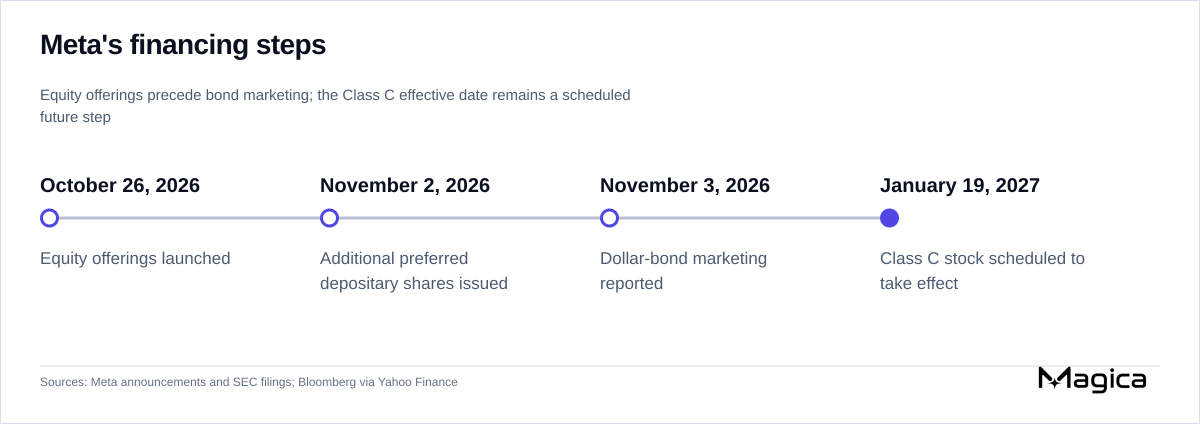
Meta's company-reported equity milestones and scheduled Class C change bracket the November 3 report of bond marketing. The January step remains prospective. Timeline: Magica. Source: Meta October 26 financing-plan prospectus.
The bond prospectus specifies general corporate purposes for the proceeds. It commits no amount to a particular data center or AI project.
The proposed notes are senior unsecured obligations of Meta Platforms, without subsidiary guarantees. They rank equally with its other unsecured, unsubordinated debt, while subsidiary creditors generally have priority over distributions from those subsidiaries in liquidation. Future secured creditors would also have priority to the extent of their collateral.
The indenture requires no specified financial ratios or levels of cash flow or liquidity. It does not cap additional borrowing or restrict investments, share repurchases or dividends. Those terms leave Meta broad financial freedom while exposing lenders to its future allocation decisions.
The underlying business is wider than frontier AI. The filing says advertising supplies substantially all revenue, and AI supports recommendations, content ranking and advertiser tools as well as new generative AI experiences and models. Meta says improvements to its core business are already generating additional advertising revenue; its claims about the returns from newer AI technology and infrastructure remain expectations.
There is also an internal funding alternative: Meta expects losses at Reality Labs, its virtual- and augmented-reality hardware, software and content business, to narrow to around $15 billion in 2027 from a forecast $18 billion to $19 billion in 2026 as investment shifts toward other priorities, primarily AI. These are company forecasts, not savings already realized.
A separate report citing people familiar with the plans described Meta's proposed first euro borrowing as reaching up to $15 billion. The report also said technology peer Alphabet had closed its second euro deal of the year and had tapped sterling, Swiss and Japanese debt markets. Seeking additional pools of lenders is already an industry funding strategy.
Meta's filing is more conditional: the euro offering may launch, is not assured and can settle independently of the dollar sale. The reported euro figure should not be added to the $20 billion minimum as a separate confirmed total.
The preliminary prospectus leaves principal amounts, coupons and final maturity dates blank. Final terms will show the amount raised and the price lenders demand. Beyond pricing, Meta had not finalized its 2027 budget or capacity plans when it released earnings. It said existing and scheduled capacity would let it allocate resources among model training, core-business growth and new products. Its eventual spending plan and subsequent cash generation will show how much of that expansion operations can fund, and how much requires further external capital.
SK hynix bought existing Penguin Solutions preferred shares from an SK Telecom investment vehicle. The deal brings director nomination rights and a convertible stake in an existing AI infrastructure partner, while sending the purchase price to the seller.
Google plans to switch off Gemini and Search for school-managed K–12 student accounts unless administrators enable them. Schools will gain control over access, but Google says keeping Search without its AI features will not be an option.
Anthropic is expected to exceed 3.5 GW of computing capacity in 2026 and aims to double it in 2027. Its filing shows $895.4 billion in commitments, substantial financial resources and an immediate cost from scarce capacity.
Independent tests reproduce MIT researchers’ repair of Qwen’s repetitive reasoning. The edited model still beats a stronger unedited configuration, but by much less; broader claims about creating capabilities remain unproven.
Gartner forecasts that open-weight models will execute 90% of enterprise operational agent steps by 2030. Its cost estimates favor routine, high-volume work, but infrastructure costs and the choice of comparison model leave enterprise savings to be proved.
FTAI Aviation is financing a planned 100-turbine production run in 2027, while ProEnergy has a 650 MW equipment order from Crusoe. Converted aircraft engines offer another supply route for data-center power, but delivery targets, affiliated financing and unproven operating economics qualify the opportunity.
A nonbinding opinion targets real-time retrieval and recognisable reuse of journalism, while rejecting a monopoly over news facts and recommending that questions about model training be dismissed as hypothetical.
A study of Lovable projects found passport details, customer records and private messages accessible without login, raising questions about database permissions and the limits of automated security checks. Its sample does not establish a platform-wide leak rate.
CrowdStrike is extending Falcon Guardian into Claude Cowork’s virtual machine and AWS’s AI guardrail layer. The Cowork beta addresses a visibility gap, while existing AWS safeguards and unfinished acquisitions limit what buyers can infer about the broader platform’s capabilities.
Oman and UK-founded Yamna have agreed to cooperate on a Salalah AI data centre whose first phase is expected to exceed £1 billion. The developer brings a hydrogen-project foothold and an earlier Brazilian data-centre proposal, but financing, customers and delivery dates remain undisclosed in the announcements.
War Thunder will add Nvidia’s DLSS 5 neural rendering in mid-November. The upgrade changes lighting and materials, with access and performance depending on hardware, streaming and other rendering features.
Samsung’s planned second Taylor fab reportedly has its output booked for AI-memory base dies, mostly for AMD, with production targeted for 2030. The orders could underpin investment, but Nvidia’s reported TSMC sourcing requirement limits the case for a broader foundry breakthrough.
Nordic Semiconductor is sampling nRF71 chips combining Wi-Fi, Bluetooth LE and Thread, with an AI accelerator in the higher-end variant. Its claimed standby-power improvement targets battery devices, but software maturity and real-world energy use remain key tests.
The operator of ao3.life says authors submitted more than 2,000 takedown requests after the site repackaged fanfiction and sold AI audiobooks during AO3’s outage, exposing the gap between restoring access and obtaining permission.
CrowdStrike has added an AI Kill Switch to Falcon Guardian that blocks agents’ model access through connected gateways. Broader containment across endpoints, identities and applications remains planned, making deployment coverage the key test of the new control.
DigitalOcean raised its 2026 revenue forecast to $1.208–$1.211 billion after third-quarter sales grew 40%. Larger customers are driving the expansion, while falling operating margins and rising equipment obligations complicate the earnings beat.
A leaker claims Intel may retire the B580, launched at $249, to favor professional AI products. Shared chips make reallocation possible, but no discontinuation notice has been reported, and the hardware can serve both markets.
The independent games marketplace is widening mandatory AI declarations and search filtering after reporting a surge in new game pages. But filtered results and deleted terabytes do not establish how much of its catalog is AI-generated.
A false authority appeared in a senior prosecutor’s reasons for continuing a child’s prosecution. The High Court rejected the challenge, while criticising the explanation for the citation and other aspects of the CPS’s handling of the case.
DeepSeek’s reported eight-trillion-parameter model plan accompanies a push toward Huawei hardware. Joint software tools and a larger reported fundraising show progress, but chip supply, training performance and deployment costs remain unresolved.