Editorial Team
7 min read
Apple led Nvidia by roughly $615 billion in market value at the November 5 close. Nvidia’s rapid sales growth contrasts with financing and construction risks for AI infrastructure, while Apple faces rising costs and uses Nvidia chips in its own cloud.
Apple, the iPhone and services company, was worth about $5 trillion at Thursday’s close, compared with AI chip designer Nvidia’s $4.39 trillion. The roughly $615 billion gap followed Nvidia’s 9.26% fall on November 5, according to a closing-market comparison.
The divergence puts two sources of technology revenue under scrutiny: consumer devices and services at Apple, and the spending by cloud operators and AI developers that dominates Nvidia’s business. Strong chip demand does not by itself secure the loans, electricity or construction approvals needed to turn orders into operating data centers.
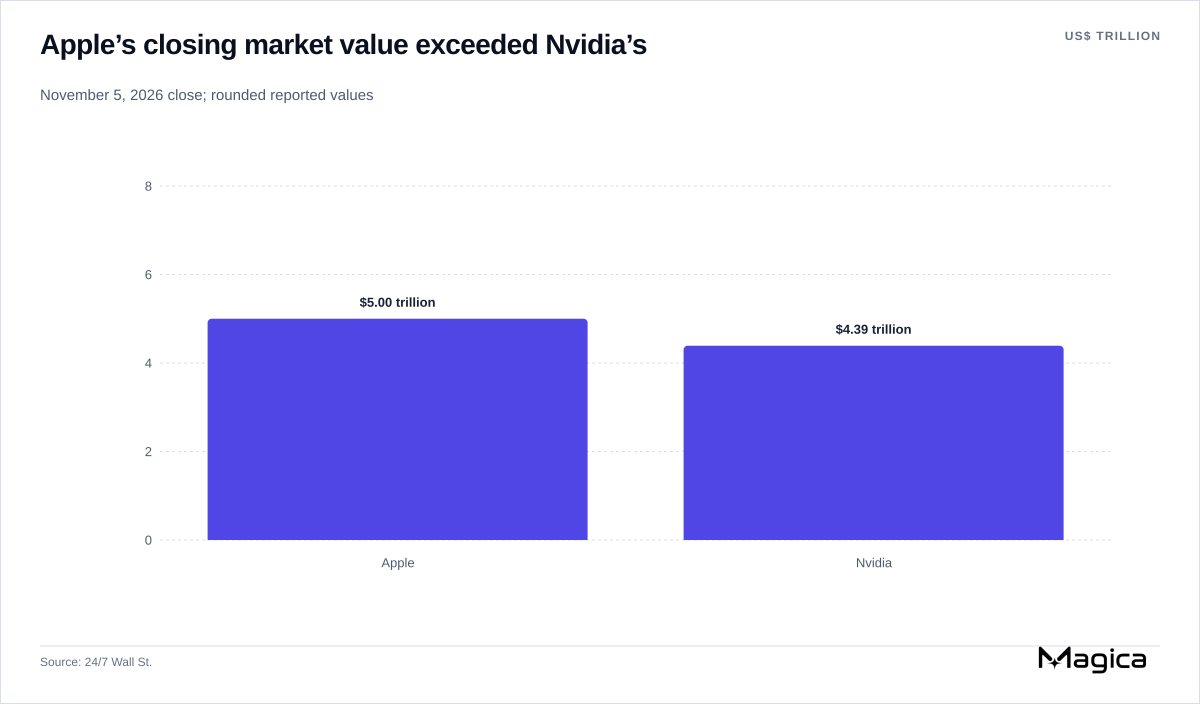
Apple and Nvidia’s rounded market values at the November 5, 2026 close. Source: 24/7 Wall St.; chart: Magica. Source: 24/7 Wall St..
Apple closed Thursday at $344.17 and Nvidia at $181.60. Nvidia lost nearly $450 billion in equity value that day and nearly $1.4 trillion from its October record, a market report calculated. It put the stock about 24% below its October 6 record close; the separate financing analysis rounded the decline to 25%.
The decline reached across the semiconductor industry. Several other chip stocks suffered double-digit losses, and the PHLX Semiconductor Index recorded its worst session since March 2020. That breadth limits how much of Nvidia’s fall can be read as a judgment on its own execution.
The market report linked the selling to Democrats winning both chambers of Congress and candidates in both parties campaigning against AI data centers. It also described a Senate bill that nearly advanced in the fall and would have made data centers pay more of the power costs they create. Those are political risks to future deployment, rather than evidence that enacted restrictions have already cut Nvidia’s sales.
The $615 billion lead is a closing-price snapshot. The valuation comparison reported that the gap had narrowed to about $550 billion after hours; it does not establish the ranking or gap at the end of Friday.
Nvidia’s quarterly results show why a construction slowdown would matter so much. Revenue for the quarter ended July 26 was $96.2 billion, up 106% from a year earlier. Data Center revenue was $89 billion, up 117%, accounting for roughly 93% of total sales.
Apple’s results for the quarter ended September 26 showed revenue of $114.5 billion, up 12%. The valuation comparison reported $57.6 billion of iPhone revenue, up 17%, and record Services revenue of $31.6 billion. Together those businesses supplied about 78% of Apple’s quarterly revenue. These shares describe each company’s business mix in different fiscal quarters, rather than a like-for-like growth comparison.
Apple also reported record annual revenue of $479 billion and said its installed base of active devices reached a new high across major product categories and geographic segments. That established customer base helps explain the importance of its device and services earnings alongside the AI infrastructure trade.
The companies’ exposures overlap. Nvidia said its graphics processing units, or GPUs, are used for confidential inference—running AI models—in Apple’s Private Cloud Compute. Apple’s consumer business therefore does not make it detached from the infrastructure needed to deliver AI services.
CoreWeave, an AI infrastructure operator and a deployment partner named in Nvidia’s quarterly release, illustrates the financing pressure. The contributor’s financing analysis reports that Nvidia owns 10% of its stock. It cites $35 billion of debt, a 15% yield demanded by investors on its notes, and negative second-quarter free cash flow of $10.5 billion. The analysis presents CoreWeave as an extreme example; its position does not describe every large cloud operator’s balance sheet.
Nvidia founder and chief executive Jensen Huang has argued that demand exceeds available capital. The financing analysis relays his proposal, reported by Yahoo Finance, that lenders accept Nvidia chips as collateral because they remain productive and can move between customers. It also relays his claim that rental prices for older H100 chips rose between October 2025 and March 2026. That claim supports his case for durable collateral value, but does not establish future rental prices or the lending terms banks will accept.
Nvidia is trying to widen the funding pool. Its quarterly release announced partnerships with six investment groups to establish independent platforms intended to mobilize more than $500 billion in third-party capital over time, subject to definitive agreements. This is a financing ambition, not $500 billion already raised or Nvidia cash committed in full.
Its own obligations deserve separate treatment. In its quarterly filing, Nvidia disclosed $279 billion of supply and capacity commitments as of July 26, up from $119 billion the previous quarter, primarily for memory and manufacturing facilities. It said some supplier arrangements could be canceled, rescheduled or adjusted, potentially at additional cost. These obligations differ from financing guarantees for customers’ construction projects.
Political opposition could constrain where funded projects proceed. The financing analysis, citing CNBC reporting and Wells Fargo estimates, says Texas holds 27% of planned U.S. data center gigawatts and that its incoming governor wants an immediate moratorium. A proposal to stop construction is consequential for planned capacity, but remains distinct from a restriction in force.
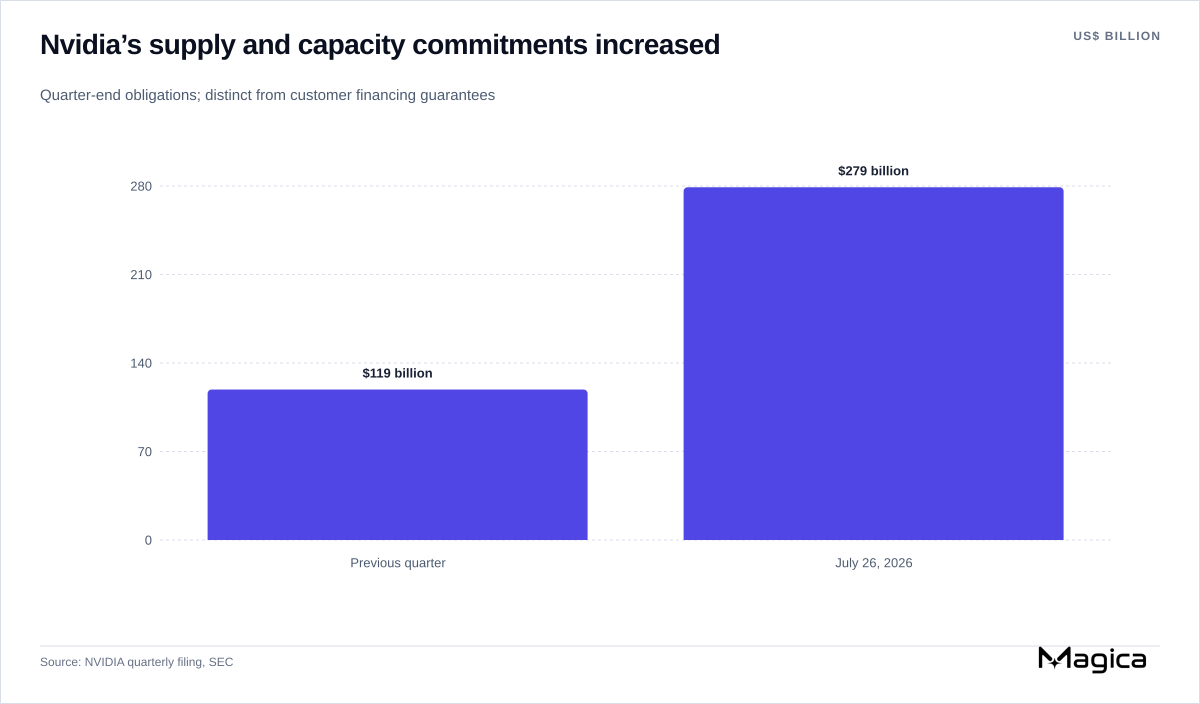
Company-reported supply and capacity commitments increased from $119 billion to $279 billion. These obligations differ from customer financing guarantees. Source: Nvidia quarterly filing; chart: Magica. Source: Nvidia quarterly filing.
Through Thursday, Apple shares had gained 26.95% in 2026 while Nvidia’s had fallen 2.4%, according to the valuation comparison. The two analyses put Nvidia at 15 times and 12.7 times forward earnings, respectively. Neither supplies a common earnings-estimate basis that would justify treating the multiples as interchangeable.
Apple’s costs are rising too. The valuation comparison reports management’s December-quarter gross-margin forecast of 45%–46%, down from September’s 47.9%, citing memory prices and the expense of scaling Siri AI. Apple’s results release says tariff refunds added approximately one percentage point to September’s margin, so part of that comparison reflects a favorable adjustment in the earlier quarter.
Management also expects December-quarter revenue growth of 7%–10%, according to the comparison. Apple’s resilience therefore comes with expectations for continued growth, alongside the cost of delivering its AI services.
The same analysis reports a roughly $7.5 billion, seven-part Apple bond offering on Thursday, its first since May 2025, and $137 billion of cash and securities against $80 billion of debt. It says Apple has dropped its net cash-neutral target. Apple’s results release says it generated $28 billion of quarterly operating cash flow and returned $28 billion to shareholders. Its access to debt sits alongside substantial cash generation and shareholder distributions.
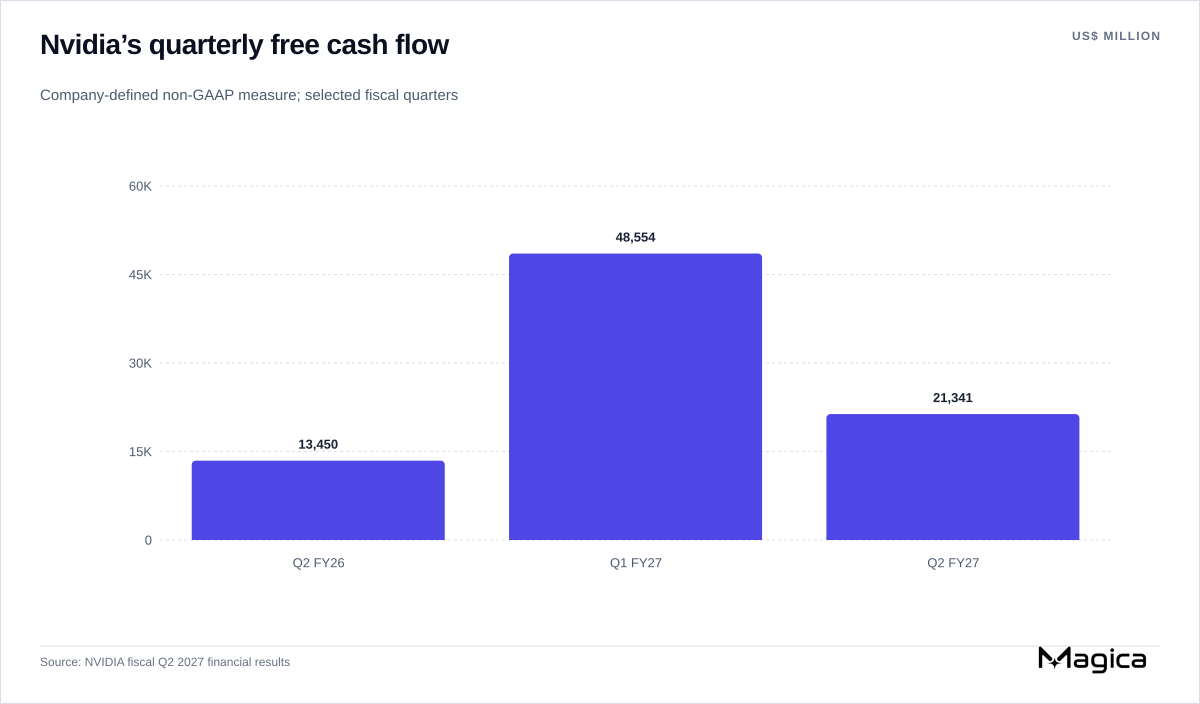
Company-reported free cash flow fell from the preceding quarter while remaining above its year-earlier level. This is Nvidia’s company-defined non-GAAP measure. Source: Nvidia quarterly results; chart: Magica. Source: Nvidia quarterly results.
Nvidia’s next report is expected November 17, according to both analyses. Its existing company forecast calls for $108 billion of third-quarter revenue, plus or minus 2%, with no Data Center compute revenue from China assumed. That is an outlook, not booked revenue.
There is substantial counterevidence to a broad construction-halt thesis. The financing analysis cites a Bloomberg-reported forecast for large cloud operators’ capital spending to rise from about $700 billion in 2026 to more than $1 trillion in 2027. It also cites CIBC’s expectation that most or all scheduled data centers will be built. Both remain projections.
Nvidia’s own cash generation also distinguishes it from the strained customers in the financing debate. Its quarterly cash-flow statement shows $24.1 billion of operating cash flow and $21.3 billion of company-defined free cash flow, after purchases and principal payments for property, equipment and intangible assets. Free cash flow was down from $48.6 billion in the preceding quarter, while remaining above $13.5 billion a year earlier. The increase in accounts receivable absorbed $22.3 billion of operating cash during the quarter, making collections a material issue alongside sales growth.
The next useful evidence is whether customers maintain spending plans, secure financing and proceed with contracts—and whether chip rental prices support lenders’ collateral assumptions. A revenue beat alone would not settle those questions. For Apple, the test is whether continued device and services growth can absorb the higher costs already reflected in its margin forecast.
Independent directors and outside counsel will investigate reports involving Nvidia’s founder and CEO, who has admitted infidelity. The board says it has no reason to believe national security or company secrets were compromised.
Apple reportedly wants Siri to pursue goals without prompts at every step. A possible 2027 debut is a reporter’s assessment, while Apple experiments with its iOS 28 development process after earlier Siri delays.
Councils, transport officials and MPs’ staff report more demanding AI-assisted correspondence. Official records show pressure alongside successful appeals, while regulators seek to protect access and contain excessive submissions.
Anthropic has reportedly taken over commitments for Caterpillar generators ordered by OnePWR, gaining access to scarce equipment and installation capabilities as it seeks greater control over data-center power.
Micron and its Taoyuan union ended a third negotiating session without agreement on profit sharing. A bonus calculator and further talks are planned, while a reported US$3 billion to US$4.5 billion expansion pause remains unaddressed by the company.
Envision says it has handed over a 200 MW first phase of its Galaxy AI campus in Inner Mongolia. The wind-turbine supplier is expanding into data-center facilities and power systems, but its 3 GW plan remains ahead of disclosed costs, utilization and reliability results.
Founded in 2025 by a team with autonomous-driving data experience, GenRobot AI says it raised $100 million in a Series A+. Its robot-data business reports million-hour quarterly deliveries, while funded rivals and undisclosed commercial metrics complicate the growth story.
AI safety advocates gained experienced lawmakers and battleground seats in the midterms, but rival technology-backed groups also elected allies, leaving federal legislation far from assured.
A federal judge found Anthropic’s Claude Max usage advertising plausibly misleading because subscribers could read the multipliers as monthly promises. Contract and misrepresentation claims survive, but several other claims were dismissed with leave to amend.
Thailand’s proposed data-centre framework would scale requirements by power demand, screen sites for electricity and water access, and assess domestic benefits. It also covers existing facilities, while conflicting application and approval schedules remain unresolved.
PJM’s independent market monitor attributes about $11 per megawatt-hour of first-half 2026 wholesale costs to data-center demand in capacity auctions. Energy costs drove more of the overall increase, while construction barriers and an October regulatory rejection complicate the response.
DataVita now says its proposed Lanarkshire AI data centres will be fully grid served, with direct renewable connections only a future possibility. The change in public presentation raises questions about promised power costs and community benefits, although the DV4 planning application already assumed grid supply.
AMD chief Lisa Su calls the chipmaker a data-center-first company as server and AI sales surge. Gaming revenue fell 40%, but PC-chip sales grew, and her remarks leave the supply outlook for expensive Radeon cards unresolved.
A reported U.S. intelligence assessment links Megaspeed executive Alice Huang to China’s Ministry of State Security, raising questions about access to Nvidia’s leadership and chip-export policy. Whether the alleged operation succeeded remains unclear.
Ocient’s $100 million Series C backs tailored AI analytics on an established database platform, with national-security investors and deployment economics shaping its expansion.
Anthropic plans IPO marketing next week and a listing in the week of November 16, according to people familiar with the plans. Buyers are discussing valuations of $1.2 trillion–$1.3 trillion, with some weighing $1.1 trillion, as its filing reveals faster-growing compute costs and extensive infrastructure commitments.
India's IT lobby chief warns that AI could make technology jobs harder for graduates to secure. Hiring is below earlier peaks, but some firms favour AI-equipped beginners over costly experienced staff. The unresolved question is how junior workers will build expertise.
Internet scans and leaked databases expose the spread of ARTEX, a security-testing framework used in cyberattacks. Researchers documented largely autonomous compromises, but the records also show failed cashouts and uncertain counts of independent deployments.
Meta's strategy chief and former CFO is joining Fireworks AI ahead of a reported fundraising push targeting at least a $30 billion valuation. The inference company announced a $17.5 billion valuation in July, making the hire part of a much larger expansion than its older funding figures suggest.
Sand.ai says its $200 million Series A+ round lifts its valuation above $1 billion. Co-lead investor Wangsu plans inference and deployment cooperation, while its filing shows substantial losses behind the startup’s video AI ambitions.