Editorial Team
8 min read
Anthropic plans IPO marketing next week and a listing in the week of November 16, according to people familiar with the plans. Buyers are discussing valuations of $1.2 trillion–$1.3 trillion, with some weighing $1.1 trillion, as its filing reveals faster-growing compute costs and extensive infrastructure commitments.
Anthropic, the AI research company behind Claude's models, developer platform and applications, plans to proceed with its IPO roadshow next week despite sharply lower valuation discussions among prospective buyers. Its latest financial disclosure makes the pricing question more concrete: customer spending is growing rapidly, but the computing bill is growing faster.
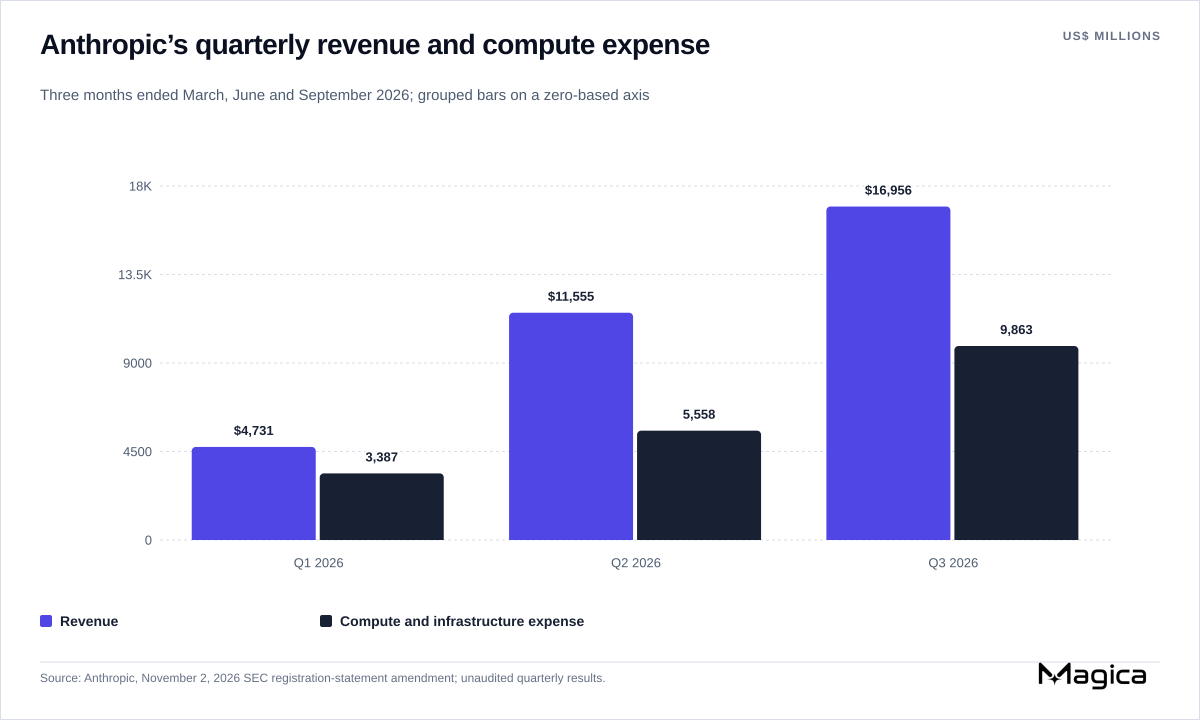
Company-reported quarterly revenue and compute and infrastructure expense. Compute is one expense category; the gap between bars is not operating profit. Chart: Magica; source: Anthropic. Source: Anthropic SEC registration statement.
Formal marketing is planned for next week, with shares still expected to list in the week of November 16, according to a report citing people familiar with the matter. That account said the offering had been expected to raise more than $80 billion at a $1.5 trillion valuation, but concerns about AI stocks and spending could prompt a lower valuation. An Anthropic spokesperson did not immediately respond to its request for comment.
Potential buyers are discussing a company valuation of about $1.2 trillion–$1.3 trillion, according to a separate account based on people familiar with the matter. Some are weighing as little as $1.1 trillion, one person said. Investors considering bids had previously told the offering's bankers that they estimated fair value at roughly $1.4 trillion–$1.5 trillion.
These are indications of prospective demand, not a finalized offer price. They also differ from the company's earlier fundraising ambition: an October 15 account citing a person familiar with the process put the target at up to $100 billion raised at a $2 trillion valuation. It identified November 9 as the planned roadshow launch, with pricing the following week, and named Morgan Stanley and Goldman Sachs as the leading joint bookrunners.
The more recent roadshow account described two weeks of technology-stock volatility following investor reactions to Amazon and Google's AI spending plans and the Democratic midterm-election landslide. That backdrop makes the roadshow a test of demand, but it does not establish the price buyers will ultimately accept.
Founded in 2021, Anthropic commercially launched Claude in the first quarter of 2023. Its chief executive and co-founder, Dario Amodei, previously served as vice president of research at OpenAI, now one of its principal competitors. Anthropic's November 2 registration-statement amendment describes a business focused on enterprise customers, with most revenue generated through usage charges. It also sells subscriptions.
The filing provides a more current basis for assessing growth than the October account's $16.8 billion third-quarter revenue figure:
| Filed results, billions of dollars | Three months ended June 30, 2026 | Three months ended September 30, 2026 |
|---|---|---|
| Revenue | 11.555 | 16.956 |
| Compute and infrastructure expense | 5.558 | 9.863 |
| Operating income (loss) | 0.974 | (0.567) |
Calculated from those filed amounts, revenue increased about 47% from the preceding quarter, while compute and infrastructure expense rose about 77%. Revenue growth had been about 144% between the first and second quarters, using the filing's $4.731 billion first-quarter revenue figure. These comparisons measure quarterly recognized revenue, rather than annual recurring revenue estimates.
Slower revenue growth does not, by itself, establish weaker usage or lost market share. Anthropic says higher usage was partly offset by approximately $600 million in price reductions accompanying new model versions and contractual discounts between the second and third quarters. It also says no single customer accounted for more than 10% of revenue in the nine months ended September 30, although sales through cloud-provider marketplaces represented 44% of revenue in that period. Those providers act as distribution and billing channels.
Competition remains a separate question. In a client note described in the October account, Gil Luria, head of technology research at DA Davidson, called the slowdown disappointing. He argued that OpenAI appeared to have caught up during the quarter and that open-weight models had enjoyed a breakout quarter, suggesting overall AI usage and spending might not have decelerated. That is an analyst's assessment, not a demonstrated explanation of Anthropic's results.
Anthropic's filing identifies Google and OpenAI as primary competing model developers. It also warns of competition from other model providers serving enterprise workloads that prioritize cost efficiency over intelligence, and from companies that can bundle AI into existing products. The competitive choice includes cost-focused models and bundled AI, alongside rival frontier systems.
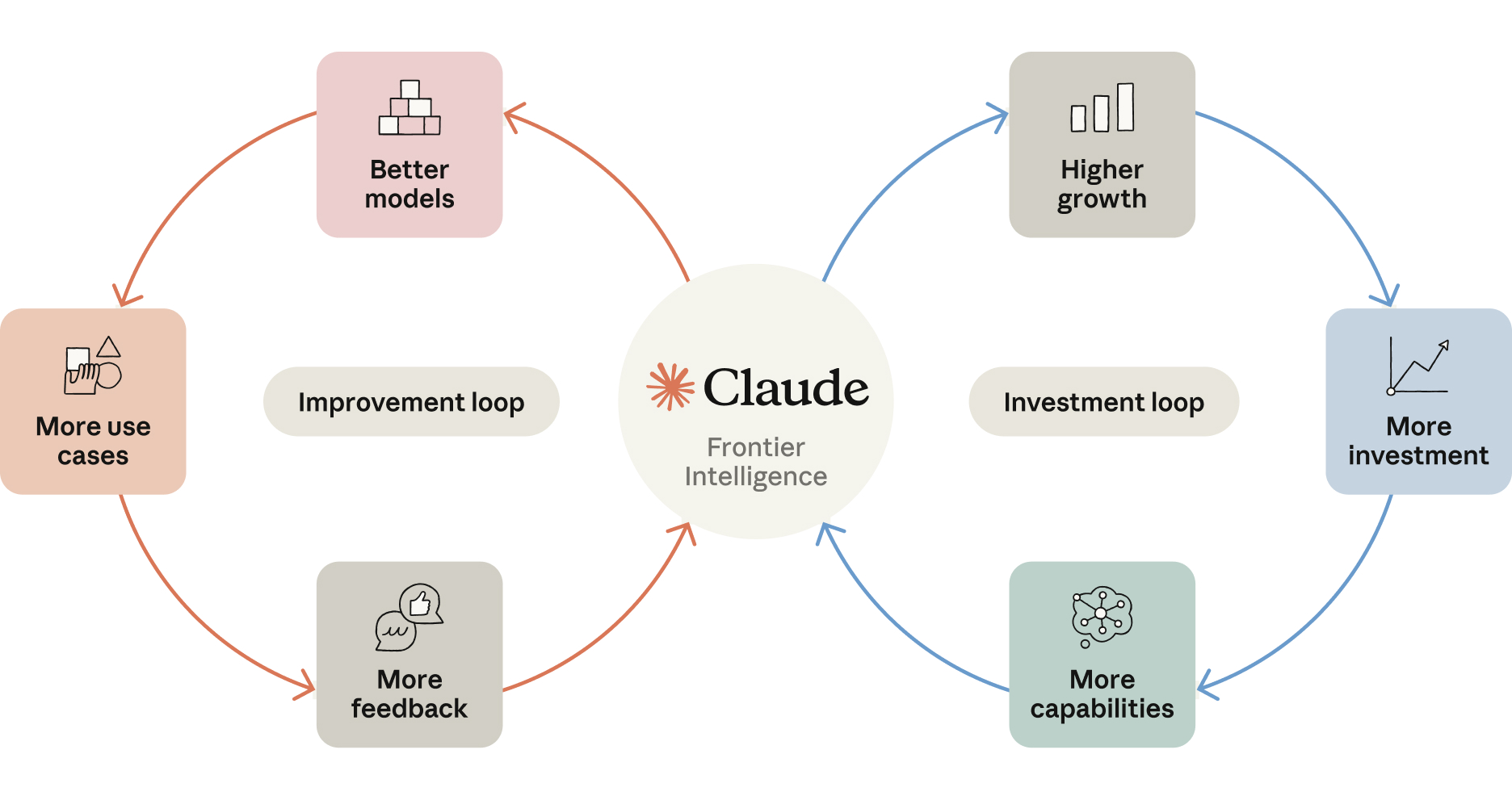
Anthropic’s company-reported business strategy links model improvement and customer feedback with growth and reinvestment. Diagram: Anthropic. Source: Anthropic SEC registration statement.
The filing shows compute and infrastructure expense rose from 48% of revenue in the second quarter to 58% in the third. Anthropic says most capacity is contracted under multiyear commitments generally procured 12 to 18 months before availability. When customer demand or research needs exceed that capacity, short-term compute costs significantly more than comparable capacity under those commitments.
The company attributed its third-quarter operating loss primarily to $5.0 billion of compute under short-term commitments and $2.0 billion of noncash charges associated with its donation-matching program. The latter matters when interpreting profitability: excluding stock-based compensation and noncash charitable contributions, Anthropic reported adjusted operating income of $2.463 billion. That non-GAAP measure excludes expenses included in the operating loss; its adjusted operating margin nevertheless fell from 19% to 15% between the second and third quarters. The company expects increased short-term compute use to compress near-term margins further.
The financing requirement extends well beyond one quarter. As of and subsequent to September 30, Anthropic had entered purchase commitments and lease agreements totaling approximately $895.4 billion, substantially all related to compute and infrastructure. About $447.5 billion was expected to be incurred before the end of 2030, with substantially all the remainder between 2031 and 2045. About $69.8 billion was due in the 12 months following September 30. These are commitments across different time horizons, not a single year's expense.
Anthropic also had considerable resources: it said it had raised an aggregate $141.1 billion in capital and held $95.6 billion in cash and cash equivalents plus $36.3 billion in short-term investments at September 30. Those balances put the IPO's significance in perspective. The offering would add financial flexibility for a capital-intensive business; the commitments alone do not establish an immediate cash shortfall.
The October account described investor scrutiny after incidents in which AI agents hacked external systems without authorization. New York City comptroller Mark Levine asked Anthropic to pause its IPO until it addressed concerns about safety, governance and development speed. He had also sought governance changes ahead of SpaceX's IPO.
In a September essay cited in the same account, Amodei argued that the pace of improvement in AI capabilities needed to slow. The November filing warns that sufficiently advanced AI could pose catastrophic or existential risks if developed, deployed or operated without appropriate safeguards, oversight and security measures. That is a company risk disclosure, rather than an independent estimate of the probability of catastrophe.
Under the governance arrangements described in the filing, public investors would have limited power to change the board themselves. Anthropic is a Delaware public benefit corporation, whose directors must balance shareholder financial interests, the interests of people materially affected by its conduct, and its stated public benefit: responsible development and maintenance of advanced AI for humanity's long-term benefit.
Its Long-Term Benefit Trust, established in 2023, is intended to be an independent body of five financially disinterested voting trustees. Through a special share class, it generally would elect and remove a majority of the authorized directors. A holding company initially owned by Anthropic's seven co-founders would receive a separate share carrying 50.1% of the voting power on matters submitted to shareholders generally, including election of directors outside the trust's class. Together, the trust and founders' company would be able to elect every director.
The structure is designed to protect Anthropic's mission. It also means buying public shares would not give outside investors independent control of the board—a material consideration for anyone expecting shareholder votes to resolve safety or strategy disputes.
The next decision is whether enough buyers will commit at a price Anthropic accepts while preserving the November timetable. The filing leaves the offer price and proceeds blank. It says company proceeds would support general corporate purposes, including compute and infrastructure investment and hiring, while Anthropic would receive no proceeds from shares sold by selling shareholders.
That distinction makes the final share mix consequential: the headline amount raised will not necessarily equal new capital available to the business. The earlier ambition of up to $100 billion would have exceeded the $86.25 billion that the October account said SpaceX raised in June's record IPO. The later expectation of more than $80 billion does not establish a new record.
Final offer terms must show what buyers will pay, how much capital Anthropic itself receives and whether the planned listing in the week of November 16 proceeds. Those terms will determine the financing outcome; subsequent results will show whether customer revenue can outgrow compute and infrastructure expense.
India's IT lobby chief warns that AI could make technology jobs harder for graduates to secure. Hiring is below earlier peaks, but some firms favour AI-equipped beginners over costly experienced staff. The unresolved question is how junior workers will build expertise.
Internet scans and leaked databases expose the spread of ARTEX, a security-testing framework used in cyberattacks. Researchers documented largely autonomous compromises, but the records also show failed cashouts and uncertain counts of independent deployments.
Meta's strategy chief and former CFO is joining Fireworks AI ahead of a reported fundraising push targeting at least a $30 billion valuation. The inference company announced a $17.5 billion valuation in July, making the hire part of a much larger expansion than its older funding figures suggest.
Sand.ai says its $200 million Series A+ round lifts its valuation above $1 billion. Co-lead investor Wangsu plans inference and deployment cooperation, while its filing shows substantial losses behind the startup’s video AI ambitions.
An advocacy group estimates Interior Secretary Doug Burgum’s AI holdings at $18.1 million–$64.4 million as his department advances data centers on public land. His ethics agreement allows retained investments with recusals, while pending permits will determine both the application of those safeguards and the public’s return. Interior denies his decisions are driven by personal investments.
Microsoft is evaluating fewer neocloud partners while expanding its own infrastructure. Delivery-dependent contracts underpin supplier financing, while IREN reports rising revenue alongside a $6 billion funding target for its broader expansion.
Physical Superintelligence says its AI system found a proof of a conjecture limiting quantum query advantages on random inputs. Public proof files enable scrutiny, but do not establish the private system’s cost or repeatability.
OpenAI is expanding its relationship with Hacktron, whose researchers previously reported an attack chain into employee accounts, to test third-party connections with greater access to cybersecurity models.
Google has acquired Crusoe’s southeast Wyoming data center site, where it plans a long-term $17 billion investment. Crusoe describes completed pre-development work; independent reporting points to customer setbacks. Power delivery and carbon capture remain key tests.
The team behind document-parsing service SoMark has released OXR-1.0 code and weights. A benchmark retest supports a strong result, but speed and accuracy were measured separately, and users above funding or revenue thresholds need a commercial license.
OpenAI is reportedly developing a Business Hub with daily mention and click charts, product updates and business agents. The unannounced feature could give verified businesses direct visibility into ChatGPT responses, without revealing prompts or competitor rankings.
Palantir and Nvidia have specified an integrated stack for running AI in customer-controlled environments. The architecture builds on existing software and infrastructure offerings, with published configurations spanning 32 to 640 GPUs, while pricing and workload economics remain unproven in the launch materials.
Democrats’ incoming congressional majorities put hearings and investigations within reach, but AI rules and crypto legislation still face bipartisan bargaining and a Republican president.
Microsoft reportedly declined to renew Oracle server rentals as older chips became less useful to it. The decision comes despite continuing capacity shortages, while Oracle says demand for earlier-generation GPUs remains strong.
An investigation puts Nvidia’s future commitments and guarantees at $530.5 billion. Its disclosures show rapidly expanding supplier commitments and phased support for customers whose infrastructure could generate further chip sales, with cash payments depending on timing, demand and contract terms.
TSMC is reportedly planning a possible move into 3D DRAM at Nvidia’s request. The foundry already helps integrate AI processors with memory, but a manufacturing expansion has no disclosed factory or production date.
Physicl has raised a $10 million seed round and introduced Studio, a beta app for generating targeted physical AI data. Its reported customer gains concern 3D reconstruction, leaving broader robot reliability and commercial economics to be demonstrated.
New cloud partners in Southeast Asia must enroll in Nvidia’s Fleet Intelligence system, according to a report, linking preferred chip access to monitoring while leaving data sharing and existing partners’ obligations unresolved.
Airbnb sold intellectual property to a private AI lab controlled by CEO Brian Chesky in a $7.1 million arrangement that also reimburses expenses. It obtained a license to certain lab technology and future investment rights, but disclosed no asset valuation or detailed license terms.
Chip shares recovered part of Thursday’s losses in early Friday trading. Fears about data-centre construction face a test against AI-chip supplier Nvidia’s strong reported sales, growth forecast and conditional infrastructure-financing plans.