Editorial Team
8 min read
PJM’s independent market monitor attributes about $11 per megawatt-hour of first-half 2026 wholesale costs to data-center demand in capacity auctions. Energy costs drove more of the overall increase, while construction barriers and an October regulatory rejection complicate the response.
Including data-center demand in PJM Interconnection’s capacity market added about $11 per megawatt-hour to wholesale power costs in January–June 2026, estimates Monitoring Analytics, the independent monitor of the regional grid operator’s markets. The finding puts a cost on securing supply for growing demand, but deciding who pays also requires confronting constraints on building that supply.
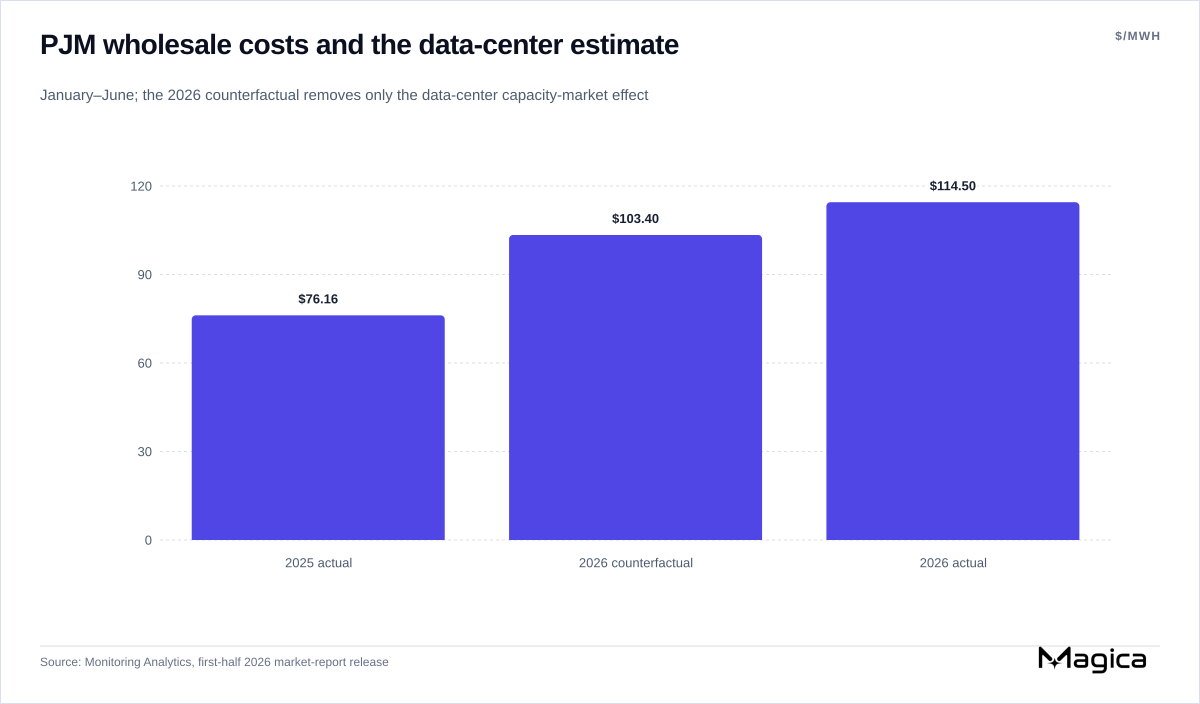
Monitoring Analytics estimates the data-center capacity effect at $11.11/MWh; its rounded totals differ by $11.10. The estimate excludes effects on energy and transmission costs and does not measure household bill increases. Source: Monitoring Analytics — Market Report Release.
The monitor’s first-half findings put total wholesale costs at $114.50/MWh, compared with $76.16/MWh in the same period of 2025, an increase of 50.3%. It estimated that costs would have been $103.40/MWh without the inclusion of data-center load in the capacity market.
The release states the data-center increment as $11.11/MWh, or 9.7% of actual total costs. Its displayed rounded totals of $114.50 and $103.40 differ by $11.10. This is a counterfactual estimate of the capacity-market effect alone; it excludes effects on energy and transmission costs and does not isolate AI workloads within data centers. The 9.7% is a share of the 2026 total, not a percentage increase measured against the lower counterfactual cost.
PJM is the regional grid operator managing wholesale electricity markets across 13 states and the District of Columbia. Capacity auctions secure commitments to meet future electricity needs, rather than buying the electricity consumed at a particular moment. A Congressional Research Service explanation describes utilities buying capacity for expected customer demand plus reserves. Successful sellers receive the clearing price, and utilities pass capacity costs to consumers under state regulatory oversight, generally with a delay.
Capacity can come from existing or new generators and qualifying demand-response programs, which help balance supply and demand by reducing electricity use. New power plants are one source of capacity, rather than the market’s only resource.
Because qualifying sellers receive the clearing price, additional forecast demand can affect payments to supply that clears, rather than simply adding the cost of serving one new customer. A market-wide wholesale estimate cannot be applied directly as a percentage increase in an individual customer’s bill. PJM delivery years run from June through May, unlike the calendar-year reporting periods used here.
The reported first-half breakdown shows why data centers’ capacity effect should not be mistaken for the whole cost surge:
| Wholesale cost component | January–June 2026 | Change from January–June 2025 |
|---|---|---|
| Energy | $72.68/MWh | +47.7% |
| Capacity | $19.61/MWh | +207.1% |
| Transmission | $19.88/MWh | +5.6% |
| Total, including other charges | $114.50/MWh | +50.3% |
Energy accounted for about 63% of the total, calculated by dividing $72.68 by $114.50. Its increase was larger in dollars per MWh than capacity’s, even though capacity grew faster in percentage terms. The data-center estimate does not explain the entire wholesale-cost surge.
The monitor’s separate real-time, load-weighted energy-price measure rose from $51.75/MWh to $72.54/MWh. It attributed $9.43/MWh of that $20.79/MWh increase to transmission-constraint penalty factors and $7.26/MWh to fuel and consumables. Those are components of an energy-price calculation, not additional amounts to add to the wholesale-cost table.
Monitoring Analytics evaluates market rules, participant behavior and competitiveness; its role includes proposing rule changes. It is a separate company formed in August 2008, with independence from market participants and PJM management and board, as described in its account of its monitoring role. That presentation identifies accountability to the Federal Energy Regulatory Commission (FERC), the federal regulator that approves wholesale capacity-market rules. It also judged 2021 capacity-market results uncompetitive: the monitor’s concerns predate this data-center finding.
The monitor found first-half 2026 energy-market outcomes generally competitive, with prices usually close to generators’ short-run marginal costs, although some high markups affected prices. Its judgment on capacity was different: it concluded that auctions for the 2025/2026, 2026/2027 and 2027/2028 delivery years were not competitive, primarily because they included forecast data-center demand.
There is a broader supply-side history, however. In its July 2024 auction announcement for June 2025–May 2026, PJM called the procurement competitive and attributed higher prices to retirements, increased demand and reliability-rule changes. The auction set a price of $269.92 per megawatt-day across much of the region, compared with $28.92 in the preceding auction. Those are payments for available capacity, not per-MWh energy prices.
PJM said approximately 6,600 MW of generation had retired or received exceptions signaling an intent to retire compared with the preceding auction. The peak-demand forecast had risen from 150,640 MW to 153,883 MW.
The Congressional Research Service’s June 2025 review explains why rule changes also matter. After generator failures during Winter Storm Elliott in December 2022, PJM changed how it modeled reliability risks and credited resources’ ability to supply power. Most resources received a lower capacity value under the new accreditation approach. The monitor criticized the implementation, while PJM disputed its assumptions and emphasized enhanced risk modeling. These disagreements concern how available supply and required reserves are defined, alongside how much demand is forecast.
That review also documented approved changes requiring plants kept open under reliability-must-run contracts, intermittent generators and storage to participate, alongside a temporary price floor and cap of approximately $175 and $325 per megawatt-day for the next two auctions. Reliability-must-run contracts pay plants to defer retirement to protect the grid. These changes sought to expand participating supply and limit prices before the 2026 findings. The review cautioned that lowering capacity prices could also weaken incentives to build.
A subsequent account of the monitor’s findings extended the measurement through July: the monitor estimated that existing and forecast data-center load accounted for $10.48/MWh, or 9%, of wholesale costs, which averaged $116.53/MWh. That seven-month estimate has a different time window from the first-half figure. The same account relayed the monitor’s estimate of a combined $29.4 billion increase in capacity-market revenues across four auctions from existing and forecast data-center load growth. That is not a first-half 2026 expense.
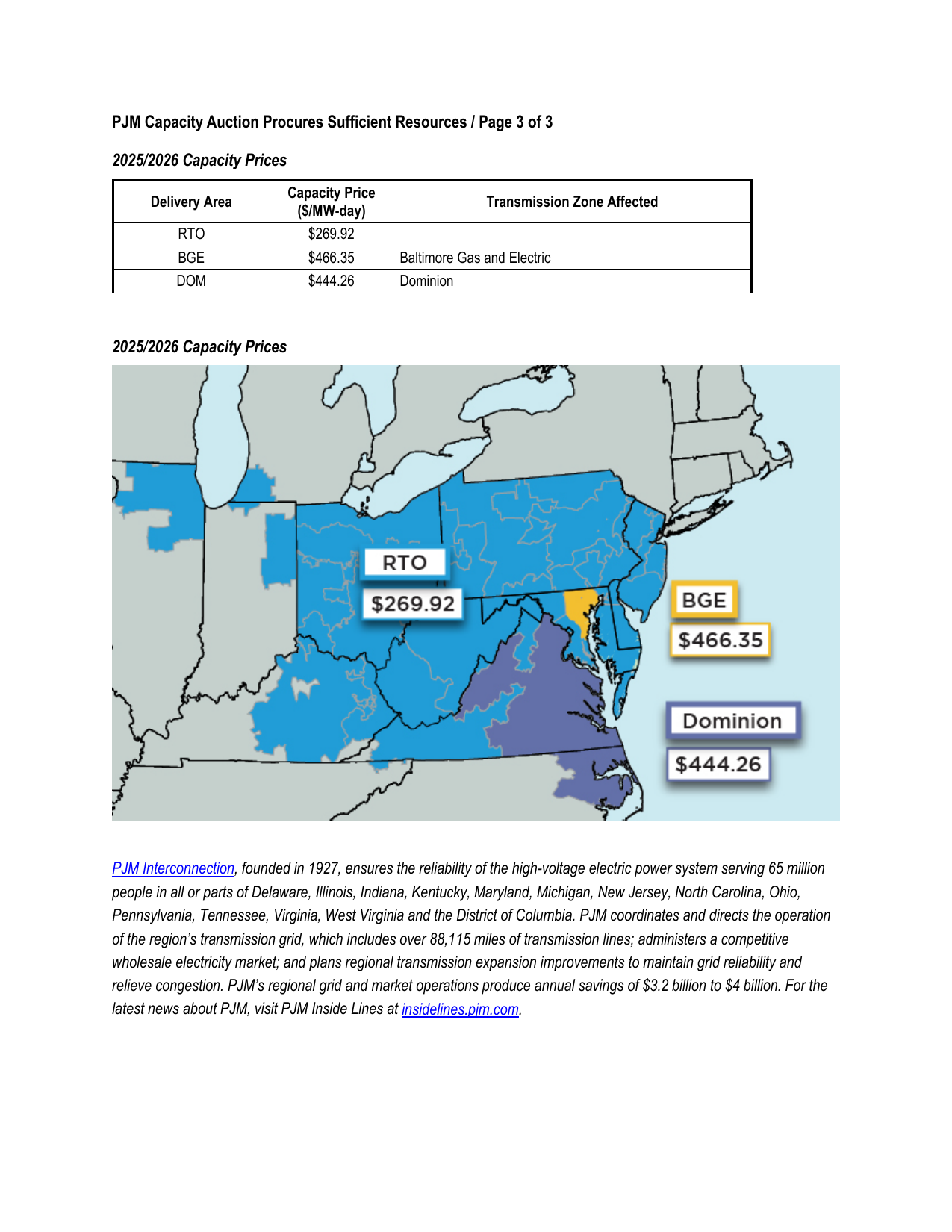
PJM Interconnection’s July 2024 auction results for June 2025–May 2026. PJM attributed higher BGE and Dominion prices to insufficient local resources and transmission constraints. Source: PJM — July 2024 Capacity Auction Results.
The monitor recommended excluding forecast data-center demand from capacity auctions and requiring data centers to bring their own new generation to prevent costs being imposed on other customers. That is a recommendation about how to accommodate growth, not evidence that the required generation has been built.
PJM’s July 2024 account identified a gap between clearing its connection process and completing construction. It said about 38,000 MW of resources had cleared its interconnection queue but remained unbuilt, citing financing, supply-chain and siting or permitting challenges. That was a historical assessment, not a count of projects still unbuilt today, but it demonstrates why faster studies alone cannot ensure new supply arrives.
Geography adds another constraint. PJM said the Baltimore Gas and Electric zone in Maryland and the Dominion zone in Virginia and North Carolina reached their zonal price caps in that auction because local resources were insufficient and transmission limited imports. It identified additional resources, transmission, or both as potential responses.
PJM described higher auction prices as an investment signal. The monitor separately calculated that theoretical energy-market net revenue for a new combustion turbine rose 108% from the first half of 2025 to the first half of 2026. That measures an incentive; it is neither a financing commitment nor proof of construction.
When transmission constraints create locational energy-price differences, customers can pay more for energy than generators receive. The monitor argues that this congestion revenue should return to customers.
In its discussion of congestion rights, the monitor said customers recovered only 55.7% of congestion costs through auction revenue rights and self-scheduled financial transmission rights in the 2025/2026 planning period. It put the shortfall at $2.2 billion, the largest in a single planning period, and the cumulative shortfall since 2011/2012 at $7.1 billion.
The monitor recommended replacing the current design with rights tied directly to the actual congestion paid by customers, who could retain or sell those rights. This is a separate proposed reform, measured over planning periods; the shortfall cannot be added to the capacity estimate as another data-center charge.
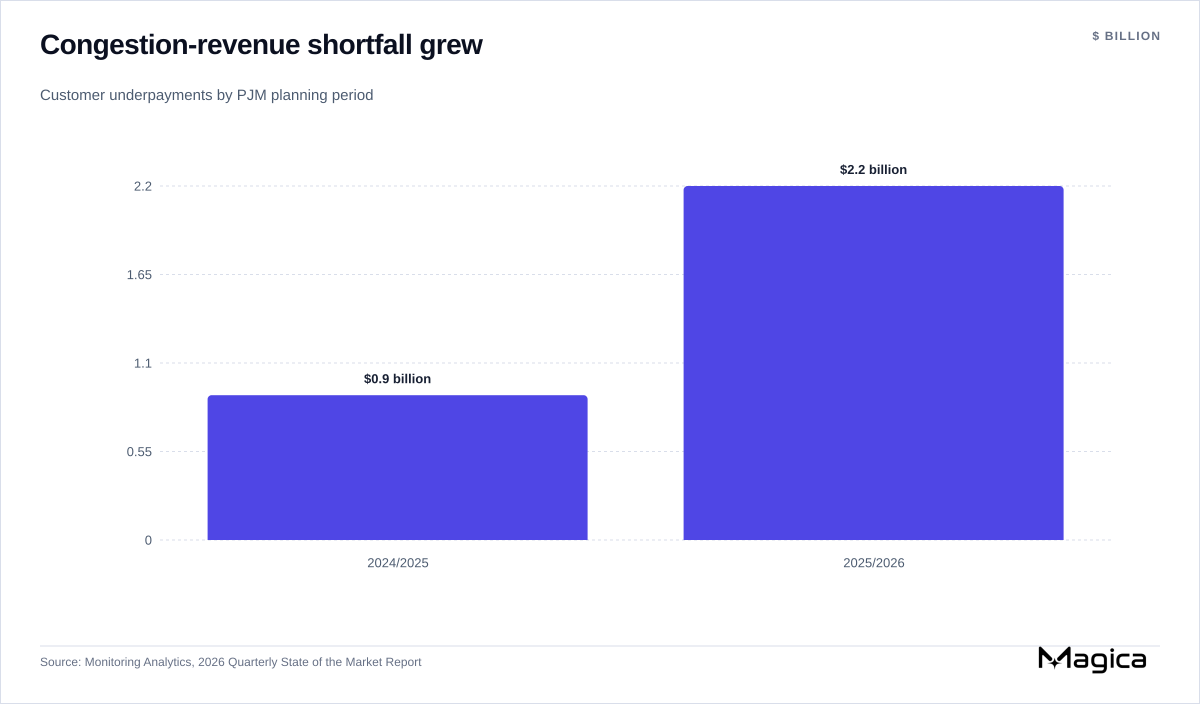
Monitoring Analytics reported congestion-revenue underpayments rising from $0.9 billion to $2.2 billion. These planning-period shortfalls are separate from the data-center capacity-cost estimate. Source: Monitoring Analytics — State of the Market Report.
FERC has already challenged one attempted response to large-load growth. In October 2026 it largely rejected PJM’s plan for bringing large loads onto its system. In an account of the decision, the regulator said key provisions intruded on state jurisdiction over retail rates and appeared to discriminate against large loads.
That ruling concerns PJM’s interconnection proposal; the monitor’s call to exclude forecast demand from capacity auctions is a separate recommendation. A workable response must establish who secures additional dependable supply, who bears costs if demand and construction arrive at different times, and how the rules fit federal and state authority. The evidence needed to judge the supply response is completed generation and transmission matched to demand that actually materializes.
A federal judge found Anthropic’s Claude Max usage advertising plausibly misleading because subscribers could read the multipliers as monthly promises. Contract and misrepresentation claims survive, but several other claims were dismissed with leave to amend.
Thailand’s proposed data-centre framework would scale requirements by power demand, screen sites for electricity and water access, and assess domestic benefits. It also covers existing facilities, while conflicting application and approval schedules remain unresolved.
DataVita now says its proposed Lanarkshire AI data centres will be fully grid served, with direct renewable connections only a future possibility. The change in public presentation raises questions about promised power costs and community benefits, although the DV4 planning application already assumed grid supply.
AMD chief Lisa Su calls the chipmaker a data-center-first company as server and AI sales surge. Gaming revenue fell 40%, but PC-chip sales grew, and her remarks leave the supply outlook for expensive Radeon cards unresolved.
A reported U.S. intelligence assessment links Megaspeed executive Alice Huang to China’s Ministry of State Security, raising questions about access to Nvidia’s leadership and chip-export policy. Whether the alleged operation succeeded remains unclear.
Ocient’s $100 million Series C backs tailored AI analytics on an established database platform, with national-security investors and deployment economics shaping its expansion.
Anthropic plans IPO marketing next week and a listing in the week of November 16, according to people familiar with the plans. Buyers are discussing valuations of $1.2 trillion–$1.3 trillion, with some weighing $1.1 trillion, as its filing reveals faster-growing compute costs and extensive infrastructure commitments.
India's IT lobby chief warns that AI could make technology jobs harder for graduates to secure. Hiring is below earlier peaks, but some firms favour AI-equipped beginners over costly experienced staff. The unresolved question is how junior workers will build expertise.
Internet scans and leaked databases expose the spread of ARTEX, a security-testing framework used in cyberattacks. Researchers documented largely autonomous compromises, but the records also show failed cashouts and uncertain counts of independent deployments.
Meta's strategy chief and former CFO is joining Fireworks AI ahead of a reported fundraising push targeting at least a $30 billion valuation. The inference company announced a $17.5 billion valuation in July, making the hire part of a much larger expansion than its older funding figures suggest.
Sand.ai says its $200 million Series A+ round lifts its valuation above $1 billion. Co-lead investor Wangsu plans inference and deployment cooperation, while its filing shows substantial losses behind the startup’s video AI ambitions.
An advocacy group estimates Interior Secretary Doug Burgum’s AI holdings at $18.1 million–$64.4 million as his department advances data centers on public land. His ethics agreement allows retained investments with recusals, while pending permits will determine both the application of those safeguards and the public’s return. Interior denies his decisions are driven by personal investments.
Microsoft is evaluating fewer neocloud partners while expanding its own infrastructure. Delivery-dependent contracts underpin supplier financing, while IREN reports rising revenue alongside a $6 billion funding target for its broader expansion.
Physical Superintelligence says its AI system found a proof of a conjecture limiting quantum query advantages on random inputs. Public proof files enable scrutiny, but do not establish the private system’s cost or repeatability.
OpenAI is expanding its relationship with Hacktron, whose researchers previously reported an attack chain into employee accounts, to test third-party connections with greater access to cybersecurity models.
Google has acquired Crusoe’s southeast Wyoming data center site, where it plans a long-term $17 billion investment. Crusoe describes completed pre-development work; independent reporting points to customer setbacks. Power delivery and carbon capture remain key tests.
The team behind document-parsing service SoMark has released OXR-1.0 code and weights. A benchmark retest supports a strong result, but speed and accuracy were measured separately, and users above funding or revenue thresholds need a commercial license.
OpenAI is reportedly developing a Business Hub with daily mention and click charts, product updates and business agents. The unannounced feature could give verified businesses direct visibility into ChatGPT responses, without revealing prompts or competitor rankings.
Palantir and Nvidia have specified an integrated stack for running AI in customer-controlled environments. The architecture builds on existing software and infrastructure offerings, with published configurations spanning 32 to 640 GPUs, while pricing and workload economics remain unproven in the launch materials.
Democrats’ incoming congressional majorities put hearings and investigations within reach, but AI rules and crypto legislation still face bipartisan bargaining and a Republican president.