Editorial Team
7 min read
Councils, transport officials and MPs’ staff report more demanding AI-assisted correspondence. Official records show pressure alongside successful appeals, while regulators seek to protect access and contain excessive submissions.
UK councils, transport officials and MPs’ staff report that AI-assisted correspondence is becoming harder to process, as staff check lengthy arguments, invented legal references and unclear demands. Their responses are beginning to change how people submit complaints and challenge decisions.
Chatbots can reduce the effort needed to raise a grievance while increasing the work required to understand and answer it. Yet correspondence totals do not establish how much of the increase comes from AI, and a difficult submission can still identify a real failure.
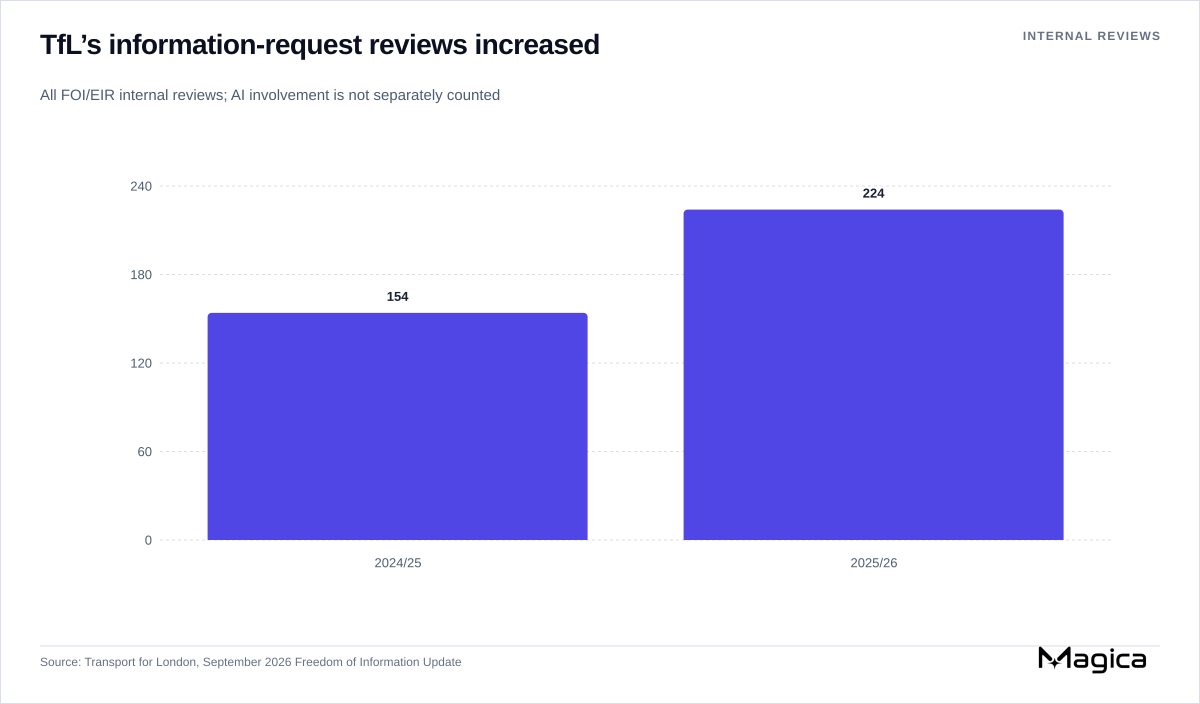
TfL reported 154 internal reviews in 2024/25 and 224 in 2025/26. These totals do not separately identify AI-assisted submissions. Source: Transport for London.
Deborah Evans, chief executive of Lawyers in Local Government, which represents 5,600 local-authority lawyers, says complaints that previously averaged about two pages are now mostly ten times longer. In a report published on 8 November, she describes AI-assisted complaints citing invented cases or law from an irrelevant jurisdiction. Her assessment conveys practitioners’ experience; it is not a measured national series.
Evans says councils receive no extra money simply because complaints increase, so the work competes with other services. The scarce resource is the staff time needed to check and respond to submissions that chatbots can generate quickly.
Parliamentary offices describe a similar problem. Hollie Wickens, a senior caseworker in a Labour MP’s office with a decade of experience in the role, says correspondence has become more demanding to handle. Vonnie Sandlan, head of office for Graeme Downie, Labour MP for Dunfermline and Dollar, says her office has stopped answering automated “click to email your MP” campaigns to focus on constituents’ requests. She also recognises that AI can help people who would struggle to draft correspondence unaided.
These accounts need a qualification: authorities describe inferring AI use partly from length, phrasing and formatting. Those impressions do not provide a reliable count of AI-written submissions, or establish that their underlying grievances lack merit.
Transport for London, the public body responsible for the capital’s transport system, offers a firmer numerical baseline. Its September committee paper says increased use of AI to generate appeals has contributed to their volume and complexity, often adding technical but inaccurate assertions. TfL is introducing a template to structure and focus appeals.
The figures cover requests under the Freedom of Information Act and Environmental Information Regulations, which provide access to information held by public authorities:
| TfL measure | 2024/25 | 2025/26 |
|---|---|---|
| Information requests received | 4,005 | 4,771 |
| Requests for internal review | 154 | 224 |
| Internal reviews as a share of request caseload | 3.8% | 4.7% |
In the year from 1 April 2025 to 31 March 2026, requests rose 19.1% from the preceding year. TfL distinguishes the 4,771 received from the 4,769 answered within the statutory deadline, giving 99.96% compliance. The deadline is usually 20 working days, with permitted extensions in specified circumstances. Annual compliance has exceeded 99% since 2019/20.
Challenges also succeeded: 43 internal reviews were upheld and 57 partly upheld, making 100 of 224 successful or partly successful. These outcomes cover all internal reviews; the paper does not identify which involved AI.
The growth was not continuous. Request volumes in the first five reporting periods of 2026/27 were 3.4% below the equivalent periods a year earlier. TfL’s record supports its account of appeals pressure, while leaving AI’s share of the workload unquantified.
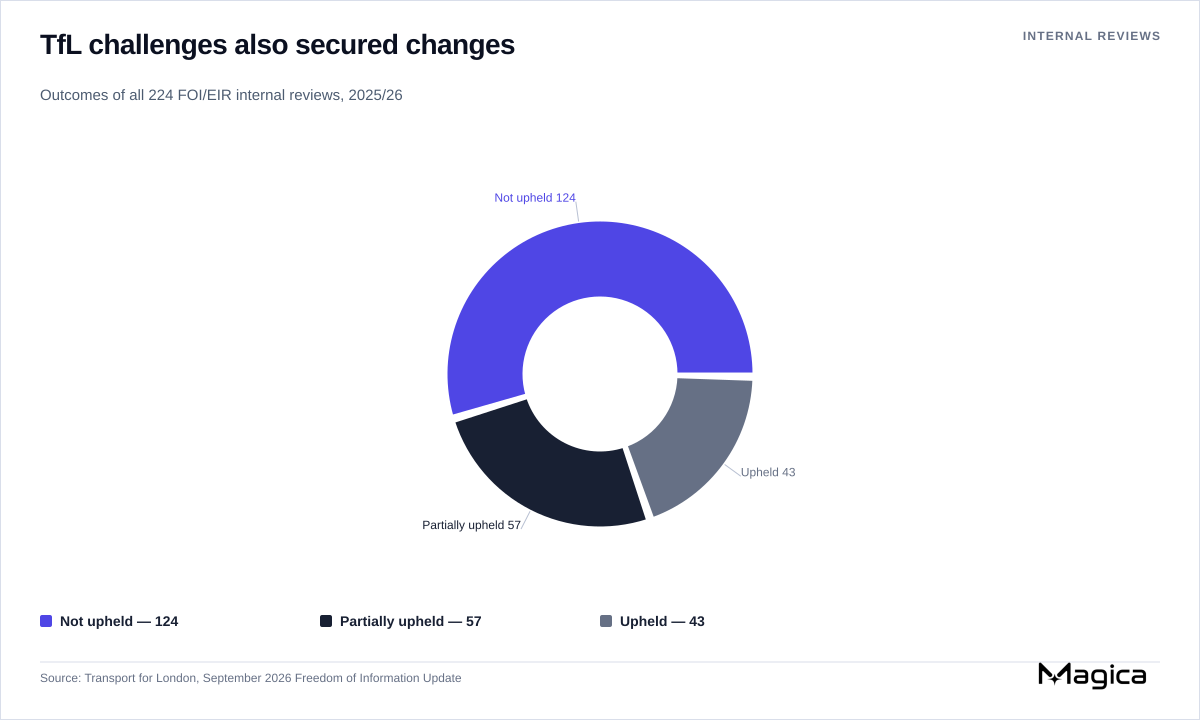
Of TfL’s 224 internal reviews, 57 were partially upheld and 43 upheld. The report does not identify which reviews involved AI. Source: Transport for London.
In Portsmouth, councillors discussed repetitive, excessive or irrelevant material in AI-enhanced complaints at a governance and audit standards committee meeting, according to a September account of the discussion.
In Edinburgh, Conservative councillor Jo Mowat brought the issue before the full council. Her motion dated 29 October described submissions running to thousands of words and legal references requiring verification. It cited one case that took two officer days to prepare a response, an example rather than an average handling time.
The motion sought a report comparing suspected AI-generated complaints with other complaints, examining resource implications and considering a sector-wide response. It establishes what Mowat wanted measured, rather than a completed assessment of Edinburgh’s caseload.
Poorly directed text can also undermine the sender’s purpose. The Local Government Association’s planning guidance, developed through work with councils, describes submissions containing fabricated references, generic arguments and points irrelevant to the proposal. Effective representations need to address relevant planning matters and the specific application or policy.
Its response includes guidance and prompts to help residents use AI, guidelines for technology providers and material councils can adapt. That approach recognises AI’s potential to widen informed participation while improving what decision-makers receive.
The Information Commissioner’s Office, the independent data-protection and information-rights regulator, issued guidance on 6 May in response to practitioners’ concerns. It said the guidance applies existing principles and creates no new legal requirements.
The ICO’s FOI guidance says authorities must respond to AI-assisted requests that meet the Act’s validity requirements. Inaccuracies, including nonexistent case law, do not necessarily make a request invalid. Its account of the FOI/EIR regime covers England, Wales and Northern Ireland; it is not a general rulebook for every council complaint or planning objection.
Authorities can seek timely clarification, correct misunderstandings and apply existing provisions on cost limits, repeated requests and vexatious or excessively burdensome requests. Where a request exceeds the cost limit, the guidance calls for advice and assistance to help the person reformulate it.
Scotland’s separate FOI appeals regulator has announced a more specific control. In a June announcement, the Scottish Information Commissioner said he could selectively limit an individual to five appeals under live investigation where submission patterns threatened the wider FOI process. Additional cases would wait until others were resolved. The measure is discretionary, not a blanket cap. The announcement said it had not yet been used. Applicants could still submit further appeals, and staff would help them prioritise cases.
The Commissioner reported 1,084 appeals in 2025/26, up from 593 in 2024/25, an 83% increase. He also cited 120 appeals from two applicants over two months, with evidence they were entirely AI-generated; those cases were closed before investigation. The annual increase does not establish AI’s contribution to the whole caseload.
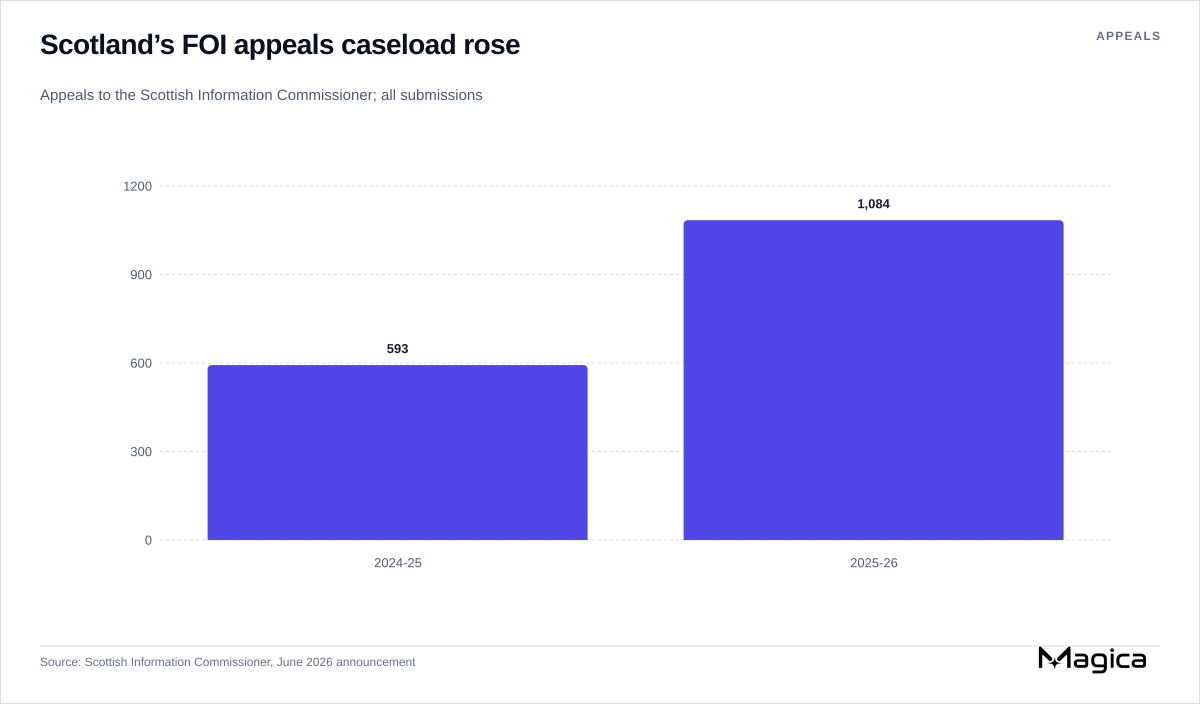
The Scottish Information Commissioner reported 593 appeals in 2024-25 and 1,084 in 2025-26. These totals do not establish AI’s contribution to the increase. Source: Scottish Information Commissioner.
An August study of agentic flooding by researchers affiliated with the Hertie School’s Centre for Digital Governance, the Cooperative AI Foundation and GovAI supplies an important limit to predictions of breakdown. It collected 84 potential cases across 11 jurisdictions, but describes observed impacts as moderate overall and considers acute operational collapse unlikely.
The researchers used an AI-assisted collection process with human review. Inclusion required official or credible third-party attribution of demand changes to AI; the method cannot establish prevalence or AI’s causal effect. Almost all identified cases involved people submitting AI-generated text while navigating the rest of the process manually. The label “agentic flooding” therefore need not mean autonomous bots completing entire government procedures.
The study warns that fees and other barriers can deter disadvantaged users. Building processing capacity or redesigning services offers alternatives, but requires investment and lead time. Its proposed remedies are not a measured demonstration that any particular intervention works.
Some lower-tech capacity measures are already visible. TfL says it answered more than 400 requests in 2025/26 by directing people to existing or forthcoming publications. The ICO identifies potential AI uses in triage, searching records and simplifying replies, subject to accuracy checks and protection of personal information. It also says work-related AI outputs and prompts held by an authority can themselves be subject to FOI, making those records part of the information-access workload.
The practical tests now are handling time, accuracy and access. Edinburgh’s proposed comparison could help distinguish avoidable complexity from additional legitimate demand. TfL’s template and Scotland’s selective appeal control need assessment against both staff workload and people’s ability to obtain information or correct decisions. Rising totals alone cannot answer whether the response improves public services.
Independent directors and outside counsel will investigate reports involving Nvidia’s founder and CEO, who has admitted infidelity. The board says it has no reason to believe national security or company secrets were compromised.
Apple reportedly wants Siri to pursue goals without prompts at every step. A possible 2027 debut is a reporter’s assessment, while Apple experiments with its iOS 28 development process after earlier Siri delays.
Apple led Nvidia by roughly $615 billion in market value at the November 5 close. Nvidia’s rapid sales growth contrasts with financing and construction risks for AI infrastructure, while Apple faces rising costs and uses Nvidia chips in its own cloud.
Anthropic has reportedly taken over commitments for Caterpillar generators ordered by OnePWR, gaining access to scarce equipment and installation capabilities as it seeks greater control over data-center power.
Micron and its Taoyuan union ended a third negotiating session without agreement on profit sharing. A bonus calculator and further talks are planned, while a reported US$3 billion to US$4.5 billion expansion pause remains unaddressed by the company.
Envision says it has handed over a 200 MW first phase of its Galaxy AI campus in Inner Mongolia. The wind-turbine supplier is expanding into data-center facilities and power systems, but its 3 GW plan remains ahead of disclosed costs, utilization and reliability results.
Founded in 2025 by a team with autonomous-driving data experience, GenRobot AI says it raised $100 million in a Series A+. Its robot-data business reports million-hour quarterly deliveries, while funded rivals and undisclosed commercial metrics complicate the growth story.
AI safety advocates gained experienced lawmakers and battleground seats in the midterms, but rival technology-backed groups also elected allies, leaving federal legislation far from assured.
A federal judge found Anthropic’s Claude Max usage advertising plausibly misleading because subscribers could read the multipliers as monthly promises. Contract and misrepresentation claims survive, but several other claims were dismissed with leave to amend.
Thailand’s proposed data-centre framework would scale requirements by power demand, screen sites for electricity and water access, and assess domestic benefits. It also covers existing facilities, while conflicting application and approval schedules remain unresolved.
PJM’s independent market monitor attributes about $11 per megawatt-hour of first-half 2026 wholesale costs to data-center demand in capacity auctions. Energy costs drove more of the overall increase, while construction barriers and an October regulatory rejection complicate the response.
DataVita now says its proposed Lanarkshire AI data centres will be fully grid served, with direct renewable connections only a future possibility. The change in public presentation raises questions about promised power costs and community benefits, although the DV4 planning application already assumed grid supply.
AMD chief Lisa Su calls the chipmaker a data-center-first company as server and AI sales surge. Gaming revenue fell 40%, but PC-chip sales grew, and her remarks leave the supply outlook for expensive Radeon cards unresolved.
A reported U.S. intelligence assessment links Megaspeed executive Alice Huang to China’s Ministry of State Security, raising questions about access to Nvidia’s leadership and chip-export policy. Whether the alleged operation succeeded remains unclear.
Ocient’s $100 million Series C backs tailored AI analytics on an established database platform, with national-security investors and deployment economics shaping its expansion.
Anthropic plans IPO marketing next week and a listing in the week of November 16, according to people familiar with the plans. Buyers are discussing valuations of $1.2 trillion–$1.3 trillion, with some weighing $1.1 trillion, as its filing reveals faster-growing compute costs and extensive infrastructure commitments.
India's IT lobby chief warns that AI could make technology jobs harder for graduates to secure. Hiring is below earlier peaks, but some firms favour AI-equipped beginners over costly experienced staff. The unresolved question is how junior workers will build expertise.
Internet scans and leaked databases expose the spread of ARTEX, a security-testing framework used in cyberattacks. Researchers documented largely autonomous compromises, but the records also show failed cashouts and uncertain counts of independent deployments.
Meta's strategy chief and former CFO is joining Fireworks AI ahead of a reported fundraising push targeting at least a $30 billion valuation. The inference company announced a $17.5 billion valuation in July, making the hire part of a much larger expansion than its older funding figures suggest.
Sand.ai says its $200 million Series A+ round lifts its valuation above $1 billion. Co-lead investor Wangsu plans inference and deployment cooperation, while its filing shows substantial losses behind the startup’s video AI ambitions.