Editorial Team
9 min read
An advocacy group estimates Interior Secretary Doug Burgum’s AI holdings at $18.1 million–$64.4 million as his department advances data centers on public land. His ethics agreement allows retained investments with recusals, while pending permits will determine both the application of those safeguards and the public’s return. Interior denies his decisions are driven by personal investments.
U.S. Interior Secretary Doug Burgum, a former North Dakota governor and Microsoft executive, retains an estimated $18.1 million–$64.4 million in AI-company investments while promoting data centers on land his department oversees. A November 6 investigation disclosed the estimate, calculated by public lands advocacy group Save Our Parks from his 2026 financial disclosure and portfolio companies’ marketing materials.
The overlap puts practical weight on Burgum’s promise to avoid matters affecting his investments. The Bureau of Land Management, Interior’s agency administering the country’s largest area of public land, is reviewing applications for about 15 data centers and 17 associated infrastructure projects across six western states, according to the investigation, citing an agency spokesperson and its land-records system. These are proposed facilities, not operating capacity.
An Interior spokesperson told the investigation that Burgum had met his ethics and disclosure obligations and rejected any suggestion that personal investments drive his decisions. The holdings establish financial exposure; they do not establish that he improperly intervened for a portfolio company.
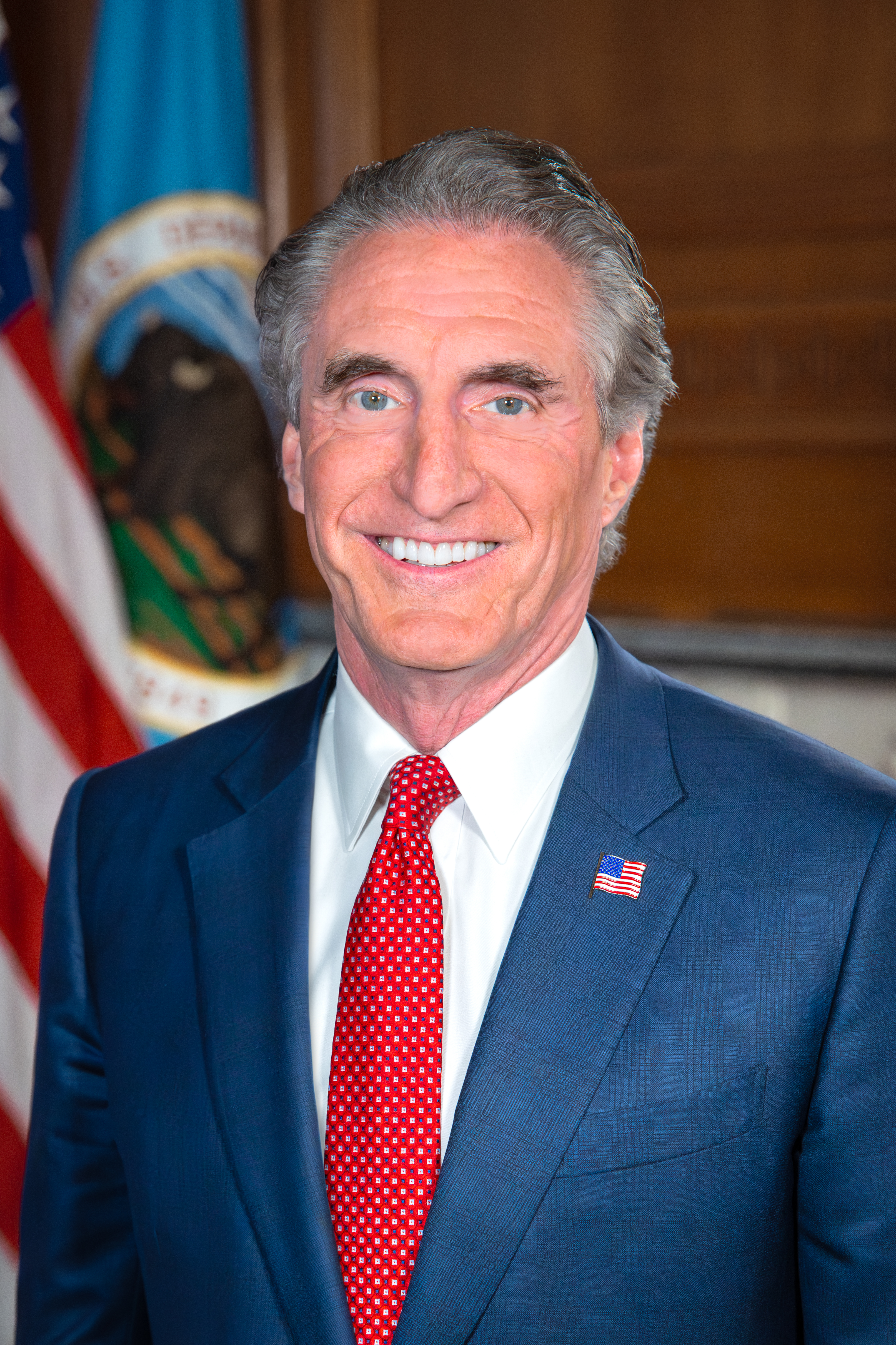
Interior Secretary Doug Burgum. Official portrait: U.S. Department of the Interior. Source: U.S. Department of the Interior.
Burgum’s official biography describes a technology career preceding elected office: he backed software startup Great Plains, led it through its public offering and acquisition by Microsoft, and stayed at Microsoft for six years as senior vice president of business solutions. He later co-founded Arthur Ventures, the venture investment firm through which much of his wealth is held, and was elected governor in 2016.
His July 31, 2026 annual disclosure records list Arthur Ventures funds and underlying businesses ranging from cybersecurity and customer-engagement software to market-research platforms. The fund entries specify that their values include underlying assets and cash: adding fund totals to their portfolio-company values would count the same exposure twice.
The $18.1 million–$64.4 million AI estimate belongs to Save Our Parks’ analysis, as conveyed in the investigation. It is neither a precise valuation nor a total for Arthur Ventures itself. The classification rests on companies’ descriptions of their activities, rather than a separate AI category in the disclosure.
The investigation also reports the group’s estimates of AI-related capital gains: $2.1 million–$11 million in the year before Burgum entered the administration, and $2.5 million–$15.1 million in 2025. The overlapping ranges do not establish a precise increase, and gains that predate his federal service cannot be attributed to his actions as secretary.
Burgum’s January 13, 2025 ethics agreement required him to leave management positions at Arthur Ventures entities while allowing him to retain financial interests and receive passive investment income. He committed to avoid personal and substantial participation in particular matters he knew would directly and predictably affect specified entities or their underlying holdings, subject to the agreement’s waiver provisions.
The agency determined at that time that divestiture of listed retained interests was unnecessary because recusals would not substantially limit his essential duties. Separately, the agreement required divestiture of named public securities, including Microsoft, Alphabet, Apple and Meta, within 90 days of confirmation. Those obligations addressed selected holdings without eliminating his technology investments.
A transaction report signed February 27, 2026 records two Arthur Ventures IV purchases on December 22, 2025, each in the $15,001–$50,000 band. Endnotes identify capital-call commitments, one through a Roth IRA. Other entries describe purchases and sales by fund managers followed by notification to Burgum or his spouse. The report received agency ethics and Office of Government Ethics certifications.
The annual disclosure also lists on-demand capital commitments to Arthur Ventures IV, V and Growth IV incurred in 2021 and 2023. Continuing fund purchases therefore need to be read alongside earlier commitments and manager activity; the transaction labels alone do not show Burgum personally choosing new portfolio companies.
Ethics specialists interviewed for the investigation said his investments appeared acceptable under the criminal conflict-of-interest statute. They nevertheless raised objections under separate ethics standards. Cynthia Brown, senior ethics counsel at government watchdog Citizens for Responsibility and Ethics in Washington, said appearance-of-conflict rules should keep him away from this work. Richard Painter, a University of Minnesota law professor and former chief White House ethics lawyer under George W. Bush, also argued for recusal. Those are the experts’ assessments, not findings of an adjudicated violation.
The investigation’s review of earlier interior secretaries supplies a comparison: Biden appointee Deb Haaland held no direct investments in companies the department regulated, while Obama appointee Sally Jewell agreed to divest oil and gas stocks as a condition of confirmation. Burgum’s arrangement instead relies on recusals for the venture interests he retains.
Burgum’s involvement also reflects powers assigned by the president. Trump’s February 14, 2025 order made the interior secretary chair of the National Energy Dominance Council, a White House body advising the president on energy production, permitting and cooperation with private energy businesses. His role thus extends beyond managing Interior’s land decisions.
Offering federal sites for AI infrastructure predates Trump’s current policy. Then-President Joe Biden’s January 14, 2025 executive order directed Defense and Energy to organize competitive public solicitations for frontier AI infrastructure—facilities capable of developing models at or beyond the state of the art. It also directed Interior to identify BLM sites for supporting clean energy.
That order paired access with conditions. It called for developers to procure new clean power matching data centers’ electricity needs and, consistent with agencies’ authority and the public interest, bear infrastructure, environmental-review, decommissioning and fair-market land costs. Selection criteria included effects on competition and plans to avoid raising other customers’ electricity and water costs.
Trump’s July 23, 2025 permitting order revoked Biden’s framework. It directed Interior and Energy to offer appropriate site authorizations after consulting industry and Commerce about project sponsors. It also sought faster environmental review and an initiative for financial support that could include loans, guarantees, grants, tax incentives and offtake agreements. The order lists possible forms of support; it does not document an award to any applicant.
The replacement defines AI data center projects as requiring more than 100 megawatts of new load and includes natural gas, coal, nuclear and geothermal power equipment among covered infrastructure. Both administrations sought faster construction; their orders offered different conditions for powering and allocating federal sites. Neither policy mandate removes Burgum’s recusal commitments.
According to the investigation, a compilation of his calendars supplied by watchdog Public Citizen shows more than 20 meetings with representatives of companies including Amazon, Microsoft and Alphabet from January through November 2025. Interior defended industry engagement as part of its energy and infrastructure mission. Burgum has framed AI expansion as strategic competition with China, while Democratic senators demanded in October that he stop the public-land siting effort and disclose his role.
The investigation describes federal property as an alternative to state and local processes where opposition over water, electricity and permitting transparency has delayed or halted projects. It says the public has less ability to stop development on federal land. That changes the approval route without resolving the engineering or resource constraints.
A July 22, 2026 U.S. Geological Survey study, prepared to inform BLM decisions, mapped energy infrastructure across Alaska and 11 western states. More than 90 million acres—38% of BLM land in the study area—lay within 10 miles of existing high-voltage transmission lines.
This is a proximity measure. The spatial analysis did not assess water availability, critical habitats, BLM conservation lands or culturally and historically significant areas, and it expressly declined to identify or recommend optimal sites. The investigation’s more specific figure of 91.3 million acres should therefore not be read as acreage cleared for construction or guaranteed access to electricity.
Existing development also provides a useful baseline. The study identified 771 AI data centers across its study area and found that 6% of western AI data centers were on or within one mile of BLM land. That count describes existing facilities; it is not a forecast of demand for federal sites, and the one-mile measure is distinct from the ten-mile transmission analysis.
Cooling adds another constraint. The study explains that water-based cooling can reduce electricity consumption onsite while consuming more water, potentially increasing competition with other users. Its climate projections indicate rising cooling demands, energy costs and possible grid stress particularly in Arizona, California and Nevada. A convenient land authorization cannot by itself settle those operating tradeoffs.
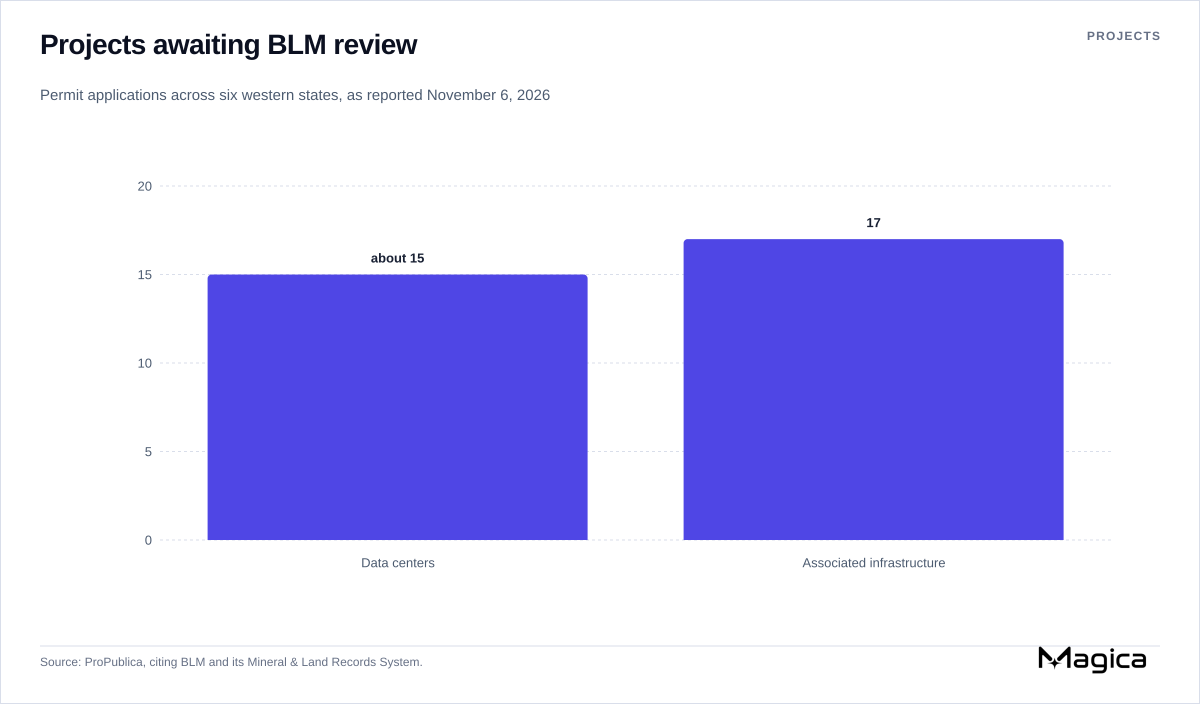
BLM was reviewing applications for about 15 data centers and 17 associated infrastructure projects across six western states. These are proposals, not operating facilities or approved capacity. Source: ProPublica.
The investigation identifies investments held by officials elsewhere in the approval system. BLM director Steve Pearce, a former New Mexico representative whose career included oil and gas, disclosed stakes in large technology companies and Titan Development, a real estate business involved in southwestern data center land acquisitions. He pledged to divest many AI investments, but not Titan. An agency spokesperson said Pearce complies with federal ethics requirements and disputed equating disclosed holdings with an actual conflict.
Michael Boren, an Agriculture undersecretary overseeing the Forest Service after serving as an acting Interior assistant secretary, disclosed an investment of up to $500,000 in Valar Atomics. The investigation describes that company’s proposed Project Beehive, a data center and nuclear-power complex on thousands of acres of BLM land in Utah. This is a proposed development, not installed generating capacity. Agriculture said Boren had complied with federal ethics requirements and would continue following its ethics attorneys’ advice.
Environmental Protection Agency administrator Lee Zeldin disclosed buying and selling up to $15,000 in shares of Datavault AI, a seller of AI, data and blockchain products, in May 2025. The agency said its ethics officials cleared him. Separately, the investigation reports that the EPA proposed a rule in July to remove a public-feedback requirement for certain state air-permit decisions, including for data centers; Democratic senators asked it to withdraw the proposal in October. That proposed procedural change matters to residents’ ability to participate regardless of whether an investment violates ethics rules.
The Boulder City, Nevada, proposal shows why authorizations still matter. According to the investigation, BLM approved a June change from a permitted solar project to a data center without studying the potential environmental implications. An Interior appeals board subsequently paused the project and returned it for further review.
The financial bargain also remains open. Interior told the investigation it was relying on the foundational 1976 federal land-management law to permit data centers, although that law did not envision them. A department spokesperson said the main charge appeared set to be annual fair-market-value rent. The report contrasts that approach with production-based royalties for oil and gas and per-megawatt charges for solar projects. Without actual rents and project terms, those different charging mechanisms cannot establish whether taxpayers will receive an adequate return.
The next evidence needed is a connection between specific decisions and specific financial interests: which applicants or policies affect retained holdings, who handles those matters, and what recusals or waivers apply. The permits must also show what developers pay, how electricity and water needs will be met, and what environmental review supports approval. Those records will test whether the safeguards Interior relied on when allowing Burgum to retain his investments remain workable as federal-land data center development advances.
Internet scans and leaked databases expose the spread of ARTEX, a security-testing framework used in cyberattacks. Researchers documented largely autonomous compromises, but the records also show failed cashouts and uncertain counts of independent deployments.
Meta's strategy chief and former CFO is joining Fireworks AI ahead of a reported fundraising push targeting at least a $30 billion valuation. The inference company announced a $17.5 billion valuation in July, making the hire part of a much larger expansion than its older funding figures suggest.
Sand.ai says its $200 million Series A+ round lifts its valuation above $1 billion. Co-lead investor Wangsu plans inference and deployment cooperation, while its filing shows substantial losses behind the startup’s video AI ambitions.
Microsoft is evaluating fewer neocloud partners while expanding its own infrastructure. Delivery-dependent contracts underpin supplier financing, while IREN reports rising revenue alongside a $6 billion funding target for its broader expansion.
Physical Superintelligence says its AI system found a proof of a conjecture limiting quantum query advantages on random inputs. Public proof files enable scrutiny, but do not establish the private system’s cost or repeatability.
OpenAI is expanding its relationship with Hacktron, whose researchers previously reported an attack chain into employee accounts, to test third-party connections with greater access to cybersecurity models.
Google has acquired Crusoe’s southeast Wyoming data center site, where it plans a long-term $17 billion investment. Crusoe describes completed pre-development work; independent reporting points to customer setbacks. Power delivery and carbon capture remain key tests.
The team behind document-parsing service SoMark has released OXR-1.0 code and weights. A benchmark retest supports a strong result, but speed and accuracy were measured separately, and users above funding or revenue thresholds need a commercial license.
OpenAI is reportedly developing a Business Hub with daily mention and click charts, product updates and business agents. The unannounced feature could give verified businesses direct visibility into ChatGPT responses, without revealing prompts or competitor rankings.
Palantir and Nvidia have specified an integrated stack for running AI in customer-controlled environments. The architecture builds on existing software and infrastructure offerings, with published configurations spanning 32 to 640 GPUs, while pricing and workload economics remain unproven in the launch materials.
Democrats’ incoming congressional majorities put hearings and investigations within reach, but AI rules and crypto legislation still face bipartisan bargaining and a Republican president.
Microsoft reportedly declined to renew Oracle server rentals as older chips became less useful to it. The decision comes despite continuing capacity shortages, while Oracle says demand for earlier-generation GPUs remains strong.
An investigation puts Nvidia’s future commitments and guarantees at $530.5 billion. Its disclosures show rapidly expanding supplier commitments and phased support for customers whose infrastructure could generate further chip sales, with cash payments depending on timing, demand and contract terms.
TSMC is reportedly planning a possible move into 3D DRAM at Nvidia’s request. The foundry already helps integrate AI processors with memory, but a manufacturing expansion has no disclosed factory or production date.
Physicl has raised a $10 million seed round and introduced Studio, a beta app for generating targeted physical AI data. Its reported customer gains concern 3D reconstruction, leaving broader robot reliability and commercial economics to be demonstrated.
New cloud partners in Southeast Asia must enroll in Nvidia’s Fleet Intelligence system, according to a report, linking preferred chip access to monitoring while leaving data sharing and existing partners’ obligations unresolved.
Airbnb sold intellectual property to a private AI lab controlled by CEO Brian Chesky in a $7.1 million arrangement that also reimburses expenses. It obtained a license to certain lab technology and future investment rights, but disclosed no asset valuation or detailed license terms.
Chip shares recovered part of Thursday’s losses in early Friday trading. Fears about data-centre construction face a test against AI-chip supplier Nvidia’s strong reported sales, growth forecast and conditional infrastructure-financing plans.
SoftBank shares fell 10.8% as default-insurance costs reached a four-year high. Delayed listings and unfinished data centers complicate its AI investment outlook, while a $40 billion bridge facility has a March 2027 maturity and a repayment plan based on existing assets and other financing.
U.S. prosecutors allege a global fraud combined AI impersonation, sham confidential deals and cryptocurrency laundering. A blocked bank transfer shows why convincing an employee and moving the money are separate hurdles.