Editorial Team
8 min read
An investigation puts Nvidia’s future commitments and guarantees at $530.5 billion. Its disclosures show rapidly expanding supplier commitments and phased support for customers whose infrastructure could generate further chip sales, with cash payments depending on timing, demand and contract terms.
Nvidia is committing money on both sides of the AI infrastructure market: securing components for the systems it sells while helping customers obtain the facilities to run them. Customer demand consequently matters to more than chip revenue—it also affects investment values and whether support agreements require payments.
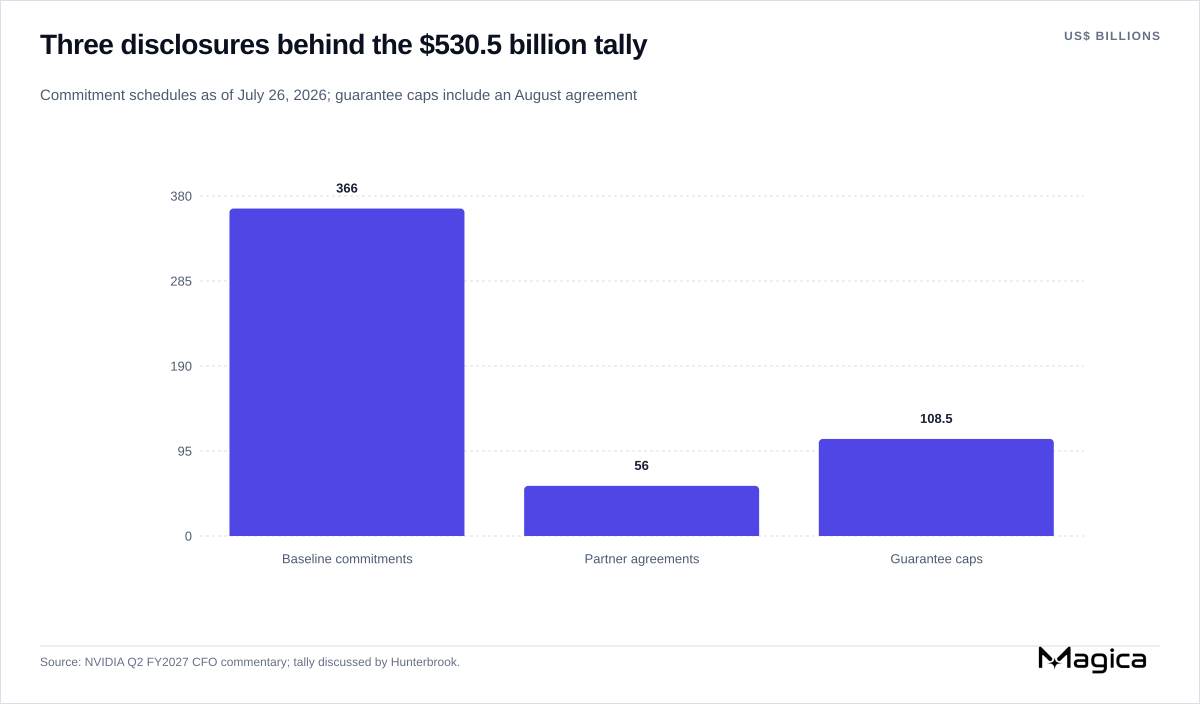
Magica chart of company-reported commitments and guarantee caps. The schedules span different dates and payment conditions; they do not measure debt or expected losses. Source: NVIDIA CFO commentary.
Hunterbrook, an investigative publisher with an affiliated investment fund, puts Nvidia’s future commitments and guarantees at $530.5 billion in its November 6 investigation. It says it mapped financial relationships from filings, contracts and reporting and checked them against Nvidia’s disclosures. Hunterbrook Capital disclosed no positions related to the article at publication, while reserving the ability to change positions.
Nvidia supplies computing platforms combining processors, networking, software and systems. Its expansion beyond graphics has a long history: a 2021 investor presentation dates its move into scientific computing through the CUDA architecture to 2006. It now has a direct commercial stake in whether AI developers and cloud providers can finance and deploy more computing capacity.
The investigation’s tally can be reconciled to three sets of figures in Nvidia’s second-quarter fiscal 2027 CFO commentary:
| Category | Disclosed amount | Scope |
|---|---|---|
| Supply and capacity | $279 billion | Future supplier commitments |
| Cloud service agreements | $29 billion | Nvidia’s research and development infrastructure |
| Data-center leases not yet commenced | $25 billion | Nvidia’s infrastructure; terms up to 20 years |
| Equity investments | $25 billion | Future investments, subject to contingencies |
| Capital expenditures | $8 billion | Future spending commitments |
| AI-cloud agreements | $36 billion | Additional partner arrangements |
| Data-center leases for third parties, not yet commenced | $20 billion | Approximately 15-year leases Nvidia expects to reassign |
| Land, power and building-shell guarantees | $108.5 billion | Maximum gross exposure |
The first five categories total $366 billion; the next two total $56 billion. Adding $108.5 billion in guarantees produces $530.5 billion. The ordinary schedules are dated July 26, 2026, but the guarantee total includes a deal signed in August. This is a combined measure across dates, rather than a single quarter-end balance.
It does not measure debt or expected losses. Purchases secure inputs, leases provide infrastructure, investments buy ownership stakes, and guarantees cover specified failures. Their economic costs and potential returns differ. Nvidia says the ordinary cloud and lease commitments support its own research, engineering and product development; the additional agreements support partner infrastructure.
Timing also changes the interpretation. Nvidia schedules $120 billion of the $366 billion for the remainder of fiscal 2027, $100 billion for fiscal 2028 and $98 billion for fiscal 2029. Together that is $318 billion, or about 87% of this schedule, through fiscal 2029. The separate $56 billion partner schedule extends further: $26 billion falls in fiscal 2032 and later. These amounts are not all immediately payable.
Nvidia says its supply and capacity commitments rose from $119 billion to $279 billion in one quarter, primarily to procure memory. That is about 2.3 times the earlier amount. Its stated purpose is to secure critical components for demand over the next several years.
The investigation notes a qualification in Nvidia’s disclosures: some agreements can be canceled, rescheduled or adjusted before firm orders are placed. It says Nvidia does not disclose the share that is firm. That leaves an unresolved distinction between capacity reserved for growth and spending the company cannot avoid if growth disappoints.
Customer support has a different rationale. Nvidia says AI-cloud providers and model developers are growing faster than their balance sheets and long-term credit profiles can support. Its arrangements help selected customers secure land, power and data-center capacity. The company says it earns revenue from upfront infrastructure sales and may receive a share of cloud providers’ revenue from third-party customers if specified criteria are met.
The August analysis of Nvidia’s disclosures also describes company memorandums of understanding with financing providers for more than $500 billion of third-party capital over time. That is a separate financing ambition, not another $500 billion of Nvidia spending to add to the tally.
The overlap is clearest at CoreWeave, an AI-cloud provider that rents computing capacity to other businesses. According to the investigation, Nvidia invested $2 billion in CoreWeave at the start of 2026 and separately agreed to buy up to $6.3 billion of capacity CoreWeave cannot sell to others.
Nvidia-backed AI software companies Mistral and Cohere also use Nvidia chips and rent CoreWeave capacity, the investigation says. Its concern is that a failure at either could reduce Nvidia’s investment value, weaken chip demand and remove a CoreWeave customer—potentially increasing the capacity Nvidia must buy. Conversely, selling that capacity to other customers can reduce the need for the backstop. An investment relationship alone does not establish that sales are circular.
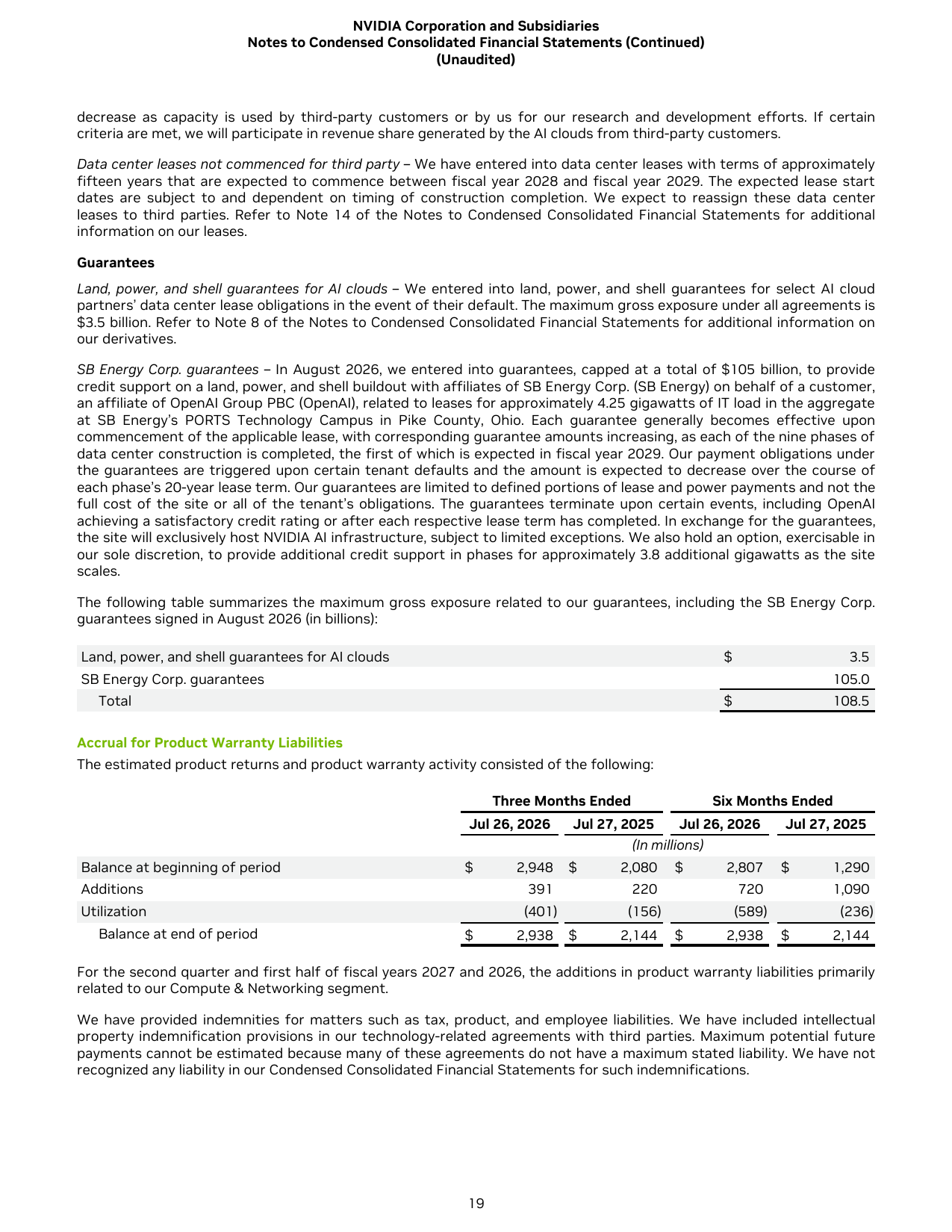
Nvidia’s company-reported guarantee terms and exposure table, from page 19 of its quarterly filing. The Ohio guarantees take effect in phases. Source: Hunterbrook.
The biggest guarantee in the tally supports the PORTS-Pike Technology Campus in Ohio, developed by SB Energy for AI model developer OpenAI. Nvidia’s CFO commentary says its August agreement provides credit support for land, power and building shells for approximately 4.25 gigawatts of capacity under 20-year leases to OpenAI.
The $105 billion cap is not a payment due today. Nvidia says the guarantees become effective in phases as conditions are met, including data centers becoming ready for service, with the first expected in fiscal 2029. Exposure declines as OpenAI makes lease payments. Nvidia also has an option to support approximately 3.8 additional gigawatts; that optional expansion is distinct from the initial arrangement.
The sales incentive is explicit. Subject to limited exceptions, the campus will exclusively host Nvidia infrastructure. Nvidia estimates each generation deployed there could involve roughly 1.5 million of its graphics processing units, or GPUs, representing approximately $150 billion to $200 billion in company revenue. It expects multiple upgrade cycles over 20 years. These are company projections, not booked sales or guaranteed returns, but they explain why Nvidia would help a customer obtain infrastructure on this scale.
The site illustrates two separate risks: whether facilities become operational on schedule, and whether the tenant keeps paying once they do. The investigation also relays Nvidia’s warning that customers may delay purchases of new architectures when data-center infrastructure is unavailable. Demand for chips alone cannot resolve a shortage of usable facilities.
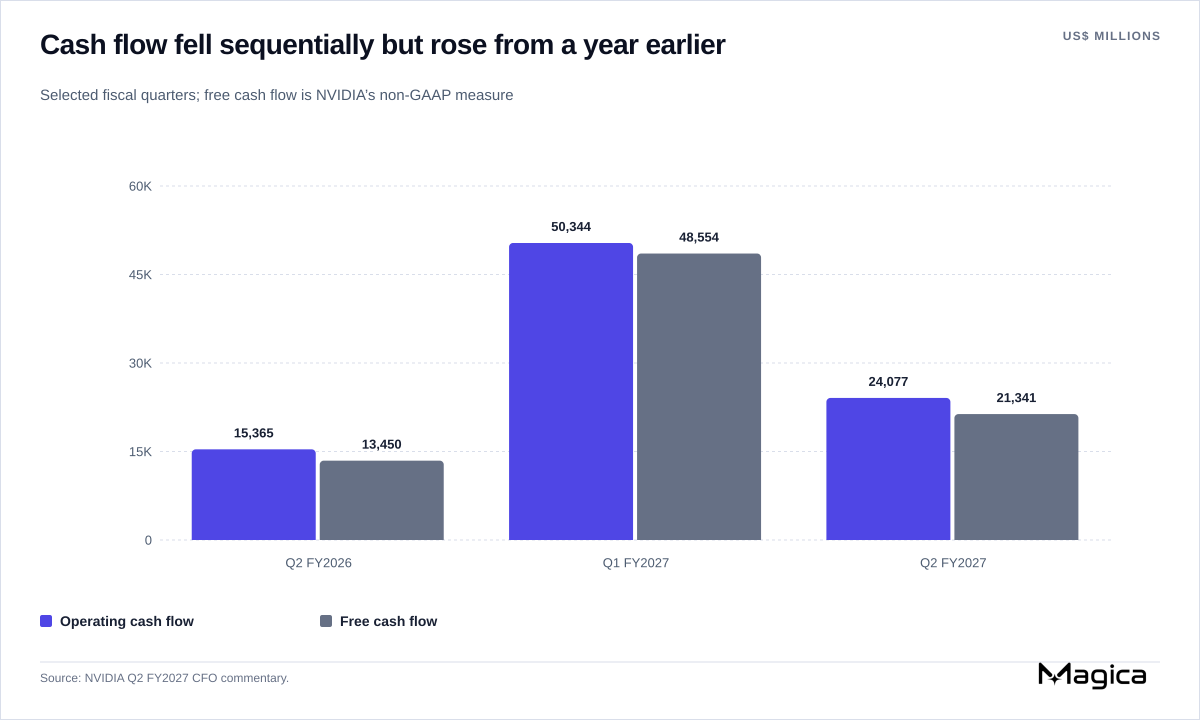
Magica chart of company-reported operating and free cash flows. Both declined sequentially but increased year over year; free cash flow is Nvidia’s non-GAAP measure. Source: NVIDIA CFO commentary.
Nvidia’s reported results provide a counterweight to the commitment totals. In its results for the quarter ended July 26, revenue reached $96.2 billion, up 106% from a year earlier. Data-center revenue was $89.0 billion, up 117%, or about 93% of total revenue. The business is expanding rapidly while remaining heavily exposed to the data-center market.
The same CFO commentary shows why earnings and available cash deserve separate attention. Nvidia reported $59.7 billion in net income and $24.1 billion in operating cash flow. Separately, its income statement included $7.8 billion in net equity-securities gains before tax. Operating cash flow rose from $15.4 billion a year earlier but fell from $50.3 billion in the preceding quarter; Nvidia attributed the sequential decline to working-capital adjustments and cash taxes.
Free cash flow, the company’s non-GAAP measure subtracting specified capital purchases and principal payments from operating cash flow, was $21.3 billion, compared with $48.6 billion a quarter earlier and $13.5 billion a year earlier. Both comparisons matter: the sequential fall does not erase year-over-year growth.
Accounts receivable reached $63.1 billion, with days sales outstanding rising from 45 in the preceding quarter to 60. Nvidia attributed this to extended payment terms on large, multi-quarter agreements with certain investment-grade customers. It ended the quarter with $56.6 billion in cash, cash equivalents and marketable debt securities and had issued $25 billion of senior unsecured notes during the quarter. These figures show financing resources and slower collection alongside the expansion; they do not establish a funding shortfall.
The investigation separately identifies roughly $99 billion in equity holdings and $235 billion of remaining share-buyback authorization. Neither belongs on top of the $530.5 billion as another contractual obligation: existing holdings differ from future investment commitments, and buyback authorization differs from required spending.
The next evidence needed is how much supplier spending remains adjustable, how quickly customers absorb cloud capacity, and which conditions activate guarantees. The aggregate cannot answer how much cash Nvidia will ultimately pay or what it will earn in return.
Competition also matters. The investigation identifies Google’s TPU and Amazon’s Trainium as alternatives to Nvidia chips. Mapping Nvidia’s financial relationships does not establish that all future AI infrastructure spending will flow back to it.
The investigation says its tally excludes later deals, including a preliminary arrangement for Nvidia to invest up to $100 billion in OpenAI in installments tied to chip orders. That proposal adds a question about future financing; it is not completed spending to fold silently into the earlier total.
For Ohio, the concrete milestones are facilities becoming ready for service, guarantees taking effect, OpenAI making lease payments and Nvidia converting projected deployments into sales. Those outcomes will show whether support for a customer becomes profitable demand, a continuing contingent exposure or an actual cash cost.
Internet scans and leaked databases expose the spread of ARTEX, a security-testing framework used in cyberattacks. Researchers documented largely autonomous compromises, but the records also show failed cashouts and uncertain counts of independent deployments.
Meta's strategy chief and former CFO is joining Fireworks AI ahead of a reported fundraising push targeting at least a $30 billion valuation. The inference company announced a $17.5 billion valuation in July, making the hire part of a much larger expansion than its older funding figures suggest.
Sand.ai says its $200 million Series A+ round lifts its valuation above $1 billion. Co-lead investor Wangsu plans inference and deployment cooperation, while its filing shows substantial losses behind the startup’s video AI ambitions.
An advocacy group estimates Interior Secretary Doug Burgum’s AI holdings at $18.1 million–$64.4 million as his department advances data centers on public land. His ethics agreement allows retained investments with recusals, while pending permits will determine both the application of those safeguards and the public’s return. Interior denies his decisions are driven by personal investments.
Microsoft is evaluating fewer neocloud partners while expanding its own infrastructure. Delivery-dependent contracts underpin supplier financing, while IREN reports rising revenue alongside a $6 billion funding target for its broader expansion.
Physical Superintelligence says its AI system found a proof of a conjecture limiting quantum query advantages on random inputs. Public proof files enable scrutiny, but do not establish the private system’s cost or repeatability.
OpenAI is expanding its relationship with Hacktron, whose researchers previously reported an attack chain into employee accounts, to test third-party connections with greater access to cybersecurity models.
Google has acquired Crusoe’s southeast Wyoming data center site, where it plans a long-term $17 billion investment. Crusoe describes completed pre-development work; independent reporting points to customer setbacks. Power delivery and carbon capture remain key tests.
The team behind document-parsing service SoMark has released OXR-1.0 code and weights. A benchmark retest supports a strong result, but speed and accuracy were measured separately, and users above funding or revenue thresholds need a commercial license.
OpenAI is reportedly developing a Business Hub with daily mention and click charts, product updates and business agents. The unannounced feature could give verified businesses direct visibility into ChatGPT responses, without revealing prompts or competitor rankings.
Palantir and Nvidia have specified an integrated stack for running AI in customer-controlled environments. The architecture builds on existing software and infrastructure offerings, with published configurations spanning 32 to 640 GPUs, while pricing and workload economics remain unproven in the launch materials.
Democrats’ incoming congressional majorities put hearings and investigations within reach, but AI rules and crypto legislation still face bipartisan bargaining and a Republican president.
Microsoft reportedly declined to renew Oracle server rentals as older chips became less useful to it. The decision comes despite continuing capacity shortages, while Oracle says demand for earlier-generation GPUs remains strong.
TSMC is reportedly planning a possible move into 3D DRAM at Nvidia’s request. The foundry already helps integrate AI processors with memory, but a manufacturing expansion has no disclosed factory or production date.
Physicl has raised a $10 million seed round and introduced Studio, a beta app for generating targeted physical AI data. Its reported customer gains concern 3D reconstruction, leaving broader robot reliability and commercial economics to be demonstrated.
New cloud partners in Southeast Asia must enroll in Nvidia’s Fleet Intelligence system, according to a report, linking preferred chip access to monitoring while leaving data sharing and existing partners’ obligations unresolved.
Airbnb sold intellectual property to a private AI lab controlled by CEO Brian Chesky in a $7.1 million arrangement that also reimburses expenses. It obtained a license to certain lab technology and future investment rights, but disclosed no asset valuation or detailed license terms.
Chip shares recovered part of Thursday’s losses in early Friday trading. Fears about data-centre construction face a test against AI-chip supplier Nvidia’s strong reported sales, growth forecast and conditional infrastructure-financing plans.
SoftBank shares fell 10.8% as default-insurance costs reached a four-year high. Delayed listings and unfinished data centers complicate its AI investment outlook, while a $40 billion bridge facility has a March 2027 maturity and a repayment plan based on existing assets and other financing.
U.S. prosecutors allege a global fraud combined AI impersonation, sham confidential deals and cryptocurrency laundering. A blocked bank transfer shows why convincing an employee and moving the money are separate hurdles.