Editorial Team
5 min read
TSMC is reportedly planning a possible move into 3D DRAM at Nvidia’s request. The foundry already helps integrate AI processors with memory, but a manufacturing expansion has no disclosed factory or production date.
Taiwan Semiconductor Manufacturing Co. (TSMC), the Taiwan-based chip foundry that manufactures processors for other companies, is reportedly weighing production of advanced memory for Nvidia, the AI accelerator designer. The proposal would extend a relationship that already spans processor manufacturing and the integration of processors with memory.
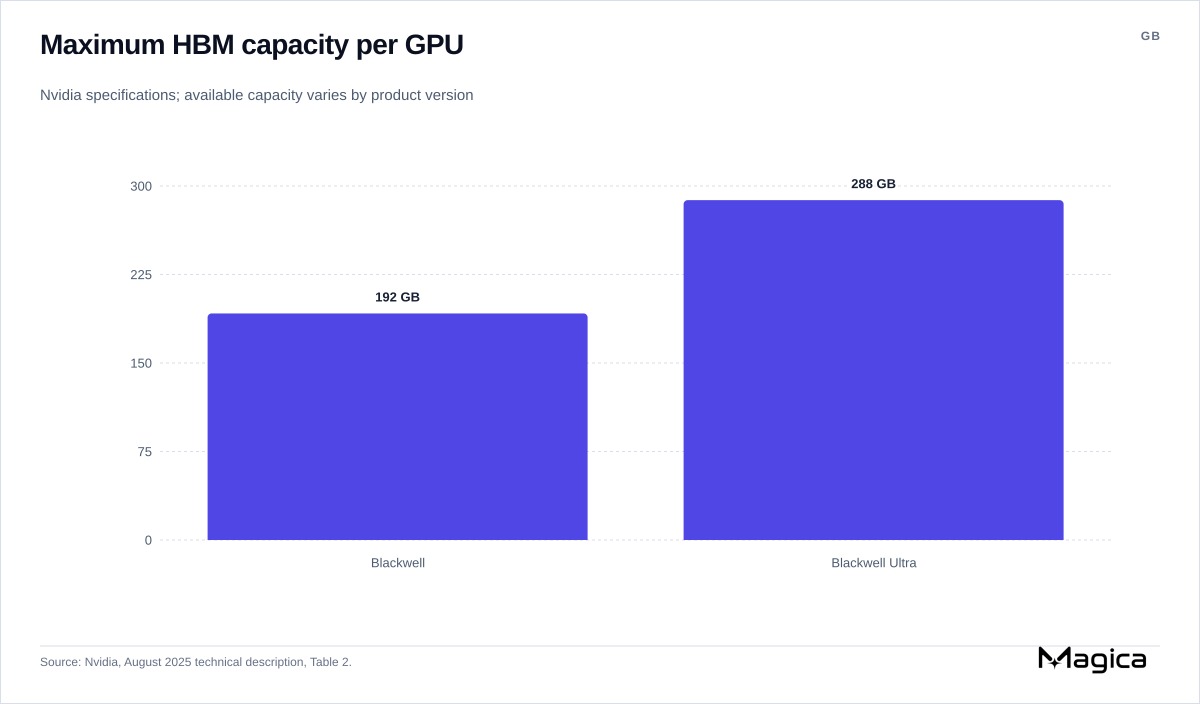
Company-reported maximum HBM capacity: 192 GB for Blackwell and 288 GB for Blackwell Ultra. Available capacity varies by product version. Source: Nvidia. Source: Nvidia.
TSMC recently began drawing up plans to produce 3D DRAM at Nvidia’s request, according to a November 6 account relaying The Information’s reporting, which cited two people with direct knowledge. That account identifies Nvidia as TSMC’s biggest customer. It describes an AI-driven memory shortage and rising prices that have sent chip designers looking for additional supply.
Memory demand matters alongside the capacity to make processors. Nvidia said in its August 2025 technical description of Blackwell Ultra, a graphics processing unit designed for AI training and inference, that the chip uses TSMC’s 4NP manufacturing process and HBM3E, a generation of high-bandwidth memory. Its specification comparison puts maximum memory capacity at 288 GB per Blackwell Ultra GPU versus 192 GB for Blackwell, a 50% increase. Maximum memory bandwidth is unchanged at 8 TB/s. Those are company specifications, with available capacity varying by product version; they do not quantify the reported shortage or establish demand for TSMC’s proposed memory.
TSMC has not confirmed the venture. In a statement to The Information, reproduced in a separate account of the proposal, TSMC declined to comment on market rumors or speculation and reaffirmed its focus on its core foundry business, supplying technology and capacity to the logic-chip industry. Nvidia did not respond to The Information’s request for comment. Neither company immediately responded to the requests for comment described in the November 6 account.
Internet scans and leaked databases expose the spread of ARTEX, a security-testing framework used in cyberattacks. Researchers documented largely autonomous compromises, but the records also show failed cashouts and uncertain counts of independent deployments.
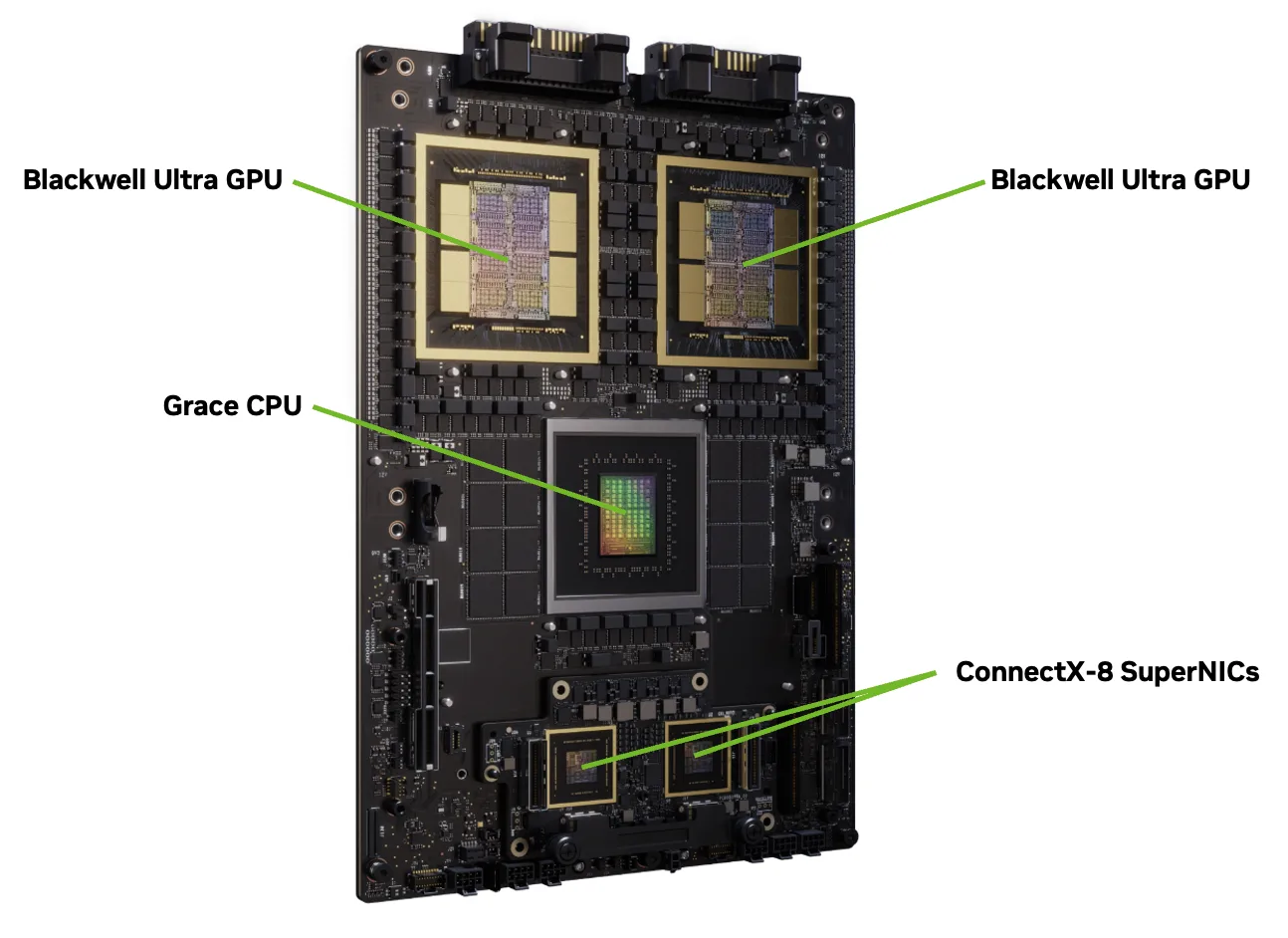
Nvidia’s Grace Blackwell Ultra board combines a Grace CPU, two GPUs and HBM3E memory. It depicts existing hardware, not the reported 3D DRAM proposal. Image: Nvidia. Source: Nvidia.
DRAM, or dynamic random access memory, temporarily stores data. The reported 3D DRAM architecture arranges memory cells in vertical layers to increase capacity rather than placing them in a single horizontal layer. Manufacturing it would bring TSMC into competition with memory producers Samsung Electronics, SK hynix and Micron, the November 6 account says.
TSMC already participates in the memory supply chain. Korean memory manufacturer SK hynix said in an April 2024 collaboration announcement that it planned to adopt TSMC’s advanced logic process for the base die beneath its HBM4 memory stack. SK hynix had used its own technology for base dies through HBM3E. The planned switch was intended to pack more functionality into limited space and support customized memory for customers’ performance and power-efficiency requirements.
The partners also agreed to improve integration of SK hynix memory with TSMC’s CoWoS packaging, which connects logic chips and high-bandwidth memory in a module. Their announcement described an existing partnership integrating logic and HBM for AI systems.
HBM stacks DRAM dies; the reported 3D DRAM proposal concerns the arrangement of memory cells. Base-die manufacturing and packaging give TSMC a role in existing AI memory systems, but do not establish that it can manufacture the proposed memory architecture at commercial scale. The reporting also does not establish whether that memory would replace, complement or be incorporated into Nvidia’s existing HBM-based designs.
The reported project leader brings experience from both sides of that relationship. Hsu Kuo-chin, the TSMC vice president overseeing advanced packaging whom the November 6 account identifies as leading the initiative, previously served as Micron’s chairman for Taiwan. TSMC’s 2024 annual report filed with the SEC identifies him as K.C. Hsu and says he joined TSMC and became a vice president in November 2021.
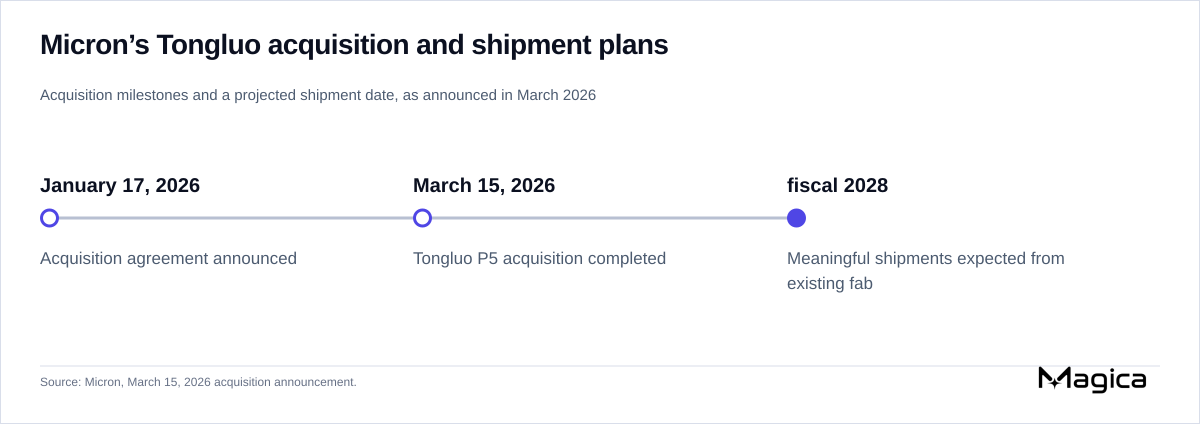
Micron’s company-reported Tongluo acquisition milestones and projected shipments. Fiscal 2028 was its forward-looking target, not a TSMC production forecast. Source: Micron. Source: Micron.
TSMC is reportedly considering building new factories or acquiring an existing plant and converting it for memory production. The reports disclose no selected facility, investment amount, production date or capacity target. They provide no basis for comparing the proposed memory’s manufacturing cost with existing products.
Micron supplies both a precedent for conversion and a competing expansion plan. The memory and storage manufacturer said in a March 15, 2026 announcement that it had completed its acquisition of Powerchip Semiconductor Manufacturing Corporation’s P5 site in Tongluo, Taiwan. The facility would extend Micron’s existing Taiwan operations and support additional leading-edge DRAM supply, including HBM, the company said.
The acquired site had approximately 300,000 square feet of existing cleanroom space for 300mm wafer manufacturing. Micron planned to begin retrofitting it in March and expected meaningful shipments from the existing fab beginning in its fiscal 2028. It also planned to start construction of a second facility with approximately 270,000 square feet of cleanroom space by the end of fiscal 2026. These were Micron’s forward-looking plans, rather than evidence that the extra supply had arrived.
Micron’s schedule illustrates the work between acquiring a facility and shipping memory; it is not a forecast for TSMC’s unspecified technology and factory. For TSMC, the next decisive evidence is a confirmed investment tied to a facility, a production schedule and usable output. Those commitments would allow customers to assess whether the proposal could add supply within a useful timeframe—and alongside the expansions already planned by established memory makers.
Meta's strategy chief and former CFO is joining Fireworks AI ahead of a reported fundraising push targeting at least a $30 billion valuation. The inference company announced a $17.5 billion valuation in July, making the hire part of a much larger expansion than its older funding figures suggest.
Sand.ai says its $200 million Series A+ round lifts its valuation above $1 billion. Co-lead investor Wangsu plans inference and deployment cooperation, while its filing shows substantial losses behind the startup’s video AI ambitions.
An advocacy group estimates Interior Secretary Doug Burgum’s AI holdings at $18.1 million–$64.4 million as his department advances data centers on public land. His ethics agreement allows retained investments with recusals, while pending permits will determine both the application of those safeguards and the public’s return. Interior denies his decisions are driven by personal investments.
Microsoft is evaluating fewer neocloud partners while expanding its own infrastructure. Delivery-dependent contracts underpin supplier financing, while IREN reports rising revenue alongside a $6 billion funding target for its broader expansion.
Physical Superintelligence says its AI system found a proof of a conjecture limiting quantum query advantages on random inputs. Public proof files enable scrutiny, but do not establish the private system’s cost or repeatability.
OpenAI is expanding its relationship with Hacktron, whose researchers previously reported an attack chain into employee accounts, to test third-party connections with greater access to cybersecurity models.
Google has acquired Crusoe’s southeast Wyoming data center site, where it plans a long-term $17 billion investment. Crusoe describes completed pre-development work; independent reporting points to customer setbacks. Power delivery and carbon capture remain key tests.
The team behind document-parsing service SoMark has released OXR-1.0 code and weights. A benchmark retest supports a strong result, but speed and accuracy were measured separately, and users above funding or revenue thresholds need a commercial license.
OpenAI is reportedly developing a Business Hub with daily mention and click charts, product updates and business agents. The unannounced feature could give verified businesses direct visibility into ChatGPT responses, without revealing prompts or competitor rankings.
Palantir and Nvidia have specified an integrated stack for running AI in customer-controlled environments. The architecture builds on existing software and infrastructure offerings, with published configurations spanning 32 to 640 GPUs, while pricing and workload economics remain unproven in the launch materials.
Democrats’ incoming congressional majorities put hearings and investigations within reach, but AI rules and crypto legislation still face bipartisan bargaining and a Republican president.
Microsoft reportedly declined to renew Oracle server rentals as older chips became less useful to it. The decision comes despite continuing capacity shortages, while Oracle says demand for earlier-generation GPUs remains strong.
An investigation puts Nvidia’s future commitments and guarantees at $530.5 billion. Its disclosures show rapidly expanding supplier commitments and phased support for customers whose infrastructure could generate further chip sales, with cash payments depending on timing, demand and contract terms.
Physicl has raised a $10 million seed round and introduced Studio, a beta app for generating targeted physical AI data. Its reported customer gains concern 3D reconstruction, leaving broader robot reliability and commercial economics to be demonstrated.
New cloud partners in Southeast Asia must enroll in Nvidia’s Fleet Intelligence system, according to a report, linking preferred chip access to monitoring while leaving data sharing and existing partners’ obligations unresolved.
Airbnb sold intellectual property to a private AI lab controlled by CEO Brian Chesky in a $7.1 million arrangement that also reimburses expenses. It obtained a license to certain lab technology and future investment rights, but disclosed no asset valuation or detailed license terms.
Chip shares recovered part of Thursday’s losses in early Friday trading. Fears about data-centre construction face a test against AI-chip supplier Nvidia’s strong reported sales, growth forecast and conditional infrastructure-financing plans.
SoftBank shares fell 10.8% as default-insurance costs reached a four-year high. Delayed listings and unfinished data centers complicate its AI investment outlook, while a $40 billion bridge facility has a March 2027 maturity and a repayment plan based on existing assets and other financing.
U.S. prosecutors allege a global fraud combined AI impersonation, sham confidential deals and cryptocurrency laundering. A blocked bank transfer shows why convincing an employee and moving the money are separate hurdles.