Editorial Team
6 min read
Palantir and Nvidia have specified an integrated stack for running AI in customer-controlled environments. The architecture builds on existing software and infrastructure offerings, with published configurations spanning 32 to 640 GPUs, while pricing and workload economics remain unproven in the launch materials.
Palantir, which builds data and operational software for governments and businesses, unveiled a sovereign AI operating-system reference architecture with Nvidia on March 12, 2026. The design packages Palantir’s applications with the GPU supplier’s computing, networking and AI software for deployments under customer control, according to the launch briefing.
The proposition matters particularly to organizations that cannot freely move sensitive data or tolerate distant computing infrastructure. But running AI locally leaves separate questions about models, software support and supplier dependence. The architecture makes the deployment plan more concrete; the launch materials do not establish its cost advantage.
Palantir began in 2003 building software for U.S. intelligence counterterrorism work before expanding into commercial enterprises. Government customers accounted for 54% of its $4.5 billion in 2025 revenue, with commercial customers supplying the remainder, according to its annual filing. Its experience with sensitive operational systems helps explain its role in this offering.
Foundry, Palantir’s data operations platform, manages data, analytics and workflows. Its Artificial Intelligence Platform, AIP, began deploying in 2023 and connects third-party language models to organizational data and operations. Palantir’s Ontology maps data, logic and actions into a representation of an organization so those models and applications can work with business context.
Nvidia supplies the accelerated computing infrastructure and software beneath those applications. The companies were already working together: Nvidia’s October 28, 2025 announcement described integration of its accelerated computing, CUDA-X libraries and Nemotron models with Palantir’s Ontology. It identified retailer Lowe’s as an early user of that broader stack, creating a digital replica of its supply chain. Nvidia also said then that AIP would be supported in a new AI Factory for Government reference design. Those statements do not establish adoption of the subsequent sovereign reference architecture.
The AI OS Reference Architecture, or AIOS-RA, is tested and qualified to run Palantir’s complete software suite on Nvidia infrastructure, Nvidia says. A reference architecture specifies how components fit together, providing a repeatable design for procurement and deployment.
Palantir’s specifications, described in this account of the launch, combine Blackwell Ultra GPU systems and Spectrum-X Ethernet networking with Nvidia AI Enterprise, CUDA-X acceleration libraries, Nemotron open models and Magnum IO. On the Palantir side, Rubix supplies the zero-trust Kubernetes layer for running containerized services, Apollo manages software deployment and updates, and AIP connects models to operational systems.
Palantir says the design addresses customers with existing GPU infrastructure, latency-sensitive workflows, data-sovereignty requirements and geographically distributed operations, as described in a report on the partnership. The vendors’ claimed benefits include control over data, models and applications, with access restrictions, auditing and privacy safeguards.
The new qualification builds on an established capability. Palantir’s filing already describes Apollo delivering software across cloud, on-premises and rugged environments, and AIP accessing open-source, self-hosted and commercially available language models. The added proposition is a specified integration of that application and management stack with Nvidia infrastructure.
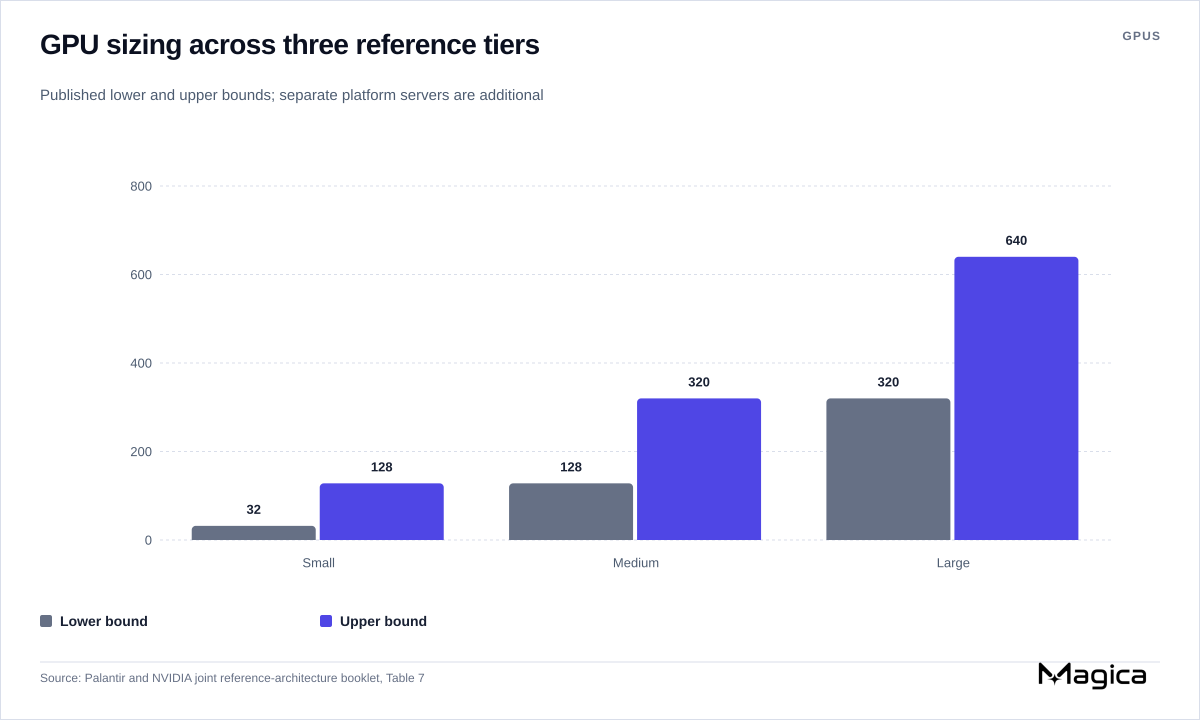
Company-reported AIOS-RA sizing guidance from Palantir and NVIDIA. GPU counts exclude separate platform servers and do not represent measured throughput. Source: Palantir Sovereign AI Operating System Reference Architecture.
The joint reference booklet separates servers running Palantir’s platform from GPU servers handling AI workloads. Its sizing guidance sets out these configurations:
| Reference size | Platform servers | GPU range |
|---|---|---|
| Small | 3 master and 9 worker nodes | 32–128 |
| Medium | 3 master and 21 worker nodes | 128–320 |
| Large | 3 master and 45 worker nodes | 320–640 |
These are design sizes, not customer installation counts or measured throughput. The booklet specifies scalable units of four GPU servers, each containing eight GPUs: 32 GPUs per unit. The eight-GPU system described in launch coverage is therefore a server component, not the entire cluster in the sizing table.
The example uses Dell PowerEdge servers; the booklet recommends sourcing platform and GPU nodes from the same manufacturer, while allowing a choice of server vendors. It permits spreading GPU servers over additional racks if a data center lacks the required power density, and warns that combining the network-switch and platform-server racks can restrict expansion.
Pretested integration may reduce installation work, but it does not settle facilities readiness or operating cost. Palantir’s filing also cautions that implementation can be complex and lengthy, and that its on-premises software licenses depend on ongoing maintenance, support and critical updates. Customer-controlled hardware still requires a sustained software-service relationship.
Nvidia already offers reference designs through server suppliers including Cisco, Dell, HPE, Lenovo and Supermicro. Its portfolio also includes an Enterprise AI Factory validated design that adds a curated software stack to the infrastructure blueprint. Buyers thus have other ways to assemble private AI infrastructure within Nvidia’s ecosystem.
The partnership report also places the agreement alongside Nvidia’s sovereign-AI arrangements with Orange Business and India’s NxtGen. Palantir separately joined Accenture in a deal to help U.K. infrastructure provider Sovereign AI serve commercial and government customers across Europe. These are alternative partnerships, not evidence of equivalent features, prices or performance.
Palantir’s own filing identifies another substitute: customers building their own systems using internal teams, consultants, enterprise software and open-source components. The practical comparison is therefore between different integration and support arrangements, as well as between local infrastructure and cloud services.
Model sourcing adds another dimension. In a CNBC interview described in the contemporaneous launch briefing, Palantir cofounder and chief executive Alexander Karp said the company was still using Claude, AI developer Anthropic’s language-model family, while the U.S. Defense Department planned to phase out Anthropic. He said integration with other language models would probably follow. For a sovereign-AI buyer, approved model supply is a separate procurement question from server location.
The launch materials reviewed provide no package price, customer-specific total cost of ownership or like-for-like benchmark against cloud deployment. They also do not identify a measured customer deployment of this particular architecture. The earlier Lowe’s example does not supply those results for AIOS-RA.
A buyer needs a priced configuration matched to its models, data volumes, users and response-time requirements, including the facilities and support commitment. Representative workload utilization and latency results would show whether the specified capacity delivers useful work economically. Model eligibility, update responsibilities and continued supplier access would establish how much operational control the installation actually provides.
Internet scans and leaked databases expose the spread of ARTEX, a security-testing framework used in cyberattacks. Researchers documented largely autonomous compromises, but the records also show failed cashouts and uncertain counts of independent deployments.
Meta's strategy chief and former CFO is joining Fireworks AI ahead of a reported fundraising push targeting at least a $30 billion valuation. The inference company announced a $17.5 billion valuation in July, making the hire part of a much larger expansion than its older funding figures suggest.
Sand.ai says its $200 million Series A+ round lifts its valuation above $1 billion. Co-lead investor Wangsu plans inference and deployment cooperation, while its filing shows substantial losses behind the startup’s video AI ambitions.
An advocacy group estimates Interior Secretary Doug Burgum’s AI holdings at $18.1 million–$64.4 million as his department advances data centers on public land. His ethics agreement allows retained investments with recusals, while pending permits will determine both the application of those safeguards and the public’s return. Interior denies his decisions are driven by personal investments.
Microsoft is evaluating fewer neocloud partners while expanding its own infrastructure. Delivery-dependent contracts underpin supplier financing, while IREN reports rising revenue alongside a $6 billion funding target for its broader expansion.
Physical Superintelligence says its AI system found a proof of a conjecture limiting quantum query advantages on random inputs. Public proof files enable scrutiny, but do not establish the private system’s cost or repeatability.
OpenAI is expanding its relationship with Hacktron, whose researchers previously reported an attack chain into employee accounts, to test third-party connections with greater access to cybersecurity models.
Google has acquired Crusoe’s southeast Wyoming data center site, where it plans a long-term $17 billion investment. Crusoe describes completed pre-development work; independent reporting points to customer setbacks. Power delivery and carbon capture remain key tests.
The team behind document-parsing service SoMark has released OXR-1.0 code and weights. A benchmark retest supports a strong result, but speed and accuracy were measured separately, and users above funding or revenue thresholds need a commercial license.
OpenAI is reportedly developing a Business Hub with daily mention and click charts, product updates and business agents. The unannounced feature could give verified businesses direct visibility into ChatGPT responses, without revealing prompts or competitor rankings.
Democrats’ incoming congressional majorities put hearings and investigations within reach, but AI rules and crypto legislation still face bipartisan bargaining and a Republican president.
Microsoft reportedly declined to renew Oracle server rentals as older chips became less useful to it. The decision comes despite continuing capacity shortages, while Oracle says demand for earlier-generation GPUs remains strong.
An investigation puts Nvidia’s future commitments and guarantees at $530.5 billion. Its disclosures show rapidly expanding supplier commitments and phased support for customers whose infrastructure could generate further chip sales, with cash payments depending on timing, demand and contract terms.
TSMC is reportedly planning a possible move into 3D DRAM at Nvidia’s request. The foundry already helps integrate AI processors with memory, but a manufacturing expansion has no disclosed factory or production date.
Physicl has raised a $10 million seed round and introduced Studio, a beta app for generating targeted physical AI data. Its reported customer gains concern 3D reconstruction, leaving broader robot reliability and commercial economics to be demonstrated.
New cloud partners in Southeast Asia must enroll in Nvidia’s Fleet Intelligence system, according to a report, linking preferred chip access to monitoring while leaving data sharing and existing partners’ obligations unresolved.
Airbnb sold intellectual property to a private AI lab controlled by CEO Brian Chesky in a $7.1 million arrangement that also reimburses expenses. It obtained a license to certain lab technology and future investment rights, but disclosed no asset valuation or detailed license terms.
Chip shares recovered part of Thursday’s losses in early Friday trading. Fears about data-centre construction face a test against AI-chip supplier Nvidia’s strong reported sales, growth forecast and conditional infrastructure-financing plans.
SoftBank shares fell 10.8% as default-insurance costs reached a four-year high. Delayed listings and unfinished data centers complicate its AI investment outlook, while a $40 billion bridge facility has a March 2027 maturity and a repayment plan based on existing assets and other financing.
U.S. prosecutors allege a global fraud combined AI impersonation, sham confidential deals and cryptocurrency laundering. A blocked bank transfer shows why convincing an employee and moving the money are separate hurdles.