Editorial Team
5 min read
JEDEC’s DDR6 preview targets faster transfers, a 96-bit data bus and 74mm modules, with server memory density a central goal. The design remains provisional, with no confirmed launch schedule or application benchmarks.
JEDEC Solid State Technology Association, the industry body developing the successor to DDR5 main memory, has outlined plans for DDR6 to deliver more than 50% higher bandwidth at introduction and use substantially shorter modules. Its November 18, 2026 preview describes development targets, subject to approval, rather than a finished standard or product launch.
The plans emphasize servers and data centers, including AI inference and agentic AI workloads that JEDEC says need more capacity and performance close to the CPU. Higher chip density and smaller modules could help systems accommodate more memory; higher transfer rates alone would not address that constraint.
JEDEC develops microelectronics standards through volunteers representing more than 400 member companies. Those members receive early access to proposals and can influence projects such as DDR6. The announcement therefore signals a shared engineering direction, while remaining subject to changes and possible disapproval by JEDEC’s board.
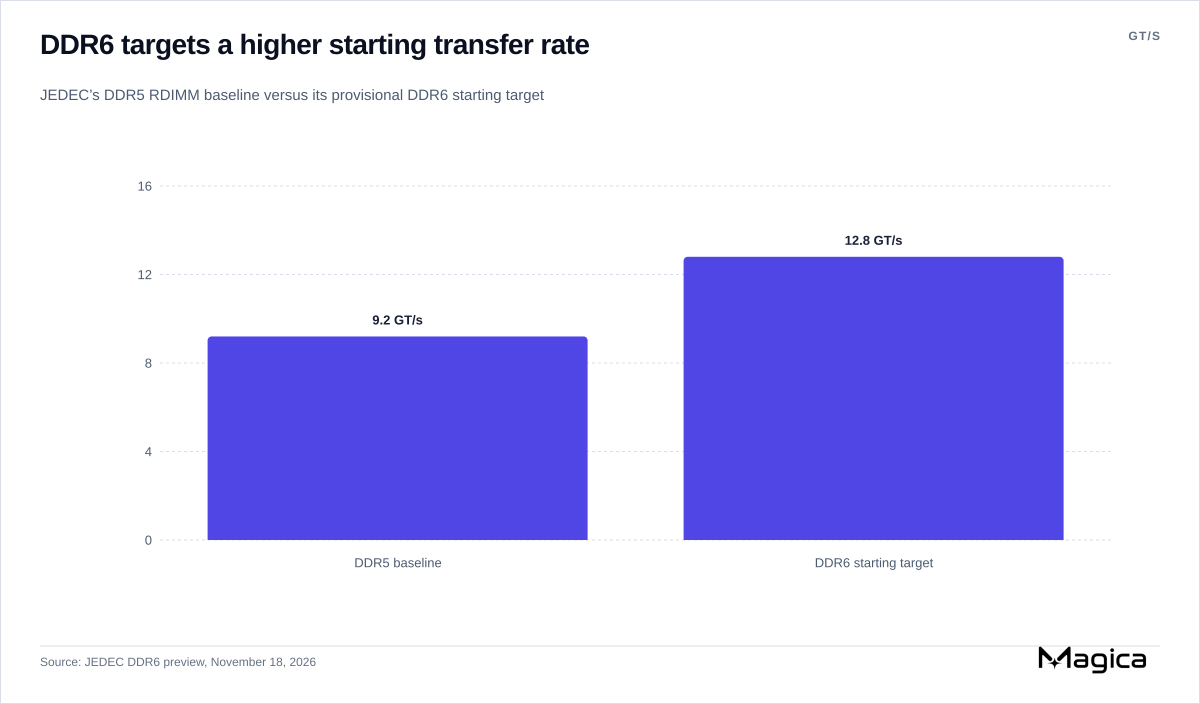
JEDEC proposes a 12.8 GT/s starting rate for DDR6 RDIMMs against its 9.2 GT/s DDR5 baseline. The provisional targets do not establish equivalent application performance gains. Source: JEDEC.
JEDEC plans an initial data rate of 12.8 billion transfers per second for registered memory modules, or RDIMMs, compared with the 9.2 GT/s DDR5 RDIMM baseline in its announcement. Its roadmap extends to 14.4 GT/s and beyond. The data bus would widen from 64 to 96 data lines, an increase of 50%.
The association targets more than 50% higher bandwidth at introduction from the combination of higher transfer rates and a wider bus. It explicitly separates that target from any claim that applications will run proportionately faster. These are proposed interface capabilities, with no application benchmark results in the preview.
Hunterbrook says IEIT Systems incorporated newer AMD firmware after its U.S. blacklisting, raising questions about software transfers and affiliated server vendors. The reporting does not establish how the code arrived or whether transfers were licensed, and Hunterbrook’s affiliated investment firm disclosed a short position in AMD.
Other architectural changes aim to make that interface more productive. Memory access would be organized into pseudo-channels to improve bandwidth per DRAM package and permit more flexible reliability configurations. Twice the bank count and improved refresh are intended to keep the data bus working more efficiently at higher speeds and capacities. Together, these plans address how memory is accessed as well as its headline transfer rate.
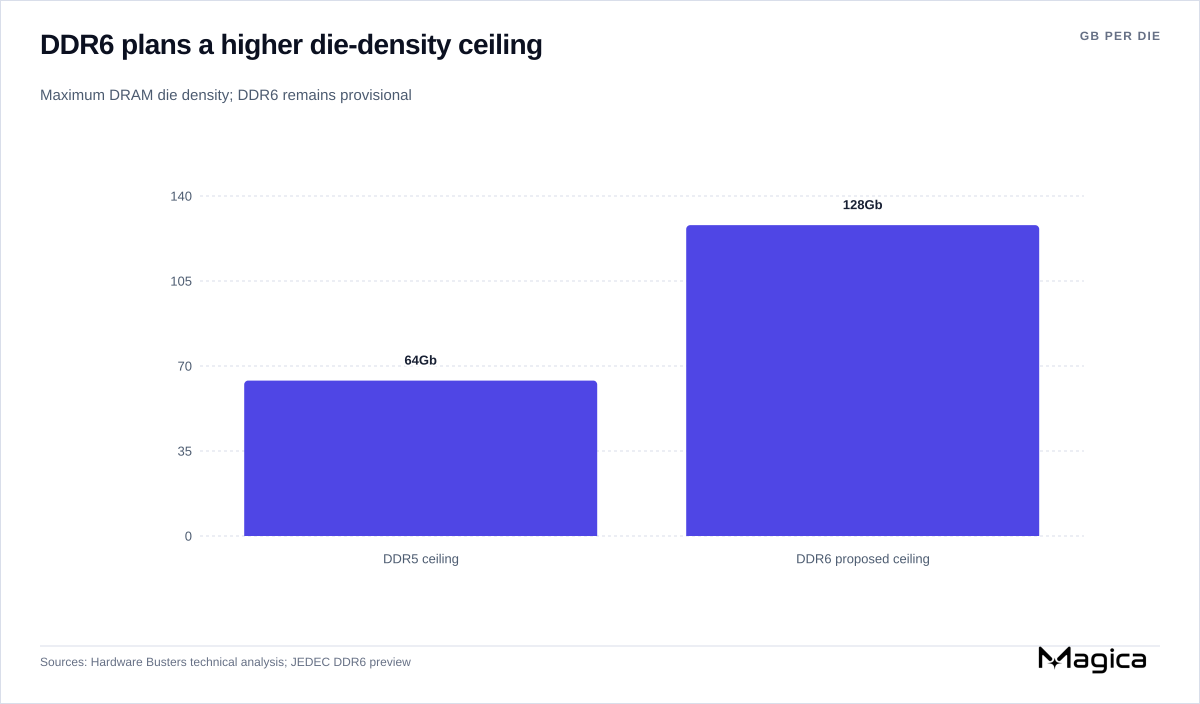
DDR6’s proposed die-density ceiling is 128Gb, compared with DDR5’s reported 64Gb ceiling. These are individual die limits, not announced module capacities. Source: Hardware Busters.
JEDEC’s proposed module length falls from 133mm for DDR5 to 74mm for DDR6. That is approximately a 44% reduction, calculated from the dimensions in its announcement. The association says the compact footprint is intended to help increase system memory density.
The mechanical details remain important gaps. A technical analysis of the preview notes that JEDEC has not disclosed the pin count or explained how the wider interface fits into the shorter module. A separate report also cautions that it remains unclear whether the shorter design will apply to all DDR6 modules; it uses a more precise DDR5 length of 133.35mm, reaching the same rounded reduction.
JEDEC describes the possible form factors as including RDIMM, unbuffered UDIMM and CAMM. That wording leaves room for different implementations rather than establishing one universal replacement stick.
Capacity plans extend to 128Gb DRAM dies, equivalent to 16GB per die, plus optimizations for stacking dies inside packages. The technical analysis describes that die-density limit as double DDR5’s 64Gb ceiling. The separate report illustrates the arithmetic with hypothetical 256GB modules using 16 such chips and 512GB modules using 32. These are capacity examples, not announced products or a JEDEC guarantee of finished module configurations.
DDR6’s server emphasis builds on work already underway within DDR5. Memory manufacturer Micron announced on July 16, 2024 that it was sampling multiplexed-rank DIMMs, or MRDIMMs, using DDR5 physical and electrical standards. It described capacities from 32GB to 256GB, compatibility with Intel Xeon 6 server processors and plans for volume shipments in the second half of 2024. That was an earlier route to more server-memory bandwidth and capacity within the existing generation.
Micron claimed up to 39% higher effective memory bandwidth in tests comparing 128GB MRDIMMs at 8,800 MT/s with 128GB RDIMMs at 6,400 MT/s, using Intel’s Memory Latency Checker tool. The equal-capacity comparison used different transfer rates, and was a supplier’s benchmark, not an independent application test. It cannot be ranked directly against JEDEC’s broader DDR6 bandwidth target, which uses a different baseline and remains a development plan.
For system designers, JEDEC’s reliability and power plans are part of the same trade-off. Multiple system error-correcting code implementations would let them balance protection against cost and power consumption. VSS-terminated input/output circuitry and data-center low-power modes target better performance per watt than DDR5. The preview does not quantify the efficiency improvement or establish the resulting system cost.
JEDEC has supplied no confirmed launch schedule. The report discussing module capacities cites expectations of a 2028 or 2029 market debut, but also notes that an initial specification draft had previously been expected in 2025. Those expectations are not a timetable from the standards body.
Operating voltage, timings and connector details remain undisclosed. Processor support is another gate: the technical analysis points to CPU memory controllers as determining when systems can adopt the new generation. Faster modules alone cannot establish a platform’s readiness.
The next useful evidence will be the finalized mechanical and electrical requirements, supported processor platforms, and measurements showing application performance, power and cost at comparable capacities. Until then, DDR6 offers a concrete set of engineering targets for fitting and moving more memory, with the delivery date and practical payoff still open.
A tribunal confirmed that the Home Office served Apple with a technical capability notice, clearing the way for much of its legal challenge to be heard publicly. The ruling leaves the notice’s legality and the disclosure of its contents unresolved.
Amazon’s Black Friday discounts take $200 off Apple’s 2026 Studio Display, but leave the height-adjustable version at $1,799 and preserve the configuration premiums.
The free ReactOS-derived operating system targets Windows 11 applications and drivers and can run some Linux programs. Downloadable builds and independent testing show progress, but incomplete compatibility keeps it far from an everyday Windows replacement.
Apple Music’s global creative director says its radio network reaches more than 50 million unique listeners a month. The disclosure puts a number on the free radio network’s reach, but does not establish audience growth, subscription returns or benefits for emerging artists.
Ukrainian specialists say airborne relays guided weapons during the Kerch Strait Bridge attacks without Starshield. The account shows a mission-specific alternative, while satellite restrictions and the network’s wider viability remain unresolved.
Sila says its long-term Panasonic supply relationship could exceed $1 billion, supporting a Washington factory expansion whose qualification, financing and manufacturing economics remain unresolved.
Microsoft will retire every To Do app on June 30, 2027. Work and school accounts get Planner as a destination, but existing lists will not migrate, and personal accounts must find another application—even with a Microsoft 365 subscription.
Elon Musk says Ukraine is seeking offensive use of commercial Starlink, while Volodymyr Zelenskyy says restrictions on military Starshield are impairing defensive interceptions. The competing accounts leave the applicable service rules and authority over the limits unresolved.
Apple’s annual shortlist includes AI narration, established Mac productivity tools, spatial games and accessibility software. App Store editors will select the winners in the coming weeks from a finalist pool the same size as last year’s.
Xiaomi’s Smart Band 11 reaches more markets with a slimmer body and revised sensors, starting at €59.99 in Germany. Its 21-day battery headline matches its predecessor, payments require an NFC model and supported cards, and location tracking still needs a phone.
Elon Musk disavowed blind loyalty to Republicans and regretted his midterm spending. His continuing ties to President Trump and the prospect of Democratic investigations leave the practical meaning of that shift unresolved.
Best Buy is reportedly selling 14 4K Blu-ray titles directly, with The Odyssey also reaching stores. The limited return goes beyond marketplace sales, while industry figures show a growing premium format inside a shrinking disc market.

Instagram is rolling out a 15-minute window to edit Story text, music, stickers and drawings while retaining views, likes and replies. Some Stories are ineligible, and edits remove earlier reshares, according to a reported app notice.
Ice Universe claims Apple is testing two flat-glass and two curved-glass prototypes for its expected 2027 anniversary iPhone. Reduced curvature, uncertain sample parts and rival designs temper claims of a radical all-glass phone.
Apple says HomeView’s first post-launch update fixes two Siri failures and unexpected removal from a home. The touchscreen hub still depends on paired devices for personal-context requests, while some server-based AI features have daily limits and planned fees for expanded access.

Internal presentations described school communities as a route to new Instagram users before Meta expanded its school safety program into student directories and communications. Meta defends the service, while its original education contractor says it had no role in the later development.
US officials say recent technology outages are unrelated and show no evidence of attack. The FAA’s account details a failure in aging equipment, working safety procedures and an investigation still underway; a broader AI connection remains unproven.
Samsung’s software beta lets Galaxy S26 owners lock existing apps and hide their notification content and widgets. It simplifies an established privacy task, but wider device support remains unconfirmed.
A supply-chain report puts iPhone 18 and Air 2 display production in late December and January ahead of an expected March 2027 launch. Leftover Air panels and uncertain order allocations complicate the outlook for suppliers.