Editorial Team
6 min read
US officials say recent technology outages are unrelated and show no evidence of attack. The FAA’s account details a failure in aging equipment, working safety procedures and an investigation still underway; a broader AI connection remains unproven.
The White House says the failures disrupting US flights, banking, workplace software and classified communications are separate incidents, with no indication of a coordinated cyberattack. Its assessment leaves another question: how can essential systems be repaired and upgraded without causing widespread service interruptions?
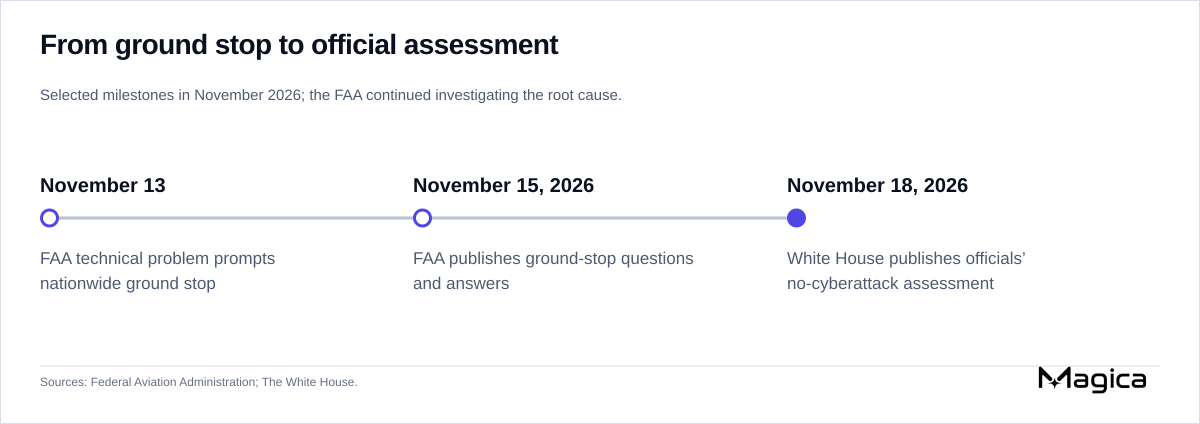
Selected November 2026 milestones, from the nationwide ground stop to the White House’s compilation of officials’ assessments. Source: Federal Aviation Administration.
Secretary of State Marco Rubio, also President Donald Trump’s national security adviser and a former Senate Intelligence Committee vice chair, said there was no evidence linking the incidents to one another or to hackers, criminals or another country. Speaking in the Philippines on Wednesday local time, he said their technical causes were distinct, according to the account of his remarks.
Director of National Intelligence Jay Clayton, a former US attorney for the Southern District of New York and Securities and Exchange Commission chairman, said the government had searched closely for signs of coordinated or state-sponsored activity and found none. Clayton became the country’s intelligence chief in August; his office describes his role as leading the intelligence community and advising the president on intelligence in its announcement of his swearing-in.
In its November 18 compilation of the officials’ remarks, the White House attributed the incidents to companies patching vulnerabilities and upgrading older systems. Clayton described systems failing to restart as expected and handoffs between systems going wrong. Those are the administration’s explanations, rather than a detailed technical reconstruction of every failure.
Democratic Senator Mark Warner of Virginia, vice chairman of the Senate Intelligence Committee and co-chair of the Senate Cybersecurity Caucus, offered a similar assessment with an explicit limit. His statement on Tuesday said there was no indication of an attack, foreign interference or coordination, while stressing that the incidents still required investigation.
The affected operators have described different immediate problems. Microsoft traced the Thursday, November 12 outage of email and other workplace tools to an earlier network capacity upgrade. The following day, the Federal Aviation Administration, which manages US air traffic, stopped departures nationwide after a telecommunications failure.
On Monday, customers reported problems accessing accounts at several major banks and using the money-transfer service Zelle after a technical problem at JPMorgan Chase spread disruption through the financial system. Chase attributed its outage to a software bug and said it was not cyber-related, according to the account of the week’s incidents. United Airlines said it resolved a separate internal system outage that delayed departures that day.
On Tuesday, Apple said it had resolved problems with services including Apple Pay and iCloud. An internal National Security Agency network used to communicate classified information also went offline. The NSA said its problems occurred during scheduled routine maintenance and that its mission-critical capabilities remained operational, according to the account of the agency’s response.
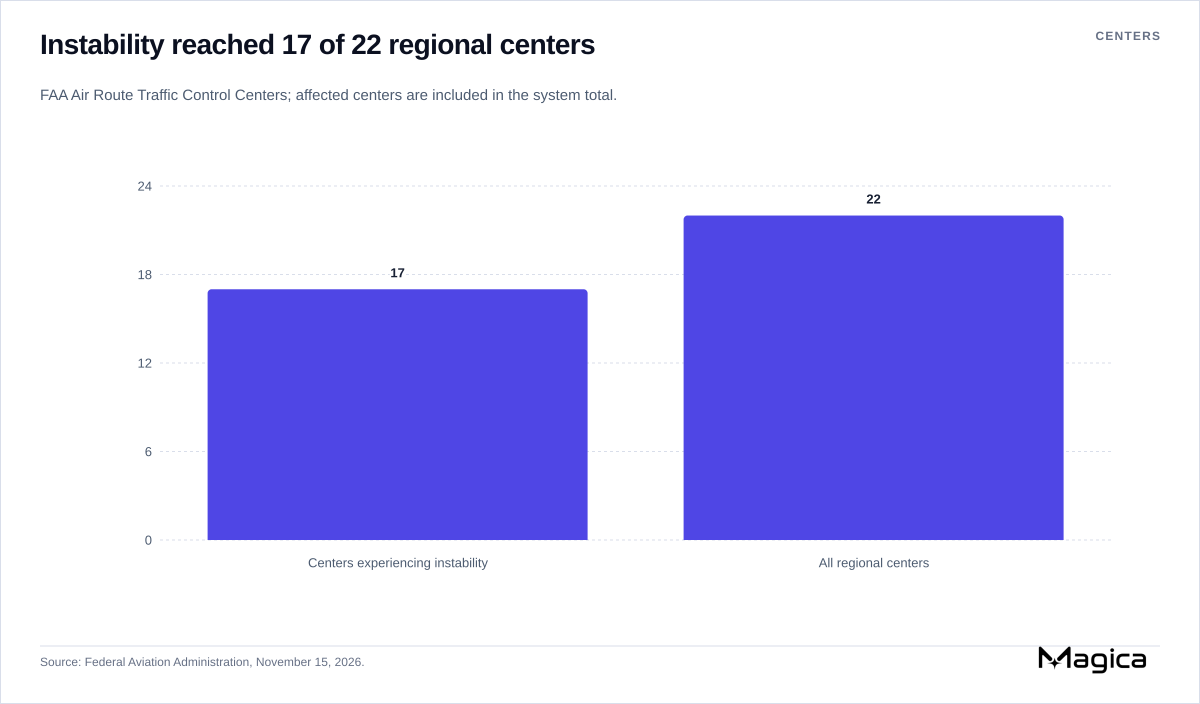
The FAA reported instability at 17 of its 22 regional centers. Affected centers are included in the system total. Source: Federal Aviation Administration.
The FAA’s November 15 explanation describes both the reach of the disruption and the protections that continued working. Its legacy telecommunications equipment became unstable amid 1,000 connection attempts every four to five seconds, disrupting aircraft communications and radar feeds. Instability began at 17 of its 22 Air Route Traffic Control Centers and spread into several facilities that handle aircraft approaching or leaving airports.
The agency identified two potential origins in its initial investigation: a radar site in Amarillo, Texas, and a radio communications site in El Dorado, Arkansas. Its network provider, L3Harris, had been working at the Arkansas site, including deploying a new router. Blocking the two locations stabilized the network, the FAA said; the agency and contractor were still investigating the root cause.
The FAA specifically distinguished routine equipment replacement from its broader modernization program. It blamed instability in its legacy system and said none of the towers modified with the program’s initial funding went down. That qualification matters: the account does not support treating all modernization as the cause of the failure.
Nor was the disruption a complete loss of communications. Some radio frequencies and radar feeds remained reliable. The FAA said approximately 3,500 aircraft landed safely and critical medical, law-enforcement and military flights continued. It reported approximately 12,462 flight cancellations on November 13, including 9,082 by major airlines, while cautioning that not all cancellations were directly caused by the ground stop.
The technical problem began around 3:30 p.m. Eastern, and air traffic resumed at 8:15 p.m., the agency said. Restoration of traffic did not mean an immediate return to normal airline operations.
Clayton also chairs the White House Super Intelligence Force, the administration’s artificial intelligence effort. He said AI enables faster scanning for vulnerabilities. Warner argued that this creates pressure to patch many systems immediately, sometimes simultaneously, straining infrastructure that cannot accommodate that speed of change. Rubio declined to speculate about AI’s role in the specific outages and referred questions to individual companies.
The discovery of a flaw is also different from evidence that it caused an outage. Cybersecurity researchers at Calif used AI to identify a vulnerability involving Java, a programming language, that the firm said could enable remote code execution. But University College London security-engineering professor Steven Murdoch cautioned that it concerned the Base64 code library bundled with a version of Java and did not affect every Java program, according to the report on the vulnerability. That discovery does not establish a shared cause for this week’s failures.
An earlier incident shows why deployment safeguards matter even when comparatively few devices are affected. In its July 2024 recovery account, Microsoft estimated that a faulty update from independent cybersecurity vendor CrowdStrike affected 8.5 million Windows devices, less than 1% of all Windows machines. Microsoft attributed the broad economic and social impact to CrowdStrike’s use by enterprises running critical services. That incident had a known common update; it supplies no evidence that the current outages share one.
Ruling out an attack as the cause also does not eliminate risks arising afterward. Cynthia Kaiser, a former deputy director in the FBI’s cyber division and now an executive at cybersecurity company Halcyon, warned that criminals and scammers could exploit the confusion to steal money, according to her assessment.
The FAA has already made operational changes. It said it disabled a router function at the suspected origins and, as a precaution, on more than 60 other Juniper routers, and paused further installations. It also promised to reconsider the timing of replacement and maintenance work at remote facilities, where daytime work had long been routine.
The remaining test is whether the FAA and L3Harris can establish the root cause and show that these measures prevent a recurrence. For the other incidents, detailed technical accounts would be needed to establish whether accelerated vulnerability discovery contributed to the failures or merely describes the wider pressure to patch.
Hunterbrook says IEIT Systems incorporated newer AMD firmware after its U.S. blacklisting, raising questions about software transfers and affiliated server vendors. The reporting does not establish how the code arrived or whether transfers were licensed, and Hunterbrook’s affiliated investment firm disclosed a short position in AMD.
A tribunal confirmed that the Home Office served Apple with a technical capability notice, clearing the way for much of its legal challenge to be heard publicly. The ruling leaves the notice’s legality and the disclosure of its contents unresolved.
Amazon’s Black Friday discounts take $200 off Apple’s 2026 Studio Display, but leave the height-adjustable version at $1,799 and preserve the configuration premiums.
The free ReactOS-derived operating system targets Windows 11 applications and drivers and can run some Linux programs. Downloadable builds and independent testing show progress, but incomplete compatibility keeps it far from an everyday Windows replacement.
Apple Music’s global creative director says its radio network reaches more than 50 million unique listeners a month. The disclosure puts a number on the free radio network’s reach, but does not establish audience growth, subscription returns or benefits for emerging artists.
Ukrainian specialists say airborne relays guided weapons during the Kerch Strait Bridge attacks without Starshield. The account shows a mission-specific alternative, while satellite restrictions and the network’s wider viability remain unresolved.
Sila says its long-term Panasonic supply relationship could exceed $1 billion, supporting a Washington factory expansion whose qualification, financing and manufacturing economics remain unresolved.
Microsoft will retire every To Do app on June 30, 2027. Work and school accounts get Planner as a destination, but existing lists will not migrate, and personal accounts must find another application—even with a Microsoft 365 subscription.
JEDEC’s DDR6 preview targets faster transfers, a 96-bit data bus and 74mm modules, with server memory density a central goal. The design remains provisional, with no confirmed launch schedule or application benchmarks.
Elon Musk says Ukraine is seeking offensive use of commercial Starlink, while Volodymyr Zelenskyy says restrictions on military Starshield are impairing defensive interceptions. The competing accounts leave the applicable service rules and authority over the limits unresolved.
Apple’s annual shortlist includes AI narration, established Mac productivity tools, spatial games and accessibility software. App Store editors will select the winners in the coming weeks from a finalist pool the same size as last year’s.
Xiaomi’s Smart Band 11 reaches more markets with a slimmer body and revised sensors, starting at €59.99 in Germany. Its 21-day battery headline matches its predecessor, payments require an NFC model and supported cards, and location tracking still needs a phone.
Elon Musk disavowed blind loyalty to Republicans and regretted his midterm spending. His continuing ties to President Trump and the prospect of Democratic investigations leave the practical meaning of that shift unresolved.
Best Buy is reportedly selling 14 4K Blu-ray titles directly, with The Odyssey also reaching stores. The limited return goes beyond marketplace sales, while industry figures show a growing premium format inside a shrinking disc market.

Instagram is rolling out a 15-minute window to edit Story text, music, stickers and drawings while retaining views, likes and replies. Some Stories are ineligible, and edits remove earlier reshares, according to a reported app notice.
Ice Universe claims Apple is testing two flat-glass and two curved-glass prototypes for its expected 2027 anniversary iPhone. Reduced curvature, uncertain sample parts and rival designs temper claims of a radical all-glass phone.
Apple says HomeView’s first post-launch update fixes two Siri failures and unexpected removal from a home. The touchscreen hub still depends on paired devices for personal-context requests, while some server-based AI features have daily limits and planned fees for expanded access.

Internal presentations described school communities as a route to new Instagram users before Meta expanded its school safety program into student directories and communications. Meta defends the service, while its original education contractor says it had no role in the later development.
Samsung’s software beta lets Galaxy S26 owners lock existing apps and hide their notification content and widgets. It simplifies an established privacy task, but wider device support remains unconfirmed.
A supply-chain report puts iPhone 18 and Air 2 display production in late December and January ahead of an expected March 2027 launch. Leftover Air panels and uncertain order allocations complicate the outlook for suppliers.