Editorial Team
9 min read

Internal presentations described school communities as a route to new Instagram users before Meta expanded its school safety program into student directories and communications. Meta defends the service, while its original education contractor says it had no role in the later development.
Meta planned to use school communities to recruit teenagers to its Instagram social network, internal presentations show, before expanding its publicly promoted school safety program into directories and other tools for connecting classmates. A November 18 report examining the records describes a commercial objective alongside the protection Meta says its School Partnership Program provides.
Meta, the company behind Instagram and Facebook, publicly launched the program in March 2025 to give US middle and high schools priority handling of safety complaints. Its September 2026 expansion added school announcements, clubs and student connections. Schools now face a broader choice than how to get harmful posts reviewed: whether to help make a commercial social network part of students’ school relationships.
Meta rejects the report’s characterization. Company spokesperson Liza Crenshaw told the report that the program helps schools protect students, communicate safely about extracurricular activities and report problems. She said Meta reviewed more than 90% of participating schools’ bullying and harassment reports within 48 hours over the past year, and reiterated that Instagram should not distract students during class.
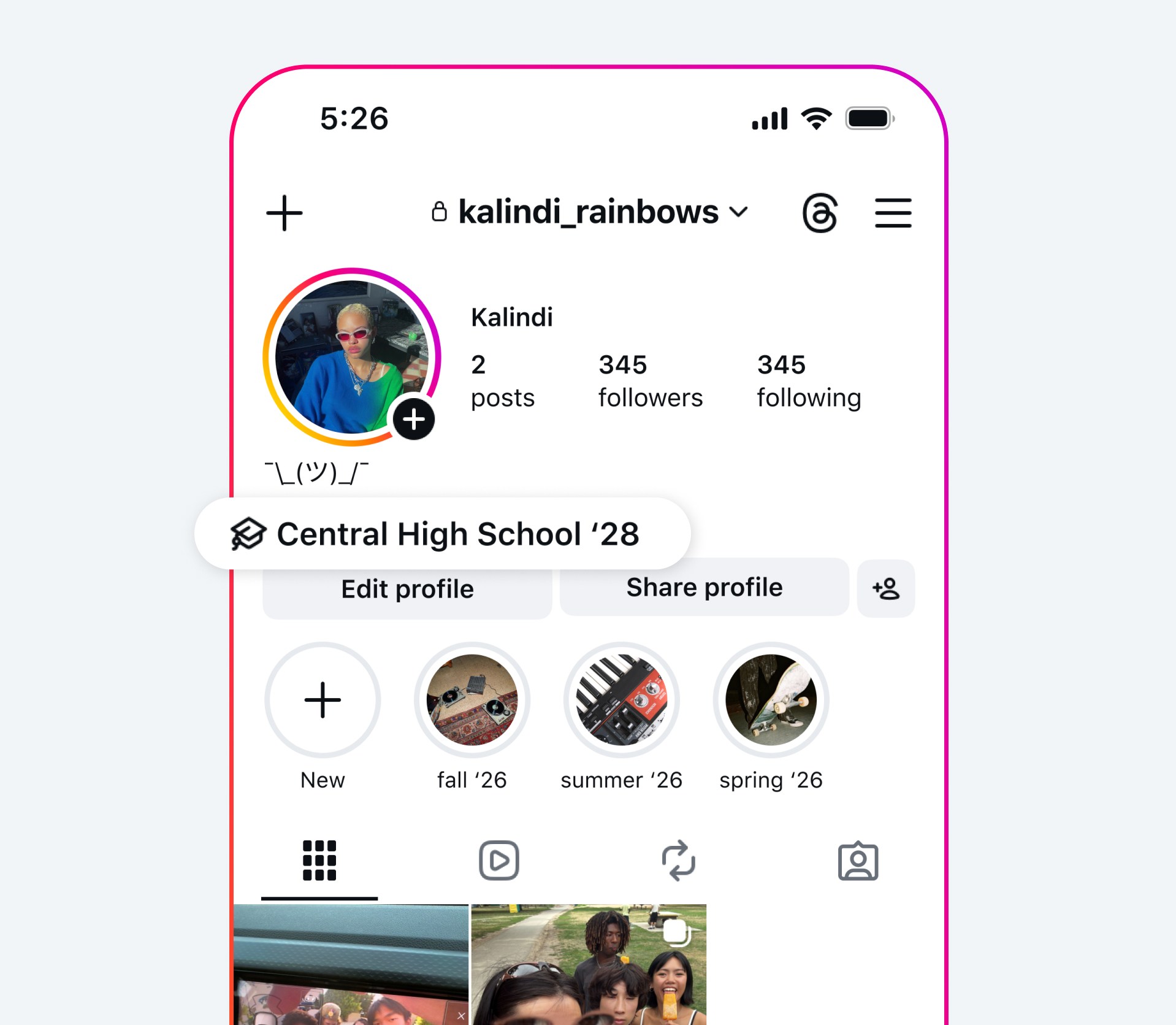
Meta’s September 2026 product mockup illustrates a school banner on a student’s Instagram profile. Image: Meta. Source: Meta.
The original program responded to a practical problem for educators: getting disruptive posts and accounts addressed. In its March 2025 announcement, Meta said it had tested the service with 60 schools over the preceding year before opening a pilot to all US middle and high schools. Schools received prioritized review, report-status updates, educational resources and a partner banner on their profiles.
That announcement included a teacher’s account of bullying and harassing posts and profiles being removed in the first week of participation. It was a testimonial, rather than an evaluation across participating schools, but it illustrates the immediate service schools sought.
By September 2026, Meta said nearly 17,000 schools had partnered with it. The company said in its expansion announcement that feedback from administrators, educators and parents about difficulties keeping students informed prompted a centralized hub for school-related accounts.
The expanded features cover different audiences and permissions:
The distinction between school enrollment and student access matters. Although middle and high schools can join the program, Meta describes the new verified student features as available to high school students in the US. They must pass verification through UNiDAYS, the third-party validator Meta selected, before accessing their verified school community.
Meta also says parents can receive notifications through its Family Center when teens join or leave a school, and can block Instagram during school hours. These are stated protections and controls; their availability does not establish how widely families use them or whether the expanded features reduce harm.
The internal initiative was called Project Gryffindor. The November report describes a 2023 presentation arguing that school communities could give teens a reason to join Instagram or find more value in it. The presentation questioned whether highly active teens could recruit less active friends when entire communities had yet to join. A 2024 presentation explicitly connected school networks with acquiring users, invitations and new friendships. The report also describes internal alarm about slowing US teen growth following TikTok’s US launch in 2018, showing why recruiting the next cohort mattered to Meta.
Those records emerged through discovery in multidistrict litigation against Meta and other social-platform companies over alleged harms to young users. They document planning ambitions, rather than measured recruitment or safety results from the current school program.
The November report traces plans to recruit teens through relationships with schools to at least 2015. A school-district plaintiffs’ brief filed in November 2025 supplies a longer history. Citing internal records, the plaintiffs describe efforts to infer students’ school affiliations and send targeted push notifications, called school blasts, to increase monthly active users within particular schools. The brief also quotes an internal estimate that school communities could add approximately 150,000 teen daily users of direct messaging. That was a potential gain, not an observed outcome of the September 2026 expansion.
The brief links engagement to Meta’s advertising business and describes earlier spending to reach families through trusted education organizations. It says Meta paid the National PTA, a parent-and-teacher organization, $110,000 and Scholastic $135,000 in 2018 for outreach, including distributing Instagram materials. The filing describes Scholastic’s role in reaching classrooms and the PTA’s access to families. Internal records quoted in the filing describe these organizations as sources of credibility and access to parents and educators. Those historical payments are not a disclosed budget for today’s School Partnership Program.
The school districts have a financial stake of their own: their brief seeks compensation for counseling, technology and staff resources they allege were diverted to address social-media disruption. It is an adversarial filing, not a judicial finding that the school program caused those costs.
The November report also cites internal records describing teens’ influence on younger children’s understanding of what and how often to share on Instagram. That extends the stakes beyond the users Meta hopes to recruit directly, although the records do not measure the school program’s effect on younger children. Instagram’s stated minimum account age is 13.
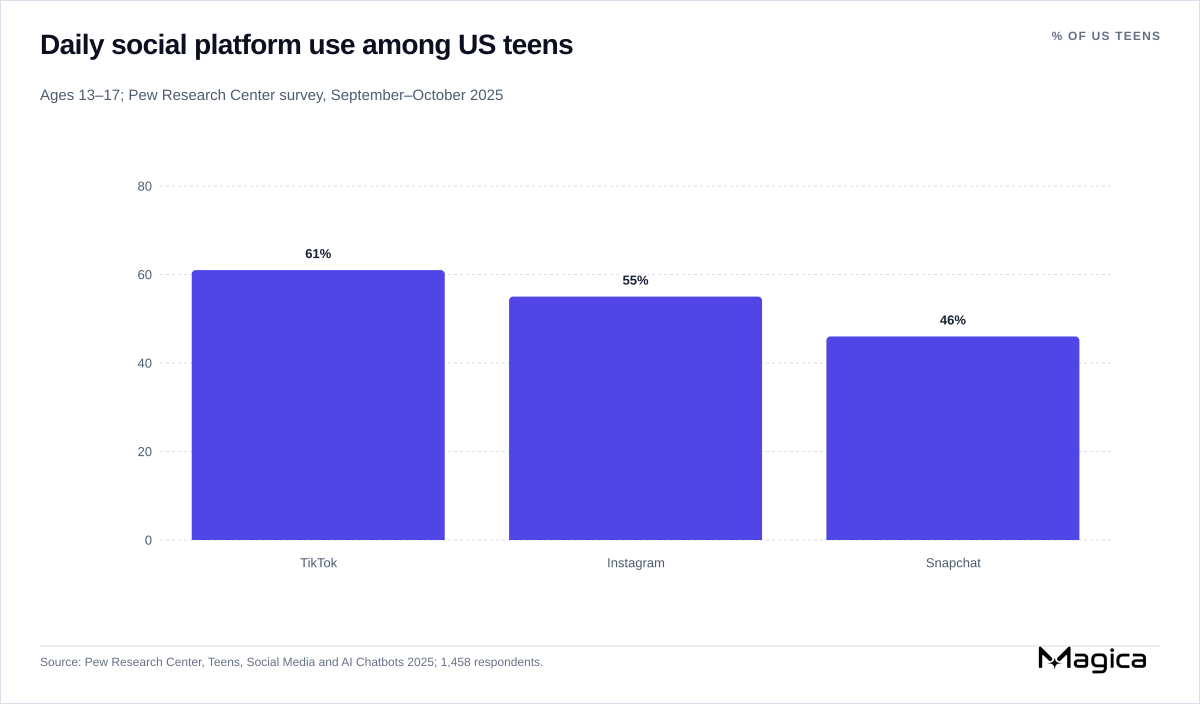
Daily platform use in Pew Research Center’s 2025 survey of US teens ages 13–17. These figures do not measure the school program’s effect on recruitment. Graphic: Magica. Source: Pew Research Center.
School affiliation was already a competitive tool. The 2023 Meta presentation discussed rivals’ school integrations and asked whether school networks could be used more directly for recruitment. Snapchat, the messaging and social app operated by Snap, already offered school and college communities with profile badges, the November report notes.
The plaintiffs’ brief provides scale for that precedent: it quotes Snap personnel describing 15 million students across 24,000 US high schools at a 2023 company town hall. Those company figures cited by litigants describe a different service and date from Meta’s participating-school count; they cannot establish which program has greater adoption today.
An independent baseline comes from a 2025 Pew Research Center survey, which found Instagram use broadly stable in recent years. It found 55% of US teens used Instagram daily, compared with 61% for TikTok and 46% for Snapchat.
The age split is particularly relevant to recruitment: 75% of 15- to 17-year-olds said they used Instagram, compared with 44% of 13- to 14-year-olds. Those figures measure use at all, not daily use. The online survey covered 1,458 teens from September 25 to October 9, 2025, and was weighted to represent US 13- to 17-year-olds living with their parents. It describes the audience available to platforms; it does not measure the school program’s contribution to sign-ups or engagement.
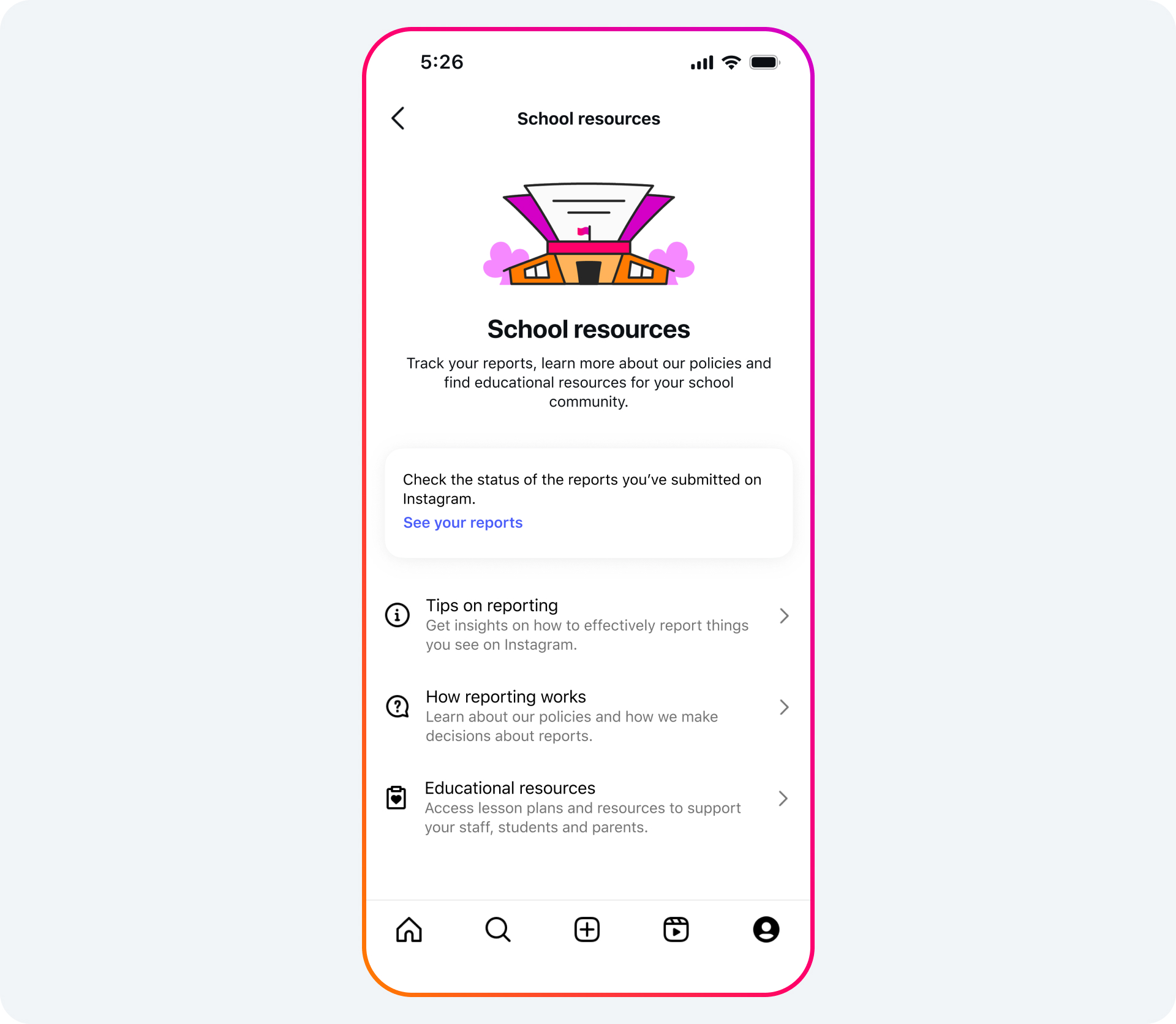
Meta’s March 2025 mockup shows report tracking and educational resources in the original school program. Image: Meta. Source: Meta.
Meta’s announcements cite the International Society for Technology in Education and the Association for Supervision and Curriculum Development, known as ISTE+ASCD, an education nonprofit, as a partner in developing the program. Its involvement supplies educator context for the original reporting service, but the nonprofit disputes a continuing partnership.
ISTE+ASCD told the November report that school leaders had sought better ways to remove disruptive Instagram posts and accounts. Both sides said the nonprofit initially approached Meta. It then performed contract work collecting educator feedback and testing account-reporting functionality in schools, work it said ended in 2025.
Crenshaw said Meta was proud of that initial work, but acknowledged that ISTE had not participated in subsequent development. The original contractor’s involvement therefore does not establish its endorsement of the later student-network features.
Verification also leaves a specific security question. Cybersecurity investigator Paul Raffile told the report that school information helps sextortionists threaten to distribute victims’ intimate images to classmates, teachers and coaches. He warned of two routes around the apparent protection: a scammer posing as a teen whom a student follows could see a school banner, or a criminal could take over an already verified student account and access school-community information.
Those are warnings about possible abuse mechanisms, not evidence that this program has increased attacks. The report said Meta did not respond to its sextortion and cybersecurity questions. Meta’s stated verification and visibility restrictions remain material safeguards, but do not answer the account-compromise scenario.
The scrutiny comes amid wider legal consequences. The November report says Meta agreed in August 2026 to a settlement worth up to $17.1 billion over state attorneys general’s claims about compulsive use and misleading safety assurances; Meta denied the allegations. It also says a Los Angeles jury found Meta’s and YouTube’s platforms were designed to be addictive to young users, while a New Mexico jury found Meta misled consumers about safety and knowingly harmed children. Meta is appealing the New Mexico verdict. Those cases concern the platforms more broadly and do not establish the effects of the school program.
For schools deciding whether to participate in the expanded service, the key question is whether the additional connections and communications improve student outcomes enough to justify any added exposure and use. Faster review can be valuable without settling that question.
Meta’s 48-hour figure measures review of submitted bullying and harassment reports. It does not reveal how often reports led to removals or whether bullying declined. Nearly 17,000 participating schools is an institutional enrollment count, not a count of students using the new features. The internal messaging forecast measures neither outcome.
Evidence on actual student adoption, harmful-contact incidents, compromised verified accounts and changes in bullying would allow schools to assess the expansion on its own merits. Until then, the records establish Meta’s recruitment ambition and its stated reporting performance, while leaving the net safety effect of embedding more school relationships on Instagram unresolved.
Hunterbrook says IEIT Systems incorporated newer AMD firmware after its U.S. blacklisting, raising questions about software transfers and affiliated server vendors. The reporting does not establish how the code arrived or whether transfers were licensed, and Hunterbrook’s affiliated investment firm disclosed a short position in AMD.
A tribunal confirmed that the Home Office served Apple with a technical capability notice, clearing the way for much of its legal challenge to be heard publicly. The ruling leaves the notice’s legality and the disclosure of its contents unresolved.
Amazon’s Black Friday discounts take $200 off Apple’s 2026 Studio Display, but leave the height-adjustable version at $1,799 and preserve the configuration premiums.
The free ReactOS-derived operating system targets Windows 11 applications and drivers and can run some Linux programs. Downloadable builds and independent testing show progress, but incomplete compatibility keeps it far from an everyday Windows replacement.
Apple Music’s global creative director says its radio network reaches more than 50 million unique listeners a month. The disclosure puts a number on the free radio network’s reach, but does not establish audience growth, subscription returns or benefits for emerging artists.
Ukrainian specialists say airborne relays guided weapons during the Kerch Strait Bridge attacks without Starshield. The account shows a mission-specific alternative, while satellite restrictions and the network’s wider viability remain unresolved.
Sila says its long-term Panasonic supply relationship could exceed $1 billion, supporting a Washington factory expansion whose qualification, financing and manufacturing economics remain unresolved.
Microsoft will retire every To Do app on June 30, 2027. Work and school accounts get Planner as a destination, but existing lists will not migrate, and personal accounts must find another application—even with a Microsoft 365 subscription.
JEDEC’s DDR6 preview targets faster transfers, a 96-bit data bus and 74mm modules, with server memory density a central goal. The design remains provisional, with no confirmed launch schedule or application benchmarks.
Elon Musk says Ukraine is seeking offensive use of commercial Starlink, while Volodymyr Zelenskyy says restrictions on military Starshield are impairing defensive interceptions. The competing accounts leave the applicable service rules and authority over the limits unresolved.
Apple’s annual shortlist includes AI narration, established Mac productivity tools, spatial games and accessibility software. App Store editors will select the winners in the coming weeks from a finalist pool the same size as last year’s.
Xiaomi’s Smart Band 11 reaches more markets with a slimmer body and revised sensors, starting at €59.99 in Germany. Its 21-day battery headline matches its predecessor, payments require an NFC model and supported cards, and location tracking still needs a phone.
Elon Musk disavowed blind loyalty to Republicans and regretted his midterm spending. His continuing ties to President Trump and the prospect of Democratic investigations leave the practical meaning of that shift unresolved.
Best Buy is reportedly selling 14 4K Blu-ray titles directly, with The Odyssey also reaching stores. The limited return goes beyond marketplace sales, while industry figures show a growing premium format inside a shrinking disc market.

Instagram is rolling out a 15-minute window to edit Story text, music, stickers and drawings while retaining views, likes and replies. Some Stories are ineligible, and edits remove earlier reshares, according to a reported app notice.
Ice Universe claims Apple is testing two flat-glass and two curved-glass prototypes for its expected 2027 anniversary iPhone. Reduced curvature, uncertain sample parts and rival designs temper claims of a radical all-glass phone.
Apple says HomeView’s first post-launch update fixes two Siri failures and unexpected removal from a home. The touchscreen hub still depends on paired devices for personal-context requests, while some server-based AI features have daily limits and planned fees for expanded access.
US officials say recent technology outages are unrelated and show no evidence of attack. The FAA’s account details a failure in aging equipment, working safety procedures and an investigation still underway; a broader AI connection remains unproven.
Samsung’s software beta lets Galaxy S26 owners lock existing apps and hide their notification content and widgets. It simplifies an established privacy task, but wider device support remains unconfirmed.
A supply-chain report puts iPhone 18 and Air 2 display production in late December and January ahead of an expected March 2027 launch. Leftover Air panels and uncertain order allocations complicate the outlook for suppliers.