Editorial Team
7 min read
A tribunal confirmed that the Home Office served Apple with a technical capability notice, clearing the way for much of its legal challenge to be heard publicly. The ruling leaves the notice’s legality and the disclosure of its contents unresolved.
The UK government has lost its attempt to keep an encryption-related notice to Apple officially unacknowledged. The November 19 ruling allows much of the challenge to its legal powers to proceed in public, without requiring disclosure of the notice’s full contents.
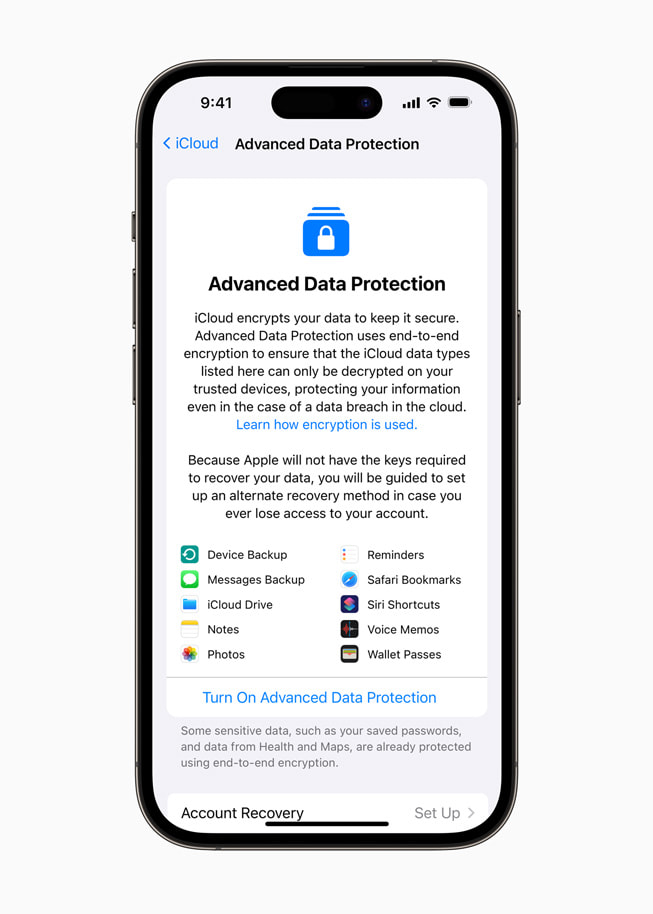
Apple’s Advanced Data Protection interface in December 2022, before its withdrawal from UK users. Image: Apple. Source: Apple.
The Investigatory Powers Tribunal, an independent judicial body that hears challenges to government surveillance and intelligence agencies, confirmed in its judgment that the home secretary had given Apple a technical capability notice under section 253 of the Investigatory Powers Act 2016. That law provides powers to require communications providers to maintain capabilities for assisting investigations.
Apple, the technology company whose iPhone and other devices connect to its iCloud storage service, is challenging those powers. The dispute centres on Advanced Data Protection, an optional expansion of end-to-end encryption for iCloud data that Apple introduced in 2022. It prevents Apple from decrypting the content it protects, creating a conflict over the access the government wants the company to preserve.
The ruling changes how that conflict can be examined. Apple can publicly contest whether the government’s statutory powers extend to regulating the security and privacy services a technology company offers customers. Judges have not decided whether the notice is lawful or whether Apple must change its services.
This follows an earlier transparency ruling. In April 2025, the tribunal rejected the government’s attempt to conceal Apple’s identity and the subject of its first claim. That claim was subsequently dismissed following a change of circumstances; Apple filed its current claim in July 2026.
Privacy International and Liberty, digital rights and civil liberties campaign groups, are pursuing a parallel challenge with two individuals. Their case contests the secrecy and lawfulness of the notices regime itself. Privacy International’s response to the ruling argues that governments should openly acknowledge attempts to restrict digital security.
The Home Office argued that formal confirmation was different from press speculation and would create a damaging precedent for future national security cases. The tribunal recognised the importance of protecting intelligence secrets, but found that the government’s evidence failed to account properly for departures from its own policy of neither confirming nor denying sensitive matters.
Two newspapers had described government sources confirming the notice. Judges inferred that the briefings occurred and were authorised by ministers, senior departmental officials or special advisers. Assertions about leak investigations carried little or no evidential value without details of what investigators had done or found. The government could have supplied further evidence, including confidentially, but chose not to.
The Home Office had also authorised Apple to brief members of the US executive without any apparent assurance of confidentiality. Senior US figures had already shown their willingness to discuss the dispute publicly. The tribunal found that confirmation would give sophisticated adversaries no information they did not already possess, while less sophisticated actors interested in the notice could readily discover its existence.
The decision therefore rests on this case’s disclosures and evidence. It does not abolish the government’s secrecy policy. Judges also expressly accepted that publishing all the notice-related material would damage national security; the boundary between necessary secrecy and permissible disclosure remains to be drawn.
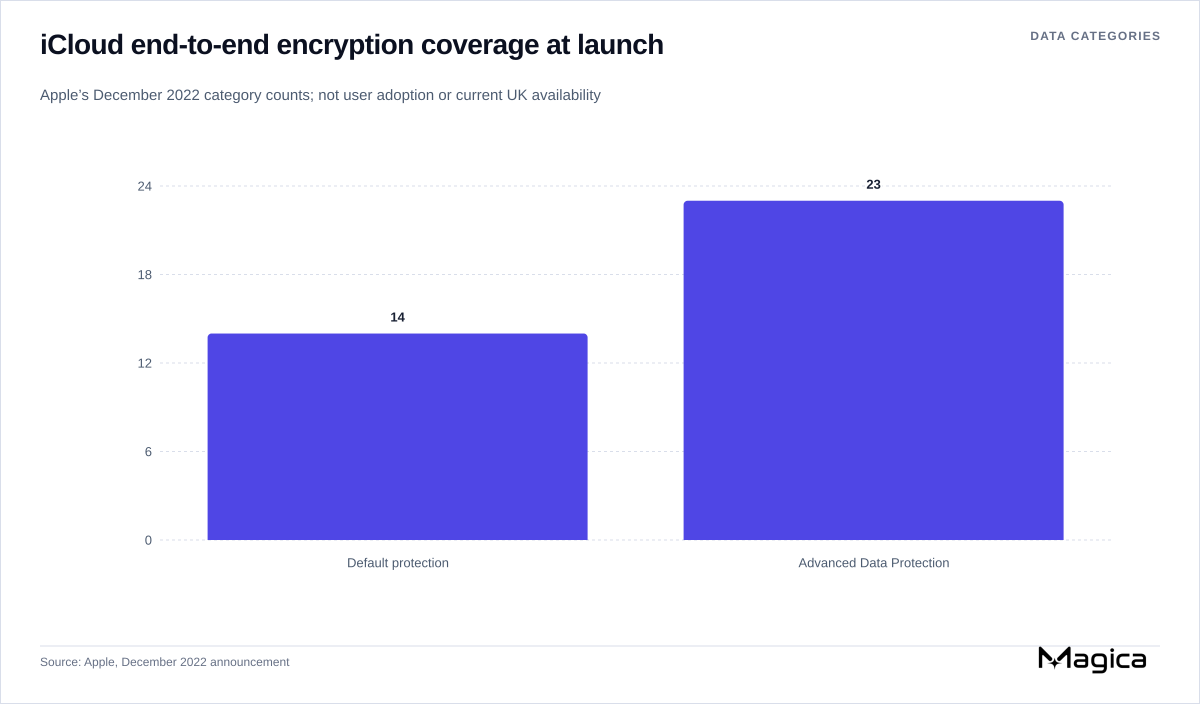
Apple’s company-reported December 2022 totals: 14 data categories encrypted end to end by default and 23 with Advanced Data Protection. These count categories, not users. Source: Apple.
Advanced Data Protection builds on protections Apple already offered. In its December 2022 announcement, Apple described longstanding encryption on its devices and said iCloud protected 14 sensitive data categories with end-to-end encryption by default, including passwords and Health data.
Opting into Advanced Data Protection expanded that total to 23 categories, including iCloud Backup, Notes and Photos. Mail, Contacts and Calendar remained outside that expanded protection because they needed to work with wider email, contacts and calendar systems. Those are Apple’s launch-era category counts, not a measure of how many people use the feature.
The technical difference is control of the keys. As the reporting explains, Advanced Data Protection keeps encryption keys on users’ devices rather than Apple’s servers. Apple cannot decrypt the protected content in response to a lawful demand. Apple said the feature also protected most iCloud data in the event of a cloud breach. The dispute thus affects protection against unauthorised access as well as the availability of data to investigators.
After the original demand became public in February 2025, Apple withdrew Advanced Data Protection from UK users. A report on the ruling describes Apple blocking UK users from enabling it rather than complying with the demand. The same report recounts Apple’s earlier statement to the publication that it had never built a backdoor or master key and never would.
Accounts differ on whether withdrawing the feature effectively complied with the notice or represented refusal. The unpublished terms prevent that question from being settled by this ruling. Nor does the judgment establish that the latest notice covers every category of iCloud data or every Apple encryption service.
The Home Office describes the demand as preserving existing investigative assistance. In a response included in the reporting on the decision, a spokesperson confirmed the notice and said Apple had helped police and intelligence agencies pursue criminals for several years. The department said the notice required Apple to maintain that ability and argued that decisions affecting public safety belong to elected governments and independent judges.
The government’s notices code distinguishes maintaining a capability from using it. A technical capability notice can require an operator to retain the ability to remove encryption when subsequently served with a warrant, notice or authorisation. It does not itself require encryption to be removed merely because the capability notice has arrived.
Under the code, an encryption-removal obligation must be reasonably practicable and concern protection applied by or on behalf of the operator. The government must consult the company and consider technical feasibility, cost, less intrusive alternatives and the public interest in secure communications systems. A Judicial Commissioner must approve the decision to issue the notice, reviewing necessity and proportionality.
The code also allows contributions towards the costs of maintaining a technical capability, subject to prior agreement. It does not establish Apple’s compliance costs or any payment to the company. These general provisions explain the regime; they do not prove that Apple’s particular notice satisfies its requirements.
Recipients generally cannot disclose a notice’s existence or contents without the home secretary’s permission. That restriction helps explain why official acknowledgement matters even after widespread reporting: the dispute involves what the company and the parties can say publicly in court, as well as what outsiders already suspect.
Public accounts describe an original worldwide demand and a later notice focused on UK users. The judgment records reporting and US statements about that sequence, but does not publish the notice’s precise terms. Confirmation of its existence should not be treated as judicial verification of every reported detail.
Apple’s five grounds of challenge concern overseas interception powers, regulation of customer security services, consultation, proportionality under the European Convention on Human Rights, and whether it was treated differently from other technology companies. Judges said the first two are questions of statutory interpretation that can be resolved entirely in public. Much of the consultation and proportionality arguments is also likely to be heard openly. Differential-treatment evidence and some rights-balancing evidence are likely to remain protected.
The parties agree that a substantive hearing in December 2026 is impractical and expect to agree directions aimed at a hearing in the first half of 2027. After evidence and written arguments are exchanged, the tribunal will decide which further details can be disclosed. The questions still to be answered are what the law permits the government to require, whether this notice meets those limits, and how much of the evidence needed to decide that can be made public.
Hunterbrook says IEIT Systems incorporated newer AMD firmware after its U.S. blacklisting, raising questions about software transfers and affiliated server vendors. The reporting does not establish how the code arrived or whether transfers were licensed, and Hunterbrook’s affiliated investment firm disclosed a short position in AMD.
Amazon’s Black Friday discounts take $200 off Apple’s 2026 Studio Display, but leave the height-adjustable version at $1,799 and preserve the configuration premiums.
The free ReactOS-derived operating system targets Windows 11 applications and drivers and can run some Linux programs. Downloadable builds and independent testing show progress, but incomplete compatibility keeps it far from an everyday Windows replacement.
Apple Music’s global creative director says its radio network reaches more than 50 million unique listeners a month. The disclosure puts a number on the free radio network’s reach, but does not establish audience growth, subscription returns or benefits for emerging artists.
Ukrainian specialists say airborne relays guided weapons during the Kerch Strait Bridge attacks without Starshield. The account shows a mission-specific alternative, while satellite restrictions and the network’s wider viability remain unresolved.
Sila says its long-term Panasonic supply relationship could exceed $1 billion, supporting a Washington factory expansion whose qualification, financing and manufacturing economics remain unresolved.
Microsoft will retire every To Do app on June 30, 2027. Work and school accounts get Planner as a destination, but existing lists will not migrate, and personal accounts must find another application—even with a Microsoft 365 subscription.
JEDEC’s DDR6 preview targets faster transfers, a 96-bit data bus and 74mm modules, with server memory density a central goal. The design remains provisional, with no confirmed launch schedule or application benchmarks.
Elon Musk says Ukraine is seeking offensive use of commercial Starlink, while Volodymyr Zelenskyy says restrictions on military Starshield are impairing defensive interceptions. The competing accounts leave the applicable service rules and authority over the limits unresolved.
Apple’s annual shortlist includes AI narration, established Mac productivity tools, spatial games and accessibility software. App Store editors will select the winners in the coming weeks from a finalist pool the same size as last year’s.
Xiaomi’s Smart Band 11 reaches more markets with a slimmer body and revised sensors, starting at €59.99 in Germany. Its 21-day battery headline matches its predecessor, payments require an NFC model and supported cards, and location tracking still needs a phone.
Elon Musk disavowed blind loyalty to Republicans and regretted his midterm spending. His continuing ties to President Trump and the prospect of Democratic investigations leave the practical meaning of that shift unresolved.
Best Buy is reportedly selling 14 4K Blu-ray titles directly, with The Odyssey also reaching stores. The limited return goes beyond marketplace sales, while industry figures show a growing premium format inside a shrinking disc market.

Instagram is rolling out a 15-minute window to edit Story text, music, stickers and drawings while retaining views, likes and replies. Some Stories are ineligible, and edits remove earlier reshares, according to a reported app notice.
Ice Universe claims Apple is testing two flat-glass and two curved-glass prototypes for its expected 2027 anniversary iPhone. Reduced curvature, uncertain sample parts and rival designs temper claims of a radical all-glass phone.
Apple says HomeView’s first post-launch update fixes two Siri failures and unexpected removal from a home. The touchscreen hub still depends on paired devices for personal-context requests, while some server-based AI features have daily limits and planned fees for expanded access.

Internal presentations described school communities as a route to new Instagram users before Meta expanded its school safety program into student directories and communications. Meta defends the service, while its original education contractor says it had no role in the later development.
US officials say recent technology outages are unrelated and show no evidence of attack. The FAA’s account details a failure in aging equipment, working safety procedures and an investigation still underway; a broader AI connection remains unproven.
Samsung’s software beta lets Galaxy S26 owners lock existing apps and hide their notification content and widgets. It simplifies an established privacy task, but wider device support remains unconfirmed.
A supply-chain report puts iPhone 18 and Air 2 display production in late December and January ahead of an expected March 2027 launch. Leftover Air panels and uncertain order allocations complicate the outlook for suppliers.