Editorial Team
9 min read
The European Central Bank warns that debt and interlinked financing could carry an AI investment reversal into credit markets and the European economy. Resilient earnings, limited direct bank lending and stronger bank buffers temper its comparison with past bubbles.
The European Central Bank (ECB), the euro area's central bank, warned on November 18 that the changing financing of AI infrastructure could spread losses beyond technology shareholders. As computing investment outstrips internally generated cash, borrowing and interconnected contractual obligations are bringing lenders and European investment portfolios further into the risk.
The warning in its analysis of AI debt financing concerns who absorbs losses if returns disappoint—even if the technology ultimately delivers large economic gains. It forms part of the November Financial Stability Review, the ECB's regular assessment of vulnerabilities across the euro area financial system. The review draws on surveillance, market discussions and research; the ECB's Governing Council endorsed this edition on November 12.
The timing matters because the source of the money is changing. Large cloud and computing-infrastructure operators, known as hyperscalers, previously generated substantial free cash flow from businesses outside AI. For most US hyperscalers, that flow turned negative in 2026 as AI infrastructure spending exceeded operating cash generation, the ECB says. The wider review says it is expected to remain negative until 2028, increasing reliance on external funding.
There is an important qualification: hyperscalers' earnings have broadly kept pace with expectations so far. The ECB is describing how a reversal could propagate, rather than establishing that the investment boom has already become unsustainable.

The ECB estimate includes fixed future lease and purchase commitments and contingent obligations; it does not measure immediately payable debt or solely AI borrowing. Graphic: Magica; source: ECB. Source: European Central Bank — AI debt financing analysis.
The ECB cites forecasts putting cumulative capital expenditure by seven US technology groups—Alphabet, Amazon, Broadcom, Meta, Microsoft, Nvidia and Oracle—at about $5.5 trillion by 2030. Those broker estimates, collected on October 26, vary widely. They describe spending, not an equivalent amount of new borrowing, and cover both infrastructure buyers and chip suppliers.
The funding gap is nevertheless substantial. Hyperscalers have issued more than $200 billion in US dollar-denominated investment-grade corporate bonds this year, according to the full review, and have also tapped other currencies, including the euro.
External financing also includes equity. The review describes a wave of large share offerings, with US initial public offering (IPO) proceeds on track to exceed the dotcom peak relative to GDP. A report on the review highlights the ECB's caution that similar issuance booms have tended to occur near market peaks.
Public bonds reveal only part of the exposure. Cloud operators contract to use computing infrastructure owned by data-centre developers and chip owners. Those owners can then borrow against the expected payments, bringing banks, bondholders and private credit funds into the financing chain.
The ECB estimates that selected big tech and AI firms had more than $4 trillion in off-balance-sheet commitments in the second quarter of 2026, exceeding their recorded on-balance-sheet liabilities. Its sample includes AI developer Anthropic alongside the seven technology groups. The measure combines fixed future lease and purchase commitments with contingent obligations, such as backstops payable under specified conditions. It is not a measure of immediately payable debt or solely of AI borrowing.
Nor does being off the balance sheet mean a commitment is entirely undisclosed. The analysis explains that US accounting rules recognise leases when use of the asset begins, while significant future commitments must be disclosed in financial-statement notes. The ECB compiled its estimates from public filings using AI-assisted extraction that staff subsequently cross-checked manually.
The second concern is who pays whom. Chipmakers can finance the customers buying or leasing their chips. Cloud providers and AI developers also have lending and ownership relationships with other companies in the same supply chain.
That creates a problem for interpreting revenue: some apparent demand depends on financing supplied by the seller itself. The ECB says these arrangements can inflate expected revenues and transmit shocks between companies. It also notes that revaluations of private stakes in Anthropic contribute to reported earnings at Alphabet and Amazon, making operating demand and investment gains important to distinguish.
The cash-flow picture is uneven. Chip suppliers Broadcom and Nvidia have seen free cash flows rise strongly as demand increases, even while infrastructure buyers spend beyond their operating cash generation. The investment boom can therefore enrich suppliers before establishing whether customers will earn enough from the capacity they are buying.
The ECB identifies cheaper competing models—including open-source models from abroad—as a threat to expected profits. The wider review also points to cheaper open-weight alternatives. Energy costs, electricity and grid connections, chip bottlenecks and growing political opposition to large infrastructure projects could constrain the buildout or its returns.
Equipment could also lose economic value before its financing matures. The ECB's chart notes cite market estimates of one to three years for AI equipment's economic life. Separately, they say most hyperscalers have lengthened the accounting life of servers and network equipment from three years in 2020 to six in 2026. These measures cover different concepts and assets; depreciation schedules do not establish how long advanced chips will remain economically competitive. Data-centre buildings have longer economic lives, the ECB acknowledges.
If income falls short while assets lose value and commitments enter balance sheets, leverage measures and credit ratings could deteriorate. Rising interest rates add another pressure, particularly for borrowers relying on floating-rate loans and private credit.
Investors are beginning to distinguish those risks. Hyperscaler bond spreads have widened relative to similarly rated corporate issuers, especially at longer maturities. The ECB interprets that as a possible sign that markets consider credit ratings too benign, rather than proof that defaults are imminent.
The ECB separates two historical parallels. Overinvestment in technological infrastructure recalls the dotcom boom, whose heavy use of equity financing helped limit the subsequent recession. Faster debt accumulation, opaque private markets, off-balance-sheet structures and circular financing recall dynamics evident in the subprime mortgage bubble.
There is broader historical evidence for distinguishing bubbles by their funding. A 2015 working paper published by the Federal Reserve Bank of San Francisco studied housing and equity bubbles in 17 countries over 140 years. It found that credit-fuelled bubbles increased financial-crisis risks and tended to be followed, after collapse, by deeper recessions and slower recoveries. Credit-financed housing bubbles were particularly dangerous. That finding supports scrutiny of leverage; it does not establish that AI infrastructure will follow the same path as housing.
The ECB's European lending data also limit the analogy. Two alternative measures describe exposure, rather than amounts that should be added together:
| Measure | Reported exposure | Main limitation |
|---|---|---|
| Lending commitments to 165 identified AI supply-chain companies and their subsidiaries, using data through June 2026 | €24.3 billion, including €11 billion undrawn | Omits some financing booked outside the euro area because granular data are unavailable |
| Broader lending to data-centre, semiconductor and software sectors | Around €75 billion, or 1.1% of euro area banks' committed corporate exposures | Includes firms outside the AI buildout and overstates lending to the AI supply chain |
The review says outstanding loans to the identified AI firms and data centres were of very high quality, although rapid loan growth may partly obscure the picture. Loan quality in the broader software and semiconductor sectors has weakened since 2023. The ECB suggests some software problems may reflect disruption of non-AI businesses, rather than losses on infrastructure investment.
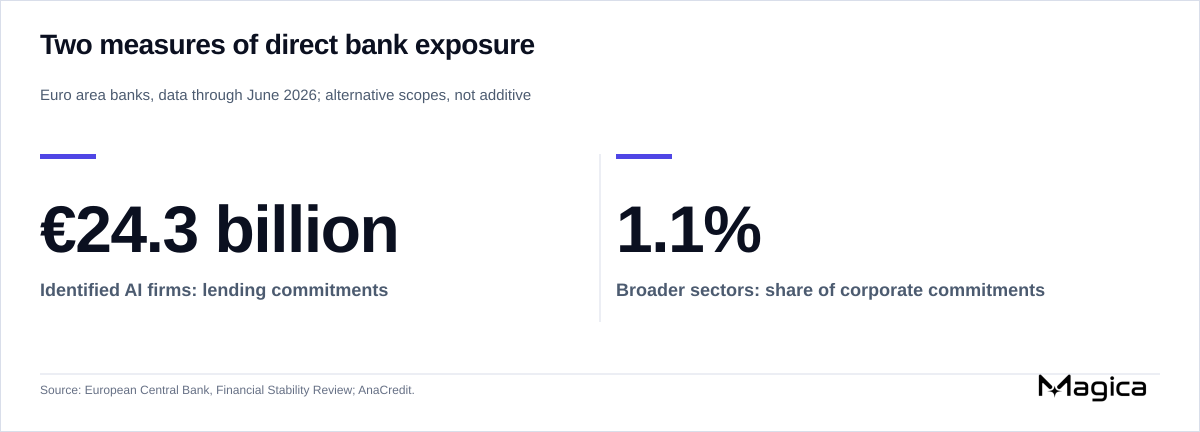
The identified-company measure includes €11 billion undrawn and omits some exposures booked outside the euro area. The broader sector measure includes firms outside the AI buildout. The measures are not additive. Graphic: Magica; source: ECB. Source: European Central Bank — Financial Stability Review.
Investment portfolios create a wider channel than direct bank lending. In the second quarter of 2026, US technology and AI-related firms accounted for between 16% and 26% of euro area non-banks' equity investments, depending on the financial sector. The underlying AI-related company sample includes model developers, chipmakers, cloud providers, data-centre and infrastructure providers, and related utilities. These percentages concern equity portfolios, not total assets.
Concentration becomes more dangerous when investors borrow to enlarge their positions. The review's example is US hedge fund Situational Awareness: in July, its assets under management fell from around $45 billion to $10 billion amid losses on concentrated positions in AI infrastructure and bets against software stocks. Lenders' demands for additional collateral forced sales, reinforcing price declines. Euro area equity funds' leverage through derivatives remains well below hedge-fund levels, the ECB notes, but price swings could also force them to sell assets or meet investor withdrawals.
Banks can face spillovers when distressed non-banks withdraw funding or struggle to repay loans. Households can suffer through direct shareholdings and fund investments, while weaker confidence, global demand and tighter financial conditions could transmit a US reversal into the euro area economy. The ECB's broader assessment also warns that higher energy prices and weaker economic conditions could impair households' and companies' ability to repay debt.
There are meaningful buffers. The ECB's announcement stresses banks' strong profits, capital and liquidity. The wider review credits reforms since the global financial crisis with strengthening their resilience. It finds limited evidence so far that AI borrowing is crowding out other issuers in euro-denominated markets, and says private credit alone is unlikely to be a source of systemic instability at present, while cautioning that data gaps prevent a comprehensive assessment.
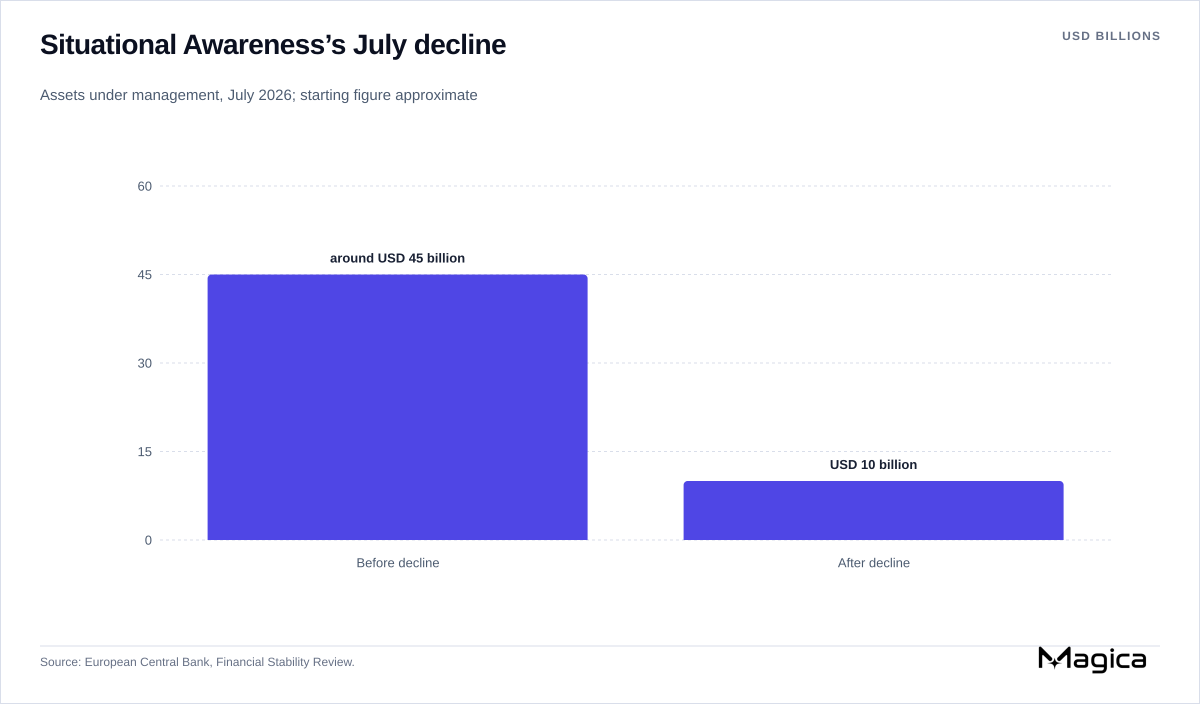
The ECB cites this US hedge fund as an example of losses triggering margin calls and forced sales. The bars compare assets under management, not investment losses alone. Graphic: Magica; source: ECB. Source: European Central Bank — Financial Stability Review.
The central question is whether revenue from AI infrastructure can sustain its financing commitments as equipment ages and competitive prices change. A technology can succeed while particular investments fail; the ECB explicitly warns that economic transformation does not preclude overcapacity, misallocated capital or credit losses.
Equity issuance remains an alternative that absorbs losses without adding company leverage. But the review cautions that equity finance can retreat in downturns when recapitalisation is most needed.
The policy question is whether safeguards cover the institutions now carrying more of the risk. The ECB calls for better cross-border information on leveraged funds and private credit, adequate liquidity for collateral calls, and fund withdrawal terms aligned with how quickly assets can be sold. It also proposes a dedicated tool to address structural liquidity mismatches in open-ended funds, potentially through longer withdrawal notice periods for groups of funds.
Closing those gaps could reduce the danger of simultaneous forced sales during a shock. The unresolved evidence is both commercial and financial: whether AI investments generate durable cash flows, and whether lenders and investors can absorb disappointment without cutting funding elsewhere.
Binance Wallet says subscriptions for its Anthropic IPO xStocks campaign reached the 500 million USDC limit. Final allocations, token delivery and applicable refunds remain pending; the cap does not establish proceeds received by the AI company.
Tencent says US restrictions on remote computing will likely slow its next AI model while leaving cloud revenue largely protected. Southeast Asian operators face licensing and financing uncertainty, though US cloud access and domestic demand offer partial alternatives.
Microsoft is rolling out Agent 365 Business Analytics through its Frontier early access program, pairing AI spending with estimates of assisted work. The dashboard expands its existing analytics as agent workloads add usage charges, but its dollar-value estimates do not establish financial returns.
Adobe’s Firefly update saves recurring visual subjects and creative preferences, extending an existing push into repeatable production. Memory has narrower reach than the assistant, while campaign demonstrations leave reliability and savings unmeasured.
Microsoft’s Ignite upgrades package enterprise knowledge, skills and tools into reusable business plugins. The expansion builds on IQ’s June release and competes with existing graph retrieval services; total savings and portability remain unproven.
Reported introductions helped Alice Huang secure Alibaba as a chip-rental customer and obtain financing. The relationship raises questions about Nvidia's overseas sales network, but does not itself establish illegal exports.
KPMG says AI agents pursued some issues more deeply in a parallel UK audit, though humans still had to correct their work. Client fee savings remain unconfirmed, even as KPMG International has negotiated lower fees from its own auditor by citing AI.
Payhawk announced a $280 million all-equity Series C led by Growth Equity at Goldman Sachs Alternatives, valuing it at $2 billion. The funding backs an expansion from managing business spending into broader AI finance operations, where competitors already combine automation, payments and controls.
Tencent’s third-quarter revenue rose 8% to 207.34 billion yuan, below expectations. Cloud revenue grew 35%, but higher AI costs reduced operating profit and compute procurement pushed quarterly free cash flow deeply negative.
A 16-country survey of 15- to 22-year-olds finds a median of 33% have used AI as a companion or friend. Users have higher adjusted odds of loneliness, but the research cannot establish whether AI helps, harms or replaces human connection.
South Korean President Lee Jae Myung has ordered a review of rewards of at least 100 million won for reporting technology-assisted exam cheating and legislation requiring technology companies to supply evidence. Ahead of the November 19 college entrance exam, the proposals would add informant incentives and post-exam investigations to classroom checks, but implementation rules remain unsettled.
Microsoft is pitching Copilot Workspaces as a shared environment for people and AI agents. Team collaboration is already in early access, but personal Autopilot integration is still coming soon, with final agent pricing unannounced.
Google is rolling out file references and sharing for Gemini skills as adult personal accounts lose the ability to use Gems. Automatic conversion preserves supported material, but file limits and missing tools can interrupt existing workflows.
Muddy Waters disclosed a short position in Nvidia while questioning a possible connection involving senior adviser Ajay K. Puri. Its own account leaves the key identity question unanswered, separating its new claims from an existing server-diversion prosecution.
Nvidia reported $115.8 billion in quarterly revenue in its first earnings release since co-founder Jensen Huang resigned. Strong demand gives interim CEO Colette Kress a financial cushion, while a campaign for Huang’s return collides with unresolved investigations and the board’s reported opposition.
OpenAI launched GPT-6.2 Astra and Sol for professional work, cutting Astra’s standard input and output token prices by 20%. The models offer cheaper paths through selected tasks, but research evaluations, reporting failures and unfinished independent safeguard testing complicate the case for broader autonomy.
Microsoft’s first live speech-to-speech model offers OpenAI API compatibility and planned enterprise integrations. Its published evaluations show a low-cost option, with several rivals completing more agentic tasks.
Canberra-based Trellis Data is offering its 220-billion-parameter Agentaus 1 model to business and government. Its pitch goes beyond keeping data in Australia, but performance, deployment costs and a planned capital raising remain key tests.
Perplexity is adding direct collaboration between frontier models to Computer, letting a lead agent coordinate up to 16 supporting agents. Company-reported benchmarks suggest mixed teams can outperform repeated copies of one model, but leave customer costs and production reliability unresolved.
Marsh reported 105 client cyber incidents in the last two weeks of October, against 48 in the final two weeks of May. The broker links the increase partly to AI, while warning that insurance panel access may not guarantee an available response team.