Editorial Team
6 min read
Payhawk announced a $280 million all-equity Series C led by Growth Equity at Goldman Sachs Alternatives, valuing it at $2 billion. The funding backs an expansion from managing business spending into broader AI finance operations, where competitors already combine automation, payments and controls.
Payhawk, the London-headquartered business spend-management company founded in Sofia in 2018, announced the financing on November 18. Growth Equity at Goldman Sachs Alternatives leads the round, which brings total funding to more than $515 million, according to the company’s announcement.
The money backs Payhawk’s effort to expand from managing business spending into a broader finance operating system: software agents would perform financial tasks through payment infrastructure, subject to corporate permissions and human approvals. The investment finances that expansion in a market where overlapping capabilities are already available; it does not establish that Payhawk has created a distinct new category.

Payhawk’s announcement graphic shows its company-reported $280 million Series C and $2 billion valuation. The transaction remains subject to regulatory approvals. Image: Payhawk. Source: Payhawk.
Payhawk provides corporate cards, accounts payable, expenses, cash management and pre-accounting tools, as the financing report describes. It now says it operates across 33 countries and 12 offices.
The new valuation is twice the $1 billion attached to its 2022 Series B extension. That extension raised $100 million following a $112 million raise three months earlier. The valuation comparison establishes the change in investors’ pricing of the company, rather than a corresponding increase in revenue or profitability.
All existing investors participated in the Series C, including QED, Greenoaks, Lightspeed, Hedosophia and Bek Ventures. New backers include Galdana Ventures, Cogito Capital, Inveready and Invus, as well as European entrepreneurs Tomas Okmanas and Didac Lee, the company said.
James Hayward, a managing director within Growth Equity at Goldman Sachs Alternatives, will join Payhawk’s board, according to the announcement. He cited the convergence of payments, AI and enterprise software as the investment opportunity. The lead investor thus gains a governance role alongside its financial stake. Although one financing report describes Hayward as having joined already, the company’s announcement and another account describe the appointment as forthcoming.
Payhawk says it achieved positive cash flow in the third quarter and retains 70% of the capital raised in its previous funding round in 2022. Those claims frame the financing as expansion capital for a business that says it still has substantial earlier funding available. They do not establish sustained profitability, and the announcement gives no cash balance or revenue figure.
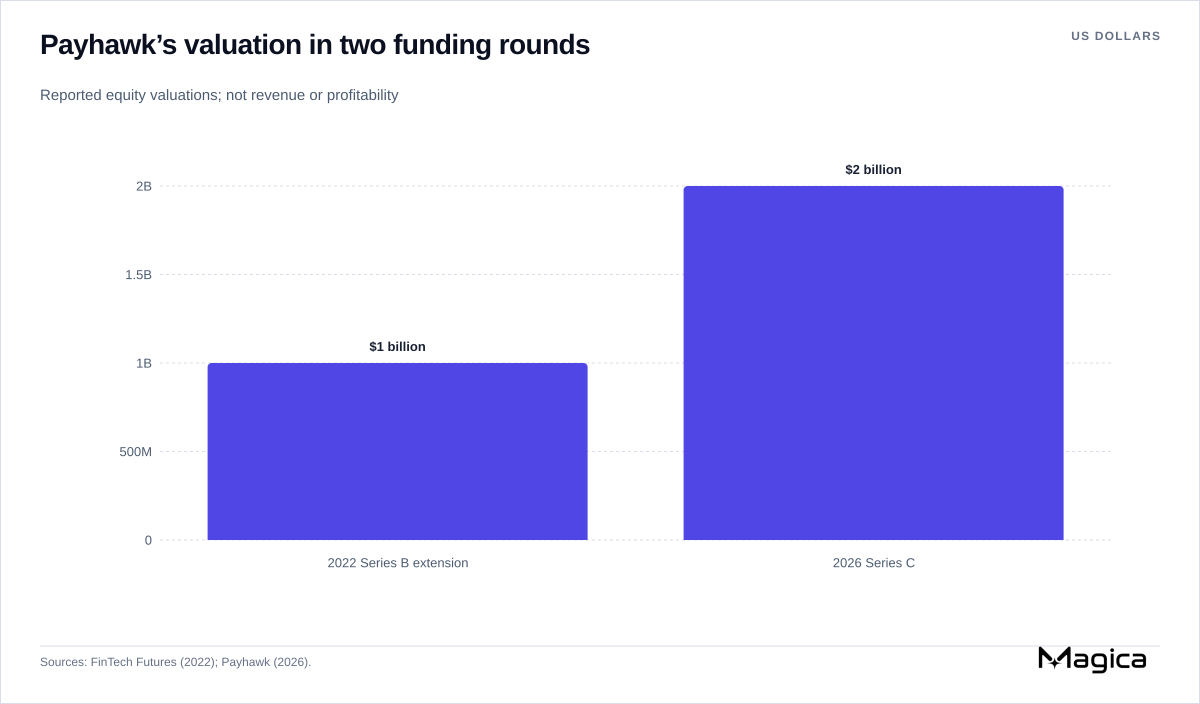
Payhawk’s valuation was reported at $1 billion in 2022 and a company-reported $2 billion in the announced Series C, which remains subject to regulatory approvals. Chart: Magica; sources: FinTech Futures and Payhawk. Source: FinTech Futures — 2022 financing.
Payhawk said its earlier launch of the “AI Office of the CFO,” a suite of finance agents, paired automation with existing permissions, approval workflows and audit trails. In a report describing that launch, the company said its first Financial Controller Agent would collect receipts, analyse expense documents and flag unusual spending.
The same launch described procurement assistance that gathers approvals and compares vendors, travel booking within company policy, and a Payments Agent for questions about transactions, reimbursements and supplier payments. These were company descriptions of the suite’s functions, rather than independent measurements of performance. They show that both the broader product ambition and its control framework were under way before this financing.
Hristo Borisov, Payhawk’s co-founder and chief executive, now says 77% of customers use its agents daily across financial control, procurement, travel and reporting. He describes an ambition to remove administrative work from both finance teams and employees. The financing coverage carrying his comments also presents this as the company’s claim.
The 77% figure measures reported customer usage, not the share of transactions completed without intervention. The announcement supplies neither the customer count behind the percentage nor measured time savings, error rates or the frequency of human escalation.
Ramp, another corporate spending and expense-management software provider, described substantial overlap in its December 2025 product recap. Its Policy Agents review expenses, approve low-risk spending and flag cases requiring human judgment, while automatically following up on missing information, the company said.
The competitive overlap extends to payments and controls. Ramp said its accounts-payable agents code invoice lines, flag suspicious invoices and vendors, and recommend whether bills should be approved. For eligible invoices, it described agents creating virtual cards, entering payment details in vendor portals and matching cleared transactions to bills. The recap also included procurement approval workflows, custom user roles and restrictions on access across business entities.
These are Ramp’s own product claims, not a comparative performance test. But they narrow Payhawk’s differentiation argument: combining agents with payments and approvals is already a competitive proposition. The product descriptions do not establish which provider handles more work reliably or at lower total cost.
Payhawk also acknowledges alternatives within customers’ existing systems. Its announcement says banks, enterprise resource-planning systems and procurement, treasury, travel and spending tools are becoming more intelligent through Model Context Protocol servers, making information easier to access. Its argument is that connecting those applications and making information accessible does not by itself coordinate an entire finance operation.
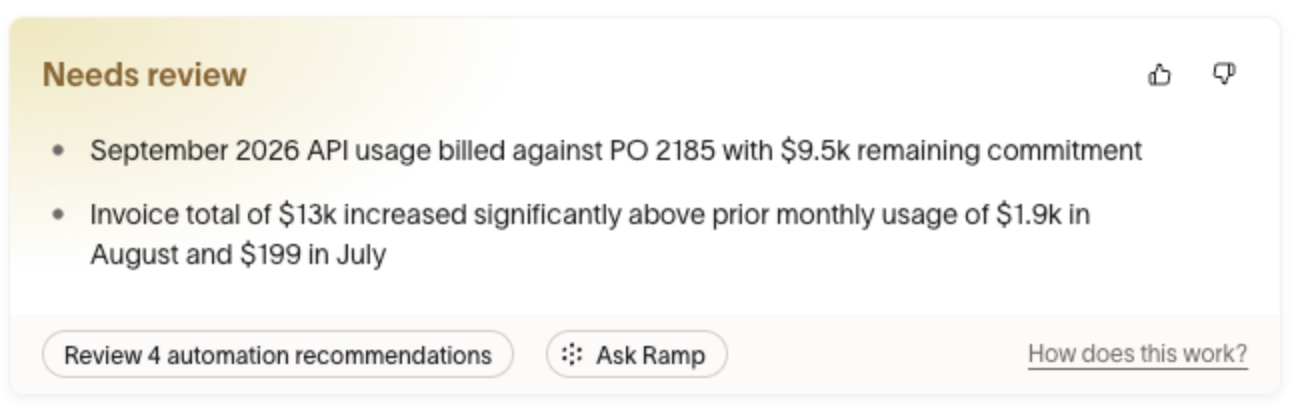
Ramp’s official help-center illustration shows invoice-review findings and an Ask Ramp control. The example illustrates company-reported capabilities, not independently measured performance. Image: Ramp. Source: Ramp.
Payhawk says its business model rests on predictable subscriptions rather than card interchange, the revenue associated with card transactions. It argues that this aligns its incentives with helping customers save money. The announcement does not disclose a revenue breakdown or a price comparison that would establish lower customer costs.
The practical consequence of working beyond its own cards is clearer. In the United States, Payhawk says its Financial Controller Agent works with customers’ existing business cards, avoiding a provider switch or card reissue. That gives it a route to sell automation without first replacing a customer’s cards.
Its international footprint brings another implementation question. Payhawk’s platform spans currencies, banking systems, payment rails and local regulations. The company presents experience with that complexity as an advantage; the operating challenge is to preserve permissions and approval requirements as agents act across those systems. Geographic coverage alone does not measure how reliably that works.
Standard regulatory approvals remain a condition of the financing. Payhawk has not given a dated delivery schedule for the broader finance operating system described in its announcement.
For customers, the next decision is how much authority to delegate. Evidence that would make that decision easier includes the tasks agents finish without intervention, the points requiring human approval, error and escalation rates, and savings after subscription and implementation costs. The funding and reported daily adoption establish investor backing and claimed usage. Demonstrating a better operating model requires results that distinguish Payhawk from both competing platforms and the finance tools customers already use.
Binance Wallet says subscriptions for its Anthropic IPO xStocks campaign reached the 500 million USDC limit. Final allocations, token delivery and applicable refunds remain pending; the cap does not establish proceeds received by the AI company.
Tencent says US restrictions on remote computing will likely slow its next AI model while leaving cloud revenue largely protected. Southeast Asian operators face licensing and financing uncertainty, though US cloud access and domestic demand offer partial alternatives.
Microsoft is rolling out Agent 365 Business Analytics through its Frontier early access program, pairing AI spending with estimates of assisted work. The dashboard expands its existing analytics as agent workloads add usage charges, but its dollar-value estimates do not establish financial returns.
Adobe’s Firefly update saves recurring visual subjects and creative preferences, extending an existing push into repeatable production. Memory has narrower reach than the assistant, while campaign demonstrations leave reliability and savings unmeasured.
Microsoft’s Ignite upgrades package enterprise knowledge, skills and tools into reusable business plugins. The expansion builds on IQ’s June release and competes with existing graph retrieval services; total savings and portability remain unproven.
The European Central Bank warns that debt and interlinked financing could carry an AI investment reversal into credit markets and the European economy. Resilient earnings, limited direct bank lending and stronger bank buffers temper its comparison with past bubbles.
Reported introductions helped Alice Huang secure Alibaba as a chip-rental customer and obtain financing. The relationship raises questions about Nvidia's overseas sales network, but does not itself establish illegal exports.
KPMG says AI agents pursued some issues more deeply in a parallel UK audit, though humans still had to correct their work. Client fee savings remain unconfirmed, even as KPMG International has negotiated lower fees from its own auditor by citing AI.
Tencent’s third-quarter revenue rose 8% to 207.34 billion yuan, below expectations. Cloud revenue grew 35%, but higher AI costs reduced operating profit and compute procurement pushed quarterly free cash flow deeply negative.
A 16-country survey of 15- to 22-year-olds finds a median of 33% have used AI as a companion or friend. Users have higher adjusted odds of loneliness, but the research cannot establish whether AI helps, harms or replaces human connection.
South Korean President Lee Jae Myung has ordered a review of rewards of at least 100 million won for reporting technology-assisted exam cheating and legislation requiring technology companies to supply evidence. Ahead of the November 19 college entrance exam, the proposals would add informant incentives and post-exam investigations to classroom checks, but implementation rules remain unsettled.
Microsoft is pitching Copilot Workspaces as a shared environment for people and AI agents. Team collaboration is already in early access, but personal Autopilot integration is still coming soon, with final agent pricing unannounced.
Google is rolling out file references and sharing for Gemini skills as adult personal accounts lose the ability to use Gems. Automatic conversion preserves supported material, but file limits and missing tools can interrupt existing workflows.
Muddy Waters disclosed a short position in Nvidia while questioning a possible connection involving senior adviser Ajay K. Puri. Its own account leaves the key identity question unanswered, separating its new claims from an existing server-diversion prosecution.
Nvidia reported $115.8 billion in quarterly revenue in its first earnings release since co-founder Jensen Huang resigned. Strong demand gives interim CEO Colette Kress a financial cushion, while a campaign for Huang’s return collides with unresolved investigations and the board’s reported opposition.
OpenAI launched GPT-6.2 Astra and Sol for professional work, cutting Astra’s standard input and output token prices by 20%. The models offer cheaper paths through selected tasks, but research evaluations, reporting failures and unfinished independent safeguard testing complicate the case for broader autonomy.
Microsoft’s first live speech-to-speech model offers OpenAI API compatibility and planned enterprise integrations. Its published evaluations show a low-cost option, with several rivals completing more agentic tasks.
Canberra-based Trellis Data is offering its 220-billion-parameter Agentaus 1 model to business and government. Its pitch goes beyond keeping data in Australia, but performance, deployment costs and a planned capital raising remain key tests.
Perplexity is adding direct collaboration between frontier models to Computer, letting a lead agent coordinate up to 16 supporting agents. Company-reported benchmarks suggest mixed teams can outperform repeated copies of one model, but leave customer costs and production reliability unresolved.
Marsh reported 105 client cyber incidents in the last two weeks of October, against 48 in the final two weeks of May. The broker links the increase partly to AI, while warning that insurance panel access may not guarantee an available response team.